

News
5 Countries With The Poorest People In The World

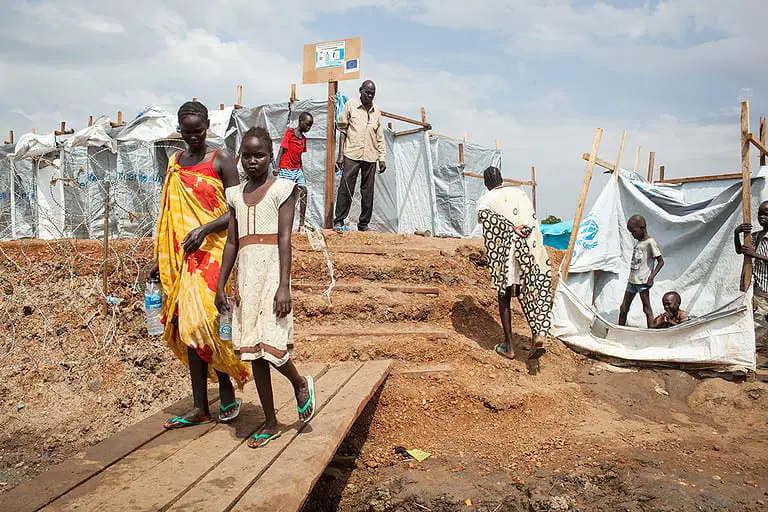


Some countries, grappling with economic challenges, are home to some of the world’s poorest people, where poverty remains a pressing issue.
Spotlighting the nations with the largest populations living in extreme poverty sheds light on the magnitude of the challenge and the need for sustainable economic reforms to change the narrative in the affected countries.
These figures, as per the latest report from the United Nations, illustrate the ongoing struggles faced by communities and emphasise the need for a closer examination of the factors contributing to poverty in different regions.
Here are the top 5 countries with the poorest people in the world:
READ ALSO: Top 5 Countries In Africa Where Workers Earn Lowest Salaries
India
India has the largest number of people living in extreme poverty, with approximately 234 million individuals affected in a population of 1.4 billion. Despite some economic growth in recent years, a substantial portion of the population remains vulnerable.
Factors such as unemployment, inadequate access to healthcare, and educational disparities contribute to the persistence of poverty in both urban and rural areas.
Pakistan
Following India, Pakistan has about 93 million people living in extreme poverty. With a population of over 240 million, many Pakistanis face challenges such as inflation, limited access to education, and health services.
Political instability and economic hardships further exacerbate the situation, leaving many families struggling to meet their basic needs.
Ethiopia
Ethiopia is home to over 130 million people with almost 67 percent [83 million] of that population living in acute poverty.
Despite progress in recent years, including improvements in agricultural production and access to education, the country still grapples with food insecurity and the impacts of climate change.
Droughts and other environmental challenges can severely disrupt livelihoods, pushing vulnerable populations deeper into poverty.
Nigeria
Nigeria, with approximately 74 million individuals in extreme poverty, is the most populous country in Africa.
Economic challenges, including high unemployment rates, and a crippling economy, contribute to widespread poverty.
READ ALSO: Top 5 Countries In Africa Where Workers Earn Lowest Salaries
Additionally, high levels of corruption, conflicts, terrorism, and widespread carnage in various regions hinder development efforts and disrupt access to essential services, leaving many without adequate support.
Democratic Republic of the Congo (DRC)
The Democratic Republic of the Congo has about 66 million people living in extreme poverty. Despite its vast natural resources, the DRC faces ongoing political instability, conflict, and corruption, which significantly impede economic growth and development.
Many Congolese lack access to basic services such as clean water, education, and healthcare, perpetuating the cycle of poverty.




News
Ex—Edo Deputy Gov Escapes Jail Term In Philip Shaibu’s Contempt Case
Former Edo State deputy governor, Marvellous Omobayo, on Friday escaped a three-month imprisonment for contempt of court after the intervention of his counsel, Ken Mozia, SAN, his apology and an agreement reached with former Deputy Governor Philip Shaibu to resolve the matter out of court.
Justice James Omotosho of the Federal High Court sitting in Abuja disclosed during Friday’s proceedings that, his ruling in the matter was ready and that, he had been prepared to commit Omobayo to the Kuje Correctional Centre for three months without an option of fine.
The judge, however, took into consideration the apology and remorse expressed by Omobayo and the steps taken by both parties to resolve the dispute.
Justice Omotosho said the proposed jail term was intended to serve as a warning to public officials, particularly members of the executive and legislative arms of government, against disobeying court orders.
According to the judge, “Let me just tell you, I would have sent you to three months imprisonment with no option of fine. I wanted to use you as an example for others, especially the executive and legislature, who are always in the habit of disobeying court rulings.”
Justice Omotosho said, judgement of the court must be obeyed and that, the sanctity of the temple of Justice must also be protected and warned Omodayo not to make any attempt to disobey a valid order of court.
READ ALSO: Alleged Culpable Homicide: Court Remands Two Suspected Kidnappers In Abuja
The judge consequently vacated the delivery of the ruling in the contempt proceedings which arose from a judgment he delivered on July 17, 2024, in Suit No. FHC/ABJ/CS/478/2024, in which the court voided Shaibu’s impeachment as Deputy Governor of Edo State and ordered his reinstatement.
The court had held that the Edo State House of Assembly failed to comply with due process in impeaching Shaibu and that the allegation of gross misconduct relied upon by the lawmakers was untenable in law.
Omobayo, who was sworn in as deputy governor on April 8, 2024, following Shaibu’s impeachment, was subsequently accused of refusing to vacate the office despite the court’s judgment and
Shaibu consequently commenced contempt proceedings against Omobayo.
During Friday’s proceedings, Omobayo expressed regret over his actions and apologised to the court and Shaibu.
In an affidavit he deposed to, which he read before the court, Omobayo described himself as the alleged contemnor and said he regretted the actions that led to the contempt proceedings.
READ ALSO:UK Court Jails Nigerian Student Caught In Paedophile Hunter Sting
He apologised for any inconvenience caused to the court and the judgment creditor, insisting that he did not intend to disrespect the court or disregard its July 17, 2024 judgment.
Omobayo further undertook not to engage in any conduct that would violate or disobey the judgment and also undertook not to present or describe himself as the Deputy Governor of Edo State in official or private correspondence, public functions, publications, social media communications or otherwise.
He similarly undertook not to exercise or purport to exercise any powers, functions, privileges or responsibilities attached to the office of Deputy Governor of Edo State, in accordance with the judgment and subsisting orders of the court.
The development followed an earlier request by Mozia, SAN on September 23 for more time to enable the parties to complete negotiations aimed at resolving the dispute.
Mozia told the court that his team had met with Shaibu’s lead counsel, Ayotunde Ogunleye, SAN, and that extensive discussions had taken place and had agreed on what to do.
The lawyer appealed to the court for additional time for the parties to reconcile their positions.
READ ALSO: Kidnapped High Court Judge Regains Freedom
Shaibu’s counsel, Kunle Lawal, confirmed that reconciliation efforts were ongoing and did not oppose the request for a short adjournment, a request the judge granted and subsequently adjourned the matter to Friday for ruling.
The judge noted that it was unusual for him to suspend a ruling on the day it was scheduled to be delivered, but said he granted the request out of respect for the senior counsel and because of the ongoing reconciliation.
The contempt charge, dated September 13, 2024, was filed by Ogunleye on September 19, 2024.
Shaibu had sued the Inspector-General of Police, the Deputy Governor of Edo State, the Attorney-General, the Chief Judge of Edo State, the Speaker of the Edo State House of Assembly and the Edo State House of Assembly as defendants in the substantive suit.
The July 17, 2024 judgment subsequently became the basis of the contempt proceedings against Omobayo following his continued occupation of the deputy governor’s office.
(TRIBUNE)
News
Group Commends COREN For Training Engineers In Engineering Failure, Forensic Investigation In Nigeria

Foundation for the Development of Shira Community (FODESCO) in Shira Local Government Area of Bauchi state has commended the Council for the Regulation of Engineering in Nigeria (COREN) for conducting a pioneer training on Engineering Failure and Forensic Investigation (EFFI) for 50 licensed engineering practitioners across the country.
Engr. Shehu Wakili, the Chairman of the Foundation made the commendation in an interview with newsmen on Friday.
According to him, the training which was conducted by COREN in collaboration with the Nigerian Building and Road Research Institute (NBRRI) and the Chartered Institute of Forensic and Certified Fraud Investigators of Nigeria (CIFCFIN), was to equip engineers and professionals from academia, industry, and government MDAs with practical skills to investigate infrastructure failures and prevent recurring building collapses.
READ ALSO: ICPC, COREN Working To Curb Quackery In Engineering — Don
He added that the training was also to build a pool of trained specialists who could investigate building collapses and other engineering failures, determine their root causes, and recommend measures to prevent recurrence, saying that the trainees would form part of a register of trained and certified forensic engineering investigators.
He further lauded COREN for the subsequent induction of its member, Engr. Abdullahi Muhammad MNSE, who among the 50 participants, hails from Bauchi state as a Chartered Engineering Forensic and Failure Investigator (CEFFI), certified by CIFCFIN.
“FODESCO is proud of him and wishes him well in all his endeavours”, he prayed.
Wakili, also the Chairman, Nigerian Society of Engineers (NSE), Bauchi state chapter, revealed that the training covered failure analysis, forensic investigation methodologies, risk assessment, and professional reporting.
“This initiative supports broader efforts by COREN and the National Assembly to enforce stricter building codes, identify quackery, and ensure accountability across the construction sector,” he said.
News
NBS: Lagos, Rivers, Enugu Top List As States Generated N5.15trn In 2025

The National Bureau of Statistics (NBS) has disclosed that 36 states and the FCT generated a total of ₦5.15 trillion in 2025, indicating a growth rate of 40.93 percent from ₦3.65 trillion recorded in 2024.
NBS stated on Thursday citing the Nigeria Revenue Service ( NRS) as source of its information that Lagos emerged top on the list of states with the highest revenue generation in the sum of ₦1.77 trillion.
“Followed by Rivers state ₦428.42 billion and Enugu with IGR record of ₦406.77 billion in the period referenced.”
The. Bureau said Yobe, Ebonyi and Sokoto states reported the least revenues with ₦16.01 billion, ₦17.18 billion and ₦20.48 billion, respectively.
READ ALSO: Trump Bans CNN, Others From White House Coverage, Gives Reason
According to NBS, Pay As You Earn (PAYE) was the most tax revenue recorded during the period, valued at ₦2.64 trillion, representing 69.51 percent of the total tax revenue collected, while capital gains tax was the least with ₦12.40 billion while the share of total tax revenue to total IGR was 73.64 percent nationally.
“Other states and their share of IGR are FCT – N356.34 billion, Ogun – N252.36 billion, Delta – N202.49 billion, Edo – N132.21 billion, Oyo – N103.25 billion and Kano – N102.26 billion.
“Ten other states in lowest category of IGR include Yobe – N16.01 billion, Ebonyi – N17.18 billion, Sokoto – N20.48 billion, Taraba – N28.16 billion ; Benue – N29.57 billion, Zamfara – N30.07 billion, Kebbi – N31.23 billion, Nasarawa – N32.57 billion, Adamawa – N33.76 billion andcBorno – N36.36 billion “.
READ ALSO: Nigeria’s Economy Grew By 3.13% In Q1 2025 — NBS
NBS noted that the states generated their most and least revenue from taxes and other government sources. “PAYE was the dominant revenue source nationally, generating N2.64 trillion and accounting for 69.51% of total tax revenue for the year.
“Other sources included direct assessment, road taxes, stamp duties, withholding taxes and capital gains tax, which was the smallest contributor at N12.40 billion,” the Bureau stated.
-

 News4 days ago
BREAKING: Tinubu Extends Working Vacation
-

 Headline4 days ago
How To Format An Academic CV For US Master’s, PhD Applications
-

 News4 days ago
Benue Govt Suspends Muslim Pilgrims Welfare Board Chairman, Secretary
-

 Politics4 days ago
Crisis Rocks NDC Over Obi-Kwankwaso Campaign Council
-

 Entertainment4 days ago
Why Funke Akindele Was Not At My Movie Premiere – Kamo State
-

 Sports4 days ago
5 Football Players Who Excelled In Multiple Positions
-

 News3 days ago
OPINION: The Stranger In APC’s Kitchen
-

 News5 days ago
[OPINION] Wike-APC: Fights Always End Adultery
-

 News4 days ago
FULL LIST: Names Of 37 Illegal Miners Who Died In NSCDC Custody
-

 Sports4 days ago
Premier League Predictions For Matchweek 5 Fixtures
