

Headline
African Court Upholds Right To Self-determination Of Saharawi People



The African Court on Human and Peoples’ Rights in Arusha, Tanzania has in a landmark judgment held that “the Moroccan occupation of Western Sahara is a serious violation of the right to self-determination.”
The court held that “all states have legal obligations to assist the Sahrawi people in the full realisation of their right to self-determination and independence.”
The judgment delivered last week followed a suit filed by human rights lawyer Femi Falana SAN against eight African Union member states before the court over “the failure of the countries to discharge their legal duty to defend the sovereignty, territorial, integrity and independence of Western Sahara.”
The case brought on behalf of Bernard Anbataayela Mornah, a Ghanaian citizen and the National Chairman of the Convention of People’s Party, a political party in Ghana against Burkina Faso; Cote D’ivore; Ghana; Mali; Malawi; and Tanzania relates “to the legal duty on the defendants to defend the sovereignty, territorial, integrity and independence of Western Sahara.”
In the judgment, the African court held that “the presence of Moroccan forces in Western Sahara is a military occupation, which violates international law.”
The judgment, read in part: “The continued occupation of the SADR by Morocco is incompatible with the right to self-determination of the people of SADR as enshrined in Article 20 of the African Charter on Human and Peoples’ Rights.”
“The Court notes that at the core of the instant Application lies the Applicant’s allegation that the admission of Morocco to the AU was not opposed by Respondent States in spite of their individual and collective obligation to defend the sovereignty of Western Sahara.”
READ ALSO: Lawyer Sues South Africa’s MultiChoice For ‘Misusing Power’ In Nigeria Market
“Considering the facts of the case and the submissions of the parties, the Court is of the view that the present Application is essentially and firmly linked to the right to self-determination, particularly, the right of the Sahrawi people to obtain assistance in their struggle for freedom from foreign occupation.”
“Although the other rights are autonomous by their nature, their violation in the instant case basically flows from the alleged denial of the right to self-determination of the people of Western Sahara.”
“It is the occupation of the SADR and the deprivation of its people of their right to self-determination that have occasioned and facilitated the alleged violations of their other rights, including their right to development, right to disposal of their natural resources, their right to peace and to non-discrimination.”
“The Court observes that the notion of self-determination has strong resonance with Africa and carries a special and deep meaning to its people. Colonisation, apartheid, military occupation and various forms of foreign oppressions that the continent experienced has defined the African identity and history as inherently and inextricably intertwined with the struggle for self-determination.”
“The African States have also consistently exhibited unwavering commitment to the right to self-determination by supporting or sponsoring resolutions adopted in the United Nations and other regional and international fora.”
“Despite the fact that the Constitutive Act of the AU, did not explicitly mention the right to self-determination, the defence of ‘the sovereignty, territorial integrity and independence of its Member States’ is specified as one of the objectives of the Union.”
“The Constitutive Act also makes the promotion and protection of human and peoples’ rights in accordance with the African Charter on Human and Peoples’ Rights, and other relevant human rights instruments’ its additional objective.”
“The Charter guarantees the right to self-determination under its Article 20 as follows: All peoples shall have the right to existence. They shall have the unquestionable and inalienable right to self-determination. They shall freely determine their political status and shall pursue their economic and social development according to the policy they have freely chosen.”
“States are required to take actions individually and jointly to facilitate the realization of the right to self-determination, including by offering assistance to people struggling for independence and freedom from domination.”
READ ALSO: Interpol Confirms Arrest Of Suspected Nigerian Cybercriminal In South Africa
“On the other hand, negative obligations involve the duty to respect the right, that is, abstaining from engaging in acts or taking measures that adversely affect people from fully enjoying their right to self-determination.”
“The Court also observes that in international law, the right to self-determination has achieved the status of jus cogens or a peremptory norm; thereby, generating the corollary obligation erga omnes on all States. As such, no derogation is permitted from the right and ‘all States have a legal interest in protecting that right’.”
“Where a peremptory norm is breached, States are also under an obligation not to recognize the illegal situation resulting from such breach and not to render aid or assistance in maintaining the situation.”
“Furthermore, the Court recalls that the obligations resulting from the right to self-determination are owed by States not only towards those who are under their jurisdiction but also to all other peoples who are not able to exercise or have been deprived of their right to self-determination.”
“In line with this, Article 20 of the Charter confers the right to get assistance on ‘all peoples’ without geographical or temporal limitations.”
“The Court observes that the right to self-determination is essentially related to peoples’ right to ownership over a particular territory and their political status over that territory. It is inconceivable to materialise the free enjoyment of the right to self-determination in the absence of any territory that peoples could call their homeland.”
“The Court recalls that although Morocco has always laid claim on the territory it occupies, its assertion has never been accepted by the international community.”
“The Court recalls that in international law, a State incurs international responsibility where three cumulative conditions are proven to have existed: an act or omission violating international law, that is, an internationally wrongful act; the act must be attributed to a State (attribution); and the ac must cause a damage or loss (causal link).”
“In addition, there should not be circumstances precluding responsibility. These conditions are spelt out in the International Law Commission’s Articles on Responsibility of States for Internationally Wrongful Acts and have been generally considered as reflecting customary international law.”
“The Court also reiterates that the right to self-determination under Article 20 of the Charter imposes an international obligation on all State Parties to take positive measures to ensure the realisation of the right, including by giving assistance to oppressed peoples in their struggle for freedom and refraining from engaging in actions that are incompatible with the nature or full enjoyment of the right.”
“The Court notes that, in view of the fact that part of the SADR’s territory is still under occupation by Morocco, there is no question that State Parties to the Charter have an obligation, individually and collectively, towards the people of SADR to protect their right to self-determination, particularly, by providing assistance in their struggle for might have resulted from such occupation.”
“All State parties to the Charter and the Protocol, as well as all Member States of the AU, have the responsibility under international law, to find a permanent solution to the occupation and to ensure the enjoyment of the right to self-determination of the Sahrawi people and not to do anything that would give recognition to such occupation as lawful or impede their enjoyment of this right.”
“The Moroccan occupation of part of the territory of the SADR seriously violates the right to self-determination and independence of the Sahrawi people.”
“Consequently, the Court finds, AU Member States have an obligation to assist the Saharawi people in the realisation of their right to self-determination and not to recognise the situation and violations resulting from this illegal occupation.”
“Indeed, the right to self-determination and independence “imposes an international obligation on all States Parties to take positive steps to realise this right, including assisting oppressed peoples in their struggle for freedom and refraining from actions incompatible with the nature or the full enjoyment of this right.”
The suit with application number 028/2018, read in part: “The territory known as Western Sahara in North Africa was forcefully and illegally colonized by Spain for several years until it pulled out and relinquished its claim as a colonial power over the territory in February 1976 as a result of the violent resistance of the Saharawi people.
“The defendants are members of the African Union which have accepted the competence of the Protocol of the African Court on Human and Peoples’ Rights on the Establishment of the African Court on Human and Peoples’ Rights.”
“Despite the illegal occupation of Western Sahara by Morocco not less than 84 countries have accorded diplomatic recognition to the Saharawi Arab Democratic Republic, a member state of the African Union. In Liberia, Sierra Leone and The Gambia the Economic Community of West African States (ECOWAS) intervened militarily to restore democratic governments with the support of the African Union.”
“In line with the provisions of its Constitutive Act, the African Union suspended Niger, Burkina Faso and other member states of the African following unconstitutional change of governments.”
“From the facts in support of this application it is indisputable that the defendants are members of the African Union which are bound to comply with its Constitutive Act as well as the African Charter on Human and Peoples Rights (African Charter) the Protocol on Democracy, Good Governance and Elections of the African Union as well as the International Covenant on Civil and Political Rights (ICCPR).”
READ ALSO: Africa A ‘Hostage’ Of Russia’s Ukraine War, Zelensky Tells AU
“The gravamen of the complaint of the Applicant is that the Defendants took part in the decision of African Union to admit Morocco to the African Union when it has not ceased to occupy parts of the territory of Western Sahara, a member state of the African Union.”
“It is the submission of the Applicant that by supporting the admission of Morocco to the African Union the defendants deliberately violated articles 3(b), (g), (f) and (g) of the African Union which require them to defend the sovereignty, territory, integrity and independence of the members states of the African Union including Western Sahara.”
“The defendants have colluded with Morocco in the subversion of the basic principles of the African Union to respect the borders existing on achievement of independence.”
“The African Charter on Human and Peoples’ Rights which provides that: ‘’Nothing shall justify the domination of a people by another. All peoples shall have the unquestionable and inalienable rights to self-determination. They shall freely determine their political status.”




Headline
FG Summons S. African Envoy Over Rising Xenophobic Attacks On Nigerians

The Federal Government has summoned the Acting High Commissioner of South Africa in Abuja over renewed concerns about xenophobic attacks and protests targeting foreign nationals, including Nigerians, living in that country.
The Ministry of Foreign Affairs said the envoy is expected at its headquarters on Monday, May 4, 2026, for a high-level engagement aimed at addressing the growing tension and safeguarding bilateral relations between both countries.
In a statement issued on Sunday, the spokesperson for the Ministry, Kimiebi Ebienfa, said Nigeria would formally express its “profound concern” over recent developments in South Africa, particularly reports of harassment, violence, and destruction of property belonging to foreign nationals.
According to the ministry, the meeting will focus on ongoing demonstrations by various groups in South Africa and documented cases of attacks on Nigerians and their businesses in parts of the country.
READ ALSO:Group Condemns Tunisian Xenophobic, Racial Attacks On African Migrants
“The objective of this engagement is to formally convey the Nigerian Government’s profound concern regarding recent events that have the potential to impact the established cordial relations between Nigeria and South Africa,” the statement read.
It added that discussions would also address ongoing demonstrations by various groups within South Africa and documented instances of mistreatment of Nigerian citizens and attacks on their businesses.
The ministry acknowledged growing anger among Nigerians over reports of xenophobic violence but urged restraint, stressing that diplomatic engagement remained the preferred channel for resolution.
It assured Nigerians that the Federal Government was actively engaging South African authorities to ensure the protection of its citizens abroad.
READ ALSO:US Visa Adjudication Sparks Concerns Over Diplomatic Relations
“The Ministry is aware of the growing discontent among Nigerians concerning the treatment of their nationals in South Africa. Nevertheless, it implores the Nigerian public to remain calm and reiterates the Federal Government’s commitment to protecting the rights and well-being of Nigerian citizens residing in South Africa,” the statement added.
The latest diplomatic move comes amid renewed reports of xenophobic tensions in parts of South Africa, where foreign-owned businesses have occasionally been targeted during protests linked to unemployment and economic hardship.
South Africa has a history of xenophobic violence dating back to 2008, with subsequent flare-ups in 2015 and 2019, when mobs attacked migrants, looted shops, and displaced thousands of foreign nationals across several provinces.
In past incidents, Nigerians and other African nationals were among those affected, prompting strong diplomatic reactions from Abuja and calls for stronger protection of foreign communities.
While South African authorities have repeatedly condemned such attacks and deployed security forces to restore order during outbreaks of violence, concerns have persisted over recurring hostility in some communities.
Headline
Mississippi Man ‘Kills Mother, Flushes Her Remains Down Toilet’


A 29-year-old Mississippi man, Zachary Lavel Jackson Jr., has been charged with multiple offences, including first-degree murder, over the death of his mother, Lana Brown Bradley, after deputies responded to her Natchez home on April 4 following a missing person report from relatives.
The Adams County Sheriff’s Office said deputies were called to Bradley’s residence after her oldest son was unable to reach her the previous day.
Jackson was initially identified as a family member before investigators confirmed he was her son.
Sheriff Travis Patten described the case as deeply disturbing.“This is by far the most heinous crime that I’ve ever witnessed in my entire life. We weren’t out there that day; this was one of those things when we walked up.
READ ALSO:Bandits Kill Nine, Injure Eight In Fresh Attack On Zamfara Village
“This was one of those cases that you will never, ever forget in your life. This is the type of case that follows you home,” Patten told WJTV.
According to the sheriff, deputies noticed signs of a recent cleanup when they arrived at the home.
“As soon as they walked in the house, they could just see where somebody had been cleaning up, and they could smell chemicals all throughout the house.
“Floor was extremely slippery. And the older son said that this is just unusual for the youngest son to be cleaning up the house like that,” Patten explained.
READ ALSO:US Comedian Reggie Carroll Shot Dead In Mississippi
Jackson, the youngest son, was found in a bathroom, where deputies allegedly made a discovery that became central to the investigation.
“I can say what was in the toilet, and it was her flesh. He chopped her up in pieces and dismembered her in a way that whoever came looking for her would have to do their due diligence to find her, and that’s just what we did,” the sheriff said.
Authorities said Jackson allegedly placed parts of his mother’s body in a suitcase and attempted to dispose of other remains.
Jackson faces charges of first-degree murder, second-degree murder, mayhem and tampering with evidence.
READ ALSO:Popular Influencer Lola Shot
Investigators said Bradley, a retired teacher, had recently sought to evict her son from the home. Patten, citing family interviews, said Jackson was believed to be mentally unstable but also noted that his actions appeared deliberate.
“He had threatened her the day before because she was looking to have him evicted from the home.
“She was in the process of doing so and had just gone to court the day before to have him removed from the home,” Patten explained.
Headline
Iran Says War With US May Resume As Trump Rejects Proposal

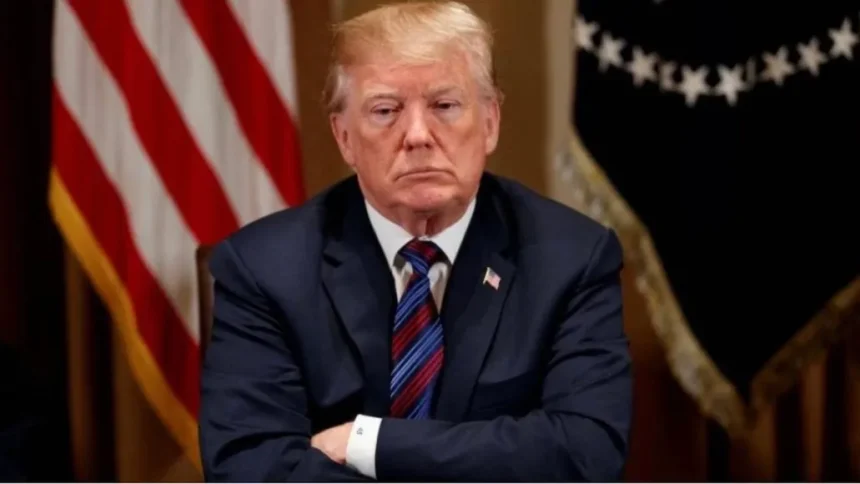
Iran’s military has warned that the war with the United States and Israel could resume, declaring that it is fully prepared for any renewed confrontation as tensions between the sides continue to deepen.
In a statement reported by Iranian state-affiliated media, senior military officials said a return to hostilities is “likely”, citing what they described as Washington’s lack of commitment to previous agreements and negotiations.
The warning comes after US President Donald Trump expressed dissatisfaction with Iran’s latest peace proposal, saying the terms presented by Tehran included demands he “can’t agree to”.
READ ALSO:US Underestimated Iran Before War – France’s Bardella
According to officials in Tehran, Iran believes it showed flexibility during earlier negotiations, including talks held in Islamabad and during the ceasefire period. However, authorities argue that the United States has instead taken a tougher stance, widening the gap between both sides.
Iranian officials insist that key issues such as sanctions relief and the status of the Strait of Hormuz must be resolved before any broader agreement, including discussions around its nuclear programme, can progress. They also reject what they describe as US demands amounting to “surrender”.
The growing diplomatic deadlock has raised fears that another round of fighting may be imminent, with Iranian authorities indicating that preparations are already underway.
READ ALSO:Iran Allows 20 More Pakistani Ships To Pass Through Strait Of Hormuz
Meanwhile, the prolonged conflict continues to have far-reaching consequences within Iran. Internet monitoring group NetBlocks reports that the country has entered its 64th day of near-total internet disruption, effectively isolating it from global online networks.
The shutdown, which began after renewed anti-government protests earlier in the year and intensified following the outbreak of the war, has significantly disrupted businesses and livelihoods across the country.
Beyond Iran, the conflict is also reshaping global dynamics. Rising oil prices linked to the war have placed pressure on international markets, while geopolitical tensions have strained alliances, including between the United States and European partners.
As both sides remain far apart on key issues, analysts warn that without a breakthrough in negotiations, the fragile pause in fighting could collapse, paving the way for renewed military escalation in the region.
-

 Politics3 days ago
2027: Tinubu’s Re-election May Put An End To Nigeria — Baba Ahmed Warns
-

 Metro4 days ago
I’m A Street Girl’ – Bimbo Ademoye Clashes With Area Boys [VIDEO]
-

 News5 days ago
VIDEO: Moment S’Court Recognises David Mark-led ADC Leadership
-

 Politics4 days ago
Senatorial Seat: Ogbakha-Edo Warns Against Imposition Of Candidates In Edo South
-

 Politics4 days ago
BREAKING: 2027: Former Adamawa APC Guber Candidate, Aishatu Binani Defects To NDC
-

 Business3 days ago
JUST IN: Nigerian Filling Stations Reduce Fuel Price After Hike
-

 Entertainment4 days ago
Actress Eniola Badmus Gets New Federal Appointment
-

 Metro5 days ago
Robbers Raid Imo Catholic Church, Steal Holy Communion Materials
-

 News4 days ago
10 African Countries With Highest Petrol Prices In Prices In April 2026
-

 Metro5 days ago
VIDEO: Policemen Filmed Assaulting Individual In Viral Clip
