
News
Alleged N95bn LG Fraud: Edo To Prosecute Obaseki, PDP Leaders, Others, Says Okpebholo
By Joseph Ebi Kanjo, Benin
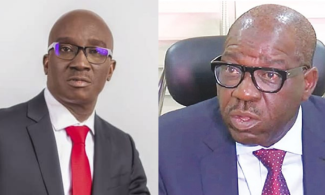
The Governor Monday Okpebholo-led government of Edo State is set to prosecute former Governor Godwin Obaseki, some PDP leaders in the state and former local government chairmen allegedly indicted for “looting the local government treasuries, running into over N95 billions.”
This is contained in a statement signed by Fred Itua, the Chief Press Secretary to the governor and made available to newsmen in Benin on Sunday.
According to the statement, the governor made the revelation when he received the report of the Administrative Panel of Enquiry set up to investigate the financial dealings of the “impeached 18 Local Government Chairmen in Edo State from 4th September, 2023 to November, 2024.”
Recall that after taking the baton of leadership on September 12, 2024, the Okpebholo-led Edo State Government on the 18th of December, 2024, set up an Administrative Panel of Enquiry to investigate the financial dealings of the 18 local government chairmen who were allegedly impeached.
READ ALSO: Okpebholo Flags Of Free Malaria Testing Treatment In Edo
Receiving the report in the statement, the governor noted that the Economic and Financial Crimes Commission (EFCC) will prosecute all those involved in the alleged crime.
Okpebholo, while expressing satisfaction with the committee’s manner of professionalism, declared that the days of financial recklessness and lack of transparency in public office were long over.
He added: “Nigerians need to start demanding accountability from elected public office holders.”
He further stressed that “it was the only way to fight corruption and ensure development.”
The Governor, while expressing dismay at the findings of the report, vowed to petition the EFCC on the findings of the report for immediate prosecution.
READ ALSO: Okpebholo Signs Two Bills Into Law
Okpebholo said: “I want to thank you for a job well done. I carefully listened to the submission of the report.
“The truth is that the administration of former governor Godwin Obaseki took Edo people for granted. They took everything belonging to Edo people and channeled it for their personal gains.
“We thank God for helping us to change the narrative to benefit Edo people. We also thank the President of Nigeria, Bola Ahmed Tinubu, because without his support, we will not be witnessing the kind of development we are experiencing in Edo today.
“A lot has happened. The Peoples Democratic Party (PDP) looted the treasury of the Local Governments and stole our collective patrimony, and nobody went after them or took action. This time, things are different. We will go after them and retrieve what they have stolen from Edo people.
READ ALSO: Okpebholo Approves Recruitment Of 500 Teachers In Edo
“They will be made to pay for it. I will personally take this document to the EFCC and ensure that justice is done for this wrong done to Edo people.”
Earlier, Chairman of the panel, Barr. Solomon Imohiosen, while submitting the report and recommendations Okpebholo, noted that findings and forensic investigations uncovered that huge sums amounting to N96 billion was either mismanaged and/or diverted to private accounts.
The panel observed that N95 billion (N95,080,676,687.86) was received from the Joint Allocation Account Committee (JAAC) by the 18 Local Government Area Chairmen for the period investigated.
The panel, however, reported that the funds were not judiciously utilized as no meaningful projects were on the ground to justify the amount received.
READ ALSO: Okpebholo’s Plan For Sporting Activities In Edo – Sports Commission Chairman, Enabulele
Confirming fraudulent diversion of Local Government funds to political godfathers in the state, the panel reported that over N10 (10,433 658,452.00) was fraudulently siphoned, using the psudo name, “Security, Environment and Training.”
The panel report added that the 18 Local Government Area Chairmen contributed to the account, using it as a conduit pipe to drain government resources, as money were transferred from there to various individuals and companies.
The panel outlined some challenges faced during the course of the assignment, which included late submission of financial records by various Local Government Councils, incomplete submission of records, deliberate obstruction of the investigation by Council personnel who failed to comply on time, but brought hefty sacks as an after-thought to dazzle panel members.
“The panel’s investigation uncovered significant irregularities in the financial activities of the 18 Local Governments Councils. The recommendations outlined in the report aim to address these issues and promote transparency and accountability in the Local Governments finances.”



News
IELTS Speaking: How Nigerian Candidates Can Improve Their Band Score

For most Nigerian candidates applying to study, work or migrate abroad, the IELTS Speaking test is the single most nerve-wracking 11 to 14 minutes of the entire exam.
Unlike Listening or Reading, there is no answer sheet to fall back on, and the pressure of speaking directly to a trained examiner can make it easy to freeze or, just as damagingly, over-prepare until you sound robotic.
The good news is that the test is graded against four public, named criteria, rather than a vague impression of how confident you sounded. Understanding exactly what each criterion rewards can therefore be one of the fastest ways to improve your band score.
Understand what the examiner is listening for
Every Speaking test is scored equally across four categories: Fluency and Coherence, Lexical Resource, Grammatical Range and Accuracy, and Pronunciation, each worth 25 percent of the final band.
Fluency and Coherence measures whether you can keep talking without excessive hesitation, and whether your ideas connect logically rather than jumping around.
Lexical Resource measures the range and precision of your vocabulary, including whether you can paraphrase a question instead of repeating the examiner’s own words back at them.
Grammatical range and accuracy looks at how varied and accurate your sentence structures are, from simple statements to more complex clauses using words like although, because, or if.
Pronunciation covers clarity, stress, and intonation, not whether you sound like a native speaker from a particular country.
READ ALSO: New Air Traffic Control Failure Delays Flights At UK Airports
This last point matters enormously for Nigerian candidates specifically: a Nigerian accent does not lower your score. IELTS examiners are trained to assess intelligibility, not accent neutrality, and both the British Council and IELTS Australia explicitly confirm that speaking with an accent is not penalised as long as your pronunciation is clear enough to be understood without strain.
What actually costs marks is mumbling, running words together so meaning is lost, or shifting stress patterns so unpredictably that the examiner has to work to follow you. Focus your practice on clarity, not on erasing an accent that was never the problem.
Never memorise answers
One of the biggest mistakes candidates can make in the Speaking test is relying on a memorised response, particularly in Part 2, the two-minute monologue based on a task card.
Examiners listen to many candidates and are trained to recognise rehearsed language, whether it is a pre-written answer or a generic template adapted to whatever topic appears.
A scripted answer can sound stiff, contain unnaturally advanced vocabulary that does not match the rest of the candidate’s speech, or ignore the specific details of the task card in favour of prepared content.
When an examiner detects this, it can affect your Fluency and Coherence score because genuine coherence comes from responding directly to what was asked, rather than delivering a monologue prepared in advance.
The solution is not to avoid preparation. Instead, prepare a structure rather than memorising sentences.
READ ALSO: Race To Find Survivors As Morocco Quake Deaths Top 1,300
For Part 2, practise a flexible structure that covers the setup, specific details, a turning point or reflection, and what you think about the subject now. Then fill that structure with fresh details based on the topic you receive on test day.
This gives you the organisation examiners reward without the unnatural delivery of a memorised script.
Use natural fillers and steady pace, not dramatic slowdown
It is perfectly acceptable to pause briefly to think. Natural fillers such as “That’s an interesting question” or “Let me think about that” can give you time to organise a more complex response without necessarily costing you marks.
Used sparingly, such phrases can sound like normal discourse markers rather than signs of weakness.
However, dramatically slowing down your speech to avoid mistakes is not a good strategy.
Multiple examiner-facing sources emphasise that speaking too slowly can be just as problematic as speaking too quickly. Fluency and Coherence partly involve how naturally your language flows, and an overly cautious pace can make your speech sound unnatural or uncertain.
READ ALSO: UK Skilled Worker Visa: 10 Ways To Prepare For Your Interview
The target is a steady, natural pace — similar to how you would explain something to a friend. You do not need to race through your answers, but you also should not deliberately stretch every sentence.
If you genuinely do not understand a question, do not guess or pretend you do. Politely asking the examiner to repeat or rephrase the question is explicitly stated by the British Council to have no effect on your score.
That is safer than answering a question you did not understand, because an irrelevant or confused response can affect your coherence more than a brief request for clarification.
Use idioms only when they actually fit
Rare or idiomatic vocabulary can contribute to a strong Lexical Resource score, as the official descriptors reward the natural use of less common and idiomatic vocabulary.
The key word, however, is naturally.
Using an idiom simply because you memorised it from a study list can work against you if it does not fit the context, is mispronounced or sounds rehearsed.
An expression that is forced into an answer can make your speech sound unnatural and may suggest that you are relying on memorised language rather than demonstrating genuine vocabulary range.
READ ALSO: Putin Issues ‘Veiled Threat’ To UK Over Support For Ukraine
One or two well-placed idiomatic expressions used correctly and naturally can therefore be more useful than filling your answers with several memorised phrases.
If you are not confident about an expression or it does not come to you naturally, use a clear, simple sentence instead. A natural response is preferable to a complicated phrase that is confused, forced or mispronounced.
FAQs
Does a strong Nigerian accent negatively impact an applicant’s final IELTS speaking score?
No. Examiners assess pronunciation for clarity and intelligibility, not for how closely you sound like a native speaker of a specific variety of English. A Nigerian accent is not penalised as long as your speech is clear enough to be easily understood; unclear articulation or unpredictable stress patterns are what actually cost marks, regardless of accent.
What should a candidate do if they completely misunderstand the examiner’s question?
Ask the examiner to repeat or rephrase it. This is explicitly permitted and, according to the British Council, does not affect your score. Guessing at an answer to a question you didn’t understand is far riskier, since it can produce an off-topic or confused response that damages your Coherence score.
How does using rare idioms correctly boost the Lexical Resource score in the IELTS exam?
Correctly used idiomatic language demonstrates the range and flexibility that the official Band 7 and above descriptors specifically call for, which can meaningfully lift a Lexical Resource score. The key word is correctly: a forced, mispronounced, or contextually awkward idiom has the opposite effect, since examiners are trained to notice when an expression sounds rehearsed or doesn’t fit the sentence around it.
(TRIBUNE)
News
Group Commends COREN For Training Engineers In Engineering Failure, Forensic Investigation In Nigeria
Foundation for the Development of Shira Community (FODESCO) in Shira Local Government Area of Bauchi state has commended the Council for the Regulation of Engineering in Nigeria (COREN) for conducting a pioneer training on Engineering Failure and Forensic Investigation (EFFI) for 50 licensed engineering practitioners across the country.
Engr. Shehu Wakili, the Chairman of the Foundation made the commendation in an interview with newsmen on Friday.
According to him, the training which was conducted by COREN in collaboration with the Nigerian Building and Road Research Institute (NBRRI) and the Chartered Institute of Forensic and Certified Fraud Investigators of Nigeria (CIFCFIN), was to equip engineers and professionals from academia, industry, and government MDAs with practical skills to investigate infrastructure failures and prevent recurring building collapses.
READ ALSO: ICPC, COREN Working To Curb Quackery In Engineering — Don
He added that the training was also to build a pool of trained specialists who could investigate building collapses and other engineering failures, determine their root causes, and recommend measures to prevent recurrence, saying that the trainees would form part of a register of trained and certified forensic engineering investigators.
He further lauded COREN for the subsequent induction of its member, Engr. Abdullahi Muhammad MNSE, who among the 50 participants, hails from Bauchi state as a Chartered Engineering Forensic and Failure Investigator (CEFFI), certified by CIFCFIN.
“FODESCO is proud of him and wishes him well in all his endeavours”, he prayed.
Wakili, also the Chairman, Nigerian Society of Engineers (NSE), Bauchi state chapter, revealed that the training covered failure analysis, forensic investigation methodologies, risk assessment, and professional reporting.
“This initiative supports broader efforts by COREN and the National Assembly to enforce stricter building codes, identify quackery, and ensure accountability across the construction sector,” he said.
News
NBS: Lagos, Rivers, Enugu Top List As States Generated N5.15trn In 2025
The National Bureau of Statistics (NBS) has disclosed that 36 states and the FCT generated a total of ₦5.15 trillion in 2025, indicating a growth rate of 40.93 percent from ₦3.65 trillion recorded in 2024.
NBS stated on Thursday citing the Nigeria Revenue Service ( NRS) as source of its information that Lagos emerged top on the list of states with the highest revenue generation in the sum of ₦1.77 trillion.
“Followed by Rivers state ₦428.42 billion and Enugu with IGR record of ₦406.77 billion in the period referenced.”
The. Bureau said Yobe, Ebonyi and Sokoto states reported the least revenues with ₦16.01 billion, ₦17.18 billion and ₦20.48 billion, respectively.
READ ALSO: Trump Bans CNN, Others From White House Coverage, Gives Reason
According to NBS, Pay As You Earn (PAYE) was the most tax revenue recorded during the period, valued at ₦2.64 trillion, representing 69.51 percent of the total tax revenue collected, while capital gains tax was the least with ₦12.40 billion while the share of total tax revenue to total IGR was 73.64 percent nationally.
“Other states and their share of IGR are FCT – N356.34 billion, Ogun – N252.36 billion, Delta – N202.49 billion, Edo – N132.21 billion, Oyo – N103.25 billion and Kano – N102.26 billion.
“Ten other states in lowest category of IGR include Yobe – N16.01 billion, Ebonyi – N17.18 billion, Sokoto – N20.48 billion, Taraba – N28.16 billion ; Benue – N29.57 billion, Zamfara – N30.07 billion, Kebbi – N31.23 billion, Nasarawa – N32.57 billion, Adamawa – N33.76 billion andcBorno – N36.36 billion “.
READ ALSO: Nigeria’s Economy Grew By 3.13% In Q1 2025 — NBS
NBS noted that the states generated their most and least revenue from taxes and other government sources. “PAYE was the dominant revenue source nationally, generating N2.64 trillion and accounting for 69.51% of total tax revenue for the year.
“Other sources included direct assessment, road taxes, stamp duties, withholding taxes and capital gains tax, which was the smallest contributor at N12.40 billion,” the Bureau stated.

 News4 days ago
BREAKING: Tinubu Extends Working Vacation
- Headline4 days ago
How To Format An Academic CV For US Master’s, PhD Applications
- News4 days ago
Benue Govt Suspends Muslim Pilgrims Welfare Board Chairman, Secretary
- Entertainment4 days ago
Why Funke Akindele Was Not At My Movie Premiere – Kamo State
 News3 days ago
OPINION: The Stranger In APC’s Kitchen
- Politics4 days ago
Crisis Rocks NDC Over Obi-Kwankwaso Campaign Council
- Sports4 days ago
5 Football Players Who Excelled In Multiple Positions
- News4 days ago
FULL LIST: Names Of 37 Illegal Miners Who Died In NSCDC Custody
- News5 days ago
[OPINION] Wike-APC: Fights Always End Adultery
- Sports4 days ago
Premier League Predictions For Matchweek 5 Fixtures


