
Headline
Annoyed’: Austria’s National Lockdown Dampens Holiday Mood

After indulging in one last night out, Austrians awoke groggily Monday to their fourth national lockdown of this pandemic, cutting short a Christmas season of shared merriment to fight rising coronavirus infections.
In the capital, Vienna, people headed to work, brought children to school or exercised outdoors, more or less normally. This was not the draconian lockdown of the pandemic’s dawn in 2020, when movements were strictly monitored. Police cars circulated Monday, in keeping with government promises to step up controls, but no spot checks were being made.
“I am particularly annoyed by the lockdown,” said Georg Huber, a lawyer on his way to the office. “One should have implemented a mandatory vaccination in the summer, when it turned out it would not be enough to hope that people get there without any coercion. I think the government just overslept.”
Austria has one of the lowest vaccination rates in western Europe, about 66% of its population of 8.9 million people, with a vocal minority who refuse to be inoculated.
The government announced a 10-day nationwide lockdown on Friday as the average daily COVID-19 deaths tripled in recent weeks and hospitals in hard-hit states warned that intensive care units were hitting capacity. It also pledged to be the first European country to mandate vaccines beginning Feb. 1.
READ ALSO: Napoli Surgeon Gives Update On Osimhen After Surgery
Under the lockdown, people can leave their homes only for specific reasons, including buying groceries, going to the doctor or exercising. Day care centers and schools remained open for those who need them, but parents were asked to keep children at home if possible.
The restrictions are likely to be extended, for a total of 20 days, after which the government has indicated plans to open up so many Austrians can celebrate Christmas as normal. Restrictions, however, are expected to remain for the unvaccinated.
At Vienna’s largest vaccine center, the government’s actions were apparently pushing more people to get vaccinated. The daily numbers of vaccinations has grown from 1,000 a day two weeks ago to 12,000 a day this week, with at least 20% coming for their first jab.
“There are some who waited to see how it was going with the vaccinations, which is a deeply human problem,″ said Dr. Susanne Drapalik, the chief physician for Samaritans Federation, which is running the center. Others were getting vaccinated so they can work, such as truck drivers who drive to countries where a health pass is required, or getting jabs ahead of the Feb. 1 mandate.
“Compulsory vaccinations are a hotly debated topic,″ Drapalik said. ”The argument that every citizen has a responsibility to himself and to others did not work.”
Barbara Kier, a singer and voice-over actor, was there for her booster shot, but said her 57-year-old mother was still unpersuaded to get her first.
“I can only give her my opinion. She must decide for herself,″ she said ”She said she won’t go yet, not that she will never go. I don’t know what she is waiting for!”
Health Minister Wolfgang Mueckstein said the lockdown was needed to bring down the number of new daily infections, which have spiked to as many as 15,000 a day, and to reduce the number of virus patients in intensive care. But most of all, he said, it was needed to bring relief “to the people who work in this sector, the nurses and doctors who cannot take it anymore.”
“It is a situation where we have to react now. The only way is with a lockdown, a relatively hard method, to lower the numbers with a wooden hammer,” Mueckstein told national broadcaster ORF.
Political analysts say the Austrian government did not effectively communicate the importance of vaccines early enough, and that many Austrians did not take the vaccination campaign seriously after former Chancellor Sebastian Kurz declared the pandemic “over” last summer. Kurz was forced out in a corruption scandal last month, replaced by his foreign minister, Alexander Schallenberg, who within a week expanded the controversial lockdown on Austria’s unvaccinated people to a lockdown for everyone.
Schallenberg also has pledged to make vaccinations mandatory by Feb. 1, with details still to be hammered out. Experts have speculated that it could be limited to certain age groups or even tied to employment, as Italy has done. In Italy, health passes are required to enter workplaces, and can be obtained with a negative test as well.
On the eve of Austria’s latest lockdown, people flocked to Christmas markets for one last night of public socializing and in-person holiday shopping. The Austrian Trade Association said sales were up 15% on Saturday, compared with the same day in 2019, before the pandemic.
READ ALSO: Buhari Suspends New NNPC Board Inauguration
Still, many business owners feared the pre-lockdown boost would not be enough to salvage their holiday season.
Boutiques in Vienna’s main shopping district adjusted to the lockdown by putting up signs advising customers they could order online for pickup. Sales people remained on the job behind locked doors to fill orders.
Sophie Souffle, who sells jewelry at markets all year round, makes most of her money over the six-week Christmas market period. Any promised help from the government will be enough to get by, she said, “but it won’t be enough to invest for future business.”
She looked around Sunday as people strolled among the market stands, window shopping more than buying, and socialized in small groups, sensing more desperation than holiday spirit.
(AP)

Headline
South Korea, Japan Protest China, Russia Aircraft Incursions
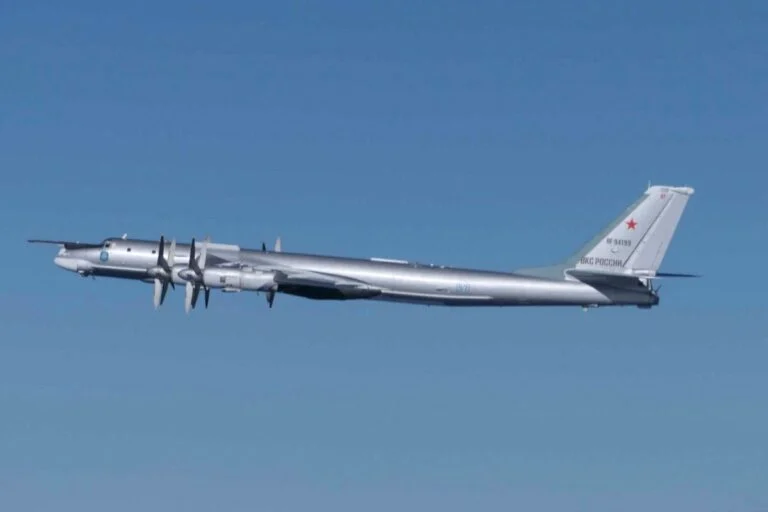
South Korea and Japan reacted furiously on Wednesday after Chinese and Russian military aircraft conducted joint patrols around the two countries, with both Seoul and Tokyo scrambling jets.
South Korea said it had protested with representatives of China and Russia, while Japan said it had conveyed its “serious concerns” over national security.
According to Tokyo, two Russian Tu-95 nuclear-capable bombers on Tuesday flew from the Sea of Japan to rendezvous with two Chinese H-6 bombers in the East China Sea, then conducted a joint flight around the country.
The incident comes as Japan is locked in a dispute with China over comments Prime Minister Sanae Takaichi made about Taiwan.
READ ALSO:China Backs Nigeria, Warns Against Foreign Interference
The bombers’ joint flights were “clearly intended as a show of force against our nation, Defence Minister Shinjiro Koizumi wrote on X Wednesday.
Top government spokesman Minoru Kihara said that Tokyo had “conveyed to both China and Russia our serious concerns over our national security through diplomatic channels”.
Seoul said Tuesday the Russian and Chinese warplanes entered its air defence zone and that a complaint had been lodged with the defence attaches of both countries in the South Korean capital.
“Our military will continue to respond actively to the activities of neighbouring countries’ aircraft within the KADIZ in compliance with international law,” said Lee Kwang-suk, director general of the International Policy Bureau at Seoul’s defence ministry, referring to the Korea Air Defence Identification Zone.
READ ALSO:Trial For South Korean Woman Accused Of ‘Suitcase Murders’ Starts Today
South Korea also said it deployed “fighter jets to take tactical measures in preparation for any contingencies” in response to the Chinese and Russian incursion into the KADIZ.
The planes were spotted before they entered the air defence identification zone, defined as a broader area in which countries police aircraft for security reasons but which does not constitute their airspace.
Japan’s defence ministry also scrambled fighter jets to intercept the warplanes.
Beijing later Tuesday confirmed it had organised drills with Russia’s military according to “annual cooperation plans”.
READ ALSO:South Korean Actress Kim Sae-ron Found Dead In Seoul Apartment
Moscow also described it as a routine exercise, saying it lasted eight hours and that some foreign fighter jets followed the Russian and Chinese aircraft.
Since 2019, China and Russia have regularly flown military aircraft into South Korea’s air defence zone without prior notice, citing joint exercises.
In November last year, Seoul scrambled jets as five Chinese and six Russian military planes flew through its air defence zone.
Similar incidents occurred in June and December 2023, and in May and November 2022.
READ ALSO:Russia Insists Ukraine Must Cede Land Or Face Continued Military Push
Meanwhile, Tokyo said Monday it had scrambled jets in response to repeated takeoff and landing exercises involving fighter jets and military helicopters from China’s Liaoning aircraft carrier as it cruised in international waters near Japan.
It also summoned Beijing’s ambassador after military aircraft from the Liaoning locked radar onto Japanese jets, the latest incident in the row ignited by Takaichi’s comments backing Taiwan.
Takaichi suggested last month that Japan would intervene militarily in any Chinese attack on the self-ruled island, which Beijing claims as its own and has not ruled out seizing by force.
AFP
Headline
Thousands Reported To Have Fled DR Congo Fighting As M23 Closes On Key City

Fierce fighting rocked the eastern Democratic Republic of Congo on Tuesday as the Rwanda-backed M23 militia rapidly advanced towards the strategic city of Uvira, with tens of thousands of people fleeing over the nearby border into Burundi, sources said.
The armed group and its Rwandan allies were just a few kilometres (miles) north of Uvira, security and military sources told AFP.
The renewed violence undermined a peace agreement brokered by US President Donald Trump that Kinshasa and Kigali signed less than a week ago, on December 4.
Trump had boasted that the Rwanda-DRC conflict was one of eight he has ended since returning to power in America in January.
READ ALSO:Ambassadorial Nominees: Ndume Asks Tinubu To Withdraw List
With the new fighting, more than 30,000 people have fled the area around Uvira for Burundi in the space of a week, a UN source and a Burundian administrative source told AFP.
The Burundian source told AFP on condition of anonymity he had recorded more than 8,000 daily arrivals over the past two days, and 30,000 arrivals in one week. A source in the UN refugee agency confirmed the figure.
The Rwanda-backed M23 offensive comes nearly a year after the group seized control of Goma and Bukavu, the two largest cities in eastern DRC, a strategic region rich in natural resources and plagued by conflict for 30 years.
Local people described a state of growing panic as bombardments struck the hills above Uvira, a city of several hundred thousand residents.
“Three bombs have just exploded in the hills. It’s every man for himself,” said one resident reached by telephone.
READ ALSO:South Africa Beat DR Congo In shootout To Finish Third At AFCON
“We are all under the beds in Uvira — that’s the reality,” another resident said, while a representative of civil society who would not give their name described fighting on the city’s outskirts.
Fighting was also reported in Runingo, another small locality some 20 kilometres (12 miles) from Uvira, as the M23 and the Rwandan army closed in.
Burundi views the prospect of Uvira falling to Rwanda-backed forces as an existential threat, given that it sits across Lake Tanganyika from Burundi’s economic capital Bujumbura.
The city is the main sizeable locality in the area yet to fall to the M23 and its capture would essentially cut off the zone from DRC control.
READ ALSO:Stampede Kills 37 During Army Recruitment In Congo Capital
Burundi deployed about 10,000 soldiers to eastern DRC in October 2023 as part of a military cooperation agreement, and security sources say reinforcements have since taken that presence to around 18,000 men.
The M23 and Rwandan forces launched their Uvira offensive on December 1.
Rich in natural resources, eastern DRC has been choked by successive conflicts for around three decades.
Violence in the region intensified early this year when M23 fighters seized the key eastern city of Goma in January, followed by Bukavu, capital of South Kivu province, a few weeks later.
– Regional risk –
The peace deal meant to quell the fighting was signed last Thursday in Washington by Congolese President Felix Tshisekedi and his Rwandan counterpart Paul Kagame, with Trump — who called it a “miracle” deal — also putting his signature to it.
READ ALSO:FULL LIST: US To Review Green Cards From 19 ‘Countries Of Concern’ After Washington Shooting
The agreement includes an economic component intended to secure US supplies of critical minerals present in the region, as America seeks to challenge China’s dominance in the sector.
But even on the day of the signing, intense fighting took place in South Kivu, where Uvira is located, which included the bombing of houses and schools.
Witnesses and military sources in Uvira said that Congolese soldiers fleeing the fighting had arrived in the city overnight Monday and shops were looted at dawn.
Several hundred Congolese and Burundian soldiers had already fled to Burundi on Monday, according to military sources, since the M23 fighters embarked on their latest offensive from Kamanyola, some 70 kilometres north of Uvira.
Since the M23’s lightning offensive early this year, the front had largely stabilised over the past nine months.
Burundian President Evariste Ndayishimiye warned in February there was a danger of the conflict escalating into a broader regional war, a fear echoed by the United Nations.
Headline
‘Santa Claus’ Arrested For Possessing, Distributing Child Sexual Abuse Material

A 64-year-old man from Hamilton Township has been arrested in the United States after investigators linked him to the possession and distribution of child sexual abuse material.
The suspect, identified as Mark Paulino, had been working as a “Santa for hire” at holiday events, a role that placed him in repeated contact with children.
Mercer County officials said the investigation began on 4 December when detectives were alerted to suspicious online activity involving the uploading of child pornography from a residence in Hamilton Township. The probe quickly identified Paulino, a retired elementary school teacher, as the person involved.
READ ALSO:Nigerian Ringleader Of Nationwide Bank Fraud, Money Laundering Jailed In US, Says FBI
Police stated that Paulino had presented himself online as a retired teacher and had recently performed as Santa Claus for photographs and private, corporate, and organisational events. “Because this role involved direct, repeated contact with children, detectives worked around the clock to secure a search warrant,” authorities explained.
The warrant was executed on 5 December, during which police seized multiple items regarded as evidentiary. Paulino was taken into custody without incident and charged with possession and distribution of child sexual abuse materials, as well as endangering the welfare of a child.
Prosecutors have filed a motion to detain him pending trial. The investigation remains ongoing, and authorities have urged members of the public with relevant information to come forward.

 News5 days ago
Rufai Oseni Breaks Silence On Alleged Suspension From Arise TV
- News5 days ago
OAU Unveils Seven-foot Bronze Statue Of Chief Obafemi Awolowo
- Politics4 days ago
JUST IN: Tinubu Holds Closed-door Meeting With Rivers, Ebonyi Govs
- News4 days ago
Why My Lineage Qualifies Me For Awujale Throne — K1 De-Ultimate
- Politics4 days ago
Tinubu, Six APC Governors Hold Closed-door Meeting At Aso Villa
- News5 days ago
Woman Taken For Dead Wakes Up Inside Coffin Few Minutes To Her Cremation
- Politics5 days ago
Ambassadorial Nominees: Ndume Asks Tinubu To Withdraw List
- News5 days ago
How I and Obey’s Son Escaped Getting Caught In Benin’s Coup —Dele Momodu
- News4 days ago
Group Wants Edo AG Professorship Investigated
- News4 days ago
Gbaboyor’s Allegations Against Otuaro Baseless, Malicious — PAP Office


