

News
Cancer: FG To Review Hospice, Palliative Care Policy – Official




The Federal Government will review the National Policy and Strategic Plan for Hospice and Palliative Care 2021, to ensure cancer patients live a fairly good quality life.
Dr Uchechukwu Nwokwu, the National Coordinator, National Cancer Control Programme, disclosed this on Sunday in Abuja, during an interview with Newsmen.
Nwokwu said that the policy, inaugurated in 2021 was meant to institutionalise hospice and palliative care services in Nigeria.
According to the International Association for Hospice and Palliative Care (IAHPC), Hospice and Palliative Care (HPC) is the active holistic care of individuals across all ages with serious health-related suffering due to severe illness and especially of those near the end of life.
The association also says HPC focuses on a continuum of care from diagnosis till patient’s death and bereavement.
It also addresses all domains that may cause suffering, including end-of-life care, loss, grief, and bereavement.
Nwokwu said that though the policy was already being implemented, it was not up to the expected scale.
READ ALSO: Top 30 Most Followed Nollywood, Other Figures On TikTok
“We are very certain that by 2024, we will review the document and then review our level of implementation as a country and see what we can do to improve on it.
“We have a new government and we are hoping that the renewed hope agenda will also translate into addressing palliative care needs of cancer patients and other patients that need palliative care services,” he said.
According to Nwokwu, cancer which does not respect any race, religion or social status, has the capacity to impoverish the richest of all people, because of the cost of care which is very expensive.
“So palliative care deals with terminal illnesses and not just cancer.
“For any illness that has the capacity or potential to last for too long, it is important to institutionalise palliative care as part of the care the person needs to receive,” he said.
Explaining how the policy came about, Nwokwu said that sometimes, someone might have a pain that could not be removed but could only be ameliorated by giving some pain medication that could just palliate it.
“So while we cannot take away the pain, we need to palliate it so that somebody who has that kind of illness will not die in pain but also live a fairly good quality of life as much as possible.
“The policy document spells out that palliative care should even start from a point of diagnosis and that means that you need to integrate the psychosocial needs of the person and even the person’s faith based system.
READ ALSO: JUST IN: Tinubu Suspends N-Power, School Feeding, Others
“If he’s a Christian you involve the pastor or the priests, if he’s a Muslim you involve the Imam or whoever can give that person some psychological or moral support.
“This is because they need to first of all accept diagnosis and the way they accept the diagnosis goes a long way in determining how far the person can accept the treatment that they’re going to be provided.
“It will also determine how much the person can also collaborate or participate in that care.
“So this palliative care is meant to start from the point of diagnosis, to end of life and even at the end of life, it also involves bereavement, even the person who has lost that loved one needs to be integrated to be able to accept the loss,” he said.
Nwokwu said that many cancer patients who were diagnosed late did not actually present late as they complained to someone or some facility when they felt pain or noticed some abnormality.
He, however, said due to lack of awareness or ability to diagnose at the facility, they did not get the needed care early enough.
“If these health workers they present to at the facilities, are able to carry out certain levels of tests or screening, they pick up these diseases early, then treatment can begin early enough and survival rate will also be higher.
“So what we want to do with the palliative care policy is to integrate these services since we have said it’s going to start from the point of diagnosis.
READ ALSO: How TB Joshua Healed My Daughter Of Asthma – Actress Ronke Ojo
“We want to integrate it in the primary levels of care so that people will understand what is to be done at that level and then cascade it or refer when it goes beyond what they can do,” he said.
Nwokwu said the palliative care policy was looking at integrating HPC services at the primary, secondary and tertiary levels of care so that at these levels, everybody knew what to do at any point in time.
He said also, that in-patients, or those who had terminal illnesses could have the opportunity of receiving a fairly good quality of life before they die.
This, he said, was because, when curative measures were no longer possible, all the patients might require was palliative care.
“At that time, it will be a waste of resources to keep that patient in a hospital bed because the bed fees and the cost of care is quite exorbitant and that adds to what we call financial toxicity.
“Those patients ought to be referred probably to a health centre or to a hospice centre where since all they require is palliation, they can stay there and be taken care of while they receive those palliative care services and be managed symptomatically.
“It is however necessary that those people at the hospice homes or at the primary health care centres must be trained on what to do.
“Then they can now have oncologists or other specialist doctors who visit them regularly to also attend to their other medical needs,” he said.




News
N5m, N10m Zero-interest Loans: SheVentures Opens Applications For Women Entrepreneurs


First City Monument Bank (FCMB) has opened a new round of applications for its SheVentures proposition, offering zero-interest loans of up to ₦10 million to women entrepreneurs to ease access to working capital and support business growth.
The facility provides loans ranging from ₦500,000 to ₦5 million under a general category, and ₦5 million to ₦10 million for sector-specific businesses, with funding capped at up to 50% of an applicant’s average monthly turnover.
At the centre of the offering is a 0% interest rate, with all charges embedded in a transparent structure.
Repayment is structured over four or six months, allowing businesses to match obligations with their cash flow cycles.
READ ALSO:I’ve Been Blacklisted In Music Industry For 13 Years – Seun Kuti
Yemisi Edun, Managing Director and Chief Executive of First City Monument Bank (FCMB), said the initiative reflects a deliberate approach to inclusive growth.
“Inclusive growth requires access to capital and the right conditions for businesses to deploy that capital effectively.
“Women-led enterprises are critical to economic activity, yet they face structural barriers.
This intervention aims to help close that gap by providing financing that supports job creation, business expansion, and long-term sustainability for women entrepreneurs.”
“Access to affordable finance remains a major constraint for women entrepreneurs,” said Nnenna Jacob-Ogogo, Group Head, SheVentures and Impact Segments at First City Monument Bank (FCMB).
READ ALSO:My Beef With Wizkid Is For Life – Seun Kuti
“By removing the cost barrier and offering quick, flexible funding, this zero-interest loan is designed to safeguard existing jobs, enable businesses to invest in growth initiatives, and foster resilience in challenging economic conditions.”
Women-owned businesses account for a significant share of Nigeria’s small and medium-sized enterprises but continue to face high borrowing costs and limited access to credit.
Through these efforts, SheVentures tackles persistent financing gaps facing women-led businesses, combining targeted funding with broader support to empower women entrepreneurs, encourage business innovation, and enhance their ability to compete on a national scale.
Applications for the zero-interest loan are now open.Apply now.
News
Xenophobic Attacks: Oshiomhole Tells FG To Retaliate Against South African Companies In Nigeria

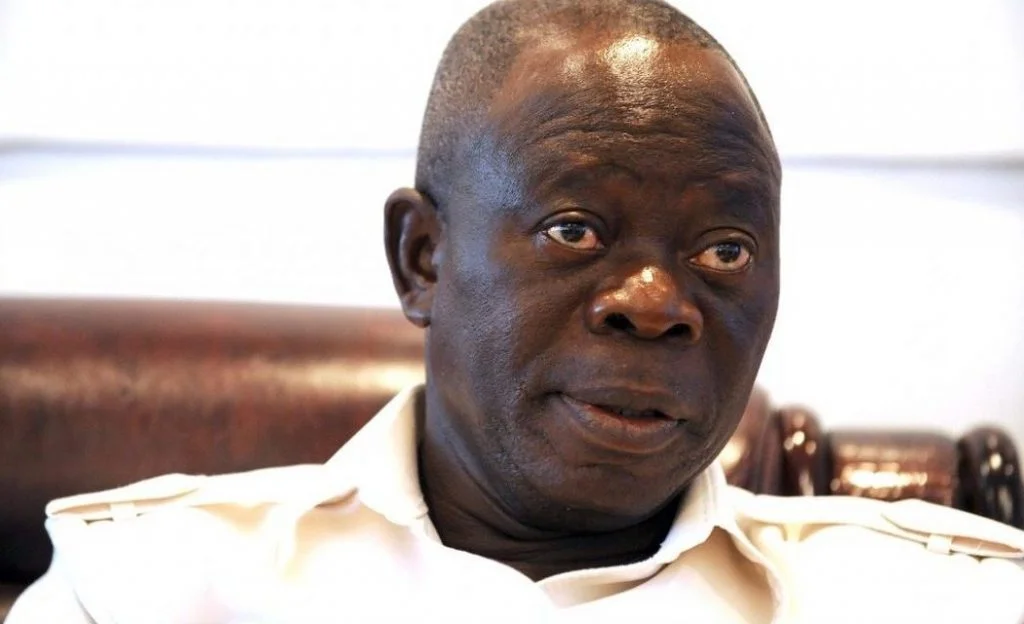
Senator Adams Oshiomhole has called on the Federal Government to retaliate against South African businesses operating in Nigeria following the recent attacks on Nigerians in South Africa.
Speaking during plenary on Tuesday, Oshiomhole said the Federal Government should consider revoking the working license of South African owned companies such as MTN and DSTV.
He argued that Nigeria must respond firmly to what he described as persistent hostility against its citizens.
READ ALSO:South Africa To Investigate ‘Mystery’ Of Planeload Of Palestinians
“I am not going to shed tears. If you hit me, I hit you. I think it is appropriate in diplomacy. It is an economic struggle,” Oshiomhole said.
He argued that while some South Africans accuse Nigerians of taking their jobs, Nigerians should return home and take over employment opportunities created by major South African companies operating in the country, including MTN and DSTV.
“When we hit back, the President of South Africa will not only talk but will also go on his knees to recognise that Nigeria cannot be intimidated.
READ ALSO:South African Ambassador Found Dead Outside Paris Hotel
“We will not condone any life being lost. If a crime has been committed under the South African law they have the right to bring any such person to justice, but to kill our people as if we are helpless, we will not allow that,” Oshiomhole added.
DAILY POST reports that several Nigerians in South Africa have reportedly been attacked, and their businesses destroyed, in ongoing xenophobic attacks in the country.
News
IGP Orders Officers Display Name Tag On Uniform, Gives Update On State Police


The Inspector General of Police, IGP, Tunji Disu, has ordered all police personnel to always have their name tags on their uniforms for easy identification.
Disu disclosed that only police personnel who are undercover are exempted from displaying their name tags.
Speaking on Tuesday, Disu said: “All police officers should have their name tags. All of us on the high table have our names apart from the undercover among us so if you look at all the Commissioners of Police we have our name tags, so it’s not our standard.
READ ALSO:
“All the Commissioners of Police are here and that is why we called this meeting, we have list of things like this that we will want to discuss with the Commissioners of Police, we have told them earlier and we will still let them know that every that happens within their area of jurisdiction falls under their control.”
On the issue of state police, the IGP said: “Since we got the signal that the Federal Government of Nigeria intend to establish State Police and since we are the federal police, we decided to take the bull by the horn and put down our own side of what we believe on how the state police should be run.
“A lot of things were taken into consideration, a lot of comparative analysis was done and it has been transmitted to the National Assembly.”
-

 Politics4 days ago
2027: Tinubu’s Re-election May Put An End To Nigeria — Baba Ahmed Warns
-

 Politics5 days ago
BREAKING: 2027: Former Adamawa APC Guber Candidate, Aishatu Binani Defects To NDC
-

 Politics5 days ago
Senatorial Seat: Ogbakha-Edo Warns Against Imposition Of Candidates In Edo South
-

 Business4 days ago
JUST IN: Nigerian Filling Stations Reduce Fuel Price After Hike
-

 Entertainment5 days ago
Actress Eniola Badmus Gets New Federal Appointment
-

 News2 days ago
BREAKING: Wike Picks Alabo George For Rivers Governorship
-

 Politics4 days ago
NDC Speaks On Peter Obi, Kwankwaso Joining Party
-

 News3 days ago
OPINION: Why South Africans Murder Nigerians In Cold Blood
-

 News4 days ago
2027: Pastor Adeboye Speaks On Nigeria’s Next President
-

 Politics5 days ago
2027: Pondi, Otuaro, Other Delta South Stakeholders, Endorse Senator Joel-Onowakpo For Second Term
