
Headline
Coup: Why President Tinubu Can’t Deploy Troops To Niger – SANs

Senior Advocates of Nigeria, SANs, have adduced reasons why President Bola Tinubu cannot unilaterally deploy troops to Niger Republic to restore democratic rule in the troubled country.
In separate interviews with Vanguard, the learned silks maintained that for the armed forces of Nigeria to be deployed on a combat duty in Niger Republic, President Tinubu, must secure the approval of the National Assembly.
However, the senior lawyers pointed out that the only time the 1999 Constitution, as amended, permits the President to deploy soldiers to another country without prior approval of the legislative arm of the government, is when there is an imminent threat to national security.
In such situation, they stressed that the President, having deployed troops outside the shores of the country, must within seven days, seek approval of the National Assembly, which in turn must take 14 days to either okay or reject the military action.
READ ALSO: US Suspends Aid To Niger Until Democracy, Bazoum Reinstated
According to Jacob Usman, SAN: “By Section 5 (4) (a) of the 1999 Constitution, as amended, the President cannot declare a state of war between Nigeria and any other country, except with the approval of both the House of Reps and the Senate, sitting in a joint session.
“What it means is that if there is any threat to Nigeria and the President is of the view that there is a need to declare a state of war between Nigeria and that country, he must seek the approval of the National Assembly, both the Senate and House of Reps in a joint session, not with each of them sitting independently.
“Subsection 4 (b) provides that except with the prior approval of the Senate, the President shall not deploy any of the armed forces of Nigeria outside the country.
“This is where the case of Niger Republic comes in. The President wrote for the approval of the Senate for the armed forces of Nigeria to be deployed on a combat duty out of Nigeria and the Senate, to my understanding rejected the approval.
“What this means is that without the Senate approving the presidential request, the President cannot and shall not deploy any armed forces of the federation out of Nigeria on a combat duty.
“However, it does not end there. By reason of subsection 5, there is a proviso that notwithstanding the provision of subsection 4, the President, in consultation with the National Defence Council, may deploy armed forces out of Nigeria on a limited combat duty if he is satisfied that there is a real threat, that is, that Nigeria is under a real threat and the President could not get the approval of the Senate.
READ ALSO: Niger’s Junta Seeks Russia’s Wagner Help To Combat ECOWAS Military Threat
“He could deploy armed forces within seven days and must seek the approval of the Senate which must either approve or reject it within 14 days.
“Where the Senate approves the request within 14 days, then, the troops may be deployed. But where the Senate rejects the request, the President must recall the troops back to Nigeria,” Usman, SAN, added.
Likewise, another SAN, Mr. Abeny Mohammed, argued that the consent of the Senate was a constitutional requirement “that cannot be vetoed by the President.”
He said: “Sending Nigerian troops to a foreign country to fight or to engage in war with a foreign country are serious matters that cannot be left to the decision of the president alone.
“It requires the collective decision by the President and the Senate. However, in the event of a sudden attack on Nigeria, the president can deploy troops to repel the attack and defend the country without waiting for the consent of the Senate, which he can seek and obtain subsequently.”
Adding his voice to the debate, a Professor of Law, Epiphany Azinge, SAN, said: “It is not in dispute that the President is the commander -in-chief of the Armed forces, but when it comes to deployment of troops, he needs the acquircence of the Senate.
“This is for many reasons. First is to avoid outright dictatorship by Mr President. Second is to ensure budgetry approval for the conflict.
“A President that decides to engage in conflict against the advice of the Senate may be starved of funds for the prosecution of the war. That is not in the best interest of the nation.”
READ ALSO: Niger Crisis: PDP Govs Knock Tinubu; Reject Military Option
Similarly, Mr. Dayo Akinlaja, SAN, when he was asked if President Tinubu could deploy troops to Niger Republic despite the withdrawal of consent by the Senate, said: “The answer is an emphatic NO.”
Continuing, he said: “It is the prerogative of the Senate to approve the deployment of troops for combat duty outside Nigeria.
“The President is expected to obtain the prior approval of the Senate before any such deployment.
“Where the approval is refused, that ends the process. Although the Constitution allows the President to deploy troops before approval where there is imminent danger of attack of the Country and thereafter seek approval within seven days, that exceptional scenario does not arise in the instant situation.”
On his part, a front-line human rights lawyer, Chief Nkereuwem Udofia Akpan, said: “You will agree with me that ours is a Constitutional democracy fashioned after the American model where the doctrine of separation of powers forms the fulcrum upon which that structure revolves.
“A community reading of Sections 5, 305(1), (2) and (3) of the Constitution shows that the president can
declare a state of emergency and deplore troops outside the shores of Nigeria in certain situations.
“The conditions laid down for such a declaration are set out in section 305 (3) subparagraphs (a)-(g) of the 1999 Constitution as amended.
READ ALSO: ECOWAS Military Chiefs Seek Diplomatic Solutions To Niger Situation
“By the provisions of subsection 2 of section 305, the President is mandated to make copies of the official gazette of the federation containing the proclamation to both the President of the Senate and the Speaker of the House of Representative.
“Upon receipt of the Gazette containing the proclamation, both houses will meet and consider whether to approve or reject .
“Clearly, the President cannot override the decision of both houses of Parliament if those houses at plenary vote to reject the proclamation. The constitution grants the National Assembly powers in section 305 (2) to jettison and refuse to approve the proclamation.
“Curiously subsection 5 of section 5 of the same Constitution provides that the president can ignore the National Assembly and consult with the National Defense Council to deplore troops outside the shores of Nigeria on the condition that national security is under imminent threat or danger.
“Now, the proviso to that section 5(5) of the constitution mandates the President to still go back to NASS for approval for the action and at that point NASS may approve or reject the deployment
“In summary, it appears to me that the framers of our constitution never envisaged a situation where the President can go to war without any input from both houses of the NASS- Senate and House of Representative,” he added.
It will be recalled that the Senate had last Friday, rejected President Tinubu’s request to deploy troops to Niger Republic in support of move by the leadership of the Economic Community of West African States, ECOWAS, to reinstate President Mohammed Bazoum, who was recently ousted from office through a coup d’état.
VANGUARD



Headline
Woman Passes Out After Receiving 100 Strokes Of Cane
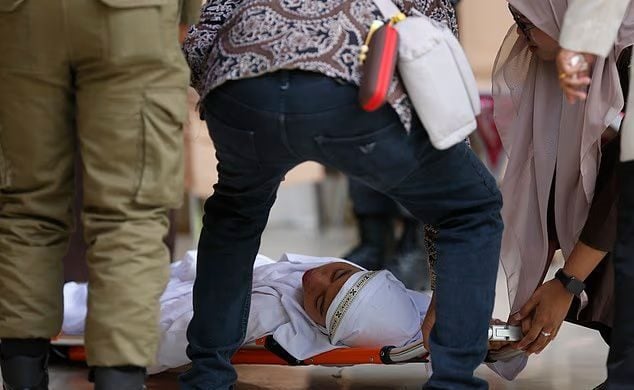
A woman has passed out after she and her partner were each flogged 100 times in public for engaging in sex outside marriage under strict Sharia laws in Indonesia’s Aceh province.
The woman, whose identity was not disclosed, was later carried away after the punishment was carried out in Banda Aceh, located at the northern tip of Sumatra island on Thursday.
A masked official dressed in brown robes administered the caning before members of the public who gathered to witness the punishment.
Her partner was also seen wincing in pain while receiving the lashes.
READ ALSO:Ex-INEC REC Reveals 2026 Electoral Act Provisions That Could Undermine 2027 Election
The pair were among several individuals punished for violating Sharia regulations in the province.
Authorities from the Banda Aceh Sharia Court and the Prosecutor’s Office handed down punishments ranging from 25 to 100 lashes for offences including extramarital sex allegedly arranged through online applications.
Aceh remains the only province in Muslim-majority Indonesia operating under Sharia law, where unmarried couples are prohibited from having sexual relations.
Caning is commonly used in the province as punishment for offences such as gambling, alcohol consumption, same-sex relations and sex outside marriage.
READ ALSO:UN Facing ‘Imminent Financial Collapse’ — Secretary General Lamenets
Under Aceh’s Sharia regulations, child rape offenders face some of the harshest penalties, including up to 200 strokes of the cane, a prison sentence of as long as 200 months or fines equivalent to two kilograms of gold.
The punishments are usually carried out publicly as a way of shaming offenders in addition to inflicting physical pain.
Such canings are often conducted outside mosques or in open public spaces, with residents watching and taking photographs during the exercise.
Human rights organisations have continued to condemn the practice, arguing that it causes emotional trauma and violates international human rights standards.
READ ALSO:18-year-old OAU Medical Student Dies While Sleeping
Amnesty International and Human Rights Watch have repeatedly criticised the punishments, saying they conflict with Indonesia’s constitution and global legal obligations.
Amnesty said in a statement: “Caning contravenes Indonesia’s constitution and is in clear violation of international human rights law and standards.
‘It constitutes a cruel, inhuman and degrading punishment and can amount to torture in violation of the UN Convention against Torture and other international covenants, to which Indonesia is a State Party.’”
Despite the criticism, local authorities have defended the punishments as part of Aceh’s religious and cultural identity, insisting they serve as a deterrent against immoral behaviour.
Earlier in January, another couple in the province reportedly received 140 lashes each after being found guilty of drinking alcohol and engaging in sex outside marriage.
(Daily Mail)
Headline
Senegal’s President Sacks Prime Minister After Months-long Feud
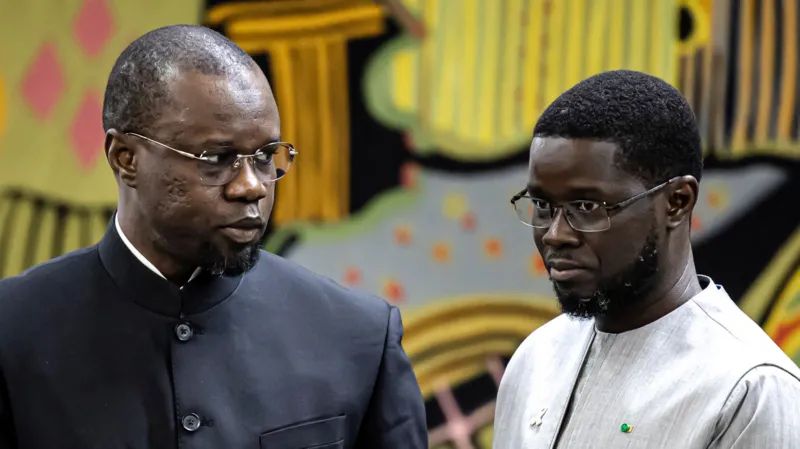
Senegal’s President Bassirou Diomaye Faye has sacked Prime Minister Ousmane Sonko and dissolved the government following months of rising political tension between the two former allies.
The decision was announced in a surprise decree read on national television by a presidential aide, stating that Faye had “ended the duties” of Sonko and “consequently those of the ministers and secretaries of state who are members of the government”.
Sonko, who remains a highly influential figure among Senegal’s youth, responded on social media, saying he would “sleep with a light heart”.
READ ALSO:Senegal Lawmakers To Debate Same-sex Relations Bill
The political fallout comes at a time of growing economic strain in the country, with the International Monetary Fund (IMF) putting Senegal’s public debt at 132% of its GDP.
His removal followed a tense parliamentary session on Tuesday, where Sonko openly criticised President Faye’s handling of the debt situation.
The development is striking given that Faye’s rise to power was largely tied to Sonko’s popularity and political backing.
READ ALSO:French Army To Leave Senegal Amid Africa Downsizing
Sonko would almost certainly have contested the presidency himself in 2024, but was barred from the race due to a defamation conviction. Instead, he threw his support behind Faye, rallying voters with the slogan “Diomaye is Sonko, Sonko is Diomaye”.
The alliance helped unseat former President Macky Sall in a dramatic electoral victory, despite both men having been released from prison only days before the vote.
Tensions between the two leaders had been building for months, with Faye reportedly accusing Sonko of excessive dominance within the ruling Pastef party, while Sonko accused the president of weak leadership and failing to defend him against critics.
(BBC News)
Headline
Six Nigerians Arrested In Thailand Over AI-Powered Romance Scam

Six Nigerian nationals have been arrested by the Thailand Police Force for allegedly operating an AI-powered deepfake romance scam syndicate from a luxury condominium along the Chao Phraya River in Nonthaburi Province, following a cocaine trafficking investigation that exposed their activities.
Thai authorities said the operation began after police arrested a Nigerian suspect identified as Patrick and three associates in April over alleged drug trafficking offences. During the raid, officers reportedly seized assets valued at about 2.5 million baht.
Investigators said financial transactions linked to the suspects led them to several foreign nationals living in a high-end riverside condominium near Phra Nangklao Bridge in Nonthaburi. Police discovered that many of the occupants were staying in groups of five or six per apartment under student visas despite not being enrolled in any educational institution or engaged in lawful employment.
According to Thai police, officers executed search warrants on three condominium units on May 22. The suspects allegedly refused to open their doors, forcing authorities to break into the apartments.
READ ALSO:Libya Journey: Cobbler Arrested For Stealing Motorcycle In Edo
Videos circulating on X captured the moment police officers forcefully gained entry into one of the apartments before arresting the suspects.
During the operation, one suspect reportedly attempted to escape by climbing over a balcony, while another was found hiding on the bathroom floor while allegedly sending warning messages to occupants in neighbouring units.
Police recovered 18 mobile phones, three laptop computers and three bank passbooks from the apartments. Authorities said some of the phones were still logged into active conversations with victims at the time of the raid.
Investigators alleged that the syndicate specialised in romance scams targeting older Thai women by using AI-generated faces and manipulated video calls to create fake online identities.
READ ALSO:Police Inspector Arrested For Armed Robbery Dies From Bullet Wounds
The suspects allegedly posed as pilots, United States military officers, doctors and engineers to gain the trust of victims before requesting money under false pretences.
Police said the fraudsters typically claimed that valuable packages or gifts sent to victims had been withheld by customs officials and required payment of clearance fees before release.
Authorities also said they recovered scripts for sexually explicit conversations allegedly used to emotionally manipulate victims into transferring funds. Investigators claimed the group relied heavily on artificial intelligence technology to generate realistic Western faces for fake video interactions.
Thai police said all six suspects are currently facing preliminary charges bordering on illegal association and immigration overstay, while additional fraud and romance scam charges are expected to follow as investigations continue.

 Metro5 days ago
My Husband Abandoned Me On Our Wedding Night To Attend Political Meeting, I Want Our Marriage Dissolved
- Headline4 days ago
Woman Passes Out After Receiving 100 Strokes Of Cane
- Headline4 days ago
JUST IN: White House Locked Down Briefly As Gunman Opens Fire At Security Checkpoint
- Politics5 days ago
Warri Ijaw Hail INEC Delineation Report, Call For Additional Electoral Wards, Others
- Politics3 days ago
Two Masked Men Gun Down Politician In His Rivers State Hotel
- News3 days ago
More Pain For Nigerians As Cooking Gas Price Increases Nationwide
- Metro5 days ago
My Wife Stop Cooking My Food, Beats Me Black And Blue All the Time, Man Tells Court
- News5 days ago
Alleged Terrorism: Court Rejects Defendant’s Bid To Travel Abroad
- Politics5 days ago
What I’ll Do As President Of Nigeria — Amaechi
- Politics3 days ago
‘Tinubu’s Borrowing In 24 Months Surpasses 55 Years’ Debt Record’


