
Business
Crude Prices Drop After Angola Quits OPEC
Crude prices slumped on Thursday after Angola quit the OPEC oil cartel, while Wall Street stocks rebounded after a streak of records was snapped.
The price of the main international and US crude contracts dropped more than 1.5 percent after Angola said it was leaving as it did not want to go along with further production cuts that OPEC and 10 Russian-led allies agreed on last month.
They later pared their losses.
In an effort to prop up prices, the OPEC+ alliance has implemented supply cuts of more than five million barrels per day (bpd) since the end of 2022.
But oil prices still slid to their lowest levels in nearly six months following the latest OPEC+ decision. The United States has been pumping at record rates, as have Brazil and Guyana, while the weak global economy has raised concerns about demand.
READ ALSO: Edo: Two Refineries Take Delivery Of 75,500 Barrels Of Crude
ActivTrades analyst Ricardo Evangelista said the departure of Angola, a relatively small producer at 1.1 million barrel per day, would hurt OPEC less than if it had been a big producer such as Iraq.
But the timing could not be worse “when the cartel is working hard to convince its members to voluntarily reduce production in order to support prices”, Evangelista said.
Wall Street’s three main indices jumped at the start of trading, having tumbled on Wednesday and breaking the Dow’s streak of five straight record closes as a spate of profit-taking swept trading floors.
The blue-chip Dow stood 0.7 percent higher in late morning trading, while the broader S&P 500 rose 0.8 percent and the tech-heavy Nasdaq climbed 0.9 percent.
READ ALSO: Port Harcourt Refinery Begins Operations – FG
The rebound “suggests yesterday’s sell-off was the result more of esoteric trading behavior than everyone, en masse, suddenly agreeing that they should take some money off the table”, said Briefing.com analyst Patrick O’Hare.
US equities have driven higher since late October, following a nearly unbroken path as inflation moderated and the Federal Reserve flagged plans for 2024 interest rate cuts.
A stream of US data in recent weeks has shown inflation continues to slow and the jobs market is softening. Other economic indicators suggest the US central bank is on course to bring prices under control while averting a recession.
Data on Thursday showed first-time claims for jobless benefits held steady last week at a level far below that would indicate an impending recession.
READ ALSO: How To Meet Rich, High-profile Men This December – Toke Makinwa Gives Tips
The most recent Fed gathering ended with officials indicating they would cut about three times in 2024, sparking a buying frenzy in markets and forcing some policymakers to try to temper expectations.
Eyes are now on Friday’s upcoming release of the personal consumption expenditures (PCE) price index, the Fed’s preferred gauge of inflation, which could be key for its next meeting in January.
“A higher-than-expected core US inflation reading tomorrow could tip us back into fretting about rates being higher for longer,” said AJ Bell investment director Russ Mould.
European indices ended the day lower.
Asian indices struck a mixed note although Tokyo tumbled on troubling news from Japanese carmaker Toyota, whose share price tanked.
READ ALSO: VIDEO: Kidnapped Abuja Musician, Band Regain Freedom
Tokyo shares slumped after the company announced a recall of a million vehicles, and its subsidiary Daihatsu decided to suspend shipments of all models over rigged safety tests.
Key figures around 1630 GMT
West Texas Intermediate: DOWN 0.6 percent at $73.78 per barrel
Brent North Sea crude: DOWN 0.5 percent at $79.29 per barrel
New York – Dow: UP 0.7 percent at 37,325.53 points
London – FTSE 100: DOWN 0.3 percent at 7,694.73 (close)
Paris – CAC 40: DOWN 0.2 percent at 7,571.40 (close)
Frankfurt – DAX: DOWN 0.3 percent at 16,687.42 (close)
EURO STOXX 50: DOWN 0.2 percent at 4,524.86 (close)
Tokyo – Nikkei 225: DOWN 1.6 percent at 33,140.47 (close)
Hong Kong – Hang Seng Index: FLAT at 16,621.13 (close)
Shanghai – Composite: UP 0.6 percent at 2,918.71 (close)
Euro/dollar: UP at $1.0994 from $1.0942 on Wednesday
Dollar/yen: DOWN at 142.11 yen from 143.57 yen
Pound/dollar: UP at $1.2664 from $1.2639
Euro/pound: UP at 86.81 pence from 86.57 pence
AFP



Business
Report Any MRS Filling Stations Selling Fuel Above N739 Per Liter — Dangote Refinery To Nigerians

Dangote Refinery has urged Nigerians to report any MRS filling station outlets nationwide selling fuel above the N739 per liter announced price.
The company disclosed this in a statement on Sunday.
The refinery insisted that its petrol being at retail outlets remain N739 per liter while the gantry price is N699.
It further called on other filling station owners to patronize its refined petroleum products at the N699 rate.
“We also call on other petrol station operators to patronize our products so that the benefits of this price reduction can be passed on to Nigerians across all outlets, ensuring broad-based relief and a more stable downstream market.”
READ ALSO:Dangote Sugar Announces South New CEO
Recall that Aliko Dangote, the president of Dangote Refinery, had pegged the retail price of his petrol at a maximum of N740.
DAILY POST reports that MRS filling and other filling stations had reduced fuel prices to between N739 and N912 per liter in Abuja.
However, reports emerged that some MRS filling stations were selling above the N739 per liter announced price benchmark.
Business
Naira Records Significant Appreciation Against US Dollar
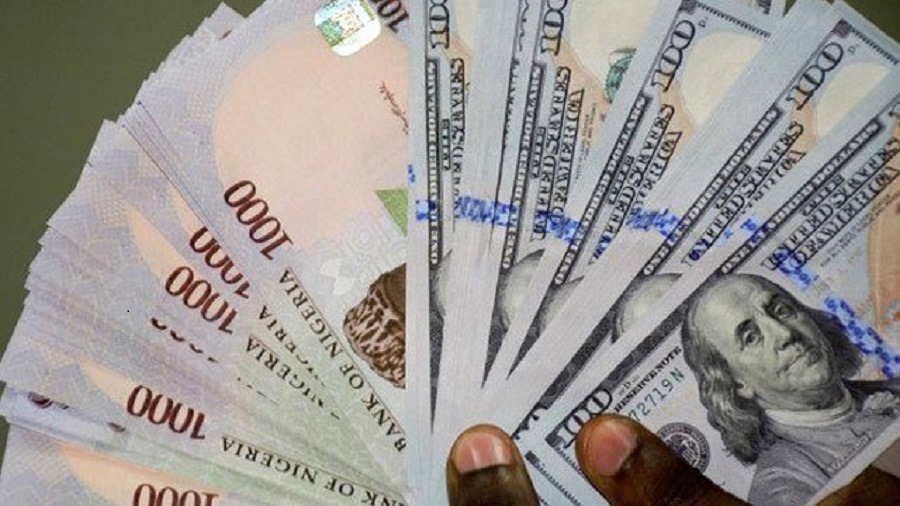
The Naira recorded significant appreciation against the United States dollar on Monday at the official foreign exchange market to begin the week ahead of Yuletide on a good note.
The Central Bank of Nigeria’s data showed that the Naira strengthened to N1,456.56 per dollar on Monday, up from N1,464.49 traded on Friday last week, 19th December 2025.
This means that the Naira gained N7.93 against the dollar when compared with the N1,464.49 was exchanged as of Friday, December 19, 2025. DAILY POST reports that Monday’s gain at the official FX market is the first since December 15th.
READ ALSO:
Meanwhile, at the black market, the Naira remained stable at N1500 per dollar on Monday, according to multiple Bureau De Change operators in Wuse Zone 4, Abuja.
The development comes as the country’s external reserves stood at $44.66 billion as of last week Friday.
Business
CBN Revokes Licences Of Aso Savings, Union Homes As NDIC Begins Deposit Payments
The Central Bank of Nigeria (CBN) has revoked the operating licences of Aso Savings and Loans Plc and Union Homes Savings and Loans Plc, citing persistent regulatory infractions and deepening financial distress in the two primary mortgage banks.
The revocation, which took effect on December 15, 2025, was carried out under Section 12 of the Banks and Other Financial Institutions Act (BOFIA) 2020 and Section 7.3 of the Revised Guidelines for Mortgage Banks in Nigeria, the CBN said in a statement issued on Tuesday.
According to the apex bank, the affected institutions failed to meet minimum paid-up share capital requirements, had insufficient assets to cover their liabilities, recorded capital adequacy ratios below prudential thresholds, and consistently breached regulatory directives.
“The CBN remains committed to its core mandate of ensuring financial system stability,” a statement, signed by the apex bank’s Acting Director, Corporate Communications, Mrs Hakama Sidi Ali said.
READ ALSO:CBN Directs Nigerian Banks To Withdraw Misleading Advertisement
Following the licence revocation, the Nigeria Deposit Insurance Corporation (NDIC) was appointed liquidator of the defunct banks in line with the law.
The Corporation said it has commenced the liquidation process and begun verification and payment of insured deposits to customers.
Under the deposit insurance framework, depositors are entitled to receive up to two million naira per depositor, with payments made through BVN-linked alternate bank accounts.
Depositors with balances above the insured limit will receive the initial two million naira while the remaining sums will be paid as liquidation dividends after the realisation of the banks’ assets and recovery of outstanding loans.
READ ALSO:CBN Issues Directive Clarifying Holding Companies’ Minimum Capital
The NDIC said depositors may submit claims either online or physically at designated branches of the closed banks, while creditors will be paid after all depositors have been fully settled, in accordance with statutory provisions.
The two mortgage banks have faced prolonged operational challenges, including depositor complaints, governance concerns, and delisting from the Nigerian Exchange (NGX) in 2024 for failure to submit audited financial statements for more than six years.
The CBN assured the public that the action was taken to strengthen the mortgage banking sub-sector and protect depositors, adding that banks whose licences have not been revoked remain safe and sound.
This means the two financial institutions can no longer operate as licensed financial institutions.

 News3 days ago
PHOTOS: New Era In Furupagha-Ebijaw As Okpururu 1 Receives Staff Of Office
- Metro5 days ago
JUST IN: Former Edo Information Commissioner Is Dead
- News2 days ago
UBTH CMD Marks 120 Days In Office, Expresses Commitment To Providing Conducive Working Environment
- News3 days ago
FG Declares Public Holidays For Christmas, New Year Celebrations
- News3 days ago
OPINION: Gumi And His Terrorists
- Metro5 days ago
She Grabs, Pulls My Manhood Anytime We Fight — Husband
- News2 days ago
FIRS Confirms NIN As Tax ID
- News5 days ago
My Wife Dented My Image, Took Our Marital Crises To Radio Stations — Husband
- News3 days ago
OPINION: Christmas And A Motherless Child
 News2 days ago
OPINION: My Man Of The Season


