
Business
E-Naira: Things To Know As CBN

The Central Bank of Nigeria (CBN) will launch a digital currency, e-Naira in October to coincide with the nation’s independence anniversary.
Governor Godwin Emefiele has assured that the advantages of the Central Bank Digital Currency (CBDC) are enormous.
The apex bank chief urged Nigerians to embrace the e-Naira and explained it is safer than cryptocurrencies.
Things to know and the benefits:
Digital currency is the electronic form of fiat money issued by governments. However, many confuse it with cryptocurrency which is a store of value secured by encryption.
The central bank of a country supervises digital currency. Cryptocurrencies are not regulated by any government, reason why authorities warn against bitcoin, ethereum and the likes.
According to The Atlantic Council, more than 80 countries are now exploring a CBDC against 35 countries in May 2020.
The American think tank says China – which banned crypto dealings – is ahead, allowing foreign visitors to use digital yuan if they provide passport information to the People’s Bank of China,
The Bahamian Sand Dollar was the first CBDC to become widely available; over 14 countries are in the pilot stage while 5 have fully launched.
They are the Bahamas, Saint Kitts and Nevis, Antigua and Barbuda, Saint Lucia, and Grenada.
In 2017, the CBN took the decision to digitize the Naira, following the rise in the use of digital payments and acceptance of the digital economy.
In late August 2021, the regulator announced the selection of Fintech company, Bitt Inc., as the Technical Partner.
The firm was key to the development and launch of the CBDC pilot of the Eastern Caribbean Central Bank (ECCB) in April 2021.
The e-Naira would only exist in digital and electronic form. Individuals and financial institutions can track transactions easier.
e-Naira local and international transfers can be made within a little time and at cheaper rates. It simplifies cross-border trade and guarantees a faster inflow of remittances.
Users would be able to transfer existing funds in bank accounts to their digital currency account.
e-Naira is expected to help Nigerians create new business opportunities, financial products and services, reduce the cost of operations and cash management.
The digital currency would be implemented through a two-tiered model to enable a structure that allows public-private partnerships.
The CBN will design the e-Naira but disseminate it through regulated financial institutions. They would provide digital cash to persons and businesses.
(DAILY POST)



Business
Naira Extends Appreciation Against US Dollar
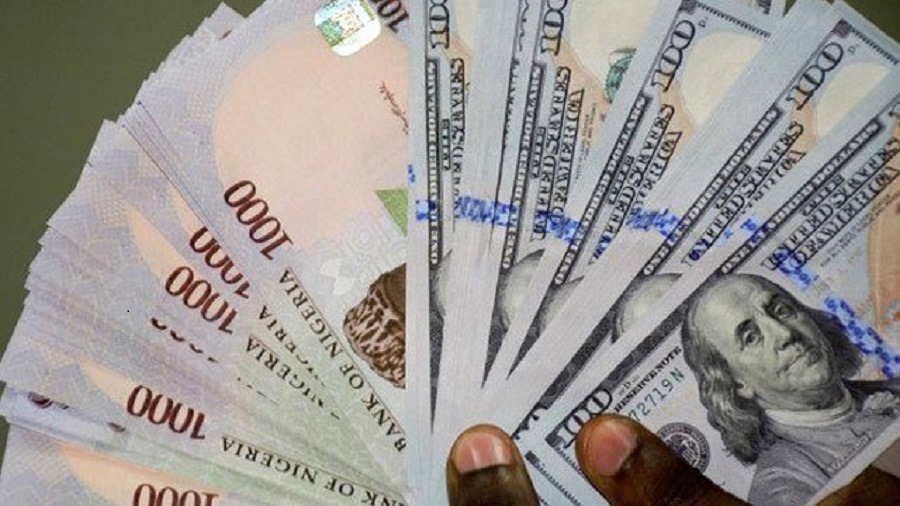
The naira extended appreciation against the dollar at the official foreign exchange market on Wednesday.
The Central Bank of Nigeria’s data showed that the Naira further firmed up on Wednesday to N1,418.26 per dollar, up from N1,419.07 exchanged on Tuesday.
Wednesday’s uptrend represents a slight N0.80 gain against the dollar on a day-to-day basis.
READ ALSO:Naira Records Significant Appreciation Against US Dollar
Meanwhile, at the black market, the Naira remained unchanged against the dollar at N1,480 per dollar on Wednesday, the same rate recorded the previous day.
The development comes as Nigeria’s foreign reserves further rose to $45.62 billion as of January 6th, 2026.
Recall that on Tuesday, the Naira posted a N10.24 gain against the dollar.
Business
Naira Continues Gain Against US Dollar As Nigeria’s Foreign Reserves Climb To $45.57bn
The Naira appreciated further against the United States Dollar at the official foreign exchange market, beginning the week on a good note.
Central Bank of Nigeria data showed that the Naira strengthened on Monday to N1,429.31 per dollar, up from N1,430.85 exchanged on Friday, 2 January 2026.
This means that the Naira gained N1.56 against the dollar on Monday when compared to N1,430.85 last week Friday.
READ ALSO:Naira Records Significant Appreciation Against US Dollar
At the black market, the Naira dropped by N5 to N1480 per dollar on Monday, down from N1475 traded Friday.
The development comes as the country’s external reserves rose to $45.57 billion as of Friday last week.
Business
NNPCL Reduces Fuel Price Again
The Nigerian National Petroleum Company Limited, NNPCL, has again reduced its premium motor spirit price.
In Abuja, on Monday morning, it was gathered that NNPCL retail outlets have reduced their fuel price to N815 per liter, down from N835.
This means that the NNPCL filling stations cut their price by N20.
The fresh price has been implemented at NNPCL filling stations in Wuse Zone 6 and 4 Abuja, Keffi-Abuja Road, and Kubwa Expressway.
READ ALSO:Fuel Price Cut: NNPCL GCEO Ojulari Reveals Biggest Beneficiaries
An NNPCL filling station attendant, who preferred anonymity, told DAILY POST that the new price was implemented on Sunday evening.
However, the N815 per liter is N79 higher than the N739 per liter sold at Dangote Refinery’s backed MRS filling stations nationwide.
DAILY POST recalls that NNPCL on December 19, 2025, cut its price of petrol by N80 to N835 amid a price war among players in the country’s oil downstream sector triggered by Dangote Refinery’s gantry price reduction to N699 per liter.

 News4 days ago
What I Saw After A Lady Undressed Herself — Pastor Adeboye
- Headline4 days ago
PROPHECY: Primate Ayodele Reveals Trump’s Plot Against Tinubu
- Metro4 days ago
Armed Robbers Shot PoS Operator To Death In Edo
- Business3 days ago
NNPCL Reduces Fuel Price Again
- Metro4 days ago
Joint Task Force Kills 23 Bandits Fleeing Kano After Attacks
- Metro3 days ago
AAU Disowns Students Over Protest
- Politics4 days ago
2027: Rivers APC Pledges To Follow Wike’s Instructions
- Metro3 days ago
Nine Soldiers Feared Dead In Borno IED Explosion
- Metro3 days ago
Edo: Suspected Kidnappers Kill Victim, Hold On To Elder Brother
- Entertainment4 days ago
Anthony Joshua Returns To UK In Private Jet


