
Headline
Ebola In Uganda: NCDC Ups Preparedness, Cautions Nigerians On Travel
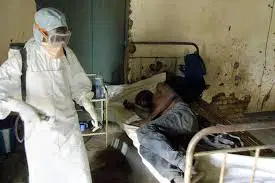
Following the confirmation of an outbreak of Ebola Virus Disease in Uganda, the Nigeria Centre for Disease Control and Prevention, NCDC, has initiated measures to strengthen the country’s preparedness, advising Nigerians to shelve travels to countries affected by the disease.
The Centre also announced that there is no case of Ebola in Nigeria.
The NCDC in the public health advisory noted that though the WHO advises against any restrictions to travel and /or trade to Uganda, Nigerians and residents to avoid all but essential travel to countries with confirmed cases of the Ebola Virus Disease.
Uganda had on 30th January 2025 confirmed a case of Ebola virus disease caused by the Sudan species, in Wakiso, Mukono, and Mbale cities in Mbale district.
According to the country’s Ministry of Health, only one case has so far been reported, and one death (confirmed by post-mortem).
Forty-four contacts are being followed up. We will continue to monitor the regional and global situations.
Making these disclosures in a public health advisory signed by the NCDC Director-General, Dr Jide Idris, the Centre noted that Uganda has experience in responding to Ebola Disease outbreaks, and necessary action has been initiated.
READ ALSO: Niger Republic Protesters Abuse, Mock Tinubu, Call Him ‘Ebola’, illegitimate President
The public advisory reads in parts, “There are no cases of Ebola virus disease in Nigeria. However, the Nigeria Centre for Disease Control and Prevention (NCDC), in collaboration with relevant Ministries, Departments, Agencies, and Partners through the National Emerging Viral Hemorrhagic Diseases (EVHD) Technical Working Group, continues these include the update of our EVD emergency contingency plan, heightened surveillance especially at the points of entry, and optimizing diagnostic capacity for EVD testing in designated laboratories in cities with international airports of entry and the National Reference Laboratory.
“In addition, all Lassa Fever testing laboratories can be activated to scale up testing if the need arises.
“Ebola virus disease (EVD), formerly known as Ebola Hemorrhagic Fever, is a severe, often deadly disease caused by the Ebola virus, with a fatality rate of 25-90 percent.
“There are 5 distinct species of the virus: Bundibugyo, Zaire (the most fatal of all the five strains, and responsible for the most EVD outbreaks including the 2014-2016 outbreak in West Africa), Reston, Tai Forest, and the Sudan (responsible for the outbreak in Uganda).
“The infection is transmitted from animals to humans, with human-to-human transmission occurring through direct contact with the body fluids (blood, saliva, vomit, urine, feces, sweat, breast milk, and semen of an infected person), contaminated objects, or infected animals such as fruit bats, chimpanzees, gorillas, monkeys, porcupines, and forest antelope.
“The virus can also be transmitted through contact with wildlife and unsafe burial practices. The incubation period, i.e. from exposure to the development of signs and symptoms ranges from 2-21 days. “During an outbreak, those at risk of infection are health workers, family members, and others in close contact with sick people and deceased patients.
“The initial symptoms of EVD include: Sudden onset of high fever, accompanied by other nonspecific signs and symptoms such as headache, body aches, muscle pain, weakness, vomiting, and diarrhea.• Jaundice (yellowing of the eye).
READ ALSO: Nigerians React As Niger Youths Mock Their President ‘Ebola Tinubu’
“The following may occur after the onset of the above symptoms: And in severe cases, uncontrolled bleeding from orifices, dysfunction and/or failure of several body organs such as the kidneys, liver, central nervous system involvement, progressing to shock and death.
“In fatal cases, death often occurs between 8 and 9 days of the onset of symptoms.
“The Ebola virus is in the same class as the Marburg virus and are both classified as Viral hemorrhagic Fevers (VHF). Based on the dynamic risk assessment conducted in response to the recent Marburg outbreak in Rwanda, the risk of EVD is also classified as moderate. A moderate risk classification indicates that EVD, without mitigation, is likely to occur in Nigeria, with the potential for significant public health consequences. So, we need to take the necessary precautions.”
The NCDC advised Nigerians that there are vaccines and therapeutics available for some strains of the Ebola virus.
“It noted that the approved vaccine for the Zaire species (EBV) is not currently available in the country but can be obtained from the WHO Afro and does not protect against the Sudan virus.
“However, early recognition, isolation of patients, and initiation of supportive treatment, implementing infection and control measures in health facilities and homes, tracing and monitoring of contacts, and safe burial practices, significantly reduce morbidity and the probability of death.
READ ALSO: Nigeria Risks Fresh Ebola Outbreak, Reps Raise The Alarm
Nigerians are, therefore, urged to adhere strictly to preventive measures such as practicing good hand hygiene – Wash your hands regularly with soap under running water or use hand sanitisers when soap and water are not readily available.
Nigerians were also advised to avoid physical contact with anyone who has symptoms of an infection with an unknown diagnosis.
“Avoid the consumption of bush meat, particularly bats and non-human primates, which are known reservoirs of the Ebola virus.
“And if you have to, ensure that such is properly prepared and cooked before consumption.
“Avoid direct contact with the blood, saliva, vomit, urine, and other bodily fluids of suspected or confirmed EVD cases.
“If you or someone you know (with a travel history to any country with Ebola cases) experiences symptoms of EVD enumerated above, call 6232 or your State Ministry of Health hotline for guidance.The NCDC also urged healthcare workers to maintain a high index of suspicion for EVD in their encounters with their patients.
READ ALSO: WHO Declares Fresh Ebola Outbreak In African Country
“In the management of a suspected or confirmed case of EVD: Ensure strict isolation of the patient. adhere strictly to infection prevention and control (IPC) measures, including the use of appropriate personal protective equipment (PPE) like face masks, hand gloves, appropriate gowns etc.
”The NCDC also urged healthcare practitioners to report suspected cases immediately to the NCDC or State Ministry of Health for appropriate response and management.
“It further noted that though the WHO advises against any restrictions to travel and /or trade to Uganda, the NCDC advised Nigerian citizens and residents to avoid all but essential travel to countries with confirmed cases of the Ebola Virus Disease.
“Persons already in Nigeria but with recent travel history to or transit through countries with Ebola cases in the last 21 days who experience symptoms such as fever, muscle pain, sore throat, diarrhea, weakness, vomiting, stomach pain, or unexplained bleeding or bruising should adhere to the following guidelines: Promptly call 6232 or State Ministry of Health hotlines for assessment and testing, shelter-in-place to avoid further spread through shared transport systems (public or private) until health authorities reach out.
“Await dedicated responders for assessment and possible transport to a designated treatment center if required.”
“The NCDC pledged to continue to strengthen surveillance across the country, including all the borders and airports, especially for travelers from affected areas; alerting health workers to heighten their level of suspicion for suspected cases; enhancing our laboratory capacities for quick testing of suspected cases; as well as coordination with the WHO and the African Regional Health Authorities to monitor developments and share critical information.”
(VANGUARD)



Headline
Moving Abroad? Essential Things Nigerians Should Pack Before Leaving Nigeria

Moving abroad from Nigeria is one of those life changes that makes a suitcase suddenly feel much smaller.
What looks like enough luggage in your bedroom can seem painfully limited once you start choosing between clothes, documents, electronics, personal care items and the small things that make an unfamiliar place feel like home.
That is why a good diaspora relocation packing list guide should not be about squeezing everything possible into your bags. It should help you decide what deserves precious luggage space, what can be bought after arrival and what should never go into your suitcase in the first place.
The distinction matters because airlines have strict baggage limits, while destination countries have their own customs rules.
Baggage allowances vary by airline, route, cabin class and aircraft, while individual checked bags are generally recommended not to exceed 23kg for handling reasons. Power banks and spare lithium batteries, for example, must generally remain in carry-on baggage rather than checked luggage.
Start with documents, not clothes
Before thinking about clothing or food, create a secure travel folder for the documents you cannot afford to lose. Your passport, visa or residence documentation, flight information, accommodation details, employment or school documents, insurance information and important contact details should stay accessible throughout the journey.
Carry originals where necessary and keep encrypted digital copies or secure backups of important documents. If you are relocating with children, their birth certificates, school records, vaccination documentation and immigration papers may also be important depending on the destination and circumstances.
Do not put irreplaceable documents in checked luggage. A suitcase can be delayed, misrouted or damaged, but losing access to your passport or immigration paperwork at the same time can turn a manageable travel problem into a serious one.
Pack for your first two weeks, not your entire future
One of the easiest ways to overpack is to imagine every possible situation you might encounter after moving. Resist that temptation. Your first luggage should support your transition, not reproduce your entire Nigerian household overseas.
Pack enough everyday clothes for your initial period, but consider the climate of your destination before filling a suitcase with Nigerian weather essentials. A person moving to the UK in winter, for instance, needs a very different wardrobe from someone moving to a warmer country.
The better strategy is to prioritize versatile clothing that can be layered and reused. Comfortable shoes, underwear, sleepwear, basic toiletries and weather-appropriate outerwear deserve more attention than multiple outfits you may rarely wear.
READ ALSO: UK Skilled Worker Visa: 10 Ways To Prepare For Your Interview
This also reflects advice commonly shared in relocation communities: keep an “open first” collection of essentials so you are not searching through every box or suitcase when you are exhausted after arrival. The practical principle is simple, make your first few days easy before worrying about everything else.
Take the Nigerian items that are genuinely difficult to replace
Food is where relocation packing becomes particularly personal. Nigerians living abroad frequently mention missing familiar foods and ingredients, especially regional items that may be difficult to find or expensive in ordinary supermarkets.
Discussions among Nigerians abroad show that the issue is not necessarily basic rice, pasta or common spices; it is often the distinctive ingredients and flavors associated with home.
That does not mean you should fill an entire suitcase with food.
Instead, prioritise small quantities of dry, commercially packaged items that are legal to import into your destination and that you genuinely use. Depending on the destination, these could include permitted spice blends, seasoning, certain dried ingredients or packaged Nigerian foods.
However, never assume that because something is dry, packaged or commonly carried by other Nigerians, it is automatically permitted. Import rules differ significantly between countries.
For Great Britain, for example, travelers can bring some packaged foods such as biscuits, chocolate, pasta and packaged soup, while meat, dairy, fruits, vegetables, nuts and seeds can be subject to restrictions.
READ ALSO: FULL LIST: US Warns Citizens Against Travelling To 23 Countries
The EU is stricter in several respects. Travelers arriving from outside the EU generally cannot bring meat or dairy products into the bloc, although specific exemptions apply to certain products and circumstances.
So if you are relocating from Nigeria to London, Paris, Amsterdam or another destination, check the destination’s official customs rules before sealing that bag of food.
Do not sacrifice luggage space for easily replaceable goods
A relocation suitcase should contain things that solve a problem, preserve something important or save you meaningful money—not everything you happen to own.
Basic toiletries, ordinary kitchen utensils, cheap hangers, bulky bedding and generic household products can often be purchased after arrival. Carrying large quantities simply because they are cheaper in Nigeria may not make economic sense once excess-baggage charges and limited suitcase space are considered.
The same applies to appliances. Check the electrical system and plug standard of your destination before taking Nigerian appliances abroad. A device that is cheap to replace may not be worth carrying if it is incompatible with the local voltage or requires additional equipment.
Ask yourself a blunt question before packing anything: Would I still pay to transport this if I had to buy extra luggage for it? If the answer is no, leave it behind.
Give electronics and valuables special treatment
Your laptop, phone, chargers, external drives, camera equipment and other essential electronics should be packed with both security and airline rules in mind.
READ ALSO: FULL LIST: Nigeria, 49 Others Affected By US’ $20,000 Visa Bond Policy
Keep valuable electronics in your carry-on whenever the airline permits it. IATA specifically advises passengers not to place valuable or irreplaceable items in checked baggage, while spare batteries and power banks have specific restrictions because of fire risk.
Keep chargers organized in a small pouch rather than scattering them throughout your luggage. If you use several devices, label unfamiliar cables before leaving Nigeria; it sounds trivial until you are sitting in temporary accommodation with three identical USB cables and no idea which one powers your laptop.
Think about health and personal-care essentials
Your relocation luggage should also cover the personal items that may be inconvenient to replace immediately. Prescription medicines, if applicable, should remain in their original packaging and be accompanied by the documentation required by the destination country.
Basic toiletries and personal-care products that you know work for you can be worth carrying in reasonable quantities, particularly during the first few weeks when you are still learning where to shop.
Do not, however, turn your suitcase into a pharmacy. Check the rules of the destination country for medicines and controlled substances before traveling, because something legally purchased in Nigeria may have different restrictions elsewhere.
Leave prohibited and questionable items behind
Some of the worst relocation-packing decisions are made with the assumption that customs officers will not notice.
READ ALSO: Travel Chaos: Air Canada Shut Down By Flight Attendant Strike
That is a dangerous gamble. The UK, for example, prohibits or restricts items including controlled drugs, offensive weapons, certain endangered species and personal imports of meat and dairy products from most non-EU countries.
Food restrictions also deserve serious attention. If you arrive in Great Britain with banned food and declare it, the Border Force can confiscate and destroy it; failing to declare prohibited products can result in penalties or prosecution.
When in doubt, check the official customs guidance for your destination before packing. If an item requires a permit, certificate or declaration, find that out before you arrive at the airport, not while standing in front of a customs officer.
Build one ‘first-night’ bag
Finally, separate the things you will need immediately from everything else.
Your first-night bag should contain a change of clothes, basic toiletries, essential documents, medications, chargers, important electronics and anything else you would need if your checked luggage were delayed. This simple step can save you considerable stress during the first 24 hours.
Your relocation luggage should make your new beginning easier, not burden you with your old life. Pack the things that are valuable, difficult to replace, culturally meaningful or immediately useful. Leave behind what is cheap, bulky and readily available.
Most importantly, remember that your airline’s baggage allowance and your destination country’s customs rules are separate issues. Staying within the weight limit does not mean every item inside the suitcase is legally admissible.
IATA emphasises that baggage conditions remain airline-specific, while governments set their own customs and import requirements.
For Nigerians relocating abroad, the smartest suitcase is therefore not necessarily the heaviest one. It is the one that contains exactly what you will need to begin your new life with less stress, fewer unnecessary expenses and no avoidable customs problems.
(TRIBUNE)
Headline
Why I Forgave Lindsay Clancy For Killing Our Children — Ex-husband Patrick

Patrick Clancy, the ex-husband of Lindsay Clancy, has spoken about his decision to forgive her for the deaths of their three children, saying he feared he would be “eaten up inside forever” if he could not reach a point of forgiveness.
In a new interview with CBS, Patrick said he believed he had done the best he could while his then-wife struggled with mental illness.
“I didn’t know how to manage a [postpartum illness]. I think mental illness has this ability to be tragically deceptive,” he said.
“When it comes to forgiveness, I also felt that if I didn’t get there, I would be eaten up inside forever,” he added.
Lindsay Clancy, a former labour and delivery nurse, was accused of killing the couple’s three children — Cora, five, Dawson, three, and Callan, eight months — in January 2023.
READ ALSO: Former Fox Business Producer Jennifer Eckhart Dies By Suicide
She attended her trial in a wheelchair after suffering permanent paralysis in the aftermath of the incident.
Patrick testified during the trial about his former wife’s mental health struggles following childbirth.
Clancy has never denied killing the children, while her defence argued that she was suffering from postpartum psychosis at the time and was not criminally responsible for her actions.
The case ended in a mistrial after one juror refused to find Clancy not criminally responsible.
Judge William Sullivan, who presided over the trial, has since sealed the jurors’ identities, citing a “real and present” risk of harm.
READ ALSO: NURTW: KWAM1 Settles Long-time Rift Between MC Oluomo, Tafa Sego
The prosecution had alleged that Clancy sent Patrick on an errand before the incident, deliberately removing him from the home.
Patrick became a focus of the trial during its seventh week, when he faced allegations that he was partly responsible for the deaths of the children.
“I think I did the best I could with what I had at the time.” Patrick said. “And I live with the outcome. I live with it every day.”
Speaking about the claims and speculation surrounding him, Patrick said they were “deeply harmful to the legacy of my children” and a “huge distraction from what really matters here, which is perinatal [mental health].”
READ ALSO: Premier League Predictions For Matchweek 5 Fixtures
Patrick has since moved to New York City with his new wife, Rachel Danis, where they hope to find some anonymity and normality.
He said he looks forward to starting a family with his new partner and telling his future children about their siblings.
The case remains unresolved and is scheduled to return to court on September 29 at Plymouth Superior Court in Massachusetts.
(Metro UK)
Headline
Former Fox Business Producer Jennifer Eckhart Dies By Suicide

Jennifer Eckhart, a popular podcaster and former associate producer at Fox Business, died by suicide at her home in Hobe Sound on Saturday morning, as reported by the Martin County sheriff.
Sheriff John Budensiek explained that he typically does not comment on suicides; however, he chose to speak publicly about Eckhart’s death to address conspiracy theories suggesting that she had been murdered.
“After thoroughly investigating the scene and the circumstances, we looked at it as if it were a homicide. However, it is not. It is a suicide. Unfortunately, she took her own life,” Budensiek stated.
Eckhart gained media attention after accusing a Fox News anchor of raping her. Investigators revealed that she had family and friends who attempted to help her, but she had been in and out of mental health facilities and had stopped taking her medications.
READ ALSO: FOX TV News Anchor Matt Vereen Arrested After child P0rn Is Found In His Laptop
Elizabeth Burrows, the director of development and communications with 211 Palm Beach and Treasure Coast, highlighted the tragedy of suicide and encouraged anyone struggling to seek help.
“Every death by suicide is a tragedy,” Burrows said.
She noted that anyone in crisis can call 211 or 988, which are available 24 hours a day, seven days a week, to provide resources or someone to talk to.
“You’d be surprised at how often just having someone who’s there to listen can help someone make it through their darkest moments,” Burrows said.
READ ALSO: PHOTOS: Jamie Foxx Steps Out In Public For First Time Since ‘Antisemitic’ Apology Post
Burrows also stressed the importance of being present and asking questions when supporting someone who may be struggling.
“It’s OK to ask. Asking about it does not make suicide more of a risk for them. If anything, it lets that person know that they are not alone,” she said. “The one answer I can always give is to never give up. As long as someone is still here, there is still an opportunity to support and assist them.”
The sheriff said Eckhart’s death remains an open investigation as they await toxicology results, but he emphasized that all evidence points to suicide.

 News2 days ago
BREAKING: Tinubu Extends Working Vacation
- News4 days ago
Six Hidden Health Benefits Of Unsweetened Zobo
- News4 days ago
Jehovah’s Witnesses Announce New Position On Blood Transfusion Policy
- News4 days ago
2027: Step-by-step Guide To Applying For INEC Ad Hoc Staff Recruitment
- News4 days ago
How 36 Nigerian States Got Their Names
- Headline4 days ago
Nigerian Man Jailed After Masturbating In Front Of Woman On UK Train
- Headline2 days ago
How To Format An Academic CV For US Master’s, PhD Applications
- News4 days ago
Stop Acid Reflux Pain: Foods You Must Ban From Your Kitchen
- Headline4 days ago
Nigerian Woman Arrested, Charged Over Illegal Voting In US
- News3 days ago
[OPINION] Wike-APC: Fights Always End Adultery


