
News
Economic Hardship: CSO Gives FG Ultimatum, Threatens Nationwide Protest
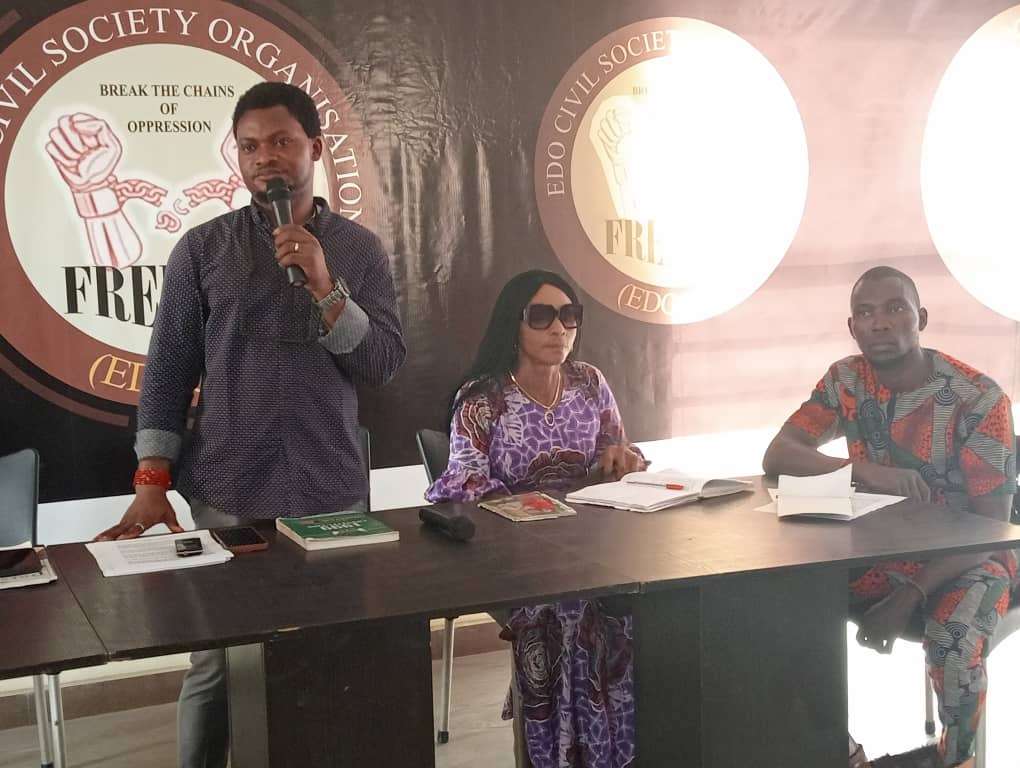
Edo Civil Society Organisations (EDOCSO), has given the President Bola Tinubu-led Federal Government to urgently end the suffering in Nigeria with two weeks, threatening that failure to do so will lead to mass protest.
The civil society organisations gave the ultimatum in Benin City, the Edo State capital, during its General Assembly on Saturday.
Reading a statement jointly signed by Comrade Austine Enabulele,
Interim Technical Committee Chairman, and Comrade Grace Okike, Interim Technical Committee Secretary, EDOCSO, the organisations lamented that the economic hardship in the land is becoming unbearable.
“We want to state clearly that failure for the federal government to swing into emergency action to end this HUNGER and economic suffering in Nigeria within the next two week the President and his Vice should resign so we can elect a better leader, or we at Edo Civil Society Organisations (EDOCSO) will have no option than to mobilize other citizens all over the country on a Tinubu/Shetima must go protest, and we shall ensure a change in the leadership of Nigeria government to prove that indeed section 14 subsection 2a can be activated by any person elected into place of leadership.
“We shall ensure a better tomorrow for Nigerians and not this present better yesterday than we are currently experiencing. Let’s not be discouraged by the show of ineptitude of our leaders but focus on taking back our country from the hands of greedy politicians,” they added.
READ ALSO: [JUST IN]FOOD CRISIS: Tinubu Orders Release Of 100,000 Metric Tons Of Grains
According to the civil society organisations, since the first day President Tinubu took over the leadership of Nigeria, “the country has known no peace in terms of our daily living.”
The EDOCSO added: “Beginning from the increase in fuel price till date, continuous rising of dollar that has affected everything in Nigeria including farm produce that comes from the local farms to our markets today, this has made the saying that whatever goes up must surely come down an irony, considering Dollar-naira exchange rate and suffering in Nigeria.”
They continued: “With dismay, pain and agony we have watched Nigerians groan in pains even when we try to assist as individuals from our own personal struggles is still never enough, and this has led to the continuous rising of suicide being committed by Nigerians everyday because they can no longer bear the hunger and sufferings, women are turning to widows and men widowers, children becoming fatherless or motherless all because, parents can no longer bear the pains of watching their children suffering, as a result of not being able to provide a meal for their children.”
According to EDOCSO, “Is it the crime that has increased all over the 36 states including the FCT, everyday we hear and experience kidnapping, armed robbery all over the country, that even the common local farmer, petty trader and mechanics are now being kidnapped in Nigeria in exchange for whatever the kidnappers can scoop for themselves from innocent citizens as ransom.
“The Federal Government has suddenly become somewhat deaf and dumb that they have refused to act or do anything about it, the almighty giant of Africa has suddenly become handicapped.
“Today in our markets, we can not even buy products manufactured locally, even the foods we bring from our local farms, all because the prices of food and all other things are going up every blessed day and the government supposedly has agencies that control market prices, while these agencies watch in their slumber with their hands folded doing nothing to correct these anomalies in the system and yet we say we have a government in Nigeria?
READ ALSO: Tinubu Inaugurates 3,112 Housing Units In FCT
“Citizens get sick in Nigeria today and can’t afford money to buy common paracetamol, there are no health centers or government hospitals to go to by citizens to be attended to with little or no money.
“In some cases, you go to the very limited hospitals and you are not well attended to by professionals because of its shortage, you can’t get drugs from these few hospitals that are available and yet the wife of the president could donate 100,000 dollars to Sierra Leone to build a hospital when we have needs for it here in Nigeria.”
EDOCSO stated that, “We also wants to state here that we are most disappointed in the National House Of Assemblies who have become a puppet in the hand of the executive not knowing the power the constitution gave them to serve the people, unfortunately we have slumbering representatives who originally don’t know why they were sent to the National House of Assemblies.
“They feel it’s their time to enrich themselves at the expense of Nigerians and we think to the extent of their uselessness, they should all go home, so Nigerians can now conveniently know they have a country without legislators.
“Flowing from the above, it is clear of the general sufferings that Nigerians have been plunged into by the federal government since the day of taking over, due to the removal of fuel subsidy without proper plans on ground to ensure the welfare of Nigerians, and of course the further devalue of our Naira till date.
READ ALSO: Nigerians Are Suffering, Address Economic Pains – Musician K1 Tells Tinubu
“We say to the Federal Government and president Bola Ahmed Tinubu that he has failed in his responsibilities and agreement reached with Nigerians, in Section 14 subsection 2b and Section 16 subsection 1b of the 1999 Constitution of the federal republic of Nigeriand as such have made the following demands.”
The civil society organisations therefore urged the Federal Government to urgently “put in place all machineries to ensure proper market price regulations to end the current economic hardship in the country,” and also put “all economic processes to give value to our currency be put in place.”
The organisations also demanded that “a proper fair and citizens friendly policies be put in place to ensure economic stability in the country,” and “all security measures to end insecurity be activated immediately.”

News
[OPINION] Jan 1 Resolutions: Why I Write What I Write

By Festus Adedayo
As I write this, I am listening to a line of the song of my favourite Jamaican reggae music superstar, Peter Tosh. It is a 1979 track entitled Jah Seh No, in his Mystic Man album. When life becomes too convoluted for me to comprehend, when it seems I am running mad, I run into Tosh’s embrace. But, running to Tosh for an embrace is problematic. Tosh himself was like a madman. He was unconventional, an iconoclast who didn’t see life from the prism of the living. A devout adherent of the Rastafari faith, he was highly spiritual, was a poet, philosopher and a staunch defender of African rights. At some point, life broke Tosh’s will, long before his assassination on September 11, 1987, aged 42, in Kingston, Jamaica. It would appear that his musical preachment made little impact. He was repeatedly assaulted by Jamaican police and once had his skull cracked by them. The charge was his illiberal smoking of marijuana. So, in this track, Tosh bore his frustration with orthodoxy and the system thus: “Must Rastas bear this cross alone and all the heathens go free? Must Rastas live in misery and heathens in luxury? Must righteous live in pain and always put to shame? Must they be found guilty and always get the blame?
Tosh’s Jamaica of 1979 bears similarities with today’s Nigeria. Jamaica wore, like an apron, significant economic instability. This led to intense poverty and inequality driven by global economic shocks, domestic policy choices, capital flight, and political violence. The aftermath was massive hopelessness.
The attendant hopelessness in Jamaica fired the muse of reggae musicians. They saw naked poverty as catalysts for their songs. For instance, in 1976, Maxwell Smith, known professionally as Max Romeo & The Upsetters Band, sang in Uptown Babies Don’t Cry, about a little lad hawking Kisko, a popular brand of ice pops, on Kingston streets and shouting “Kisko pops! Kisko pops!”. He also sang about another lad who, as Star newspaper vendor, shouted, “Star News, read the news!”. They were embroiled in existential survival, said Romeo, and “help(ing) mummy pay the fee, for little junior to go to school.” For Tosh, in his Get Up, Stand Up, Jamaicans must stand up for their rights while Bob, apparently frustrated by the system, in Time Will Tell, sang confidently that ”Jah would never give the power to a baldhead to come crucify the dread.”
But the Jamaican governmental and political leadership, epitomised by Edward Seaga and Michael Manley, kept on taking advantage of the people’s hopelessness. Nigeria of today is yesterday’s Jamaican mirror on the wall. The hopelessness in the land has the capacity to break the most impregnable will. Everything seems to be upside down. Seaga and Manley are replicated in Bola Tinubu and Abubakar Atiku. Or Peter Obi and other scavengers for power.
MORE FROM THE AUTHOR:OPINION: Can Tinubu, Our Eddie Kwansa, Now Come Home?
Everything is shrouded in a fog. Hope of retrieval of country from the jaws of political carnivores recedes by the day. This year, prelude to election year, will even be worse. Foes will stab friends and friends will stab foes, not in the back, but in their very before. War has begun, says So-kple-So. That line reminds me of Ghanaian Akan poet, Kojo Senanu’s poem, “My Song Burst” in the A Selection of African Poetry, authored by him and Theo Vincent, which recited that Akan war song.
Physical or psychological repression is writ large. Impunity reigns like a malevolent incubus. Those are actually not the ailment. The disease is the Nigerian people. The way Nigerians’ minds have become warped, significantly captured and compartmentalized into a binary, is mind-boggling. Never have Nigerians’ minds operated in a gross profile as this. Tribe, religion, and political parties determine where everyone stands. No one sees rot and maggots but opportunities. Everyone is running a rat race to take a bite of Nigeria’s carrion. Our sense of judgment has been significantly recalibrated. When I read comments by some otherwise knowledgeable and brilliant people on visible rots in the polity, I feel I am falling into depression. Yet, a part of me warns not to take Nigeria seriously. If you run mad and then die, Nigerians would piss on your graveside.
Many times, I have toyed with the option of abandoning this thankless ritual of column-writing which I began in 1998. It is a killing ritual for which, not only don’t you get paid but you are insulted for daring to have a voice. Maybe I could find sanity in silence and abandonment of my voice? After all, Reno Omokri and Daniel Bwala have found redefinition in becoming the biblical Lot’s wife. But my mind tells me I would face hell on earth and would even not rest in peace. But the truth is, where I stand has potentials of running me mad. Permit me to be immodest, those who know me know I have an ecumenical spirit that cannot hurt a fly. But when I sit behind my laptop, I am like a possessed Yoruba deity of smallpox called Sonpona. Chaos, otherwise known as upside-down, which Fela said has its meaning too, is meaningless to me. Everywhere I turn, I see chaos and my head spins, threatening to explode. Even when I cannot totally extricate myself from the rot in the land, I am grieved like a pallbearer. Yet, another part of me tells me that order and chaos are Siamese, built into a profile by the Omnipotent.
MORE FROM THE AUTHOR:OPINION: Abulu, The Prophetic Madman, At Akure Summit
As 2025 spun into oblivion, I stood to make a New Year resolution. But before I did this, I checked the literature of resolutions. It offers no comfort. Over a century ago, specifically on January 1, 1887, Rudyard Kipling, English journalist and novelist, attempted to drill into the philosophy of resolutions. In a timeless poem which explored the human desire to make New Year resolutions and the failure that attends it, he gave a tribe of New Year resolution makers a short-lived hope. He did this in a poem he entitled Little-Known Poem on New Year’s Resolutions. Billions of people in the world make resolutions on New Year’s Day. But, said Kipling, there are trials and tribulations in resolutions. In seven short stanzas, Kipling took readers on a journey. He begins by listing vices he wants to give up. They hung on him like an apparition. Chief among the vices were alcohol, gambling, flirting, and smoking. But in each of the stanzas, as he proposes a resolution, he proposes contrary sentences that nullify the resolutions and even justifying their reversals.
Matthew Wills, in his Why New Years Falls on January 1st: Why do we celebrate the beginning of the New Year on the first of January?, took the world on a journey on the frivolities of January 1st. Julius Caesar, he said, is why. The eponymous Julian calendar, said Matthew, began in Mensis Ianuarius (or Januarius) 45B.C. The month of January, he further reminded us, is named after the Roman god called Janus. Janus is a god who had two faces. While one faces the future, the other faces the past. Janus was however perceived, according to Wills, as “the god of beginnings, endings, and transitions, or, more prosaically, doors and passageways.”
Among the Yoruba, just like Jews’, the agricultural season marks the beginning of the year. For them, the newness of a year is defined by their philosophy of time, which they also approximated in the saying, the next season is here so, don’t eat your yam seedling, «Àmódún ò jìnnà, má jẹ isu èèbù rẹ». Season and time, to the Yoruba, are expressed in an embodiment of words like àkόkὸ (time around), ìgbà (season) and àsìkò (specific season) which they most times deploy interchangeably. The people also have sayings which speak to their conception of time. For instance, late professor of philosophy and my teacher at the University of Lagos, Sophie Oluwole, in one of her works, “The Labyrinth Conception of Time as Basis of Yoruba View of Development” published in Studies in Intercultural Philosophy (1997), cited Yoruba saying to illustrate this. “Tí wón bá ńpa òní, kí òla tèlé won kí ó lo wò bí won o ti sin ín (when today is being killed, tomorrow’s attendance at the murder scene is necessary so that it could see where the corpse of today is buried and for it to know how it too would be interred). The two other Yoruba sayings Oluwole cited to illustrate time and season are, one: “ogbón odún ni, wèrè èèmí ni” (this year’s wisdom is next year’s folly) and “Ìgbà ò lo bí òréré, ayé ò lo bí òpá ìbon” (a life span cannot exist ad infinitum; it is not vertical, and is unlike the straightness of the barrel of a gun).
MORE FROM THE AUTHOR:OPINION: Ted Cruz’s Genocide, Blasphemy And Ida The Slave Boy
These were all I reflected upon as I proposed to make a 2026 Resolution. The self-imposed road of a columnist I tread is a lonely, hard road strewn with briers and thorns. I remember the sermon of another Jamaican reggae great, Jimmy Cliff. It is a hard road to travel and a rough road to walk, he counseled. Many times, you are lonely, dejected and rejected on this road. You open your mouth to speak but wordless words ooze therefrom. Just as Tosh lamented in his “Must Rastas bear this cross alone and all the heathens go free?” volunteering anti-establishment opinion is like carrying a cross. Many times, I am inundated by family and friends to turn apostate of my belief. They fear death or state castration. Can’t the world see? Don’t they see the pains, grits and uncertainty on this road? Don’t they know that there is lushness, flourish and plenty on the other side? If I neglected these for a carapace-hard travel, I thought I would be hailed. No. Why is one who chose this lonely road the demon? And those who sup in the bowl of destruction heroes? Why? No response. Only echo of my own silent voice.
In this dejection, Audre Geraldine Lorde came to my rescue. Lorde was an American professor, philosopher, feminist, poet and rights activist. She was also a self-described Black lesbian. Lorde got romantically involved with Mildred Thompson, American sculptor, painter and lesbian she met in Nigeria during FESTAC 77. In a paper she delivered at the Modern Language Association›s “Lesbian and Literature Panel,” Chicago, Illinois, December 28, 1977 with the title, The Transformation of Silence into Language and Action, Lorde gave insight into the pains she encountered on account of her beliefs: “I have come to believe over and over again that what is most important to me must be spoken, made verbal and shared, even at the risk of having it bruised or misunderstood.”
It could also mean pain or death, but she said, “learning to put fear into a perspective gave me great strength” and that “I was going to die, if not sooner, then later, whether or not I had ever spoken.” Gradually, said Lorde, “I began to recognize a source of power within myself that comes from the knowledge that while it is most desirable not to be afraid, my silences had not protected me.” She died of liver cancer in 1995.
Yes, this is a rough, lonely road. It could be excruciating when you see friends, especially ones in government, desert you because they don’t want to associate with you. You walk alone like a deranged alchemist. Some even ask why, with your endowment and ascription, you live comparatively like a pauper. Your views are criminalized. Where you stand is not popular. But both madman Peter Tosh and lesbian Audre Geraldine Lorde give the will to trudge on in the New Year, regardless. Lorde was loud in my head with her admonition. After her initial apprehension of a mastectomy resulting from a breast cancer, she said: “I was going to die, sooner or later… My silences had not protected me. Your silences will not protect you…. What are the words you do not yet have? What are the tyrannies you swallow day by day and attempt to make your own, until you will sicken and die of them, still in silence? We have been socialized to respect fear.”
There and then, I made a bold vow, a New Year resolution: I will continue to speak truth to power. Regardless.
News
What I Saw After A Lady Undressed Herself — Pastor Adeboye

General Overseer of the Redeemed Christian Church of God (RCCG), Pastor Enoch Adeboye, has recounted a remarkable experience in which he said a woman was miraculously healed after prayers.
Adeboye shared the testimony while speaking at the RCCG annual gathering, describing the incident as a clear demonstration of divine intervention and the power of prayer.
According to the cleric, the incident occurred during a visit to a city where he had checked into an undisclosed hotel.
READ ALSO:Pastor Adeboye To Lead Prayers For Nigeria
He said the lady approached him, greeted him and insisted on following him to his hotel room despite his objections.
“I told her, ‘Please don’t put me into trouble, I can pray for you here,’ but she insisted on following me,” Adeboye recounted.
He said that upon getting to the hotel room, the woman revealed the condition that prompted her persistence.
READ ALSO:How RCCG Pastor Absconded With $8,000, Marry New Wife In US — Pastor Adeboye’s wife
“When she pulled her dress up, what I saw shocked me. Her body was covered with scars,” he said.
Adeboye explained that he immediately began to pray for the woman, adding that he did not mind being loud during the prayers.
“I began to pray for her, and before I knew it, all the scars were gone,” he said.
The RCCG leader described the experience as a powerful testimony of faith, stressing that it reinforced his belief in prayer as a tool for healing and transformation.
News
Missing N128bn: SERAP Demands Probe Into Power Ministry, NBET Expenditures
The Socio-Economic Rights and Accountability Project (SERAP) has urged President Bola Ahmed Tinubu to immediately order an investigation into allegations that more than N128 billion in public funds is missing or has been diverted from the Federal Ministry of Power and the Nigerian Bulk Electricity Trading Plc. (NBET), Abuja.
The allegations are contained in the latest annual report of the Auditor-General of the Federation, published on September 9, 2025, which highlighted multiple cases of financial irregularities, undocumented payments, ents and suspected diversion of public funds across both institutions.
In a letter dated January 3, 2026, and signed by SERAP’s Deputy Director, Kolawole Oluwadare, the organisation called on President Tinubu to direct the Attorney General of the Federation and Minister of Justice, Lateef Fagbemi, SAN, alongside relevant anti-corruption agencies, to promptly probe the findings and ensure accountability.
SERAP stressed that any individual found culpable should be prosecuted where sufficient admissible evidence exists, while all missing or diverted funds should be fully recovered and paid back into the national treasury.
READ ALSO:SERAP Drags Akpabio, Tajudeen To Court Over Alleged Missing N18.6bn NASS Complex Project Funds
The group further urged the president to deploy any recovered funds to address the deficit in the 2026 budget and help ease Nigeria’s growing debt burden.
According to SERAP, Nigerians continue to bear the consequences of entrenched corruption in the power sector, which has contributed to persistent electricity shortages, frequent transmission line failures and unreliable power supply nationwide.
The organisation argued that addressing corruption in the sector would significantly improve access to regular and uninterrupted electricity.
The civil society group described the allegations as a grave breach of public trust and a violation of the 1999 Constitution (as amended), Nigeria’s anti-corruption laws and international obligations, including the United Nations Convention against Corruption.
READ ALSO:SERAP Drags RMAFC To Court Over Proposed Salary Hike For Political Office Holders
Detailing the audit findings, SERAP noted that the Ministry of Power failed to account for over N4.4 billion transferred to the Mambilla, Zungeru and Kashimbilla project accounts, with no evidence provided on how the funds were utilised.
The Auditor-General expressed fears that the money may have been diverted and recommended its recovery.
The report also revealed that the ministry paid over N95 billion to contractors for various projects without documentation or proof that the projects existed or were executed.
Additionally, more than N33 million was reportedly spent on foreign travels for the minister and aides to attend international events in Abu Dhabi and Dubai without required approvals from the Secretary to the Government of the Federation or the Head of Civil Service.
READ ALSO:SERAP Sues NNPCL Over Alleged Failure To Account For Missing N825bn, $2.5bn
Further concerns were raised over unaccounted expenditures, including over N230 million on the GIGMIS platform and more than N282 million paid as non-personal advances to staff beyond statutory limits, all without adequate documentation.
At NBET, the Auditor-General uncovered multiple cases of irregular contract awards and payments. These include over N427 million in contracts awarded without evidence of procurement advertisements, more than N7.6 billion transferred into purported sub-accounts of unnamed beneficiaries, and over N9.3 billion paid to Egbin Power Plc without documents to authenticate the transactions.
The audit also cited payments exceeding N8 billion made without proper record-keeping, over N420 million paid to ineligible consultants without evidence of services rendered, and more than N1.1 billion spent as extra-budgetary expenditure without approval from the Minister of Finance or the National Assembly.
READ ALSO:SERAP Kicks As Bill To Jail Nigerians Who Don’t Vote Is Proposed
Other questionable expenditures highlighted include payments for vehicles without due process, unapproved legal fees, undocumented staff welfare packages, and consultancy services not captured in approved budgets.
SERAP warned that if decisive action is not taken within seven days of the receipt or publication of its letter, the organisation would consider legal steps to compel the government to act in the public interest.
Citing constitutional provisions, SERAP reminded President Tinubu that Section 15(5) of the Constitution mandates the abolition of corrupt practices, while Section 16 obliges the government to ensure that the nation’s resources are managed to promote the welfare and happiness of all citizens.

 Headline8 hours ago
PROPHECY: Primate Ayodele Reveals Trump’s Plot Against Tinubu
- News8 hours ago
What I Saw After A Lady Undressed Herself — Pastor Adeboye
- Metro10 hours ago
Joint Task Force Kills 23 Bandits Fleeing Kano After Attacks
- Politics10 hours ago
Why Kano Governor Postponed Formal Defection To APC
- Metro8 hours ago
Armed Robbers Shot PoS Operator To Death In Edo
- Metro8 hours ago
Gunmen Demand N200m Ransom For Kidnapped Brothers In Edo
- Politics9 hours ago
2027: Rivers APC Pledges To Follow Wike’s Instructions
- News9 hours ago
Reps Release Four Tax Acts For Public Records
 News10 hours ago
NiMet Forecasts Three-day Dust Haze, Sunshine
- News8 hours ago
Missing N128bn: SERAP Demands Probe Into Power Ministry, NBET Expenditures


