
News
Edo Guber: ADC Distance Self From Collapsing Structure Into APC

The leadership of the African Democratic Congress, ADC Edo State chapter, has distance themselves from the purported collapsing of its party structure into the All Progressives Congress, (APC) ahead of the September 19 governorship election in the state.
The leadership also emphasized that Mabel Oboh remains the party’s governorship candidate in the forthcoming governorship election in the state.
The stand of the party was made known to Journalists in Benin through its chairman, National Campaign Council, Friday Musa,
while reacting to the alleged collapsing of the party’s structure into the APC by its acting chairman, Mr. Christopher Inegbedion.
READ ALSO: Edo 2020: Ize-Iyamu Promises Rural Broadband Development, Skill Acquisition Centres
Musa said Mr. Inegbedion has never been the chairman of the party as he was forced on them, adding that whatever he has done, he did it for himself and not for the party.
“So many of you know that the former acting chairman, Christopher Inegbedion. We want to make it public that he has never been a party chairman even though he was purportedly forced on us and which so many of us felt that it is not possible to pass through another means to become the chairman of the party.
“Inegbedion is a self-acclaimed chairman of ADC. Our chairman is Vincent Okoawo, and ADC has been very much functional around the leadership of Okoawo. We dissociate ourselves completely as a party from whatever Inegbedion performs in his own right”, he said.
He said the ADC is not shifting its ground and is not collapsing into any political parties in the state but poised to win the election.
READ ALSO: Breaking: Edo 2020: Council Boss, Family Escape Assassination
“ADC is not shifting ground for any political party. We are ready for the election come September 19. Our candidate, Mabel Oboh remains, and for that we are not shifting ground for anybody. If Christopher Inegbedion decides to defect, it is his own right, we can’t infringe on it. But the fact is that, whatever he did, he did it by himself and for himself.
“And not that the ADC as a political party in Edo State collapse to join another party. We remain as a party and we are ready to go into the contest.
“We make it clear that ADC as a political party and most specially the third force among the political parties in Nigeria, in Edo State, we are very formidable and strong as ever before”, he added.
Reacting to the alleged collapsing of the structure of the party into the APC, the governorship candidate of ADC in the forthcoming election, Mabel Oboh, said the said Christopher Inegbedion has long been suspended from the party.
READ ALSO: Breaking: Edo 2020: Council Boss, Family Escape Assassination
She said the said Inegbedion acted own his own volition and that the ADC as a party still remains intact, stressing that she is contesting the governorship election and that the party is strongly behind her.
She called on the citizens of the state to disregard his action and come out to cast their votes for her in the forthcoming governorship election.
However, while trying to get the views of Mr. Christopher Inegbedion on the matter through his mobile phone, he told our Reporter to come to Ekpoma before he could comment on the issue, noting that he would not know if he is talking to a spirit.

News
Shatta Wale Bailed Burna Boy From Ghana Prison After Arrest For Smoking Weed – Captan

Ghanian singer, Captan, has claimed that his former record label boss, Shatta Wale, once bailed Nigerian singer Burna Boy out of prison in Ghana after he was allegedly arrested for smoking weed.
Speaking in a recent podcast interview, Captan claimed that Shatta Wale sent him and others to free Burna Boy from police custody.
He also claimed that Shatta Wale and his group once accommodated Burna Boy when he was being hunted by some dangerous men.
READ ALSO: Wale Edun Opens Up After Sack
Captan said, “I once bailed Burna Boy out of prison in Ghana when he was arrested for smoking weed. Shatta Wale sent me and some guys to go and free him from police custody.
“There was a time we also accommodated him when some people were after his life. We helped him settle the case.”
He added that he and Burna Boy are no longer in good terms after the Nigerian artist’s fallout with his mentor, Shatta Wale.
He, however, said he and Shatta Wale are open to reconciling with Burna Boy if he asks for it.
Watch the video here
News
Children’s Day: Chaos At Ogbe Stadium As Dozens Faint

Chaos erupted on Wednesday during the Children’s Day celebration as dozens of students reportedly collapsed following a stampede triggered by the use of pepper spray.
The event,
organised by the Edo State Ministry of Education at the Samuel Ogbemudia Stadium was disrupted after some male students of Ihogbe College allegedly made uncompromising advances towards female students at the venue.
A parent who identified himself as Oboh Emmanuel said, “the behaviour of those uncultured students attracted the attention of bouncers stationed at the stadium as they rebuked the male students.”
Oboh said the affected students later regrouped and attacked the bouncers, leading to a confrontation within the crowded arena.
READ ALSO:Children’s Day: Edo Commits To Child Protection
It was gathered that in the ensuing confusion, the bouncers were reported to have deployed pepper spray in an area occupied by a large number of students.
Several students, particularly female students, reportedly fainted after inhaling the substance, while others sustained injuries after being stepped on during the ensuing melee.
The panic was said to have spread across the stadium as students, teachers and parents scampered for safety.
Many of the affected students were reportedly rushed to the Edo Specialist Hospital for medical attention.
READ ALSO: Egor LG Chair, Ogbemudia, Vice, Osawe Impeached
Reacting to the incident, Chief Press Secretary to Governor Monday Okpebholo, Dr Patrick Ebojele, said the security personnel that fired the tear gas had been detained.
He said all the students, except two, that were rushed to the hospital have been discharged.
Ebojele stated that doctors wanted to observe the students till tomorrow before allowing them to go home.
“The two students are not seriously injured. Doctors want to observe them overnight. Permanent Secretary, Ministry of Education is still at the hospital. The man who used pepper spray has been detained.
“The incident did not happen the way it is being exaggerated. All modalities were put in place to ensure the children enjoyed their day.”
News
Okpebholo Salutes Edo Muslims, Seeks Continued Support, Prayers
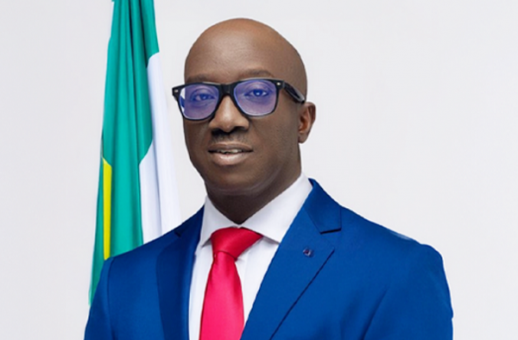
Governor Monday Okpebholo of Edo State has urged Muslims and all Nigerians to continue to pray for peace, unity and progress in the country even as they celebrate the annual Eid-al-Adha
The governor, who was represented by his deputy, Dennis Idahosa, stated this during the annual Eid-al-Adha celebration with Muslim faithfuls held at Government House in Benin City.
He reiterated his administration’s commitment to fairness, inclusivity and equal opportunities for all citizens irrespective of religion and tribe.
READ ALSO:ADC Penetrates Okpebholo’s District As Defections Strengthen Party in Edo Central
According to him, the present administration remains determined to building a government that reflects the diversity of Edo State, noting that competent and qualified Muslims have continued to play vital roles in his government because of their capacity, integrity and commitment to service.
“As a government, we remain committed to fairness, inclusivity and equal opportunity for every Edo citizen, irrespective of religion, ethnicity or political affiliation. This is why quality and competent Muslims are serving in key positions in our administration.”
Okpebholo appreciated the Muslim community in Edo State for their unwavering support and continuous prayers for his administration, noting that such prayers and support have contributed immensely to the peace and steady development being witnessed across the state.
READ ALSO:Okpebholo Felicitates Muslims On Eid-el-Fitr Celebration
He then called on all Nigerians to use the occasion of Eid-al-Adha to pray for the administration of President Bola Ahmed Tinubu, stressing that the country needs collective prayers, unity and cooperation to overcome its present economic and security challenges.
“I urge all Muslims and indeed all Nigerians to use this occasion to pray for our dear nation and for the administration of President Bola Ahmed Tinubu. Nigeria needs our collective prayers, unity and support as we strive to overcome our challenges and build a more prosperous future for all.”
In his remarks, the Chief Imam of Edo State, Abdulfatai Enabulele, applauded the governor for what he described as remarkable developmental strides recorded in less than two years in office.
The cleric commended the administration for ongoing infrastructural development and efforts geared towards improving governance in the state, but appealed to the government to revisit and complete some abandoned projects inherited from the previous administration for the benefit of the people.

 Metro5 days ago
My Husband Abandoned Me On Our Wedding Night To Attend Political Meeting, I Want Our Marriage Dissolved
- Headline4 days ago
Woman Passes Out After Receiving 100 Strokes Of Cane
- Headline4 days ago
JUST IN: White House Locked Down Briefly As Gunman Opens Fire At Security Checkpoint
- Politics5 days ago
Warri Ijaw Hail INEC Delineation Report, Call For Additional Electoral Wards, Others
- Politics3 days ago
Two Masked Men Gun Down Politician In His Rivers State Hotel
- News3 days ago
More Pain For Nigerians As Cooking Gas Price Increases Nationwide
- Metro4 days ago
Police Reject N500m Bribe, Recover N7.8bn Illicit Drugs In Lagos
- News5 days ago
Alleged Terrorism: Court Rejects Defendant’s Bid To Travel Abroad
- Metro5 days ago
My Wife Stop Cooking My Food, Beats Me Black And Blue All the Time, Man Tells Court
- Politics5 days ago
What I’ll Do As President Of Nigeria — Amaechi


