

Latest news
Facts About Ukhun Kingdom Kingship And Emancipation




By Prince Alex Eguakhide
Ukhun is a notable community in Esan West Local Government Area of Edo State, Nigeria.
Its history and cultural heritage reflect the broader traditions of Esanland, which is deeply rooted in migration, resilience, and connection to the Benin Empire.
The Esan people, including those of Ukhun, were historically influenced by the exodus from the Benin Kingdom during the reign of Oba Ewuare in the 15th century.
These migrations helped established Ukhun and similar settlements as independent kingdoms within the Esan cultural framework.
INTERESTING FACTS ABOUT UKHUN KINGDOM AND KINGSHIP.
The biggest influence on Ukhun Kingdom came from Edo, founders of Benin Empire like every Esan land.
In 14th century, Oba Ewuare passed laws of mourning that prohibited sexual intercourse, bathing, drumming, dancing and cooking e.t.c.
These laws proved too restrictive for many citizens, and these citizens fled the kingdom to Esan land.
Firstly, they encamped at the Obadan/Okphiamen community. The settlement was said to be about 30 miles away from Benin Empire.
After 13 years of encampment, Ukhun Kingdom was one of the many Esan people who went further into the hinterlands as a result of incessant attacked from the Benin warriors.
This exodus shaped Ukhun Kingdom cultural identity like every other 35 established autonomous kingdoms in Esan land including but not limited to: Irrua, Uromi, Ekpoma, Ewu, Ekpon, Ewohimi, Ujogba, Uzea, Emu, Ohordua, Illushi, Ebelle, Ow, Egoro, Ewuatto, Ewosa, Opoji, Okhuesan, Ugboha, Amahor, Urohi, Igueben, Ubiaja e.t.c.
Ukhun Kingdom discovered and founded their presents geographical location as their Aboriginal which is today captured among the Esan West Local Government Area in Edo state.
Ukhun Kingdom was also referred to as the “KUKURUKU’S”, a name derived from the Kukuruku Hills which was a defence barricade for the people during the inter-tribal wars and also by reason of its geographical location, being the last community of the Esan land on northern escarpments plateau of the Esan people.
Ukhun Kingdom originally shared its borderline with the “AFEMAI”, who at first settled at Aviele, of the Kukuruku division around Uwen-Aken until the invasions of the “NUPES”.
Before now, Ukhun community consists of 22 quarters until the invasions called Nupe or Bida war of 1847-1850. For example, the Afaken quarter was a multifid district by virtue of their homogeneous numbers and geography in the ancient Benin Empire, and which they carried on with to the present day modern Ukhun Kingdom as a bifid district called ” Afaken” quarter.
Eleven out of the 13 homogeneous numbers fled during the invasions of the NUPES in 1847-1850 and Afaken majorly bore the brunt of the attacked.
READ ALSO: Full List: Asake Is Spotify’s Most-streamed Nigerian Artist For 2023
This reduced Afaken to bifid districts namely, the “ AFOBOIMEN AND THE UWEN-ODIALE”. Until 1885, that is nearly after 50 years of separation, the survivors and their offsprings came back all mixed up in their custom and religion.
Many of the returnees had been converted to Islam.The Uwen-Aken are people of Ukhun extraction majorly from Afaken quarter whom never returned to their Aboriginal in Ukhun Kingdom, now under the old Kukuruku division.
In the wisdom of our forefathers, for these homogeneous to form a formidable force in the present Ukhun Kingdom and from external forces, AFOBOIMEN AND UWEN-ODIALE were fused in their ancestry DNA and called “AFAKEN”, known as Afaken quarter in the present Ukhun Kingdom.
One thing is of very important to note that from the onset, there are two parts to every Esan district, the Royal families and the non Royal families (common people).
They are quite distinct. For nearly all the ancient ruling houses were and still are, the Onojie, who with their families are referred to as the ruling houses.
Among the 22 quarters that make up Ukhun Kingdom, Ogbuje quarter was also identified with the lineage of the ruling houses of the Benin Empire, and this is what gave credence to the Ukhun people as an autonomous Kingdom among other established Esan kingdoms in Edo State.
Ogbuje quarter in Ukhun Kingdom has always been recognized with the royal blood flowing in their vein in Ukhun Kingdom. Unfortunately, the Ogbuje lost their royal heritage because an incumbent from this quarter had no male child before he died and his daughter married into the Uwen-Otun quarter.
When her father died, she performed the burial ceremonies of her father (the late king) in her husband’s place where she took away all paraphernalia of Onojieship.


This robbed Ogbuje of the right to inheritance and in compensation, installation of new Enijies became theirs.
A similar situation befell the Uwen-Otun quarter, the then new royal family. The incumbent king also died without a male child. The only daughter he had, was married to the Akhimien family in Uwen- Okolo quarter in Ukhun Kingdom.
She also performed the burial rite ceremonies of her father ( the late king from Uwen-Otun) in her husband’s place but the difference in her case was that, Uwen-Otun didn’t allow her to relocate the paraphernalia of Onojieship.
This resulted to some conflicts within the community and led to the exodus of the Uwen-Otun remains to the old Kukuruku division for many years.
In early 60s, the elders of the land disagreed to the new order of the ruling houses by conquest. They insisted the order should be reversed to the original position, which is, recognizing the Uwe-Okolo as the only ruling house in Ukhun Kingdom.
This was not without resistance from the impostures in the corridor of power.
READ ALSO: 11 Banks Generated N72.7bn From Account Maintenance Charges In H1 2023
However, for many years, Ukhun Kingdom was governed through gerontocracy, until 1980 when the Chief Justice O Sadoh as the then Attorney General and Commissioner for Justice to the old Bendel state, convinced the elders to see the benefits attached to a community with a king.
Our fathers agreed with the new concept and dropped their agitations and this paved the way for the installation of king Iboi of Ogbeta in 1983, with the composition of three quarters kindred: – Uwen Okolo – Uwen-Ogbeta – Uwen-Ijiekhine.
The term Uwen-Ijiekhine pertains to a historical or cultural concept in the Ukhun Kingdom, which is part of the traditional Edo-speaking regions of southern Nigeria.
Ukhun Kingdom is one of the significant domains with ties to the larger Benin Empire, known for it rich history, culture, and governance systems.
Here’s an outline of what might be relevant to this term and its context: Understanding Uwen-Ijiekhine. The term “Uwen-Ijiekhine” in Edo language can be broken into parts:Uwen: translate to “voice,” “song,” or “message.”Ijiekhine: Often signifies “elders,” “ancestors,” or something related to tradition and authority.Together, Uwen-Ijiekhine mean “the voice of the elders/ancestors” or “ancestral decree.” It could reference oral traditions, spiritual declarations, or a council of elders in the Ukhun Kingdom.
Role in Ukhun Kingdom: Ancestral Worship and Oral Traditions: Edo kingdoms, including Ukhun, deeply venerates ancestors. Uwen-Ijiekhine represents the wisdom and guidance passed down from ancestors.
Governance and Decision-Making: In many traditional societies, councils of elders (Ijiekhine) played key roles in decision-making.
The phrase might refer to communal agreements or proclamations by these elders.
Historical Documentation: Oral traditions were crucial for preserving Ukhun’s history, and terms like Uwen-Ijiekhine symbolizes the importance of verbal records.
Cultural Significance Festivals and Rituals: In the Ukhun Kingdom, many festivals are rooted in honouring ancestors and celebrating their legacy.
The phrase also invoked in rituals or songs as a sign of respect to the forebears.
Connection to Benin Empire: The Ukhun Kingdom, like others in the Edo-speaking area, shared governance, religion, and cultural systems influenced by the Benin Empire.
Uwen-Ijiekhine also have relevance in broader Edo traditions.
Interpretation in Modern Context Identity and Heritage: For descendants of the Ukhun Kingdom, understanding terms like Uwen-Ijiekhine is vital for preserving historical identity.
READ ALSO: Full List Of Winners: Burna Boy, Tems Shine At 2023 BET Awards
Historians and anthropologists studying the Edo-speaking regions may use concepts like Uwen-Ijiekhine to understand governance and social structure.
Succession- Gerontocratic: Title goes to the eldest man in the three quarters kindred- Installation performed by Ogbuje (a custom arising from historical ties)
Background- Ogbuje’s role in installation originated from daughter of an Ogbuje incumbent married into Uwen-Okolo. She performed her father’s burial rites in her husband’s place, retaining kingship paraphernalia, Ogbuje lost inheritance rights; compensation: installation of new Onojie.
Ukhun had Enijies initially attached to Ekpoma. In 1909, Onojie of Ukhun aligned with Ewu, attending Irrua native court and Original site marked by Ukeguale Oba in Uwen-Okolo maintained as a meeting place for all Ukhuns, and later expansion was made among the three ruling quarters.
Key Points:- Gerontocratic succession ensures elderly leadership- Ogbuje’s installation role honors historical ties- Ancestral site preservation maintains cultural heritage.
The first three -Uwen Okolo , Uwen – Ogbeta and Uwen – Ijiekhine forms the one ruling House of Oba, succession is Gerontocratic, the title goes to the eldest man in the three quarters kindred.
When an Onojie dies, his children have up to three months to perform the burial rites of their father before a successor is installed.
The installation is performed by Ogbuje, the custom arising from the facts that this quarter used to be part of the Oba ruling house.
An incumbent from this quarters had no male issue and his daughter married into the Uwen – Okolo quarter. when her father died she correctly performed the burial ceremony of her father in her husband’s place where all royal accoutrements of Onojieship ( kingship).
UKHUN KINGDOM EMANCIPATION
Ukhun and Idoa are two districts on the northern escarpment of the Esan plateau. They are true Esan communities. All round the Esan lands are border villages and by virtue of their geography and history, their custom/traditional practices are being infringed upon by the custom of their non.
ESAN NEIGHBORING UKHUN villages, with such infringement are as follows ERHA ,AMA , AWAIN UJAGBE , UKHUN and IDOA , ERHA had been detached from Esan to join Ivvbiosakon , now Owan, Ama and Awain since 1895, came under the present Etsako and all in the defunct Kukuruku.
During the Nupe Invasion called Nupe or Bida War 1847 –1850, most of those Northern Esan villages bore the brunt of the onslaughts of Nupe vandals and were sacked further inland into the thick impenetrable wild animals infested jungles, in which even dared devil Nupe themselves feared head hunters, tsetse flies made it impossible for their horses to survive.
Most of the communities fled and took refuge in the defunct Kukuruku division and only began to return home when Nupe domination came to an End after the Royal Niger Company around about 1885, that is after nearly 50 years of separation, the survival and their offspring came back all mixed up in their custom, religion and organisation.
The Nupe who had gained full control over most of the defunct Kukuruku division had converted the people into Islam, got them to pay tribute in slaves, money, guinea corn etc.
What kept the returnees together had been the Esan language Ontology and tribal marks.
The original ruling families were lost and the only way to exercise discipline was through the old respect of elders, this leading to Genrontocracy, the eldest men in the community exercised the Authority over the communities.
And as each communities grew, many quarters developed and whoever was the oldest become the community leader and on his death, the next oldest took over and the trajectory was such that, by providence design, the next leader often emerged from another quarter.
Cultural Heritage and Traditions.
The people of Ukhun share the rich Esan traditions of governance, language, and spirituality.
Leadership in Ukhun revolves around the Onojie (king), who is central to community affairs and the custodian of traditions.
The first Onojie of Ukhun, like other Esan kings, likely emerged through the Benin Empire’s practice of appointing leaders for affiliated communities.
Oral traditions play a crucial role in preserving Ukhun’s history, particularly through storytelling, songs, and rituals.
Esan culture emphasizes respect for elders (Edion) and organized age grades (Ighene and Egbonughele), each with defined responsibilities, such as burial rites and maintenance of community resources.
Festivals, like the Igbabonelimhin dance, mark significant cultural and communal events, involving performances rich in somersaulting and vibrant music.
Boundaries and Quarters Ukhun, like other Esan communities, is organized into quarters that form its socio-political structure.
Each quarter has specific roles and contributions to the overall governance and cultural activities.
These divisions also influence how resources and responsibilities are allocated within the community.
Ukhun kingdom consist of 10 quarters. 1. Uwen- Okolo which is the first among Ukhun components .2. Uwen- Ogbeta 3.Uwen – Ijiekhine 4.Ogbuje 5 . Afaken 6 . Ebhoigben 7 . Ebbeyen 8 . Oderie 9 . Uwen – Itun 10 . Okede
Values and Interests
The values of Ukhun reflect Esanland’s emphasising on family, farming, and community solidarity.
Agriculture, particularly yam, cassava, and palm produce, form the backbone of the economy.
Social harmony is prioritized through community-led conflict resolution mechanisms, often under the guidance of elders and the Onojie.
Influence Of Christianity And Modernity
Ukhun, while deeply traditional, has also embraced Christianity alongside indigenous practices.
The interplay of these influences shape the modern identity of the community, blending historical roots with contemporary beliefs.


Latest news
Mob Fury Over Missing Man: Youth Leader Declared Wanted as Brother, Mother Die in Akwa Ibom Community Tragedy

By Our Correspondent
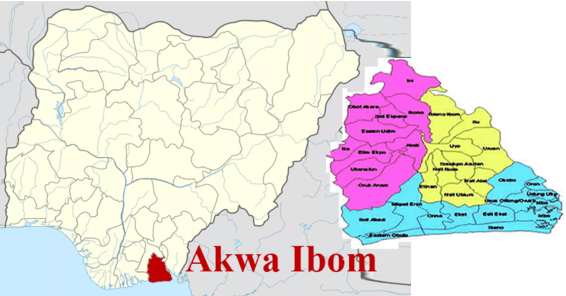
Tension and grief have enveloped Effoi Village in Eket Local Government Area of Akwa Ibom State following a tragic mob attack that claimed the life of a middle-aged man, Godwin Ikott Bassey, amid allegations linked to his elder brother, Dennis Ikott Bassey.
The incident, which has sent shockwaves across the community, was reportedly triggered by the unresolved disappearance of a villager, a development that has fueled anger among local youths for years.
Sources within the community disclosed that the mob, allegedly acting on suspicion and pent-up frustration, stormed the residence of the Bassey family in search of Dennis Ikott Bassey, who has been accused of having a connection to the long-standing case.
Unable to find their prime target, who was reportedly said to have fled to Benin City, Edo State, for safety, the assailants descended on his younger brother, Godwin Ikott Bassey, fatally attacking him in what eyewitnesses described as a brutal act of mob justice.
It was gathered that Dennis Ikott Bassey, now on the run, had long been on the radar of irate youths over a lingering community-related dispute said to have spanned over 10 years.
A source, who spoke on condition of anonymity due to security concerns, told our correspondent that Dennis Ikott Bassey once served as the youth leader of Effoi Village, a position that placed him at the centre of several sensitive community matters.
The source further revealed that suspicion surrounding his alleged involvement in the unresolved disappearance had continued to grow, eventually boiling over into violence.
The unfortunate incident, which occurred on May 15, 2025, has since deepened divisions within the community, with many residents expressing fear over possible reprisals and further unrest.
In a tragic twist, the violence did not end with the killing of Godwin, as his aged mother reportedly slumped and died shortly after receiving news of her son’s gruesome death.
Residents described the elderly woman’s death as heartbreaking, noting that the emotional trauma proved too overwhelming for her to bear.
Further findings revealed that the late Godwin Ikott Bassey was a well-known automobile mechanic in the area, respected for his quiet lifestyle and dedication to his trade.
However, it was further gathered that the assailants allegedly trailed Dennis to Benin City, where they reportedly unleashed another wave of violence in an area within the metropolis where he was believed to be hiding.
The police authorities in Edo State, upon enquiry by our correspondent, confirmed the incident, stating that no arrests had been made in connection with the development.
As of the time of filing this report, efforts to reach local law enforcement authorities in Akwa Ibom State were unsuccessful, while the whereabouts of Dennis Ikott Bassey remain unknown, with community members calling for calm and a thorough investigation into the incident.
Latest news
Tension As Unknown Gunmen Kill Police Informant In Imo Community

By Qosim Sulaiman
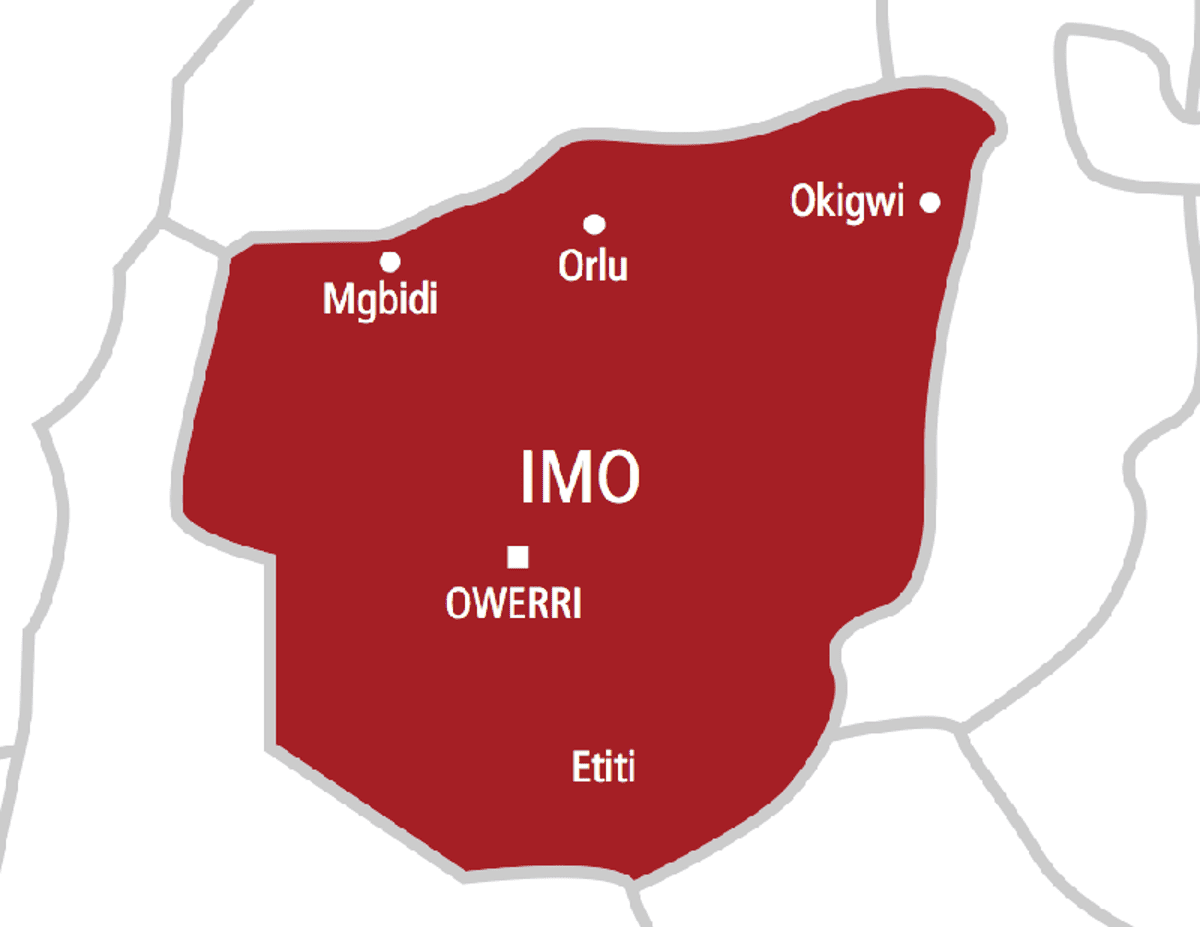
Palpable tension engulfed the residents of Nkwogwu community, Aboh Mbaise Local Government Area of Imo State following the killing of an elderly man, Pa Albert Nwanchukwu, believed to be a police informant.
The assailants, numbering about eight, who reportedly stormed the home of the late Nwanchukwu at about 10pm on Tuesday, 22 April, 2025, were said to have met him where he was relaxing in his compound and immediately opened fire on him.
According to our source who pleaded anonymity, before his assassination, the late Nwanchukwu, had reportedly went to a police station in the locality to inform them of the activities of the gunmen, just as he pleaded to the police to get them arrested.
Our source disclosed that the late Nwanchukwu never knew that some policemen are accomplished in the act, adding that the policemen no doubt informed the gunmen who in anger came and killed him.
READ ALSO: Again Unknown Gunmen Kill One In Imo, Set Govt Vehicle Ablaze
Our source narrated: “They were about eight in number. They came with different weapons – guns, machetes. They were all masked except their leader.
“It was late but the floodlight from the streetlight was bright. They drove dangerously and went straight to Mr Albert Uwandu Nwachukwu house. The man was relaxing in the front of his house. Immediately they saw him, they opened fire,” he died on the spot”, an eyewitness who saw the entire scene from the balcony of his house recounts.
Our source added: “Further investigations proved that the spy had informed this notorious gang of late Pa Nwachukwu’s visit to the police, thereby leading to the attack on his household.”
After killing the man, the gang reportedly went inside the house searching for other family members.
READ ALSO: One Killed As Unknown Gunmen Attack Hotel, Set Vehicles Ablaze In Ebonyi
While it was evident that the gang intended to eviscerate the entire members of the family, three of his children – Victor Onyedikachi Nwachukwu, Promise Rita Nwachukwu Yakubu and Blessing Nzebechi Nwachukwu escaped.
“I saw the three of them. They ran through the back door. Since that time, we have not seen them again”, the same eye-witness disclosed to our correspondent.
This particular incident has thrown the entire community and Aboh Mbaise Local Government in general, into mourning.
While some questioned the safety of police informants, other believed the incident shows the rot in the police force of the country.
Expressing his disappointment in the police, the chairman of Aboh Mabise LGA; Honourable Barrister Iheukwumere Henry Alaribe vowed a major crackdown on the unknown gunmen.
The Commissioner of Police, Imo State Command, CP Aboki Danjuma promised a total clampdown and return of sanity to the community.
Latest news
Protect Oil Palm Host Communities; Address Spate Of Kidnapping, Violence, Govt Told

By Joseph Ebi Kanjo
A non-profit organization – African Law Foundation (AFRILAW), has appealed to the government at levels to ensure the protection of oil palm host communities and address the spate of kidnapping and violence in such areas.
AFRILAW further urged the governments to ensure that communities’ rights and privileges are respected in land deals with oil palm companies to avoid human rights violations.
Okereke Chinwike Esq,
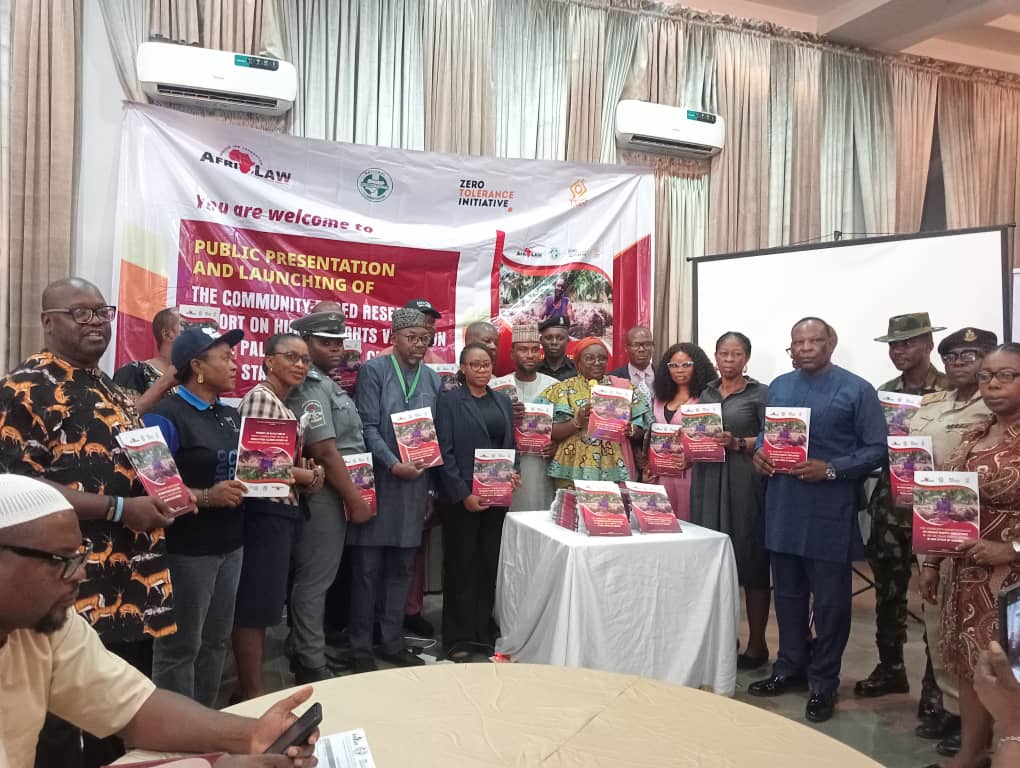
Founder and Chief Executive Officer, AFRILAW, made the appeal in Benin on Tuesday at the Public Presentation and launching of ‘The Community-based Report on Human Rights Violations in the Palm Oil Supply Chain in Edo State.’
INFO DAILY reports that the event is part of AFRILAW activities under the “Promoting Human Rights in Palm Oil Supply Chain in Nigeria Project,” being implemented by AFRILAW in partnership with Zero Tolerance Initiative (ZTI) and the National Human Rights Commission (NHRC) with funding support from True Cost Initiative (TCI) USA.
READ ALSO: SERAP To Court: Stop CBN From ‘Implementing ‘Unlawful, Unjust ATM Fee Hike’
According to the AFRILAW founder, addressing companies’ human rights violations from their operations in host communities require evidence-based research, hence the research and report presentation.
“The Report we are presenting today documents evidence of community rights violations by major oil palm companies operating in the state. The research is informed by the increasing spate of violence and community protests against the operations of oil palm companies operating in Edo state, and provides greater understanding of the prevailing cases of community and human rights violations and nature of conflicts,” he noted.
He, therefore, urged the government to
“put in place a mandatory binding CSR laws and guidelines for companies to ensure that community rights and privileges are protected.”
He further appealed to the government to “ensure effective implementation of the National Action Plan on Business and Human Rights and set forth clear expectations for business enterprises regarding the importance of respecting the rights of human rights defenders, indigenous people and communities in Nigeria.”
READ ALSO: Woman Who Accused Jay-Z, Diddy Of Rape Drops Lawsuit
On his part, Executive Secretary, National Human Rights Commission, Anthony Ojukwu (SAN), described the report as essential, stressing that beyond normal advocacy, research-based advocacy is more efficient and effective.
Represented by Mrs Mary Okoh, Deputy Director, Legal/Focal Point Business and Human Rights, NHRC, Ojukwu said beyond Corporate Social Responsibility (CSR) organization should take seriously major issues of mainstreaming human rights into their operations.
“That means anyone who wants to set up a business must put into consideration the needs of the people and not what the organization or company needs. We have found out that this is where human rights violations start.
“Let them be part of the discussion and planning in the setting up of the business. Let them know what is at stake for them,” he said.
Goodwill messages were delivered by government agencies and ministries, while the presentation and launching also attracted security agencies including the Nigeria Police Force, the Nigerian Army, the Nigerian Customs Service, and the Nigeria Immigration Service among others.
-

 Politics5 days ago
2027: Tinubu’s Re-election May Put An End To Nigeria — Baba Ahmed Warns
-

 Business4 days ago
JUST IN: Nigerian Filling Stations Reduce Fuel Price After Hike
-

 News2 days ago
BREAKING: Wike Picks Alabo George For Rivers Governorship
-

 Politics2 days ago
JUST IN: Why I left ADC For NDC With Kwankwaso – Peter Obi Opens Up
-

 Politics4 days ago
NDC Speaks On Peter Obi, Kwankwaso Joining Party
-

 News5 days ago
2027: Pastor Adeboye Speaks On Nigeria’s Next President
-

 News4 days ago
OPINION: Why South Africans Murder Nigerians In Cold Blood
-

 Business2 days ago
Why We Sited Our Multi-Billion Naira Automobile Firm Branch in Benin – Skyewise Group CEO
-

 Entertainment4 days ago
Again, Tragedy Hits Nollywood As Another Actress Dies
-
Politics3 days ago
Peter Obi, Kwankwaso Formally Join NDC, Warn Members Against Litigation


