

News
FG Lists Two Presidential Jet For Sale In Switzerland

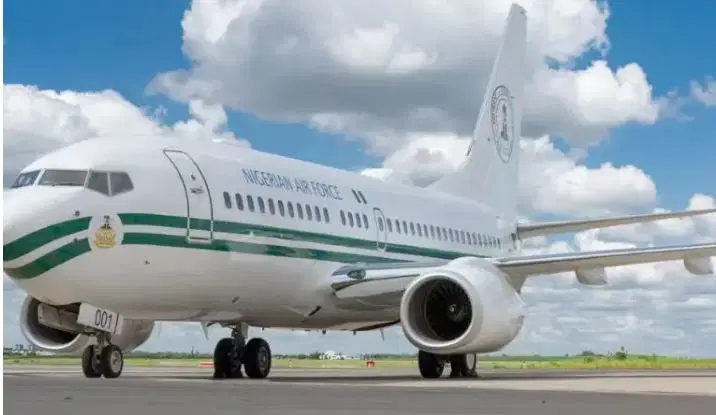


The Federal Government has place on sale about two-decade-old Boeing 737‑700 Business Jet (BBJ) with the listing hosted by AMAC Aerospace in Basel, Switzerland.
The Presidency source said with over 19 years in service, the BBJ has become increasingly expensive to maintain and subject to safety scrutiny, particularly after a mechanical incident during an official trip to Saudi Arabia in April 2024.
This disclosure for the sale of the Boeing 737‑700 Business Jet (BBJ) was made via a US-based aircraft listing site, The Controller: https://www.controller.com/listing/for-sale/244434099/2005-boeing-bbj-jet-aircraft
The aircraft, used during the administration of former President Olusegun Obasanjo, and acquired for $43m in 2005, is being sold months after President Bola Tinubu transitioned to a refurbished Airbus A330-200 last August amid economic concerns and public scrutiny.
The plane had undergone inspections and maintenance in preparation for sale, according to aviation marketplace Controller.com.
Nigeria’s presidential air fleet, overseen by the Nigerian Air Force and the Office of the National Security Adviser, has about 10 aircraft.
These include fixed wings such as a 13-year-old Gulfstream Aerospace G550, Gulfstream G500, two Falcon 7Xs, a Hawker 4000, and a Challenger 605.
Three of the seven fixed wings are reportedly unserviceable.
READ ALSO:Nigeria Becoming Land Flowing With Tears And Blood — Anglican Bishop Of Warri Laments
The rotor-wing fleet includes two Agusta 139s and two Agusta 101s, all operated by the Nigerian Air Force but supervised by the Office of the National Security Adviser.
Both the Muhammadu Buhari and Tinubu administrations had earlier pledged to streamline the PAF for cost-efficiency.
Until August 2024, the BBJ-737 with tail number 5N-FGT, ferried the President until the administration acquired the refurbished Airbus A330-200, registered 5N‑FGA.
The aircraft, acquired for roughly $100 million (approx. ₦150bn) from a repossessed German bank asset, arrived in France for initial maintenance and reconfiguration in mid-2024.
However, since February 2025, the President has been using a San Marino-registered BBJ (REG: T7-NAS).
Sources in early May 2025 confirmed that the new A330-200 had been flown to South Africa to change its livery to reflect the Nigerian colours and the office of the President.
“The last I heard is that they took it abroad, I think to South Africa, to change the body design. You know it doesn’t have the green white green,” one source had said, asking to remain anonymous.
READ ALSO:2027: Peter Obi Speaks On Running For President, Deal With Atiku
“It’s not only the body paint. I learned they are doing some refurbishment on it,” a second official stated.
The Swiss private aviation firm which facilitated the acquisition of the Airbus A330, it was gathered is also preparing the BBJ-737 for sale.
With over 19 years in service, the Presidency said the BBJ became increasingly expensive to maintain and subject to safety scrutiny, particularly after a mechanical incident during an official trip to Saudi Arabia in April 2024.
Despite a partial refurbishment in July 2024, including upgrades to its first-class seating, new carpeting, and completion of C1-C2 inspections, the presidency is retiring the jet and listing it for sale.
Also, the aircraft is not enrolled in any engine maintenance programme, while both of its CFM56-7BE engines remain “on condition” that is, they are not subject to guaranteed performance coverage.
According to the listing, interested buyers may contact AMAC Aerospace for the asking price privately.
Configured to carry 33 passengers and 8 crew, the listing said the aircraft offers a 5-zone seating layout.
Zone 1 is dedicated to crew rest, including two crew rest seats and two cabin attendant seats. Zone 2 features a VIP stateroom equipped with a bed, a two-place divan, and a private lavatory. Zone 3 includes a VIP lounge configured as a four-seat conference room.
READ ALSO:Tragedy As Navy Boat Capsizes After Free Medical Outreach In Delta
In Zone 4, passengers will find nine forward-facing first-class seats. Finally, Zone 5 offers eighteen forward-facing business-class seats.
The aircraft underwent a partial interior refurbishment in July 2024, including new carpeting through 90 per cent of the cabin and a full refurbishment of the first-class seating area.
Full-service galleys are located both forward and aft, featuring a steam oven, microwave, chilled compartments, storage areas, and warming drawers.
Other features include four enclosed lavatories—one for crew use, one within the VIP stateroom, one serving the first-class cabin, and another in the business-class section.
Connectivity is provided via Ka-Band Wi-Fi powered by the Honeywell MCS-7000 system.
Entertainment options include a 32-inch monitor in the master bedroom, another in the VIP lounge, one more in the first-class cabin, and two 21-inch monitors in the business-class cabin.
READ ALSO:FG To Spend N17bn On Lagos Bridge Damaged By Fire
The BBJ is equipped with cutting-edge avionics systems. It includes three VHF communication radios by Gables Engineering, two VHF navigation radios by Rockwell Collins, and two HF transceivers. Safety and situational awareness are enhanced by an L3 Comms DFDR, a CVR, and Honeywell’s EGPWS.
The aircraft is fitted with two ATC transponders, a pair of DME units, and Rockwell Collins radio altimeters.
Additional avionics include three Thales ADC/ADM units, two Honeywell ADIRUs, and Rockwell Collins weather radar and TCAS systems.
Emergency equipment includes an Artex ELT with interface unit. The flight control and guidance systems comprise two Rockwell Collins FCCs, a Flight Dynamics HGS computer, and two Smith Industries FMS units.
Navigation aids include two ADFs and two Rockwell Collins MMR(GLU) units. Cabin pressurisation is managed by two Nord-Micro CPCs.
The aircraft also carries integrated flight and engine monitoring systems, with components by BAE Systems, Hamilton Sundstrand, Oeco, Honeywell, Teledyne Controls, Vibro-Meter, and Avtech.
Controller.com says the aircraft is fully compliant with ADS-B, CPDLC, FANS-1/A, and RVSM requirements.
READ ALSO:Coalition: Why Tinubu Must Not Sleep —Primate Ayodele
The Boeing BBJ is powered by two CFM56-7BE engines, each with 3,821 hours since new and 1,881 cycles.
The engines are on-condition and not enrolled in a maintenance programme.
The auxiliary power unit, a Honeywell 131-9B, has logged 5,982 hours and 3,622 cycles.
It says the aircraft is capable of intercontinental range, thanks to eight auxiliary fuel tanks that boost total capacity to 70,000 pounds.
This includes standard tanks of 45,000 pounds, plus auxiliary tanks split between the left wing (8,500 lbs), right wing (8,500 lbs), center (28,000 lbs), forward aux (10,000 lbs), and aft aux (15,000 lbs).
Currently, the BBJ is undergoing B1-B2 inspections at AMAC Aerospace in Basel.
The C1-C2 inspections were completed in July 2024. Maintenance is tracked using the Veyron system.
On the outside, the aircraft retains its original 2005 exterior paint scheme, featuring a white base accented with green highlights to portray the Nigerian colours.
(VANGUARD)




News
Transfer: Premier League Clubs Scramble For Dele-Bashiru


Lazio midfielder, Fisayo Dele-Bashiru is a subject of interest from three Premier League clubs, according to Sky Sports.
Lazio reportedly rejected offers from Nottingham Forest and Bournemouth for the Nigeria international in January.
READ ALSO:Film Premiere: Edo In Talks With Embassies To Promote Safe Migration —Agazuma
La Biancolesti are bracing for more interest in Dele-Bashiru ahead of the summer transfer window, according to Sky Sports.
The 24-year-old has two years left on his contract with the Serie A club.
The attacking midfielder joined the Rome-based club from Turkish Super Lig outfit Hatayspor in 2024.
He has been a regular feature for Lazio this season.
News
Xenophobic Attacks: Nigerian Students To Picket MTN, MultiChoice, Other Businesses


The leadership of the National Association of Nigerian Students, NANS South-West Zone D, has announced plans to picket South African companies in Nigeria following the ongoing xenophobic attacks in the country.
DAILY POST reports that some Nigerians were recently killed in South Africa over the violent attacks.
A statement issued to newsmen by Comrade Adeyemo Josiah Kayode, Coordinator, NANS South-West, Zone D, said that the association is mobilizing to take decisive and lawful action by organizing peaceful picketing and mass advocacy against South African business interests operating in Nigeria.
READ ALSO:Xenophobic Attacks: Oshiomhole Tells FG To Retaliate Against South African Companies In Nigeria
“We categorically state that the continued targeting of Nigerians under any guise is unacceptable and must come to an immediate end.
“This will include major corporations such as MTN Group and MultiChoice Group. It is morally indefensible for businesses to thrive in an environment where the lives of Nigerians are protected, while Nigerians are subjected to fear and violence elsewhere.
“This contradiction will no longer be tolerated,” the statement said.
News
N5m, N10m Zero-interest Loans: SheVentures Opens Applications For Women Entrepreneurs


First City Monument Bank (FCMB) has opened a new round of applications for its SheVentures proposition, offering zero-interest loans of up to ₦10 million to women entrepreneurs to ease access to working capital and support business growth.
The facility provides loans ranging from ₦500,000 to ₦5 million under a general category, and ₦5 million to ₦10 million for sector-specific businesses, with funding capped at up to 50% of an applicant’s average monthly turnover.
At the centre of the offering is a 0% interest rate, with all charges embedded in a transparent structure.
Repayment is structured over four or six months, allowing businesses to match obligations with their cash flow cycles.
READ ALSO:I’ve Been Blacklisted In Music Industry For 13 Years – Seun Kuti
Yemisi Edun, Managing Director and Chief Executive of First City Monument Bank (FCMB), said the initiative reflects a deliberate approach to inclusive growth.
“Inclusive growth requires access to capital and the right conditions for businesses to deploy that capital effectively.
“Women-led enterprises are critical to economic activity, yet they face structural barriers.
This intervention aims to help close that gap by providing financing that supports job creation, business expansion, and long-term sustainability for women entrepreneurs.”
“Access to affordable finance remains a major constraint for women entrepreneurs,” said Nnenna Jacob-Ogogo, Group Head, SheVentures and Impact Segments at First City Monument Bank (FCMB).
READ ALSO:My Beef With Wizkid Is For Life – Seun Kuti
“By removing the cost barrier and offering quick, flexible funding, this zero-interest loan is designed to safeguard existing jobs, enable businesses to invest in growth initiatives, and foster resilience in challenging economic conditions.”
Women-owned businesses account for a significant share of Nigeria’s small and medium-sized enterprises but continue to face high borrowing costs and limited access to credit.
Through these efforts, SheVentures tackles persistent financing gaps facing women-led businesses, combining targeted funding with broader support to empower women entrepreneurs, encourage business innovation, and enhance their ability to compete on a national scale.
Applications for the zero-interest loan are now open.Apply now.
-

 Politics4 days ago
2027: Tinubu’s Re-election May Put An End To Nigeria — Baba Ahmed Warns
-

 Business4 days ago
JUST IN: Nigerian Filling Stations Reduce Fuel Price After Hike
-

 Politics5 days ago
BREAKING: 2027: Former Adamawa APC Guber Candidate, Aishatu Binani Defects To NDC
-

 Entertainment5 days ago
Actress Eniola Badmus Gets New Federal Appointment
-

 News4 days ago
2027: Pastor Adeboye Speaks On Nigeria’s Next President
-

 News2 days ago
BREAKING: Wike Picks Alabo George For Rivers Governorship
-

 Politics4 days ago
NDC Speaks On Peter Obi, Kwankwaso Joining Party
-

 News3 days ago
OPINION: Why South Africans Murder Nigerians In Cold Blood
-

 Politics5 days ago
2027: Pondi, Otuaro, Other Delta South Stakeholders, Endorse Senator Joel-Onowakpo For Second Term
-

 Politics2 days ago
JUST IN: Why I left ADC For NDC With Kwankwaso – Peter Obi Opens Up
