

Headline
Forex Crisis: EFCC 7,000-man Task Force Goes After Dollar Racketeers

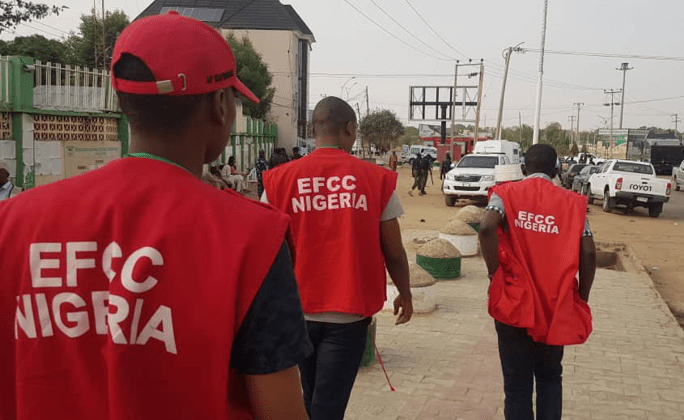


In a move to reduce the pressure on the naira, the Economic and Financial Crimes Commission has raised a 7,000-man special task force across its 14 zonal commands to clamp down on dollar racketeers.
The spokesperson for the anti-graft agency, Dele Oyewale, in a statement on Wednesday in Abuja, said the commission had summoned the proprietors of private universities and other schools charging tuition in dollars.
The naira has been on a free fall against the dollar in the past weeks with the currency losing value against the greenback.
In the past weeks, the naira had plunged from about 900/dollar to over 1,400/dollar at the official market.
The Governor of the Central Bank of Nigeria, Olayemi Cardoso, who appeared before the House of Representatives on Tuesday, disclosed that Nigerians spent $98bn in 10 years on foreign education, healthcare and personal travels, which had impacted the naira.
He spoke against the backdrop of the central bank’s battle to stabilise the exchange rate amid dollar shortage.
Cardoso argued that the foreign exchange market was facing increased demand pressures, causing a continuous decline in the value of the naira.
According to him, factors contributing to this situation include speculative forex demand, inadequate forex due to low remittance of crude oil earnings to the CBN, increased capital outflows, and excess liquidity from fiscal activities.
To address exchange rate volatility, he said a comprehensive strategy had been initiated to enhance liquidity in the forex market.
This includes unifying FX market segments, clearing outstanding FX obligations, introducing new operational mechanisms for Bureau De Change operators, enforcing the Net Open Position limit for commercial banks, and adjusting the remunerable Standing Deposit Facility cap.
Cardoso revealed that between 200 and 2020, foreign education expenses amounted to a substantial $28.65bn, as per the CBN’S publicly available Balance of Payments Statistics.
Similarly, medical treatment abroad incurred around $11.01bn in costs during the same period. Within the same period, Personal Travel Allowances accounted for a total of $58.7bn.
READ ALSO: Auction Excess Dollars In Former Governors’ Accounts – Fayose’s Brother Tells Tinubu [Video]
Cumulatively, Nigerians spent about $98bn on foreign trips, medical tourism and overseas education, a figure the CBN governor said was more than the total foreign exchange reserves of the central bank.
Further compounding the situation, according to Cardoso, has been the consistent decline in Nigeria’s export earnings against the backdrop of increasing imports.
In contextualising the problem, Cardoso pointed out that Nigeria’s annual imports, which require dollars for payment, amounted to $16.65bn in 1980.
Worried by the development, the Finance Minister and Coordinating Minister for the Economy, Wale Edun, had last Friday met with the CBN Governor and the EFCC Chairman, Ola Olukoyede, to proffer solutions to the naira crisis.
The meeting, according to a statement signed by the Federal Ministry of Finance, was to strategise on stabilising the beleaguered currency.
“This afternoon at Finance HQ, HM Finance & Coordinating Minister for the Economy, Wale Edun, EFCC Chairman Ola Olukoyede and CBN Governor Olayemi Cardoso, engaged in a strategic discussion focused on enhancing the efficiency of our financial system and stabilising the naira,’’ the finance ministry posted on its X handle.
To strengthen the national currency and stabilise the nation’s volatile exchange rate, the CBN directed Deposit Money Banks to sell their excess dollar stock latest February 1, 2024.
The CBN, which made the disclosure in a new circular released last week Wednesday, also warned lenders against hoarding excess foreign currencies for profit.
According to officials, the central bank believes some commercial banks hold long-term foreign exchange positions to enable them to profit from the volatile movements of exchange rates.
The new circular introduces a set of guidelines aimed at reducing the risks associated with these practices.
In continuation of the targeted measures, the EFCC revealed it had set up a special task force to enforce the extant laws against currency mutilation and dollarisation of the economy.
It explained that it arrested some perpetrators issuing invoices in dollars and mutilating the naira in Lagos and Rivers States.
READ ALSO: Why FG Chose N800/Dollar Exchange Rate For 2024 Budget – Minister
Zonal commands
Oyewale said, “The EFCC has raised a special task force in all its zonal commands for the enforcement of extant laws against currency mutilation and dollarization of the economy.
“The taskforce, inaugurated by the Executive Chairman of the commission, Ola Olukoyede, was raised to protect the economy from abuses, leakages and distortions exposing it to instability and disruption
“Already, the commission has made some arrests of perpetrators of issuance of invoices in dollars and mutilation of the naira in Lagos and Port Harcourt.
“Also, proprietors of private universities and other institutions of higher learning charging fees in dollars have been invited by the Commission.
“The commission is committed to the enforcement of all laws in place for the reflation and stimulation of the economy.”
The CBN Act, 2007, stipulates that the currency notes issued by the CBN “shall be the legal tender for the payment of any amount in Nigeria.”
Furthermore, the Act stipulates that any person(s) who contravenes this provision is guilty of an offence and shall be liable on conviction to a prescribed fine or six months imprisonment.
Meanwhile, The PUNCH findings show the EFCC special task force is operating in all its 14 commands with over 7,000 operatives or about 500 operatives in each command.
The zonal commands are Abuja, Benin, Enugu, Gombe, Ibadan, Ilorin, Kaduna, Kano, Lagos, Maiduguri, Makurdi, Port Harcourt, Sokoto and Uyo.
A source, who was not authorised to speak on the issue, revealed that all private universities and other tertiary institutions charging dollars and other foreign currencies in place of naira had been invited by the EFCC for a briefing, and sensitised on the fact that only the naira is a legal tender in Nigeria.
A second source, who declined to be named for confidential reasons, said the school proprietors would not be arrested by the EFCC unless they continued to violate the law by accepting foreign currency.
He stated, “The Special Task Force is operating in all our 14 commands, and we have about 500 operatives in each command’s task force; that equals over 7,000 operatives overall.
READ ALSO: Naira Depreciates Against Dollar, Loses N81
“We invited, quizzed, and sensitised all the proprietors of all private universities and other tertiary institutions charging dollars and other foreign currencies in place of naira.
“The aim of the sensitisation was for them to know about extant laws making only naira and kobo legal tenders in Nigeria, as opposed to dollar, pounds, or other foreign currency.
“However, none of the proprietors would be steered or prosecuted for now, unless they go ahead to keep charging in dollars or other foreign currencies.”
Foreign airlines
However, the President of the Association of Foreign Airlines and Representatives in Nigeria, Dr Kingsley Nwokoma, said there was no cause for alarm, adding that the EFCC’s action would not affect his members.
But he asked banks to repatriate the trapped funds from tickets sold in naira.
Meanwhile, reacting to the development, the Director-General of the Nigeria Employers’ Consultative Association, Mr. Wale Oyerinde, said, “From what we’ve heard as contained in the CBN Act, dollarisation is an economic offence, so they are on point. It is not whether it will salvage the economy or not. Salvaging the economy requires a multifaceted approach and efforts.”
Also speaking, a facilitator with the Nigerian Economic Summit Group, Dr. Ikenna Nwaosu, said, “The answer first would be that a doctor heal yourself. Many government agencies are still charging in foreign currency. If you look at the Nigerian Ports Authority, the Nigerian Maritime Administration and Safety Agency, most of their fees are in dollars for all their services. They issue invoices in dollars. So when your own government agencies have not stopped why are you telling individuals not to charge in dollars. So I can’t say whether it would work or not because they government is not complaint. If you want to do uniform let it get to everywhere. I want to add that if you are saying that you are promoting investment in the country, you have to lead by example.”
Also, the President, Association of Bureau De Change, Aminu Gwadabe, said it was illegal for businesses or individuals in Nigeria to demand payment in forex.
He noted that allowing such would further weaken the embattled naira.
“It is illegal to ask for payment of whatever sort in foreign currency here in Nigeria. The CBN already issued a circular to this effect. Allowing institutions to receive payment in dollars will further cause more damage to the naira which is already depreciating,” he said.
Recently, some schools have reportedly requested for tuition fees in forex. An example of such is Wigwe University, a private university reportedly owned by Group Managing Director, Access Holdings Plc, Mr. Herbert Wigwe
According to document published on its website (https://www.wigweuniversity.edu.ng/tuitionfess/) Wigwe University‘s 2024/2025 College of Arts students are expected to pay $12,000 annually as tuition fee; College of Engineering, $15,000; College of Management and Social Sciences, $15,000; and College of Science and Computing, $15,000.
SOURCE: PUNCH




Headline
FG Summons S. African Envoy Over Rising Xenophobic Attacks On Nigerians

The Federal Government has summoned the Acting High Commissioner of South Africa in Abuja over renewed concerns about xenophobic attacks and protests targeting foreign nationals, including Nigerians, living in that country.
The Ministry of Foreign Affairs said the envoy is expected at its headquarters on Monday, May 4, 2026, for a high-level engagement aimed at addressing the growing tension and safeguarding bilateral relations between both countries.
In a statement issued on Sunday, the spokesperson for the Ministry, Kimiebi Ebienfa, said Nigeria would formally express its “profound concern” over recent developments in South Africa, particularly reports of harassment, violence, and destruction of property belonging to foreign nationals.
According to the ministry, the meeting will focus on ongoing demonstrations by various groups in South Africa and documented cases of attacks on Nigerians and their businesses in parts of the country.
READ ALSO:Group Condemns Tunisian Xenophobic, Racial Attacks On African Migrants
“The objective of this engagement is to formally convey the Nigerian Government’s profound concern regarding recent events that have the potential to impact the established cordial relations between Nigeria and South Africa,” the statement read.
It added that discussions would also address ongoing demonstrations by various groups within South Africa and documented instances of mistreatment of Nigerian citizens and attacks on their businesses.
The ministry acknowledged growing anger among Nigerians over reports of xenophobic violence but urged restraint, stressing that diplomatic engagement remained the preferred channel for resolution.
It assured Nigerians that the Federal Government was actively engaging South African authorities to ensure the protection of its citizens abroad.
READ ALSO:US Visa Adjudication Sparks Concerns Over Diplomatic Relations
“The Ministry is aware of the growing discontent among Nigerians concerning the treatment of their nationals in South Africa. Nevertheless, it implores the Nigerian public to remain calm and reiterates the Federal Government’s commitment to protecting the rights and well-being of Nigerian citizens residing in South Africa,” the statement added.
The latest diplomatic move comes amid renewed reports of xenophobic tensions in parts of South Africa, where foreign-owned businesses have occasionally been targeted during protests linked to unemployment and economic hardship.
South Africa has a history of xenophobic violence dating back to 2008, with subsequent flare-ups in 2015 and 2019, when mobs attacked migrants, looted shops, and displaced thousands of foreign nationals across several provinces.
In past incidents, Nigerians and other African nationals were among those affected, prompting strong diplomatic reactions from Abuja and calls for stronger protection of foreign communities.
While South African authorities have repeatedly condemned such attacks and deployed security forces to restore order during outbreaks of violence, concerns have persisted over recurring hostility in some communities.
Headline
Mississippi Man ‘Kills Mother, Flushes Her Remains Down Toilet’


A 29-year-old Mississippi man, Zachary Lavel Jackson Jr., has been charged with multiple offences, including first-degree murder, over the death of his mother, Lana Brown Bradley, after deputies responded to her Natchez home on April 4 following a missing person report from relatives.
The Adams County Sheriff’s Office said deputies were called to Bradley’s residence after her oldest son was unable to reach her the previous day.
Jackson was initially identified as a family member before investigators confirmed he was her son.
Sheriff Travis Patten described the case as deeply disturbing.“This is by far the most heinous crime that I’ve ever witnessed in my entire life. We weren’t out there that day; this was one of those things when we walked up.
READ ALSO:Bandits Kill Nine, Injure Eight In Fresh Attack On Zamfara Village
“This was one of those cases that you will never, ever forget in your life. This is the type of case that follows you home,” Patten told WJTV.
According to the sheriff, deputies noticed signs of a recent cleanup when they arrived at the home.
“As soon as they walked in the house, they could just see where somebody had been cleaning up, and they could smell chemicals all throughout the house.
“Floor was extremely slippery. And the older son said that this is just unusual for the youngest son to be cleaning up the house like that,” Patten explained.
READ ALSO:US Comedian Reggie Carroll Shot Dead In Mississippi
Jackson, the youngest son, was found in a bathroom, where deputies allegedly made a discovery that became central to the investigation.
“I can say what was in the toilet, and it was her flesh. He chopped her up in pieces and dismembered her in a way that whoever came looking for her would have to do their due diligence to find her, and that’s just what we did,” the sheriff said.
Authorities said Jackson allegedly placed parts of his mother’s body in a suitcase and attempted to dispose of other remains.
Jackson faces charges of first-degree murder, second-degree murder, mayhem and tampering with evidence.
READ ALSO:Popular Influencer Lola Shot
Investigators said Bradley, a retired teacher, had recently sought to evict her son from the home. Patten, citing family interviews, said Jackson was believed to be mentally unstable but also noted that his actions appeared deliberate.
“He had threatened her the day before because she was looking to have him evicted from the home.
“She was in the process of doing so and had just gone to court the day before to have him removed from the home,” Patten explained.
Headline
Iran Says War With US May Resume As Trump Rejects Proposal

Iran’s military has warned that the war with the United States and Israel could resume, declaring that it is fully prepared for any renewed confrontation as tensions between the sides continue to deepen.
In a statement reported by Iranian state-affiliated media, senior military officials said a return to hostilities is “likely”, citing what they described as Washington’s lack of commitment to previous agreements and negotiations.
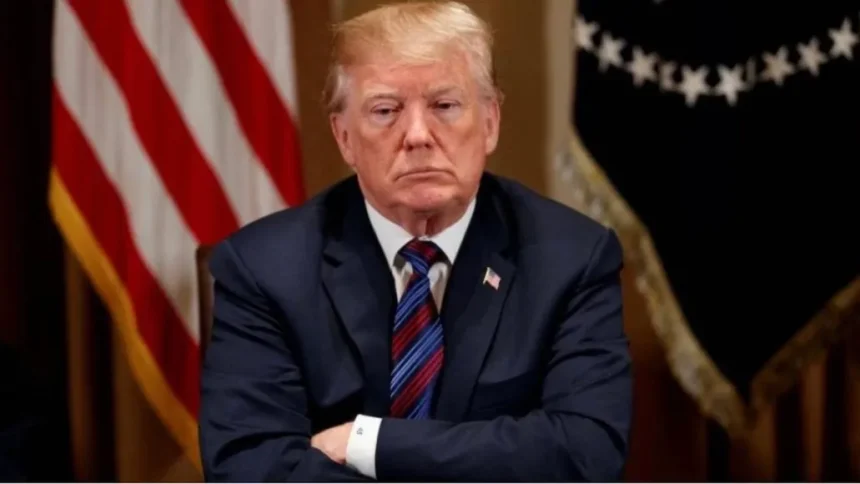
The warning comes after US President Donald Trump expressed dissatisfaction with Iran’s latest peace proposal, saying the terms presented by Tehran included demands he “can’t agree to”.
READ ALSO:US Underestimated Iran Before War – France’s Bardella
According to officials in Tehran, Iran believes it showed flexibility during earlier negotiations, including talks held in Islamabad and during the ceasefire period. However, authorities argue that the United States has instead taken a tougher stance, widening the gap between both sides.
Iranian officials insist that key issues such as sanctions relief and the status of the Strait of Hormuz must be resolved before any broader agreement, including discussions around its nuclear programme, can progress. They also reject what they describe as US demands amounting to “surrender”.
The growing diplomatic deadlock has raised fears that another round of fighting may be imminent, with Iranian authorities indicating that preparations are already underway.
READ ALSO:Iran Allows 20 More Pakistani Ships To Pass Through Strait Of Hormuz
Meanwhile, the prolonged conflict continues to have far-reaching consequences within Iran. Internet monitoring group NetBlocks reports that the country has entered its 64th day of near-total internet disruption, effectively isolating it from global online networks.
The shutdown, which began after renewed anti-government protests earlier in the year and intensified following the outbreak of the war, has significantly disrupted businesses and livelihoods across the country.
Beyond Iran, the conflict is also reshaping global dynamics. Rising oil prices linked to the war have placed pressure on international markets, while geopolitical tensions have strained alliances, including between the United States and European partners.
As both sides remain far apart on key issues, analysts warn that without a breakthrough in negotiations, the fragile pause in fighting could collapse, paving the way for renewed military escalation in the region.
-

 Politics4 days ago
2027: Tinubu’s Re-election May Put An End To Nigeria — Baba Ahmed Warns
-

 Metro5 days ago
I’m A Street Girl’ – Bimbo Ademoye Clashes With Area Boys [VIDEO]
-

 Politics5 days ago
BREAKING: 2027: Former Adamawa APC Guber Candidate, Aishatu Binani Defects To NDC
-

 Politics5 days ago
Senatorial Seat: Ogbakha-Edo Warns Against Imposition Of Candidates In Edo South
-

 Business3 days ago
JUST IN: Nigerian Filling Stations Reduce Fuel Price After Hike
-

 Entertainment4 days ago
Actress Eniola Badmus Gets New Federal Appointment
-

 News5 days ago
10 African Countries With Highest Petrol Prices In Prices In April 2026
-

 News2 days ago
BREAKING: Wike Picks Alabo George For Rivers Governorship
-

 News3 days ago
OPINION: Why South Africans Murder Nigerians In Cold Blood
-

 News4 days ago
2027: Pastor Adeboye Speaks On Nigeria’s Next President
