
Headline
Ghana, Guinea, Nigeria Top Cyber Threat Incidents In West Africa – Report

Ghana has led the West African region in both the frequency and diversity of cyber threats for the first half of 2024, facing a high volume of distributed denial of service attacks directed at industries, including computer services and telecommunications, says NETSCOUT’s 1H2024 Distributed Denial of Service Threat Intelligence Report released on the company’s website on Tuesday.
According to the report, Ghana has experienced the highest volume of cyber attacks in West Africa, with the maximum bandwidth of its largest DDoS attack measuring 314.25 Mbps, a total of 4,753 attacks over six months, out of which 2,759 were targeted at computer-related services businesses; while the Republic of Guinea follows with 2,918 cases, with Nigeria coming third place with 2,721 cases of cyber threats.
The report partly read, “Ghana experienced by far the highest volume attack in West Africa, with the maximum bandwidth of its largest DDoS attack measuring 314.25 Mbps. Known for an economic resilience that is driven by agriculture and mining, Guinea surprisingly took the second spot in the NETSCOUT results for West Africa in terms of attack frequency, with 2,918 incidents listed. Wireless telecommunications carriers bore the brunt of these strikes, which were mostly TCP-type attacks.
“Nigeria, a major digital hub in Africa, experienced the third highest volume of cyberattacks in West Africa, coming in at 2,721 for the first half of 2024. Attacks in the computer-related services field were prevalent, as in Ghana, with 867 incidents, but local beauty salons were second on the list for Nigeria, enduring 206 incidents, followed by data processing hosting companies at 116.
READ ALSO: BREAKING: Equatorial Guinea Restricts WhatsApp Amid Sex Scandal
“The growing complexity of DDoS threats seen worldwide, including a notable increase in both attack frequency and sophistication, is reflected in Nigeria. The country experienced more complex attacks than others within the region, with 23 different attacks vendors seen in one single attack, from TCP and CLDAP (Connection-less Lightweight Directory Access Protocol) attacks to Domain Name System (DNS) amplification and many more”, states Bryan Hamman, regional director for Africa at NETSCOUT.
“Côte d’Ivoire and Liberia both faced similar attack frequencies, with 1,598 and 1,515 incidents noted respectively. The two countries also experienced similarities in the types of attack vectors used – mostly TCP-related – as well as the sector that was hardest hit, which was wireless telecommunications for both.”
The report stressed that wireless telecommunications carriers were identified as the prime targets for threat actors in the Republic of Benin, recording 196 incidents, 107 in Senegal, 32 in Mali, and 16 in Cameroon.
The Regional Director for Africa at NETSCOUT, Bryan Hamman, noted the report “Is in line with NETSCOUT’s Global Threat Intelligence Report figures, which measured attacks on the sector at 834,471 for the first part of 2024, a substantial 34% increase on the figures seen for 2H 2023, which was calculated at 622,295. We believe this points to an objective by cybercriminals to disrupt critical communication infrastructure.”
READ ALSO: JUST IN: Queen Camilla Suspends Public Engagements Due To Chest Infection
Interestingly, although Cameroon fell more within the middle of the pack in terms of attack frequency, at 544, its largest DDoS attack reached 118.05 Gbps in bandwidth, much higher than the statistics seen for Senegal (27.31 Gbps) for instance, Guinea (12.35 Gbps) or Mali (0.81 Gbps).
He added, “In some cases, as seen by Cameroon and Ghana as well as Nigeria (134.86 Gbps), attack volumes can reach more than 100 Gbps, requiring upstream providers to mitigate the attack. Although many smaller attacks, such as those around 1Gbps, often bypass detection and mitigation by upstream providers due to being below-configured thresholds, they can still have a severe impact on enterprises.
“Statistics from NETSCOUT’s latest report show that generally, countries within West Africa have not been as heavily targeted as the likes of Morocco in the north of the continent, or South Africa in the SADC region. The latter falls within the top five most targeted countries within the entire Europe, Middle East and Africa (EMEA) region.
“This being said, we are certainly seeing variabilities in attack types and targets across West Africa, reinforcing the need for country-specific cyber defences and resilient strategies to protect these growing digital economies. While the West African threat landscape cybersecurity challenges may align in many areas with worldwide trends, the nuances in each country’s threat landscape highlight the importance of localised security strategies to protect both critical and emerging digital infrastructures.
“NETSCOUT’s Threat Intelligence Report provides essential insights to help West African organisations bolster their cybersecurity defences. By leveraging these findings, businesses across the region can effectively mitigate these evolving threats and secure their digital ecosystems.”



Headline
Woman Passes Out After Receiving 100 Strokes Of Cane
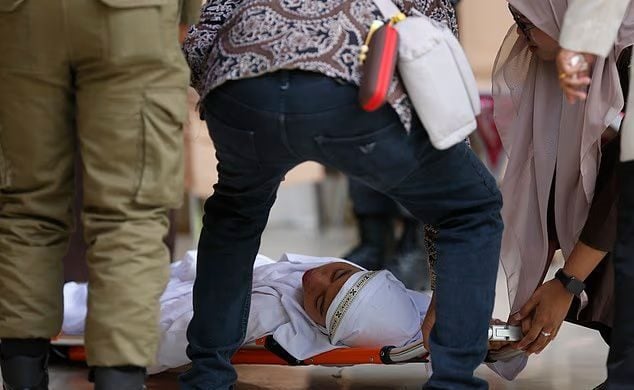
A woman has passed out after she and her partner were each flogged 100 times in public for engaging in sex outside marriage under strict Sharia laws in Indonesia’s Aceh province.
The woman, whose identity was not disclosed, was later carried away after the punishment was carried out in Banda Aceh, located at the northern tip of Sumatra island on Thursday.
A masked official dressed in brown robes administered the caning before members of the public who gathered to witness the punishment.
Her partner was also seen wincing in pain while receiving the lashes.
READ ALSO:Ex-INEC REC Reveals 2026 Electoral Act Provisions That Could Undermine 2027 Election
The pair were among several individuals punished for violating Sharia regulations in the province.
Authorities from the Banda Aceh Sharia Court and the Prosecutor’s Office handed down punishments ranging from 25 to 100 lashes for offences including extramarital sex allegedly arranged through online applications.
Aceh remains the only province in Muslim-majority Indonesia operating under Sharia law, where unmarried couples are prohibited from having sexual relations.
Caning is commonly used in the province as punishment for offences such as gambling, alcohol consumption, same-sex relations and sex outside marriage.
READ ALSO:UN Facing ‘Imminent Financial Collapse’ — Secretary General Lamenets
Under Aceh’s Sharia regulations, child rape offenders face some of the harshest penalties, including up to 200 strokes of the cane, a prison sentence of as long as 200 months or fines equivalent to two kilograms of gold.
The punishments are usually carried out publicly as a way of shaming offenders in addition to inflicting physical pain.
Such canings are often conducted outside mosques or in open public spaces, with residents watching and taking photographs during the exercise.
Human rights organisations have continued to condemn the practice, arguing that it causes emotional trauma and violates international human rights standards.
READ ALSO:18-year-old OAU Medical Student Dies While Sleeping
Amnesty International and Human Rights Watch have repeatedly criticised the punishments, saying they conflict with Indonesia’s constitution and global legal obligations.
Amnesty said in a statement: “Caning contravenes Indonesia’s constitution and is in clear violation of international human rights law and standards.
‘It constitutes a cruel, inhuman and degrading punishment and can amount to torture in violation of the UN Convention against Torture and other international covenants, to which Indonesia is a State Party.’”
Despite the criticism, local authorities have defended the punishments as part of Aceh’s religious and cultural identity, insisting they serve as a deterrent against immoral behaviour.
Earlier in January, another couple in the province reportedly received 140 lashes each after being found guilty of drinking alcohol and engaging in sex outside marriage.
(Daily Mail)
Headline
Senegal’s President Sacks Prime Minister After Months-long Feud

Senegal’s President Bassirou Diomaye Faye has sacked Prime Minister Ousmane Sonko and dissolved the government following months of rising political tension between the two former allies.
The decision was announced in a surprise decree read on national television by a presidential aide, stating that Faye had “ended the duties” of Sonko and “consequently those of the ministers and secretaries of state who are members of the government”.
Sonko, who remains a highly influential figure among Senegal’s youth, responded on social media, saying he would “sleep with a light heart”.
READ ALSO:Senegal Lawmakers To Debate Same-sex Relations Bill
The political fallout comes at a time of growing economic strain in the country, with the International Monetary Fund (IMF) putting Senegal’s public debt at 132% of its GDP.
His removal followed a tense parliamentary session on Tuesday, where Sonko openly criticised President Faye’s handling of the debt situation.
The development is striking given that Faye’s rise to power was largely tied to Sonko’s popularity and political backing.
READ ALSO:French Army To Leave Senegal Amid Africa Downsizing
Sonko would almost certainly have contested the presidency himself in 2024, but was barred from the race due to a defamation conviction. Instead, he threw his support behind Faye, rallying voters with the slogan “Diomaye is Sonko, Sonko is Diomaye”.
The alliance helped unseat former President Macky Sall in a dramatic electoral victory, despite both men having been released from prison only days before the vote.
Tensions between the two leaders had been building for months, with Faye reportedly accusing Sonko of excessive dominance within the ruling Pastef party, while Sonko accused the president of weak leadership and failing to defend him against critics.
(BBC News)
Headline
Six Nigerians Arrested In Thailand Over AI-Powered Romance Scam

Six Nigerian nationals have been arrested by the Thailand Police Force for allegedly operating an AI-powered deepfake romance scam syndicate from a luxury condominium along the Chao Phraya River in Nonthaburi Province, following a cocaine trafficking investigation that exposed their activities.
Thai authorities said the operation began after police arrested a Nigerian suspect identified as Patrick and three associates in April over alleged drug trafficking offences. During the raid, officers reportedly seized assets valued at about 2.5 million baht.
Investigators said financial transactions linked to the suspects led them to several foreign nationals living in a high-end riverside condominium near Phra Nangklao Bridge in Nonthaburi. Police discovered that many of the occupants were staying in groups of five or six per apartment under student visas despite not being enrolled in any educational institution or engaged in lawful employment.
According to Thai police, officers executed search warrants on three condominium units on May 22. The suspects allegedly refused to open their doors, forcing authorities to break into the apartments.
READ ALSO:Libya Journey: Cobbler Arrested For Stealing Motorcycle In Edo
Videos circulating on X captured the moment police officers forcefully gained entry into one of the apartments before arresting the suspects.
During the operation, one suspect reportedly attempted to escape by climbing over a balcony, while another was found hiding on the bathroom floor while allegedly sending warning messages to occupants in neighbouring units.
Police recovered 18 mobile phones, three laptop computers and three bank passbooks from the apartments. Authorities said some of the phones were still logged into active conversations with victims at the time of the raid.
Investigators alleged that the syndicate specialised in romance scams targeting older Thai women by using AI-generated faces and manipulated video calls to create fake online identities.
READ ALSO:Police Inspector Arrested For Armed Robbery Dies From Bullet Wounds
The suspects allegedly posed as pilots, United States military officers, doctors and engineers to gain the trust of victims before requesting money under false pretences.
Police said the fraudsters typically claimed that valuable packages or gifts sent to victims had been withheld by customs officials and required payment of clearance fees before release.
Authorities also said they recovered scripts for sexually explicit conversations allegedly used to emotionally manipulate victims into transferring funds. Investigators claimed the group relied heavily on artificial intelligence technology to generate realistic Western faces for fake video interactions.
Thai police said all six suspects are currently facing preliminary charges bordering on illegal association and immigration overstay, while additional fraud and romance scam charges are expected to follow as investigations continue.

 Metro5 days ago
My Husband Abandoned Me On Our Wedding Night To Attend Political Meeting, I Want Our Marriage Dissolved
- Headline4 days ago
Woman Passes Out After Receiving 100 Strokes Of Cane
- Headline4 days ago
JUST IN: White House Locked Down Briefly As Gunman Opens Fire At Security Checkpoint
- Politics5 days ago
Warri Ijaw Hail INEC Delineation Report, Call For Additional Electoral Wards, Others
- Politics3 days ago
Two Masked Men Gun Down Politician In His Rivers State Hotel
- News3 days ago
More Pain For Nigerians As Cooking Gas Price Increases Nationwide
- News5 days ago
Alleged Terrorism: Court Rejects Defendant’s Bid To Travel Abroad
- Metro5 days ago
My Wife Stop Cooking My Food, Beats Me Black And Blue All the Time, Man Tells Court
- Politics5 days ago
What I’ll Do As President Of Nigeria — Amaechi
- Politics3 days ago
‘Tinubu’s Borrowing In 24 Months Surpasses 55 Years’ Debt Record’


