
News
I Have Successfully Defended My Right To Govern Rivers – Fubara
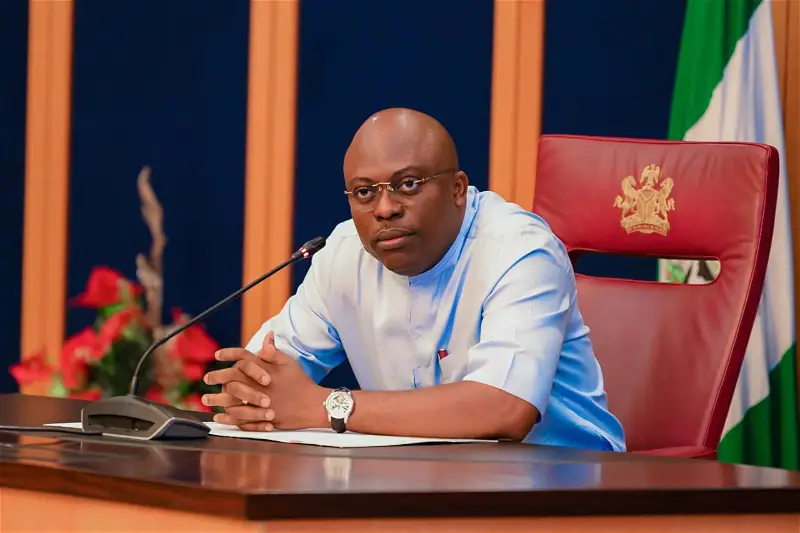
Rivers State Governor, Siminalayi Fubara, has revealed that his administration inherited 34 uncompleted projects, valued at over N225. 279bn spread across 13 local government areas of the state.
Fubara also disclosed that under his watch, the state government awarded nine new road projects, valued at N534.332bn.
This is even as he described as vicious and existential, the political crisis that was waged against his administration, barely three months after take-off on May 29, 2023.
The governor assured all that the worst was over because his administration had successfully defended the rights and privileges to govern the state and advance its progress in liberty and freedom without compromise.
Fubara said these while presenting an account of stewardship and scorecard to mark the first anniversary of his administration in Port Harcourt, the state capital, on Wednesday.
The governor said, “We started this journey with a bang. We were focused. We were determined to make the change we promised with a sense of urgency.
“But then, somehow, we suddenly found ourselves in the cesspit of crisis barely three months into our tenure. It was not just an ordinary political crisis. It was a vicious existential crisis.
“But thank goodness, the worst is over. We have successfully defended our rights and opportunity to govern our state and advance its progress in freedom, and we will continue to prevail.”
Fubara stated that since then, a lot has changed in the political landscape, adding that he remains committed to the covenant taken a year ago to put Rivers State first, defend her interest, and ensure that the people get the dividends of democracy and good governance.
He added, “For us, any government worth its name must be accountable, responsive, and responsible for the security and well-being of the people.
“Having managed the affairs of our state for one year, including dispensing public resources, it is only proper that we render account with a public presentation of our performance record.
“I am, therefore, pleased to stand before you to present our scorecard for the first year we have been in office as the Executive arm of the Government of Rivers State.”
READ ALSO: Fubara Blows Hot, Says ‘I’m Not Scared Of Anything, Anybody
He reflected on his promise to deliver on the core priorities of economic growth, infrastructure, healthcare, education, and agriculture, as contained in his blueprint as a resolve to build a virile, resilient, and progressive State that caters to the needs of the people.
The governor said he was proud to report that, despite the unprecedented challenges, his first year in office witnessed significant achievements visible to everybody.
Fubara said that he inherited a state whose economy was on a declining trajectory despite its growth potential but within one year of his administration, the negative narrative had changed for the better.
The governor revealed that he set up an Internally Generated Revenue Investment Advisory Committee that he chairs to coordinate activities in the sector that has increased the inflow of economic investments to the State.
He added, “We also needed to attract investments into the state and increase our internally generated revenue base as too much reliance on federal allocations was a challenge to the realisation of our development goals.
“We, therefore, set up an IGR/Investment Advisory Committee, which is helping us to navigate our course for increased economic investments and internally generated revenue to accelerate economic growth, create jobs and advance the welfare and well-being of our people.”
Fubara emphasised, “Our liberalised business-friendly economic policies and programmes are boosting confidence and attracting local and international investors and investments into the State, judging by the expression of interest offers we receive every month.
“We have kept our taxes low, frozen the imposing of taxes on small businesses across the state, and increased the ease of doing business in the state by eliminating bureaucratic bottlenecks. No request for the signing of a certificate of occupancy remains in my office beyond two days, except if I am otherwise engaged beyond two days or out of town.
“One year down the line, and we believe we are succeeding. Our internally generated revenue witnessed an astronomical increase from N12 billion to between N17 billion in off-peak periods and N28 billion during the peak months.”
Continuing, he said, “We have established a N4 billion matching fund with the Bank of Industry to support existing and new micro, small, and medium-sized businesses to grow their businesses to drive economic growth and create jobs and wealth for citizens. Over 3,000 citizens and residents have applied to access this loan to fund their businesses at a single-digit interest rate, and a repayment period of up to five years.”
READ ALSO: Pro-Fubara Lawmakers Confirm Eight Commissioner-nominees
He expressed his belief in using infrastructure as key to sustainable development, which was why, he explained, he did not abandon “the 34 uncompleted projects that he inherited, valued at over N225.279 billion spread across 13 local government areas of the state”.
The governor also said that 12 of those projects have been completed and put to use while construction work is ongoing on the others, with nine new road projects initiated by his administration valued at N534.332 billion.
Fubara stated that except for the Port Harcourt Ring Road project which is funded with the loan, other ambitious projects of his administration such as the Elele-Egbeda-Omoku Road, Okania-Ogbogoro Road and the Trans-Kalabari Road are funded from accumulated IGR and federal allocations savings.
He explained, “I wish to emphasize that with a combined cost of N528.6billion, the 50.15 kilometres Port Harcourt dual-carriage Ring Road, the dualisation of Elele-Egbeda-Omoku Road and the Trans-Kalabari Road projects are three most ambitious road projects ever carried out by any Governor in Rivers State.
“The 50.15 kilometres Port Harcourt Dual Carriage Ring Road, with six flyovers, one river crossing, walkways, drains, streetlights, and spanning six local government areas, was awarded to Julius Berger Nigeria Plc at a total cost of N195.3billion for a 36-month completion period.
“The speed with which the project is advancing shows that this administration is in a hurry to deliver this project even before the due date with the 77 per cent down payment of N150billion to the contractor. Presently, work on the project is progressing satisfactorily from six different locations.
“The 33.5-kilometre Elele-Egbeda-Omoku Road was awarded on the 26th of March, 2024 at a total cost of N80.886billion to Craneburge Construction Company with a down payment of 50 per cent of the contract sum and 24-month completion timeline. The contractor has since commenced work on this project, ” Fubara said
The governor said so much has been achieved in the health sector with Rivers State Emergency Ambulance Service resuscitated, facilities upgraded at the Rivers State University Teaching Hospital, 1,000 medical personnel employed, and 35 primary healthcare centres empowered to function maximally.
He assured all that his administration was committed to economic diversification through agriculture, stressing that efforts are at top gear to attract serious investors to take over and revive all state-owned farms and agricultural assets.
The purpose, he emphasised, is to harness the huge agricultural potential of the State to enhance food security, grow the economy, create jobs and generate revenue for the government and stakeholders.
READ ALSO: JUST IN: Fubara Wins As Court Voids Tenure Extension For Rivers LGA Chairmen
He said, “In addition, we have concluded plans to engage our youths in profitable agriculture, and applied to participate in the second phase of the Special Agro-processing Zones project of the African Development Bank, and all other agriculture development schemes of the Federal Government.”
In the education sector, Fubara explained that he inherited several uncompleted secondary schools’ reconstruction and other projects.
Among other efforts made, Governor Fubara said: “On assumption of office, we quickly released funds to complete these schools and deliver them for public use.
“To this end, we made final payments of N701,943,233,05 for the completion and delivery of Community Secondary School, Rumuepirikom; N355,682,471.99 for Kalabari National College; N329,330,552.25 for Government Comprehensive Secondary School, Borokiri; N379,793,277.60 for Government Secondary School, Eneka; N461,973,829.38 for Government Secondary School, Emohua; N134,600,000.00 for Comprehensive Secondary School, Alesa–Eleme; N1,142,279,618.17 for Community Secondary School, Koroma, Tai; N1,863,213,093.13 for Government Comprehensive School, Okarki; N585,084,678.80 for Government Secondary School, Ataba; and N2,092,313,561.19 for Government Girls Secondary School, Ahoada.
“We also released N193,785,313.00 for the reconstruction of Community Secondary School, Kunusha, N1,500,000,000.00 for the reconstruction of Okrika Grammar School; N612,632,677.94 for the furnishing of the University of Port Harcourt Convocation Arena; and N700,000,000.00 for the twin hostel projects at the Yenagoa campus of the Nigerian Law School.
“We released N1,902,334,833.33 as matching funds for the Universal Basic Education Board for the provision of infrastructure, including the rehabilitation of basic education schools. It is noteworthy that the State’s Universal Basic Education Board has used funds released to rehabilitate over 50 basic education schools across the State,” he added.
He listed other projects and programmes undertaken by the administration across various sectors as well as the financial commitments made to ensure quality project delivery within specifications and timelines.
Fubara said the payment of salary to civil servants has been sustained, adding that an engineering firm has been engaged to do a structural assessment of what can be done to give the Rivers State Secretariat Complex a facelift.
Speaking at the event as the Chairman of the occasion, former representative of Rivers East Senatorial District at the National Assembly, Senator John Azuta Mbata, said the essence of democracy and sovereignty is for leaders to serve the people, be responsible to them and work to improve their well-being.
READ ALSO: Rivers Crisis: Again, Amaewhule-led Assembly Overrides Fubara, Passes LG Bill Into Law
Mbata stated that the governor has distinguished himself as a servant-leader whose one year in office is momentous, full of enormous accomplishments, and has such audacity to embark on an unusual phenomenon of reporting back to the people on how he has served them.
The chairman emphasised that Fubara, by conducting himself as answerable to the people, has set a record difficult to match for upholding accountability and democracy, sustaining public trust, and fostering good governance.
He said, “So, we are glad that such an occasion has presented itself in this State, where our servant-leader is before the people to give account and show his scorecard. I congratulate you most heartily for this great achievement.
“Popular sovereignty principle connotes the fact that power belongs to the people. It is the people that leaders are called upon to serve. The people play the role of choosing their leaders through regular and periodic elections, and also the people have the mandate to renew or refuse to renew the mandate periodically.
“It is accountability that ensures responsibility and transparent exercise of power in the public interest. Accountability provides the opportunity for the players to explain and account for their performance in office. I am proud that His Excellency has chosen the path of transparency and accountability as Governor of Rivers State,” he said.
In his welcome address, Secretary to the Rivers State Government, Dr Tammy Danagogo, described Governor Fubara as an eagle leader.
Such a leader, Danagogo explained, flies higher and touches the sky with speed and accuracy at hitting his target without any noise making in solving many societal and human problems that offer succour to the people.
He said over the past year, Governor Fubara has championed what he called, ‘a quiet and noiseless revolution’ wherein he had worked assiduously, performed excellently and achieved what seemed almost impossible.
On such a day, Dr Danagogo stated, “Governor Fubara, who is the people’s Governor, decided to present a vivid account of his stewardship to the people on how public funds have been deployed judiciously in delivering critical projects and social services.”
Wike and Fubara have been engaged in a prolonged feud, which necessitated the intervention of President Bola Tinub to diffuse the growing tension in the state.
A few weeks ago, five pro-Wike commissioners resigned for the second time last week, citing a hostile working environment.
These resignations came after four others had previously stepped down.
PUNCH

News
Eating Takeout Food Often May Increase Heart Disease Risk — Study

Research suggests that higher takeout food consumption may increase a person’s risk of cardiovascular disease, like heart disease.
In a new study, published in Food Science & Nutrition, researchers said eating takeout food too often can influence systemic inflammation that underlies much cardiovascular disease.
The study of over eight thousand people in the 2009 to 2018 U.S. National Health and Nutrition Examination Survey (NHANES) found that those who eat greater amounts of takeout food are likely to have various elevated risk factors for heart disease.
They were interviewed in their homes and also visited a mobile examination centre, where they recalled their food intake, received cardiometabolic health assessments, and had blood collected.
READ ALSO:23 Ships With Fuel, Food Items To Arrive Lagos Ports – NPA
Mammograms may predict heart disease risk in women — Study
The researchers found a correlation between the amount of takeout food a person consumes and their likelihood of developing chronic low-level inflammation, a key driver of cardiovascular pathology.
Deaths from cardiovascular disease and the consumption of takeout foods are both on the rise, and while that does not prove a causal relationship, the study explores whether there is a connection between the two.
The study tracked degrees of systemic inflammation according to the Dietary Inflammatory Index (DII), a scale that quantifies the risk of inflammation related to the intake of specific dietary substances.
READ ALSO:Food Security: 14,000 Smallholder Farmers To Benefit From N4bn Smart Agriculture Training In Bauchi
The three major takeaways from the analysis included that a higher level of takeout food consumption corresponded to an unfavourable cardiometabolic profile consisting of lower HDL, as well as higher triglycerides, fasting glucose, serum insulin, and insulin resistance.
Jayne Morgan, MD, cardiologist and Vice President of Medical Affairs in a reaction, who was not involved in the study, explained that “Takeout food raises the cardiovascular risk not because of one ingredient, but because of a predictable combination of nutrients, additives, and preparation methods that adversely affect blood pressure, lipids, insulin sensitivity, inflammation, and endothelial function.”
“This includes excess sodium that increases blood volume and blood vessel stiffness, and unhealthy fats, usually saturated fats or trans fats, that increase cholesterol level and atherosclerosis, a condition that can lead to heart attack and stroke.”
Michelle Routhenstein, Preventive Cardiology Dietitian at Entirely Nourished, also not involved in this study, declared, “It is also important to recognise that frequent takeout use often reflects broader lifestyle pressures such as demanding schedules, limited access to cooking resources, irregular meals, and disrupted sleep, all of which can quietly compound cardiovascular risk.”
News
How To Identify Fake Kiss Condoms In Circulation

The National Agency for Food and Drug Administration and Control (NAFDAC) has recently warned Nigerians about the circulation of counterfeit Kiss brand condoms in major markets across the country.
Contents
Original DKT Kiss condoms
Fake Kiss condoms
In a public alert published on its website recently and referenced as Public Alert No. 042/2025, the agency said the warning followed information received from DKT International Nigeria, a non-governmental organisation involved in contraceptive social marketing and HIV/AIDS prevention.
NAFDAC stated, “The National Agency for Food and Drug Administration and Control is notifying the public about the sale and distribution of fake Kiss condoms in various Nigerian markets.
“The information was received from the MAH-DKT International Nigeria, a leading non-governmental organisation focused on contraceptive social marketing. Its mission is to provide Nigerians with affordable and safe options for family planning and HIV/AIDS prevention.
“The fake Kiss condoms have been reported to be found in Onitsha Market, Idumota Market, Trade Fair Market, and various markets in Kano, Abuja, Uyo, Gombe, Enugu, and others.”
READ ALSO:Married Man Denies Wife At Brazil Concert To Kiss Tems On Stage [VIDEO]
Kiss condom is a brand of male latex condoms designed to offer sexual protection, including the prevention of unwanted pregnancy and sexually transmitted infections such as HIV, gonorrhoea and syphilis.
To help consumers avoid counterfeit products, NAFDAC outlined key differences between original and fake Kiss condoms.
Original DKT Kiss condoms
The original product comes in a light red box pack with clear instructions printed on the lower part of the pack, including single-use warnings and storage and caution information. The box contains detailed medical device information, including MDSS GmbH, Germany, and a complete Nigerian address at Isolo Industrial Layout, Oshodi-Apapa Expressway.
The condom pack is light red, with the word “Kiss” closely written on six lines. The wallet outer pack is lighter red, carries the Oshodi-Apapa address, manufacturer details, and a clear product description beside the condom image. The hidden flap includes revision dates, medical device details, and caution information, while the wallet inner contains detailed instructions and eight bullet points under important notes.
READ ALSO:Lagos Names Mandy Kiss Anti-drug Abuse Ambassador
The original condom is large, oval-shaped, well-lubricated, and has a large teat end for semen collection.
Fake Kiss condoms
In contrast, fake Kiss condoms come in darker-coloured box packs with little or no additional information. Some boxes are plain white inside and lack condom images. The address is wrongly listed as 42, Montgomery Road, Yaba, Lagos, while the manufacturer’s address is incomplete or missing. Storage and caution information is absent.
The condom pack is darker, with “Kiss” loosely written on five lines and wide spacing. The condom strip is longer than the original. The wallet outer pack is also darker red, carries incorrect or missing addresses, lacks colour wave designs, and shows inconsistencies in barcode lines. Medical device and caution information are missing, and the hidden flap contains no details.
Inside the wallet, information is summarised with only six bullet points. The fake condom is thinner, round-shaped, less lubricated, and has a smaller teat end.
(TRIBUNE)
News
Lagos: Police Arrest 14 Suspected Traffic Robbers On Lekki-Epe Expressway

Fourteen persons suspected to be involved in traffic-related robbery have been arrested at various points along the Lekki-Epe Expressway in Lagos over the past two weeks.
The arrests were confirmed on Tuesday by the Lagos State Police Command spokesperson, SP Abimbola Adebisi, via a post on her official X handle, @AbimbolaShotayo.
According to her, operatives of the Command’s Tactical Squad based in Elemoro carried out the operations that led to the suspects’ apprehension.
READ ALSO:VIDEO: Chaos As Last-minute Shoppers Overwhelm Lagos Balogun Market
She explained that the arrests followed sustained patrols and intelligence-driven operations aimed at curbing criminal activities associated with traffic congestion and improving the safety of motorists and other road users along the busy corridor.
Adebisi noted that the development reflects the Command’s determination to strengthen security and uphold law and order on the Lekki-Epe axis, adding that the Tactical Squad has continued to proactively identify crime-prone areas and respond swiftly to threats posed by criminal elements.
She called on residents and commuters to support police efforts by providing timely and credible information that could assist in preventing and detecting crime.
READ ALSO:VIDEO: Chaos As Last-minute Shoppers Overwhelm Lagos Balogun Market
“Security is a shared responsibility. Members of the public are encouraged to stay alert and promptly report any suspicious movements or activities to the nearest police station,” she said.
The police spokesperson further reassured residents and road users of the Command’s commitment to maintaining aggressive patrols and security operations to protect lives and property in the area.
She reiterated the Command’s community policing message, “See Something, Say Something,” stressing the importance of cooperation between the police and the public in sustaining peace and security.

 News5 days ago
PHOTOS: SGF George Akume Weds Ooni’s Ex-Queen
- News3 days ago
Ex-Edo Gov Obaseki Reacts As His Cousin Is Beaten, Stripped
- News2 days ago
BREAKING: Anthony Joshua Involved In Road Accident
- Politics2 days ago
Wike Speaks On Defecting To APC
- Politics2 days ago
You’re Not 001 – Wike Rubbishes Claims Of Fubara Being APC Leader In Rivers
- Politics2 days ago
JUST IN: INEC Excludes PDP From Ekiti Governorship Election
- Metro3 days ago
Obaseki Beaten, Stripped In Edo
- Entertainment5 days ago
I’ve Stopped Impregnating Women Anyhow – 2Baba
- News2 days ago
NAF Neutralizes Bandits At Turba Hill, Kachalla Dogo Sule Camps
- Politics2 days ago
Go To Hell, You Didn’t Pay My School Fees – Wike Hits Seyi Makinde


