
Business
ICYMI: CBN Orders Banks To Charge 0.5% Cybersecurity Levy
The Central Bank of Nigeria has ordered banks operating in the country to start charging a cybersecurity levy on transactions.
A circular from the apex bank on Monday disclosed that the implementation of the levy would start two weeks from today.
The circular was directed to all commercial, merchant, non-interest and payment service banks, among others.
The circular revealed that it was a follow-up on an earlier letter dated June 25, 2018 (Ref: BPS/DIR/GEN/CIR/05/008) and October 5, 2018 (Ref: BSD/DIR/GEN/LAB/11/023), respectively, on compliance with the Cybercrimes (Prohibition, Prevention, Etc.) Act 2015.
READ ALSO: FG To Delist Naira From P2P Platforms
The recent public engagements by the Office of the National Security Adviser on the above subject, also refers.
Following the enactment of the Cybercrime (Prohibition, Prevention, etc) (amendment) Act 2024 and under the provision of Section 44 (2)(a) of the Act, a levy of 0.5 per cent (0.005) equivalent to a half per cent of all electronic transactions value by the business specified in the Second Schedule of the Act, is to be remitted to the National Cybersecurity Fund which shall be administered by the Office of the National Security Adviser.
The CBN said that all banks, other financial institutions and payment service providers are now required to implement the directive, saying, “The levy shall be applied at the point of electronic transfer origination, then deducted and remitted by the financial institution. The deducted amount shall be reflected in the customer’s account with the narration, ‘Cybersecurity Levy’.
“Deductions shall commence within two weeks from the date of this circular for all financial institutions and the monthly remittance of the levies collected in bulk to the NCF account domiciled at the CBN by the fifth business day of every subsequent month.”
READ ALSO: Pandemonium During Church Service As Man Pulls Gun, Attempts To Shoot Pastor [VIDEO]
Exempted from the levy include loan disbursements and repayments, salary payments, intra-account transfers within the same bank or between different banks for the same customer, intra-bank transfers between customers of the same bank.
Also exempted from the levy were inter-branch transfers within a bank, cheque clearing and settlements, Letters of Credits, Banks’ recapitalisation-related funding only bulk funds movement from collection accounts, savings and deposits including transactions involving long-term investments, among others.
The CBN, in recent times, has been making an effort to sanitise the financial sector. It recently issued a directive which barred fintechs from onboarding new customers.
The fintechs have in turn warned their customers against engaging in crypto transactions on their platforms.
This also comes barely a week after the Federal Government had directed Deposit Money Banks to immediately begin the deduction of 0.375 per cent stamp duty charge on all mortgaged-backed loans and bonds.



Business
Naira Continues Gain Against US Dollar As Nigeria’s Foreign Reserves Climb To $45.57bn
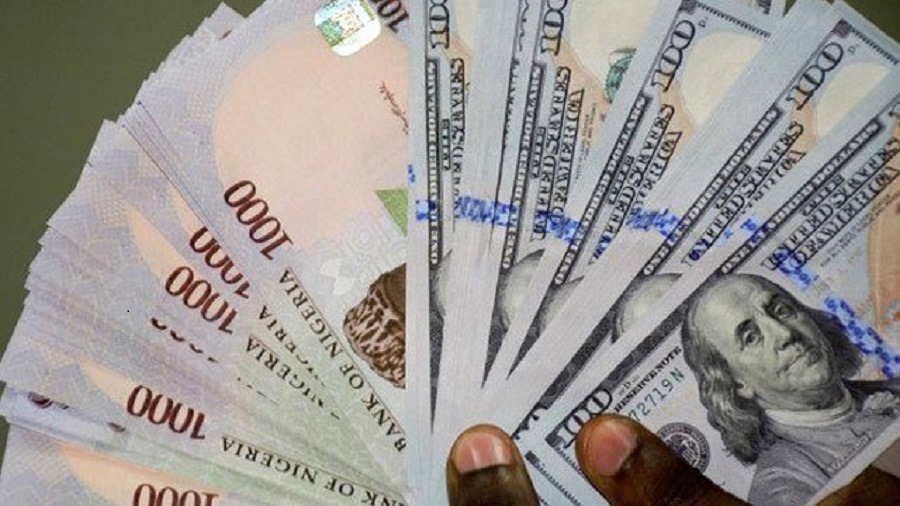
The Naira appreciated further against the United States Dollar at the official foreign exchange market, beginning the week on a good note.
Central Bank of Nigeria data showed that the Naira strengthened on Monday to N1,429.31 per dollar, up from N1,430.85 exchanged on Friday, 2 January 2026.
This means that the Naira gained N1.56 against the dollar on Monday when compared to N1,430.85 last week Friday.
READ ALSO:Naira Records Significant Appreciation Against US Dollar
At the black market, the Naira dropped by N5 to N1480 per dollar on Monday, down from N1475 traded Friday.
The development comes as the country’s external reserves rose to $45.57 billion as of Friday last week.
Business
NNPCL Reduces Fuel Price Again
The Nigerian National Petroleum Company Limited, NNPCL, has again reduced its premium motor spirit price.
In Abuja, on Monday morning, it was gathered that NNPCL retail outlets have reduced their fuel price to N815 per liter, down from N835.
This means that the NNPCL filling stations cut their price by N20.
The fresh price has been implemented at NNPCL filling stations in Wuse Zone 6 and 4 Abuja, Keffi-Abuja Road, and Kubwa Expressway.
READ ALSO:Fuel Price Cut: NNPCL GCEO Ojulari Reveals Biggest Beneficiaries
An NNPCL filling station attendant, who preferred anonymity, told DAILY POST that the new price was implemented on Sunday evening.
However, the N815 per liter is N79 higher than the N739 per liter sold at Dangote Refinery’s backed MRS filling stations nationwide.
DAILY POST recalls that NNPCL on December 19, 2025, cut its price of petrol by N80 to N835 amid a price war among players in the country’s oil downstream sector triggered by Dangote Refinery’s gantry price reduction to N699 per liter.
Business
NNPCL Announces Restoration Of Escravos-Lagos Pipeline

The Nigerian National Petroleum Company Limited (NNPCL) has announced the complete restoration of the Escravos-Lagos Pipeline System (ELPS) in Warri, Delta State, following the recent explosion on the asset.
The chief corporate communications officer (CCCO) of the nation’s oil company, Andy Odeh, in a statement, said that the pipeline is fully operational, reiterating the company’s resilience and commitment to energy security.
“NNPC Limited is pleased to announce the successful restoration of the Escravos-Lagos Pipeline System (ELPS) in Warri, Delta State.
READ ALSO:Fuel Price Cut: NNPCL GCEO Ojulari Reveals Biggest Beneficiaries
“Following the unexpected explosion on December 10, 2025, we immediately activated our emergency response, deployed coordinated containment measures, and worked tirelessly with multidisciplinary teams to ensure the damaged section was repaired, pressure-tested, and safely recommissioned.
“Today, the pipeline is fully operational, reaffirming our resilience and commitment to energy security. This achievement was made possible through the unwavering support of our host communities, the guidance of regulators, the vigilance of security agencies, and the dedication of our partners and staff.
“Together, we turned a challenging moment into a success story, restoring operations in record time while upholding the highest standards of safety and environmental stewardship.
“As we move forward, NNPC Limited remains steadfast in its pledge to protect our environment, safeguard our communities, and maintain the integrity and reliability of our assets. Thank you for your trust as we continue to power progress for Nigeria and beyond,” the statement read.

 News3 days ago
What I Saw After A Lady Undressed Herself — Pastor Adeboye
- Headline3 days ago
PROPHECY: Primate Ayodele Reveals Trump’s Plot Against Tinubu
- Metro3 days ago
Armed Robbers Shot PoS Operator To Death In Edo
- Metro2 days ago
AAU Disowns Students Over Protest
- Metro2 days ago
Nine Soldiers Feared Dead In Borno IED Explosion
- Metro3 days ago
Joint Task Force Kills 23 Bandits Fleeing Kano After Attacks
- Politics3 days ago
2027: Rivers APC Pledges To Follow Wike’s Instructions
- Metro2 days ago
Edo: Suspected Kidnappers Kill Victim, Hold On To Elder Brother
- Business2 days ago
NNPCL Reduces Fuel Price Again
- Entertainment3 days ago
PHOTOS: Anthony Joshua Makes First Social Media Post After Surviving Deadly Car Crash


