
News
Inflation: Knocks, Kudos Trail CBN’s Hike Of Interest Rate To 16.5 Percent
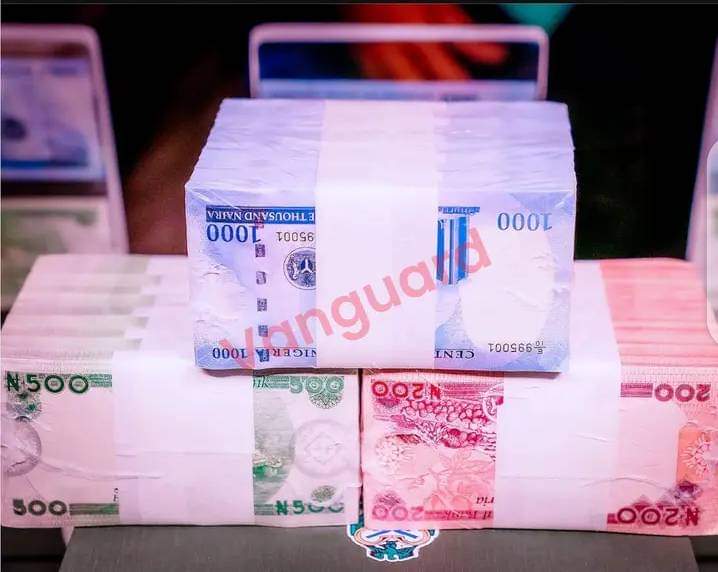
In less than three months after it had raised the country’s interest rate to a double-digit, 15.5 percent, the Monetary Policy Committee (MPC) of the Central Bank of Nigeria (CBN) again on Tuesday raised the benchmark for lending to 16.5 percent as a bullish move to tackle inflation.
At the same time, CBN says it is eyeing plans to reduce the volume of N500 and N1000 notes in circulation “over time” to tame inflation.
Recall that the CBN had earlier increased the MPR by 100 basis points, from 13 percent to 14 percent in July this year.
The bank has made several justifications, to address Nigeria’s skyrocketing inflation in line with basic economic theory, stating that interest rate is inversely related to inflation.
Announcing the committee’s decision at the end of its two-day meeting on Tuesday, the CBN Governor, Mr Godwin Emefiele, said the MPC also decided to hold all other parameters constant.
The Asymmetric Corridor of +100/-700 basis points around the MPR was, thus, retained; the Cash Reserve Ratio (CRR) was maintained at 32.5 percent and the Liquidity Ratio of 30 percent was also maintained.
According to Emefiele, 11 members of the MPC unanimously okayed monetary decisions.
READ ALSO: Naira Redesign: Buhari, Emefiele Played Nigerians, Only Changed Dye Of Currency – Sowore
“Nine members voted to raise the MPR by 100 basis points, while two voted to raise rates by 50 basis points,” he said.
Emefiele said in deciding on its policy stance, the MPC felt that all the causative factors in the economy, like the Russian-Ukraine war and supply chain disruption were still dominant.
“Loosening option was not desirable at this meeting. The committee also felt that with the rising inflation, loosening the stance of policy would lead to a more aggressive rise in inflation.
“As regards whether to hold, the MPC was of the view that doing that close to December festive season and expected heavy spending during the 2023 general election would jeopardise the gains of previous policy rates tightening.
“It would plunge the economy deeper into the inflation trap,” he said.
He added that the MPC decided to continue tightening at a somewhat moderated rate.
“At this meeting, the options considered were whether to hold or further tighten policy rates.
“The option to loosen was not considered as this will greatly undermine the gains of the three previous decisions,” he said.
In the same vein, the bank governor, Emefiele, announced plans to reduce the volume of N500 and N1000 notes in circulation “over time.”
The Governor made this known in his briefing to the media at the monetary policy communique held on Tuesday.
He was responding to questions about the ease of counterfeiting N1,000 notes and if there were plans to reduce the volume
READ ALSO: JUST IN: CBN Gov, Emefiele Explains Features Of New Naira Notes.
Emefiele claimed that the effort is aimed at curbing the inflation rate, which he partly blamed on the higher-denominated naira notes.
He started by using the UK as an example, saying, “In the UK, they have a denomination of 50 pounds, but the most spent denomination is 20 pounds. Nobody spends 50 pounds. If you carry 50 pounds in the UK, they will suspect, sic, report you.”
And then comparing this to Nigeria, “The reverse is what is happening in Nigeria.
“Nigerians want to carry N500 and N1,000. And in fact, we are beginning to think that increasing the high denomination is also part of fueling inflation. So, yes, we will launch N200, N500, and N1,000; over time, we will reduce the volume of N500 and N1,000 in circulation. Let people carry N50 around.
“If you want to do high-value transactions, embrace online, embrace our agency programme, embrace our mobile banking programme, that is what you need,” he said.
The latest monetary decision has generated both knocks and kudos from economic experts, and stakeholders.
Raising interest rate alone won’t tame Nigeria’s inflation — Experts
In a swift response to the apex bank’s policy to raise the interest rate, a Financial Inclusion/Wealth Management expert, Mr Idakolo Gbolade said an interest rate increase alone wouldn’t tame Nigeria’s inflation and ailing economy.
Gbolade, reacting to the CBN latest interest rate increase to 16.5 percent, made this disclosure in a chat with DAILY POST.
In sharp contrast to CBN’s position on the latest monetary decision, Gbolade, on the contrary, stated that owing to the political atmosphere, the current government may not achieve any change in the nation’s economy before the handover in 2023. He added that the decision could further worsen the continued fall of the Naira.
“The CBN decision is predicated on their constant effort to tame Nigeria’s stubborn inflation, which has not relented despite consistent increases in interest rates in the last six MPC meetings.
“The effort is also geared towards mopping up excess liquidity in the economy.
“The CBN is also aiming at boosting investors’ confidence and profitability projections regarding foreign inflows which can positively impact our foreign reserves.
“The MPC decision could further cause the value of the Naira to continually decline due to persistent scarcity of the Dollar.
“The rising cost of food items will not decrease because of the declining value of the Naira.
“Energy cost is also projected to increase as the cost of doing business in the sector will significantly increase.
“In fairness to the CBN, these measures are supposed to tame inflation and cause the economy to bounce back, but these policies alone cannot cause the needed change looking at political activities that are unfolding and this present government might not be able to do much before handover in 2023,” he stated.
Raising MPR will spike inflation
Also, reacting to the development, the Chief Executive Officer, BIC Consultancy Services, Mr Boniface Chizea said he anticipated that the MPC would increase rates but didn’t expect it to be that high.
“Yes! This was anticipated but probably not as steep as an increase of 100 basis points considering the rapid pace at which the rates have been increased over the last two to three meetings.
“With the inflation rate rising beyond 20 per cent, MPC did not have much choice. No corporate treasurer will be ready to save money today and earn returns several basis points below the inflation rate!
“So, it is imperative to raise base interest rates by this hike. Unfortunately, on the other hand, interest rates as factor costs have the potential to spike the inflationary pressures,” he said.
A Professor of Economics at the Olabisi Onabanjo University, Ago-Iwoye, Ogun, Sheriffdeen Tella, who didn’t see the increase coming, said the higher rate would compound inflation.
“When I heard about it, I was shocked. The higher interest rate will compound the inflation woe.
“Government should reduce its expenditure and CBN should stop lending to the government. The exchange rate should further appreciate – those are the solutions,” he said.
However, Prof. Ndubisi Nwokoma, Director, Centre for Economic Policy Analysis and Research (CEPAR) University of Lagos, said the increase of the benchmark rate would fight inflation.
“Yes, the increase was expected. This is as it should be given that inflation has risen to over 21 per cent and that the burden of debt service is increasing.
“The current negative return to capital vis-a-vis inflation should be addressed with this move.
“Although this tightening of credit by this move will impact negatively on economic growth; it will nonetheless help to fight inflation as well as attract new capital into the economy and address the challenges in the exchange rate of the naira,” he said.
For the Executive Director of Nigerian Workforce Strategy and Enlightenment Centre (NIWOSEC), Dr. David Ehindero the increment of the Monetary Policy Rate (MPR) by 100 basis points to 16.5 percent from 15.5 percent will have a positive implication on the dwindling economy.
He emphasised that the Apex bank must ensure stability in the economy before introducing new guidelines and involvement of stakeholders is necessary too.
He said, “The Government should consider reducing the cost of Governance to enable more public spending for the masses or tax the masses.
“An increased tax rate is already burdened, and an inflation-infested society like Nigeria is the height of insensitivity. The majority of Nigerians can’t access goods in the market; Nigerians are not leaving; they are surviving. Let the government consider reducing the cost of Governance and seal every loophole in the economy through corruption and frivolous spending.
“Government should also look deep into the padding of our annual budget with projects that will have no direct bearing on economic growth because the ordinary man doesn’t know what MPC policy is.”
Enhindero appealed to the CBN to engage the public rigorously in enlightenment, especially on the issue of currency redesign for a better approach amidst the MPC policies implementation.
Borrowers, investors, pensioners will suffer from the interest rate increase
A don of Accounting and Financial Development at Lead City University, Ibadan, Prof. Godwin Oyedokun, said investors, borrowers, and pensioners would suffer from the policy.
He explained that theoretically, increasing interest rates leads to inflation reduction.
“The interest rate increase is not new; for instance, last year, England tried to increase the interest rate to curb inflation because it is believed that inflation will decline when the interest rate is up.
“While interest is rising, it will cool down prices but would make borrowing more expensive. In the interim, increasing interest rates will reduce inflation. It is within the purview of the Central Bank of Nigeria to intervene in Monetary policy.
“Of course, at times, it could also impact the cost of prices of products in the market. In theory, inflation and interest rate have an inverse relationship; when interest rates are low, inflation tends to rise, while when interest rates are high, inflation tends to reduce.
“If we have a high rate of inflation, what happens is that you lose the value of the equivalent of whatever you hold as an asset.
“There are two important things we are discussing, the interest rate and inflation. If the interest rate is high, it will increase the cost of borrowing; the borrowers will have to pass the cost to consumers by increasing the price of the product/service.
READ ALSO: JUST IN: Buhari To Unveil New Naira Notes Tomorrow – Emefiele
“On the other hand, if you are not borrowing money from the bank, instead keep depositing cash at the bank for saving or fixing, the rate of returns will be higher.
“Inflation will reduce the value of your savings not from the bank but from the economy. What happens is that a certain percent of inflation would have affected it. So if the interest is high, say 16 percent and the rate of inflation is 10 percent, you will be left with 6 percent.
“Those getting loans will suffer for it, while those with deposits in their accounts will gain more money. If you do plus and minus, the situation is better than having a low-interest rate.
“Pensioners will also suffer because pensions are static and this will reduce their purchasing power. The only people that will gain are those who keep their money as a deposit with high-interest rates,” he said.
In all this, Nigerians seek a quick end to poverty, rising inflation, insecurity, among other economic miseries.
DAILY POST



News
Migration Agency Warns Migrants Against Irregular Travel Routes

The International Organisation for Migration (IOM), in collaboration with Giving is Healing Foundation, has sensitised residents of Ayobo in Alimosho Local Government Area of Lagos State on the dangers of irregular migration and the need to embrace legal travel procedures.
Speaking during a sensitisation programme held at Megida Ifelodu Community Development Association in Ayobo, the founder of Giving is Healing Foundation, Mr. Gbolahan Ayediran, warned intending migrants against using illegal travel routes.
Ayediran said many Nigerians desire to migrate abroad in search of better opportunities but often ignore proper procedures, thereby exposing themselves to several dangers.
“Lots of people want to migrate and most of them do it in the wrong direction. The reason for the programme is for us to advise people on how they can migrate in the right way. As much as migration is their right, they should do it correctly,” he said.
READ ALSO:How Wike Rescued Me From Political Oblivion — Oshiomhole
He advised intending travellers to obtain the necessary travel documents before embarking on any journey, noting that such documents include international passports, visas, flight tickets and yellow cards, depending on the destination country.
According to him, migrants should also gather adequate information about their destination countries to enable them make informed decisions before travelling.
Ayediran further highlighted some of the dangers associated with irregular migration, including abuse, exploitation, discrimination and forced labour.
Also speaking, the Chairman of Megida Ifelodu Community Development Association, Elder Mathews Amusan, commended the organisers for enlightening members of the community on safe migration practices.
READ ALSO: He Can’t Fix His Party Let Alone Nigeria – Oshiomhole Blasts Atiku
He urged residents planning to travel abroad to always follow legal migration procedures to avoid falling victim to human trafficking and other migration-related challenges.
One of the participants, Mr. Kolawole Adenoko, said the programme enlightened him on the dangers of irregular migration and the importance of travelling through the proper channels.
He added that he would also educate his relatives and friends on the risks associated with illegal migration.
News
Shatta Wale Bailed Burna Boy From Ghana Prison After Arrest For Smoking Weed – Captan

Ghanian singer, Captan, has claimed that his former record label boss, Shatta Wale, once bailed Nigerian singer Burna Boy out of prison in Ghana after he was allegedly arrested for smoking weed.
Speaking in a recent podcast interview, Captan claimed that Shatta Wale sent him and others to free Burna Boy from police custody.
He also claimed that Shatta Wale and his group once accommodated Burna Boy when he was being hunted by some dangerous men.
READ ALSO: Wale Edun Opens Up After Sack
Captan said, “I once bailed Burna Boy out of prison in Ghana when he was arrested for smoking weed. Shatta Wale sent me and some guys to go and free him from police custody.
“There was a time we also accommodated him when some people were after his life. We helped him settle the case.”
He added that he and Burna Boy are no longer in good terms after the Nigerian artist’s fallout with his mentor, Shatta Wale.
He, however, said he and Shatta Wale are open to reconciling with Burna Boy if he asks for it.
Watch the video here
News
Children’s Day: Chaos At Ogbe Stadium As Dozens Faint
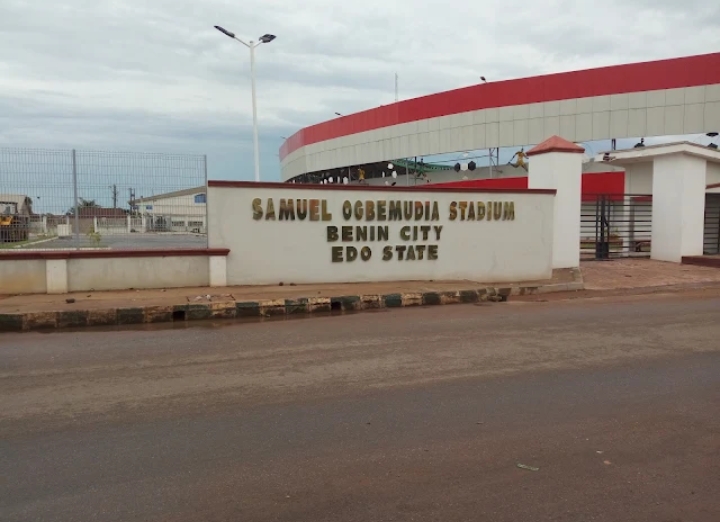
Chaos erupted on Wednesday during the Children’s Day celebration as dozens of students reportedly collapsed following a stampede triggered by the use of pepper spray.
The event,
organised by the Edo State Ministry of Education at the Samuel Ogbemudia Stadium was disrupted after some male students of Ihogbe College allegedly made uncompromising advances towards female students at the venue.
A parent who identified himself as Oboh Emmanuel said, “the behaviour of those uncultured students attracted the attention of bouncers stationed at the stadium as they rebuked the male students.”
Oboh said the affected students later regrouped and attacked the bouncers, leading to a confrontation within the crowded arena.
READ ALSO:Children’s Day: Edo Commits To Child Protection
It was gathered that in the ensuing confusion, the bouncers were reported to have deployed pepper spray in an area occupied by a large number of students.
Several students, particularly female students, reportedly fainted after inhaling the substance, while others sustained injuries after being stepped on during the ensuing melee.
The panic was said to have spread across the stadium as students, teachers and parents scampered for safety.
Many of the affected students were reportedly rushed to the Edo Specialist Hospital for medical attention.
READ ALSO: Egor LG Chair, Ogbemudia, Vice, Osawe Impeached
Reacting to the incident, Chief Press Secretary to Governor Monday Okpebholo, Dr Patrick Ebojele, said the security personnel that fired the tear gas had been detained.
He said all the students, except two, that were rushed to the hospital have been discharged.
Ebojele stated that doctors wanted to observe the students till tomorrow before allowing them to go home.
“The two students are not seriously injured. Doctors want to observe them overnight. Permanent Secretary, Ministry of Education is still at the hospital. The man who used pepper spray has been detained.
“The incident did not happen the way it is being exaggerated. All modalities were put in place to ensure the children enjoyed their day.”

 Headline4 days ago
Woman Passes Out After Receiving 100 Strokes Of Cane
- Headline4 days ago
JUST IN: White House Locked Down Briefly As Gunman Opens Fire At Security Checkpoint
- Politics3 days ago
Two Masked Men Gun Down Politician In His Rivers State Hotel
- Politics5 days ago
Warri Ijaw Hail INEC Delineation Report, Call For Additional Electoral Wards, Others
- News3 days ago
More Pain For Nigerians As Cooking Gas Price Increases Nationwide
- Metro4 days ago
Police Reject N500m Bribe, Recover N7.8bn Illicit Drugs In Lagos
- News5 days ago
Alleged Terrorism: Court Rejects Defendant’s Bid To Travel Abroad
- Politics5 days ago
What I’ll Do As President Of Nigeria — Amaechi
- News3 days ago
FG Declares Two Days Public Holiday For Eid-el Kabir Celebration
- Politics3 days ago
‘Tinubu’s Borrowing In 24 Months Surpasses 55 Years’ Debt Record’


