Connect with us

News

JUST IN: Court Remands Fubara’s Loyalists Over Rivers Assembly Explosion

Published

on

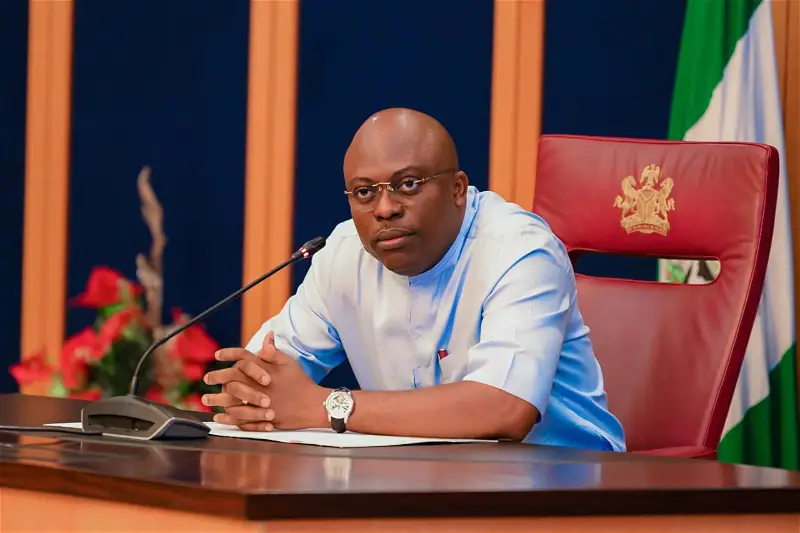
A Federal High Court sitting in Abuja on Thursday remanded some loyalists of the River State governor for their alleged involvement in the explosion that rocked and razed the Rivers State Assembly complex.

An explosion had rocked the complex of the state Assembly amid alleged moves by some lawmakers to impeach Governor Siminalayi Fubara on October 30, 2023.

Some loyalists of the governor were said to have been behind the incident.

Advertisement

No fewer than five of them were arraigned on Thursday before Justice Bolaji Olajuwon of the Federal High Court in Abuja.

READ ALSO: JUST IN: S’Court Upholds Fubara’s Election

They are Chime Eguma Ezebalike, Prince Lukman Oladele, Kenneth Goodluck Kpasa, Osiga Donald and Ochueja Thankgod.

Advertisement

In the 7 charges, the defendants were accused of committing alleged terrorism offences by invading, vandalising and burning down Rivers State House of Assembly during the wake of the political crisis that rocked Port Harcourt in October last year.

They were also accused of killing a Superintendent of Police, Bako Agbashim, and five police informants in the Ahoada community of the state.

The police informants alleged to have been killed are Charles Osu, Ogbonna Eja, Idaowuka Felix, Paul Victor Chibuogu, and Saturday Edi.

Advertisement

READ ALSO: Rivers Elders Write Tinubu, Fubara, Say Presidential Intervention Death Sentence

They are to remain in prison custody till February 2 when their respective bail applications will be determined by the Judge.

They were also accused of using various cult groups, namely- Supreme Viking Confraternity, Degbam, Iceland, and Greenland to unleash mayhem on the people of the state and their commercial activities.

Advertisement

They all pleaded not guilty to the allegations.

Although the immediate past factional Speaker of the Rivers State House of Assembly, Hon Edison Ehie, was not listed in the 7 counts terrorism charges, he was however represented in court by a Senior Advocate of Nigeria SAN, Oluwole Aladedoyin, on the ground that his name featured prominently in the alleged offences.

He challenged the allegations that he was at large alongside other suspects.

Advertisement

Justice Olajuwon did not however allow further arguments on the ground that he was not yet a defendant in the charges.

READ ALSO: Rivers Crisis: Lawmakers Sign Impeachment Notice On Fubara

Shortly after the arraignment, the leader of the prosecuting team, Audu Garba, applied for a date for a full-blown trial of the defendants.

Advertisement

However, a Senior Advocate of Nigeria SAN, Lukman Fagbemi, who stood for Chime Eguma Ezebalike and Prince Lukman Oladele who are 1st and 2nd defendants, sought to move applications for their bail on the ground that they have been in police custody since last year.

The government lawyer, Audu Garba, vehemently opposed the reason that he had just been served with the bail applications and needed time to study them and file a counter affidavit.

Justice Olajuwon agreed with the prosecution lawyer that the bail applications were not ripe for hearing and fixed February 2 for the hearing of all bail applications.

Advertisement

Pending hearing and determination of the bail applications, the judge ordered that the five defendants be taken to Kuje Prison on remand and be returned to court on the adjourned date.

The defendants are hereby remanded pending the hearing and determination of the bail applications,” he said.

Advertisement
Advertisement
Comments

News

Nigeria Army Alone Cannot Defeat Bandits — Sheikh Gumi

Published

on

Islamic cleric Sheikh Ahmad Gumi has said the Nigerian military cannot defeat bandit groups through force, arguing that dialogue remains the only path to resolving insecurity in the northwest and other regions.

In an interview with the BBC, Gumi stated that modern armies worldwide struggle against guerrilla fighters, and Nigeria is no exception.

“But even the military says that in dealing with this civil unrest and criminality, only 25% is kinetic action; the rest depends on the government, politics, and local communities. The military cannot do everything,” he said. “Where have you ever seen the military defeat guerrilla fighters? Nowhere.”

Advertisement

His comments come as President Bola Tinubu’s administration introduces sweeping security reforms, including changes in military leadership and a nationwide security emergency aimed at tackling violent groups responsible for kidnappings, extortion and rural attacks.

READ ALSO:Gumi Reacts As Saudi Bars Him From Hajj

Addressing accusations of maintaining ties with bandit leaders, Gumi said he has had no contact with them since 2021, when the federal government formally designated the groups as terrorists. “I never went there alone,” he said.

Advertisement

“It was in 2021 when I was trying to see how we could bring them together. But unfortunately, the government at the time, the federal government, was not interested. They declared them terrorists, and since that time we have completely disengaged from all contact with them.”

Despite criticism that his advocacy emboldens armed groups, Gumi maintained that negotiation with non-state actors is a global practice. “When they say we don’t negotiate with terrorists, I don’t know where they got that from,” he said. “It is not in the Bible, it is not in the Quran. America had an office negotiating with the Taliban in Qatar. Everyone negotiates with outlaws if it will stop bloodshed.”

He described the armed groups as largely “Fulani herdsmen” engaged in what he called an “existential war” linked to threats to their traditional livelihoods of cattle rearing. “They want to exist. That is their life.

Advertisement

READ ALSO:Insecurity: What Sheikh Gumi Told Me After Visiting Bandits Hideouts — Obasanjo

They know where to graze and how to care for their cattle,” he said, adding that the crisis has grown from farmer–herder tensions into widespread criminality.

Gumi has long faced public backlash for his engagements with bandits and for remarks such as his earlier claim that kidnapping schoolchildren is a “lesser evil” than killing soldiers.

Advertisement

Meanwhile, Gumi, in the same interview, also restated his view that the abduction of schoolchildren by armed groups constitutes a “lesser evil” than attacks on Nigerian soldiers, while emphasising that both acts are unacceptable.

“I think part of what I said then is correct and part of it wrong,” Gumi said, referring to his controversial 2021 statement.

“Saying kidnapping children is a lesser evil than killing soldiers, definitely it is lesser. But all of them are evil. All evils are not the same.”

Advertisement
Continue Reading

News

How France Helped Benin Foil Coup Detat

Published

on

France helped the authorities in Benin thwart a coup attempt at the weekend, an aide to President Emmanuel Macron said Tuesday, revealing a French role in a regional effort that foiled the latest bid to stage a putsch in West Africa.

Macron led a “coordination effort” by speaking with key regional leaders, the aide, asking not to be named, told reporters, two days after Sunday’s failed coup bid.

France — at the request of the Beninese authorities — provided assistance “in terms of surveillance, observation and logistical support” to the Benin armed forces, the aide added.

Advertisement

Further details on the nature of the assistance were not immediately available.

A group of soldiers on Sunday took over Benin’s national television station and announced that President Patrice Talon had been deposed.

READ ALSO:

Advertisement

But loyalist army forces ultimately defeated the attempted putsch with the help of neighbouring Nigeria, which carried out military strikes on Cotonou and deployed troops.

West Africa has endured a sequence of coups in recent years that have severely eroded French influence and presence in what were French colonies until independence.

Mali saw coups in 2020 and 2021, followed by Burkina Faso in 2022 and then Niger in 2023. French forces that had been deployed in these countries for an anti-jihadist operation were consequently forced to withdraw.

Advertisement

A successful putsch in Benin, also a former French colony, would have been seen as a new blow to the standing of Paris and Macron in the region.
Guinea-Bissau, a former Portuguese colony, was meanwhile rocked by a coup in November after elections which led to military authorities taking over.
– ‘Caused serious concern’ –

READ ALSO:

On Sunday, Macron spoke with Talon as well as the leaders of top regional power Nigeria and Sierra Leone, which holds the presidency of West African regional bloc ECOWAS, the Elysee aide said.

Advertisement

The situation in Benin “caused serious concern for the president (Macron), who unequivocally condemned this attempt at destabilisation, which fortunately failed”, said the aide.

ECOWAS has said troops from Ghana, Ivory Coast, Nigeria and Sierra Leone were being deployed to Benin to help the government “preserve constitutional order”.
“Our community is in a state of emergency,” Omar Alieu Touray, president of the Economic Community of West African States (ECOWAS) said on Tuesday, highlighting the jihadist threat in the region as well as coups.

The bloc had threatened intervention during Niger’s 2023 coup that deposed president Mohamed Bazoum — an ally of Macron — but ultimately did not act.
France also did not carry out any intervention against the Niger coup.
“France has offered its full political support to ECOWAS, which made a very significant effort this weekend,” said the aide.

Advertisement

READ ALSO:

At least a dozen plotters had been arrested and all hostages, including high-ranking officers, had been released by Monday, according to loyalist military sources.

Talon made his own television appearance late Sunday, assuring the country that the situation was “completely under control”.

Advertisement

Talon, 67, is due to hand over the reins of power in April after the maximum-allowed two terms leading Benin, which in recent years has been hit by jihadist violence in the north.

On Tuesday, former Beninese president Thomas Boni Yayi, whose opposition Democrats party has been excluded from next year’s presidential elections, condemned the failed coup.

“I condemn most vigorously and strongly condemn this bloody and shameful attack on our country,” said Boni Yayi, a former chairman of the African Union who served as Benin’s president from 2006 to 2016.

Advertisement

The transfer of state power “responds to a single cardinal and unconditional principle: that of the ballot box, that of the people, that of free and transparent elections”, Boni Yayi added in a video posted on Facebook.
(AFP)

Continue Reading

News

Reps Panel Grills TCN Officials Over Poor Grid Stability

Published

on

The House of Representatives Ad-Hoc Committee investigating multi-billion-naira power sector reforms on Tuesday interrogated officials of the Transmission Company of Nigeria (TCN), exposing fresh gaps between Nigeria’s installed power capacity and the electricity actually delivered to homes and industries.

Appearing before the committee chaired by Hon. Ibrahim Aliyu, TCN Managing Director, Dr. Sule Ahmad Abdulaziz, dismissed widely circulated claims that Nigeria currently generates 13,000 megawatts of electricity. He stressed that the figure reflects installed capacity—not what the national grid has ever produced.

The highest ever generated this year was 5,801MW,” Abdulaziz said. “Nigeria has never produced 13,000MW on the national grid. That number is installed capacity, not generated capacity.”

Advertisement

He explained that until April 2024, the National Control Centre responsible for daily generation and dispatch records was under TCN’s direct supervision, giving the company access to “accurate and verifiable” data.

READ ALSO:Collapsed National Grid Restored – TCN

Responding to scrutiny from committee member Hon. Abubakar Fulata, who questioned why only about 6,000MW is typically wheeled despite supposedly higher available generation, Abdulaziz insisted TCN had never failed in transmission.
“Our transmission capacity today is 8,600MW,” he stated. “At no time has power been generated that TCN could not evacuate. Anyone claiming otherwise should produce the data.”

Advertisement

On the company’s financial health, TCN’s Executive Director of Finance told lawmakers the company is weighed down by massive debts owed by electricity distribution companies (DisCos), revealing: N217 billion in electricity subsidy debt (Jan 2015–Dec 2020) taken over by the Federal Government
N450 billion owed by DisCos from Jan 2021 to date.

Clarifying controversies around grid instability, a senior TCN system operations official said the company recorded 11 grid collapses, contrary to the 22–23 often quoted.

Giving a breakdown of causes, he explained that six collapses were caused by generation issues, including gas shortages, four linked to vandalism of transmission towers, leading to sudden loss of load, one triggered by distribution network failures, often due to rainfall-induced feeder trips.

Advertisement

READ ALSO:Blackout Looms As Vandals, Again, Attack Transmission Line – TCN

He emphasised that all three segments generation, transmission and distribution can trigger system collapse, adding that the Nigerian Electricity Regulatory Commission (NERC), with Central Bank support, had implemented Service Level Agreement (SLA) interventions to address systemic bottlenecks.

TCN officials further disclosed the company has over 100 ongoing transmission projects, many of which are 65%–90% complete but stalled for lack of funding.
Power infrastructure cannot be energised at 99%. It must be 100% complete,” an official noted.

Advertisement

If outstanding debts are paid, we can finish priority projects and strengthen the grid.”

He added that TCN aims to expand wheeling capacity to 10,000MW by March next year through network upgrades and simulation-based grid optimisation.

Committee chairman Hon. Ibrahim Aliyu said the presentations had clarified earlier misconceptions about TCN’s role in the sector’s failures but expressed concern over the slow expansion of critical infrastructure, pledging the parliament intervention to address the anomaly in due course.

Advertisement
Continue Reading

Trending