

News
JUST IN: Tinubu Sends ₦70,000 Minimum Wage Bill To NASS

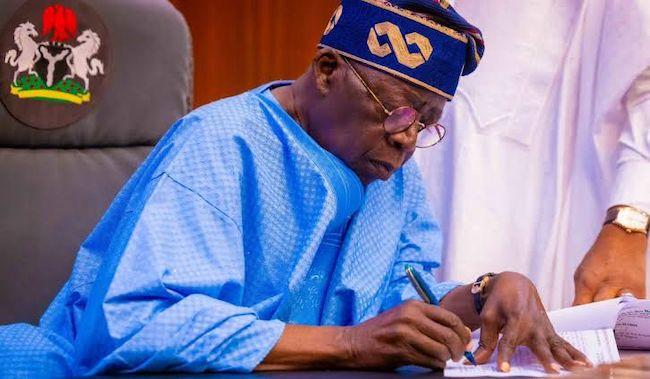


President Bola Tinubu has transmitted a national minimum wage bill to the House of Representatives in the National Assembly for consideration and passage.
The President and the leadership of the Organised Labour had last Thursday agreed on ₦70,000 as the new minimum wage for Nigerian workers.
Information Minister Mohammed Idris had said “the new national minimum that Mr President is expected to submit to the National Assembly is ₦70,000”.
READ ALSO: Why We Accepted Tinubu’s New Minimum Wage – Labour
The truce between the government and labour sides followed a series of talks between labour leaders and the President in the last few weeks after months of failed talks between labour organs and a tripartite committee on minimum wage constituted by the President in January.
The committee, which comprised state and federal governments and the Organised Private Sector, had proposed ₦62,000 while labour insisted on ₦250,000 as the new minimum wage for workers who currently earn ₦30,000 as minimum wage.
Labour had said ₦30,000 was unsustainable for any worker going by the economic vagaries of inflation and high cost of living which followed the removal of petrol subsidy by the President.
READ ALSO: [JUST IN] MINIMUM WAGE: Again, Labour Leaders In Closed Session With Tinubu
Despite its initial insistence on ₦250,000 as the new minimum wage, Labour accepted the President’s offer of ₦70,000 last Thursday.
The President of the Nigeria Labour Congress (NLC), Joe Ajaero, said Labour accepted ₦70,000 and rejected a proposal by President Bola Tinubu to pay ₦250,000 minimum wage on a condition to increase petrol prices.
He also said Labour agreed to the ₦70,000 offer because minimum wage won’t be reviewed once in five years anymore but once every three years.
The transmission of the wage bill came about six weeks after the President said in his Democracy Day speech on June 12, 2024 that an executive bill on the new national minimum wage for workers would be sent to the National Assembly for passage.




News
OPINION: Nigeria’s Ass In The Lion’s Skin


By Lasisi Olagunju
“Those who educate children well are more to be honored than they who produce them; for these only gave them life, those the art of living well.” — Aristotle.
The Ass in the Lion’s Skin is Aesop’s story of a donkey who finds a lion’s skin abandoned in the forest. He wears it and begins to terrify other animals who mistake him for a lion. Delighted by the fear he inspires, the ass grows bold and starts roaming everywhere with counterfeit majesty. But one day, unable to contain himself, he brays. The sound betrays him instantly. The animals discover that beneath the lion’s appearance stood only a donkey. Soon, he becomes food for the real majesties of the forest.
Moral: appearances and shortcuts cannot substitute for substance.
At the top of this page, Aristotle urges society to honour teachers, but he attaches a condition to that honour: they must “educate well.” In that single adverb — “well” — lies the entire question of quality. If you teach, teach well. But how does one teach well after escaping the rigours that produce good teachers?
Education minister, Tunji Alausa, some days ago announced that candidates seeking admission into Colleges of Education would no longer be required to sit the UTME. Under the new policy, applicants need only four SSCE credits; no competitive entrance examination. The only other requirement is registration with the Joint Admissions and Matriculation Board (JAMB). The decision marks a sharp departure from the previous system in which all tertiary institution candidates sat the UTME.
I was reading Luther Sheeleigh Cressman’s ‘The Teacher: An Old Tradition and a New Obligation’, published in November 1930, and came across a striking description of the teacher in antiquity. The teacher, he wrote, was “the one who led the boy and in so doing led him to know what life expected of him.” He was the guide who passed down to the young the values of society and helped them make sense of the world around them.
Now what makes a teacher?
Not all who wear the masquerade’s mask are ancestors. The mask alone does not make the spirit; authenticity matters. A teacher who lacks knowledge of what he teaches, who teaches nonsense, is no teacher at all. Nigeria’s education policy has long produced such teachers. Now, it has embarked on a more ambitious journey: to manufacture the appearance of access while quietly weakening the substance of standards.
I spoke with old and young friends teaching in universities and colleges of education. They all agree that teacher education is the bedrock of a nation’s overall development. “A nation cannot rise above the quality of its teachers,” one of them, an old schoolmate, lamented. He was right.
A nation may celebrate rising admission figures and boast that barriers have been removed, but if the intellectual gatekeeping that guarantees quality is dismantled, the system eventually betrays itself, just as the donkey’s bray exposed him.
Minimum JAMB admission scores are now 150 for universities, 100 for polytechnics and effectively zero for colleges of education. Some private universities are even pushing for 80. Their argument is that they would patch up the poverty of the intakes later. But what kind of system does that and still expects to stand?
The Yoruba have a proverb: Iyawo bẹ́ẹ̀ bẹ́ẹ̀, ọmọ bẹ́ẹ̀ bẹ́ẹ̀ ni í bí fún ni — the wife you marry as “manage” will produce “manage” children. A marriage consummated in patchwork will produce patchwork offspring. Computer scientists call it “garbage in, garbage out.”
READ MORE FROM THE AUTHOR: [OPINION] Awolowo: Legacies And Prophecies
The irony is painful. The teacher stands at the foundation of national progress and development. Every professional who preens in personal or collective success first passed through the hands of a teacher. To dilute the entry threshold into teacher education, therefore, is to tamper with the roots while hoping the branches will flourish.
What, if I may ask, are the ultimate goals of this policy? To populate the colleges and produce more teachers without substance? The irony is painful: the Tinubu government’s mantra is ‘Renewed Hope.’ But what hope lies in a policy whose disaster is already predictable? Ghanaian writer, Ayi Kwei Armah, wrote in The Beautyful Ones Are Not Yet Born: “When you can see the end of things even in their beginnings, there’s no more hope, unless you want to pretend, or forget, or get drunk or something.”
But our husbands in power insist that these measures are necessary to save the system from collapse. The colleges, they say, must have students. They must destroy the system in other to save it.
The whole scenario resembles a Yoruba tale explaining the monkey’s sunken eyes. Dissatisfied with the arrangement of her child’s eyes, monkey’s mother tried to adjust them. In the process, she pushed them too far inward into their sockets, and the deformity became permanent.
That is often what we do with public policy here: in the name of reform, we destroy the very thing we claim to improve. It is the danger of misguided correction — an attempt to fix a problem that ends up worsening it irretrievably.
By abolishing the UTME requirement for colleges that train teachers, and by lowering entry standards into education faculties in the universities, the government has effectively weakened the gate into the profession responsible for producing every other profession including the ‘golden’ ones.
There is another Aesop fable that speaks directly to this logic. It is the story of the farmer whose hen laid golden eggs.
Impatient with the slow but steady reward, the farmer concluded that if one golden egg came each day, then a treasure must surely be hidden inside the bird itself. In greed and foolish haste, he killed the hen, only to discover that it was no different from every other hen. In trying to get more, he destroyed the very source of his wealth.
That is the tragedy of teacher education in Nigeria. In the desperation to fill classrooms, the country is destroying the very standards needed to produce competent teachers that will produce tomorrow’s wealth.
Removing the entry gate to teacher training schools sends a troubling message: that teaching no longer requires rigorous intellectual preparation. Instead of attracting bright and committed young people into education, the government has confirmed an old social prejudice — that Colleges of Education are refuges for academic rejects. Rather than pull the system back from free fall, government may have pushed it further toward the cliff’s edge.
READ MORE FROM THE AUTHOR: OPINION: ‘I Am Jagaban, They Can’t Scare Me’
The cliff is a hair’s breadth from disaster. A nation that weakens the process of producing teachers should not be surprised when ignorance multiplies in its classrooms and mediocrity parades itself as national leadership. Take a look at the quality of some of the persons in charge of your country. Who were their teachers? You would want to know.
A very senior professor heard the minister, and, with a very heavy heart, fired a message to me: “You have the language… Please can you address this new policy (announced by the Minister of Education) of no entrance exam to study at the College of Education? Already, the quality of output is incredibly poor as only those who could not make the grades are being admitted to Education. Yet, these are the people that will be teaching in our schools. Please, what is wrong with us?
“As vice chancellor, in my fourth year, I insisted that only those who applied for programmes in Education would be admitted to the university’s Faculty of Education and not those who failed to meet the grades in other courses. We cannot afford to afflict our children with people who only found themselves in Education because they could not make the grades elsewhere. It is worse now; they do not have to write any exam again to enter.”
Leading me by the hand, the professor showed me statistics from the Joint Admissions and Matriculation Board (JAMB). Between 2015 and 2019, JAMB statistics reveal the depth of the crisis confronting Nigeria’s Colleges of Education. In 2015, the institutions had a carrying capacity of 215,397 students, yet only 18,722 candidates applied, representing just 8.69 percent of available spaces. Admissions stood at 74,555, which was only 34.61 percent of approved quota.
The pattern continued in 2016. Although the carrying capacity rose to 248,446, applications dropped to 18,365, amounting to only 7.39 percent of quota. Admissions also declined proportionately to 71,554, representing 28.80 percent of available spaces.
In 2017, the carrying capacity expanded dramatically to 365,392. However, applications increased only marginally to 35,905, or 9.83 percent of quota, while admissions stood at 74,165, representing just 20.29 percent utilisation of capacity.
The situation worsened in 2018. Out of a carrying capacity of 390,685, only 24,525 candidates applied, amounting to a mere 6.28 percent. Admissions dropped further to 59,366, representing only 15.19 percent of quota.
By 2019, the carrying capacity had climbed to 403,225, yet applications remained critically low at 34,138, or 8.47 percent of approved spaces. Admissions rose slightly to 69,610, but this still accounted for only 17.26 percent of total capacity. Between 2019 and now, the figures have remained embarrassingly tragic.
What we have above exposes a stark reality: Nigeria’s Colleges of Education are overwhelmingly under-subscribed. Who, with both eyes open, would invest money, years and a future in schools whose certificates command so little worth? At no point within the five-year period did applications reach even 10 percent of approved quota, while admissions never exceeded 35 percent of carrying capacity.
My professor engaged me. He pointed to statistics on university undergraduates studying Education. The figures suggested that many admitted candidates were not originally interested in the discipline but were redirected into it simply because spaces existed there.
We spoke and agonised over the situation.
READ MORE FROM THE AUTHOR: OPINION: Ibadan, Makinde And Tinubu
But what can we do? We may have wisdom, but we do not have power (àwa l’ó l’ogbón, a ò l’ágbára). Fuji musician, Ayinde Barrister, sang that more than forty years ago.
My professor and I agree that those who want to read teacher education should actually have the highest scores in UTME with other loose ends tightened. But who would want to go through all the trouble and graduate into joblessness and poverty?
There is a reason why some other courses are very competitive. We all know the reason: some assurance of good life after the rigours of school life. Teaching on the other hand is burdened by low prestige, by poor remuneration and absence of social respect. How many of today’s teachers teach out of choice? A society that recruits reluctant minds into teaching should not expect inspired learning in its schools. Reluctant teachers will teach to fail.
Many candidates entering Colleges of Education today do so not out of passion but out of disappointment. They are often students who could not secure admission into more competitive programmes. Now, dismantling the little barrier of selection into the colleges won’t make the schools attractive to candidates of value.
The teacher is the quiet manufacturer of civilisation. A nation desperate for greatness cannot, therefore, afford to lower the gate into the teaching profession. If it does, as we do, the consequence is predictable: Badly trained teachers turn out weak in the classroom; weak teachers inevitably produce weak pupils, and weak pupils eventually become weak professionals, and weak leaders who produce weak institutions. The crisis multiplies across spheres, sectors and, even generations.
This is why the issue goes beyond education policy. It is about national survival.
In Aesop’s story, the farmer believed he was solving a problem. He thought he was accelerating prosperity. Instead, he destroyed the source of it. Nigeria is making the same mistake in its approach to teacher education with its choice of convenient quantity over quality.
An old teacher told me that “the temptation of governments everywhere is to pursue numbers: more admissions, more enrolment, more institutions, more certificates.” But, he said, education is not a factory for producing paper qualifications. It is the cultivation of minds. And cultivation requires standards.
So, what do we do? What Nigeria needs is not the dilution of teacher training but the elevation of the teaching profession itself. Bright students will not aspire to become teachers unless the profession is respected, properly rewarded and intellectually competitive. No self-respecting person will rush to go to gateless Colleges of Education unless they cease being waiting rooms for rejected university candidates.
What the government decided, and which the minister announced, was pure, painful irony: we complain daily about collapsing standards in our schools and we thought weakening the process of producing teachers is the solution. It is like diagnosing a sick person and poisoning their meal.
Eyo Ita was Leader of Government Business, Eastern Region of Nigeria. Nnamdi Azikiwe took over from him as premier in 1954. In 1948, Ita wrote about what he called “the vanishing race” of teachers and “the paradox of the undervaluation of the teacher.” Few people, he said, regarded the teacher as a significant part of “the wealth of the nation” in the same way they valued minerals and cattle, capital and tools of production, and other “raw” materials of culture. Yet, he argued, the teacher is “the soul of the people, the conscience of the race, the guardian of the spirit, and the shaper of destiny.”
Ita added that the teacher’s “shrine is so high and so far removed from the realistic world of flesh and blood, of yam and corn and clothes and shelter, that people usually forget about the teacher himself, except for brief moments.
“If the Nigerian teacher would sharpen his skill and strengthen his economic power; his profession would become more respectable and enviable; his economic power and social position would prevent him from being treated as a mere sport or worthless tool of politicians.” He warned that failure to integrate the teacher into the flux of life had “deprived the earth of its salt.”
Ita wrote those words 78 years ago. Twelve years later, Nigeria gained independence. Sixty-six years after independence, it is tragic that all the country can think of is to improve the teacher’s condition by debasing their work and diminishing them.
News
Otuaro: Baseless Allegations, Disregard Them, Group Urges Public

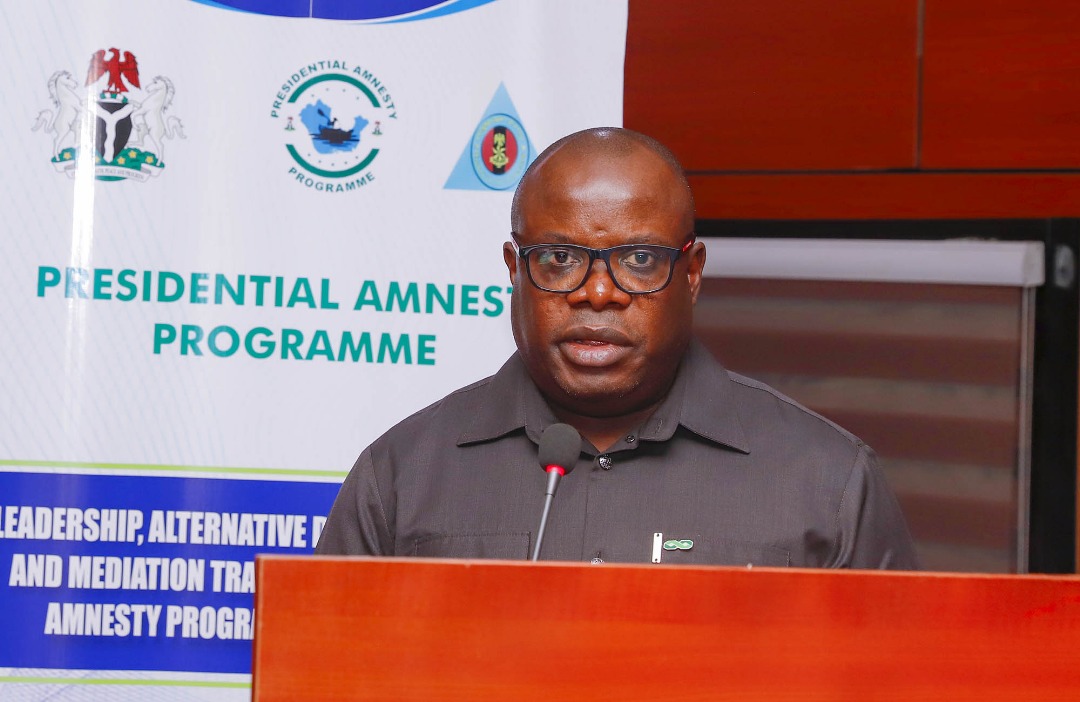
The Ijaw People’s Development Initiative, IPDI has reacted to a statement circulating online regarding the Presidential Amnesty Programme (PAP), describing it as baseless.
The statement under the disguise ‘Niger Delta Stakeholders Forum and Niger Delta Ethnic Nationalities,’ had demanded accountability regarding the management of the Programme and its administrator, Dr Dennis Otuaro.
Reacting to the statement, National President, IPDI, Comrade Austin Ozobo, said: “We consider it necessary to respond point by point to correct misconceptions, reject unsubstantiated claims, and keep the record straight in the interest of PAP beneficiaries, stakeholders, and the general public.
“It is worthy of note that the PAP operates under strict federal financial regulations and is subject to routine audits by the Office of the Auditor-General of the Federation, the Ministry of Finance, and other oversight bodies.
“All disbursements, including stipends, vocational training, education support, and third-party contracts, are processed through the Treasury Single Account, TSA, with verifiable records”, the statement read.
READ ALSO:PAP Sends Additional 15 Scholarship Beneficiaries For Post-Graduate Studies In UK
According to the IPDI, the Programme welcomes lawful criticism and scrutiny at any time. However, linking such a call to specific individuals without evidence amounts to trial by the media and undermines due process.
“Dr Dennis Otuaro, administrator of the Presidential Amnesty Programme has maintained a good record of financial management, hence no formal petition with verifiable evidence has been submitted to any anti-graft agency till date”.
“It may interest you to know that the N65,000 monthly stipend is fixed by the Appropriation Act and can only be reviewed through a budgetary process approved by the National Assembly and the Presidency.
‘The PAP management has consistently conveyed beneficiaries’ concerns on cost of living to relevant authorities”.
“Again, claims that allocations to the Programme have risen significantly while stipends remain unchanged misrepresents the budget structure.
READ ALSO:PAP: N’Delta Stakeholders Laud Otuaro’s 2 Years Of Strategic Reforms
“Note, increased allocations in recent years have been tied to expanded reintegration programs, education sponsorships, skills acquisition, and infrastructure support for training centers, not solely to stipend payments”.
The group reiterated that the allegation that the Amnesty Programme Office “kidnaps and detains delegates” is false, reckless, and defamatory, adding that the PAP has no paramilitary or law enforcement mandate, nor does it operate detention facilities and that any incident involving law enforcement is outside the control and purview of the Programme.
“We challenge the authors to provide verifiable details of time, place, and persons involved so the matter can be addressed through appropriate legal channels,” the group said
On Claims of Selective Empowerment and 500% Payment Increases, the group maintained that payments to contractors, ex-agitator leaders, and service providers were governed by existing contracts and agreements predating the current administration.
“No individual or camp has received unilateral increases without contractual basis or due process. Allegations of 500% increases are unsubstantiated and designed to stoke division among beneficiaries,” it added.
READ ALSO:Otuaro Links Increase In PAP Scholarship Beneficiaries To Tinubu
“The current administration has maintained a policy of transparency in engagement with leaders and has expanded inclusion by verifying and capturing previously omitted beneficiaries where due“, IPDI added.
The group further said, “The PAP remains a neutral, peace-building institution established under the 2009 Amnesty Declaration. Its mandate is to coordinate disarmament, demobilization, and reintegration. The Office does not engage in political victimization, intimidation, or exclusion of stakeholders. Engagement with ex-agitator leaders and community structures is conducted based on their role in maintaining peace and facilitating reintegration, not political alignment”.
“The PAP under Chief Denis Otuaro’s leadership remains committed to transparency, fairness, and the original mandate of the Amnesty Programme. Constructive criticism is welcome and has informed policy adjustments in the past. However, campaigns of calumny, unverified allegations, and attempts to drag the Programme into commercial or political disputes do not serve the interest of peace in the Niger Delta”, IPDI said.
“We urge all stakeholders to channel grievances through the established engagement channels of the Programme and to avoid statements that threaten the fragile stability we have worked to sustain”.
Consequently, the IPDI urges members of the public to disregard what its described as “flimsy and unsubstantiated allegations, misconception, and missives by faceless groups above“.
News
[OPINION] Olukoyede’s EFCC: Taming The ‘Fantastically-Corrupt’


Since its creation 23 years ago, by Chief Olusegun Obasanjo, as president of Nigeria, Africa’s most populous and influential country, the Economic and Financial Crimes Commission (EFCC), had apparently not gotten a head, who had piloted the affairs of the commission, like Mr. Olanipekun Olukoyede, its Executive Chairman, a chief-operations-officer of the Commission.
It could be said that Olukoyede, the Czar thief catcher and arrestor of economic saboteurs, has given the EFCC’s enemies such a tough time as he has taking the anti-graft fight to the doorsteps of the high-profile individuals across the country. These range from former state governors, serving and former ministers, retired and serving civil servants, businessmen, clergies, traditional rulers, cyber-influencer, entertainers, professionals and numerous others.
Olukoyede brings years of experience in law, fraud management, and business intelligence to bear on the position. Before him, Mallam Nuhu Ribadu was EFCC’s inaugural chair; succeeded by the first and only female, Mrs. Farida Waziri; Ibrahim Lamorde, Ibrahim Magu, and Abdul Rasheed Bawa.
The anti-graft agency has its hands full with massive financial fraud and money laundering cases. In the clause of “physicians, look at thyself”, EFCC in its resolve is known to have been flushing out officers within the body, who run foul to the law.
In the past, before Olukoyede’s appointment, it was widely believed that it was only the “fries and not the big fishes”, who the Commission could summon the courage to prosecute; and that most culprits were also left from the hook, because of compromise by some corrupt officers of the Commission, and feeble litigation processes.
Mr. Godwin Emefiele, former Governor of the Central Bank of Nigeria (CBN), happened to have opened to Olukoyede’s a deluge of “big-men and women”, who have been arrested, investigated and cooling their feet in detention or those bailed, that are facing severe court trials. There is the biggest 19-count charge at the Ikeja Special Offences Court, involving an alleged $4.5 billion fraud.
Immediate-paste governor of Kogi State, Yahaya Bello, faces two massive, but separate legal battles totalling over N190 billion on fraud allegation. EFCC secured from the Court of Appeal, forfeiture of 14 properties and huge money linked to him.
Abubakar Malami (former Attorney-General of the Federation), with his son, Abdulaziz and his wife, is currently charged on a-16-count of money laundering. The court has stayed interim forfeiture of 57 properties valued at over N213 billion.
MORE FROM THE AUTHOR:OPINION: Contesting The Portable Vs Carter Efe’s Cruel Ring-fight
EFCC had also secured the arrest of Sadiya Umar-Farouq, a female former Minister of Humanitarian Affairs, and a former Permanent Secretary, through a Federal High Court, on a 21-point alleged fraud and corruption charge, involving $1.3 million and N746.6m and others amounting to 37.1 billion.
Uju Kennedy-Ohanenye, also female and former Minister of Women Affairs, was removed from office by President Bola Tinubu, over alleged misappropriation and diversion of N138.4 million, and had been under EFCC questioning.
A recent discovery, which startled Nigerians and the world, the Commission (EFCC) had reportedly arrested a serving Director-General of the Energy Commission of Nigeria, Dr. Mustapha Abdullahi, over alleged money laundering involving about ₦500 billion.
Somewhat, this had deflated the claim that those arrested and persecuted are political opponents and not serving officers of the Tinubu’s government.
EFCC is a “Nigerian law enforcement and anti-graft agency that investigates financial crimes, such as advance fee fraud (419 Fraud) and money laundering. It was also set up to fight against corruption and to protect the country from economic saboteurs”.
The Commission, whilst responding to pressures from the Financial Action Task Force on Money Laundering (FATF), that named Nigeria as one of 23 countries not cooperating in the international community’s efforts to fight money laundering, had revved in performance, in a bid to roll back the blights.
And so, it is a strenuous goal for EFCC, as entrenched in the ‘EFCC Establishment Act 2004’, which gives it specialist jurisdiction against severe financial and commercial crime – covering multiple high and lower levels.
MORE FROM THE AUTHOR:OPINION: Tenebe Could Deprive Tinubu From Winning Edo Election
Born on 14 October 1969, Olukoyede, a civil servant, has had a clear break from past, where past executive chairmen of the Commission had left the Commission, where all serving officers were drafted from the Nigerian Police Force (NPF). However, President Bola Ahmed Tinubu is widely commended for Olukoyede’s appointment to the position, with the Senate also eulogized for screening him.
Whilst briefing the Press in Abuja, on his two-year activities in office, on October 23, 2025, the Commission’s boss certainly made unprecedented progress in the fight against economic and financial crimes. He spoke through the Director of Public Affairs of the Commission, Wilson Uwujaren, as he listed the recovery of N566 billion, alongside other currencies and assets, among the achievements of the Commission.
He further revealed that the Commission received over 19,000 petitions, conducted 29,240 investigations, filed 10,525 cases in court, and secured 7,503 convictions.
Olukoyede asserted that the Commission recovered ₦566,319,820,343.40, $411,566,192.32, £71,306.25, €182,877.10, and other foreign currencies from proceeds of financial and economic crimes. Added to this was the recovery of 1,502 non-monetary assets, comprising 402 properties in 2023, 975 in 2024, and 125 so far in 2025.
“Among these recovered assets are two notable landmarks: the final forfeiture of 753 units of duplexes in Lokogoma, Abuja, and the forfeiture of Nok University, now the Federal University of Applied Sciences, Kachia, Kaduna State,” he said.
He listed several high-profile cases prosecuted within the period, including those involving former governors Willie Obiano, Abdulfatah Ahmed, Darius Ishaku, Theodore Orji, and Yahaya Bello. Others are former ministers Olu Agunloye, Mamman Saleh, Hadi Sirika, Charles Ugwu, and former Central Bank Governor, Godwin Emefiele.
EFCC was also said to have reentered and invigorated some longstanding fraud cases, such as ones linking Fred Ajudua, former People Democratic Party, PDP National Chairman Haliru Bello Mohammed, ex-National Security Adviser Sambo Dasuki, and former Nigerian Social Insurance Trust Fund, NSITF boss, Ngozi Olojeme.
MORE FROM THE AUTHOR:OPINION: The Rough Games Arewa Bourgeoisies Play With The Talakawas
The EFCC said it arrested 792 suspects involved in asset and cryptocurrency frauds in Lagos, among who were 192 foreigners who were prosecuted and deported.
A Task Force on Naira Abuse and Dollarisation of the Economy was established by EFCC, which accordingly, had notable impacts in sanitizing money actions countrywide. “The campaign against naira abuse, racketeering, and speculative currency trading has helped reduce pressure on the naira and complemented the Central Bank’s efforts in stabilizing the economy,” he said.
Olukoyede also spoke on the Commission’s strengthened partnerships with foreign law enforcement agencies, including the Korean Police, Royal Canadian Mounted Police, Spanish Police, and German Police.
He also mention benefitting synergy with the FBI, the UK’s National Crime Agency (NCA), INTERPOL, and Japan’s JICA, in subsequent joint investigations and the repatriation of stolen assets to victims from Spain, Canada, and the United States.
Strengthening EFFC’s mandate at the regional level, and in Africa, Olukoyede and the Commission are said to be up and doing. For instance, a thing that had never happened to EFFC, he had been twice elected as President of the Network of National Anti-Corruption Institutions in West Africa (NACIWA), which led to the founding of a permanent secretariat in Abuja.
A strong media presence is needed to successfully inform the public of the ideals of EFCC and its update activities. And so, ‘EFCC Radio 97.3FM’, Nigeria’s first anti-corruption radio station, was established Olukoyede. EFCC should count itself very lucky for having in its fold, tested, diligent and veteran journalists who are ostensibly seasoned in the ideals and watchdog principles of the Commission.
-

 News4 days ago
Gun Battle In Oyo Forest As Police Disrupt ₦10m Ransom Collection Plot
-

 Politics3 days ago
Four Fubara Loyalists Disqualified As APC Clears 21 For Rivers Reps Primaries
-

 News3 days ago
Lagos Sanctions 15 Money Lending Companies For Sharp Practices
-

 Metro4 days ago
Drama As Teenagers Stage Secret Wedding With N3,000 Bride Price
-

 Politics3 days ago
2027: Court Rebukes Plaintiff, Lawyer In Suit Against Jonathan, Awards N1m Fine
-

 News4 days ago
PAP Sends Additional 15 Scholarship Beneficiaries For Post-Graduate Studies In UK
-

 Sports4 days ago
CAF Introduces New Laws After Chaotic AFCON Final In Morocco
-

 Metro2 days ago
‘My Husband Refused To Work, Took To Excessive Drinking, Smoking After He Returned From South Africa’
-

 News3 days ago
Adeleke: Crime Cannot Dethrone Apetu And Enthrone Oluwo
-

 News3 days ago
IGP Vows To End Impunity, Upgrade Traffic Warden Unit
