
Headline
Kenya Anti-tax Protests Death Toll Hits 13

The death toll from protests in Kenya has climbed to 13, an official from the main doctors’ association told AFP Wednesday, after anti-tax hike rallies turned violent and police opened fire at demonstrators who ransacked parliament.
The unprecedented scenes that left parts of parliament ablaze and gutted and injured scores of people on Tuesday have shocked Kenyans and prompted President William Ruto’s government to deploy the military.
The mainly youth-led rallies began mostly peacefully last week, with thousands of demonstrators marching in the capital Nairobi and across the country against the tax increases.
But tensions flared sharply on Tuesday afternoon, as police officers fired live rounds on crowds that later ransacked the parliament complex.
Hours later, Defence Minister Aden Bare Duale announced that the government had deployed the army to support the police in tackling “the security emergency” in the country.
“So far, we have at least 13 people killed, but this is not the final number,” Simon Kigondu, president of the Kenya Medical Association said, adding that he had never seen “such level of violence against unarmed people.”
“Deaths, mayhem”, read the front-page headline on the Standard newspaper, while the Daily Nation described the situation as “Pandemonium”, saying: “The foundations of the country have been shaken to the core.”
READ ALSO: You Can’t Kill All Of Us,’ Kenya Protesters Vow To March Again
An official at Kenyatta National Hospital in Nairobi said Wednesday that medics were treating “160 people… some of them with soft tissue injuries, some of them with bullet wounds”.
In a late-night press briefing, Ruto warned that his government would take a tough line against “violence and anarchy”, likening some of the demonstrators to “criminals”.
“It is not in order or even conceivable that criminals pretending to be peaceful protesters can reign terror against the people, their elected representatives and the institutions established under our constitution and expect to go scot-free,” he said.
The government has been taken by surprise by the intensity of opposition to its tax proposals –- mostly led by young, Gen-Z Kenyans — which culminated in the scenes at parliament that played out live on television.
Images shared on local TV stations after crowds broke through the barricades showed the building ransacked, with burnt furniture and smashed windows.
READ ALSO: 10 Things To Know About Kenya President-elect, Ruto
As police fired at the angry crowds, leaving several bodies strewn on the ground, protest organisers urged people to walk home together and “stay safe”.
– ‘Madness’ –
A heavy police presence was deployed around parliament early on Wednesday, according to an AFP reporter, the smell of tear gas still in the air.
A policeman standing in front of the broken barricades to the complex told AFP he had watched the scenes unfold on TV.
“It was madness, we hope it will be calm today,” he said.
Earlier on Tuesday, the rallies in various Kenyan cities had been largely peaceful.
However, tensions escalated in Nairobi later in the day, with some protesters hurling stones at police, who deployed tear gas and water cannons before firing live bullets.
AFP journalists saw three people bleeding heavily and lying motionless on the ground near parliament.
READ ALSO: You Can’t Kill All Of Us,’ Kenya Protesters Vow To March Again
– ‘Brute force’ –
The unrest has alarmed the international community, with the White House appealing for calm and more than 10 Western nations — including Canada, Germany and Britain — saying they were “especially shocked by the scenes witnessed outside the Kenyan Parliament”.
UN chief Antonio Guterres and the head of the African Union Commission, Moussa Faki Mahamat, have also expressed deep concern.
Veteran opposition leader Raila Odinga, who heads the Azimio coalition, accused the government of unleashing “brute force on our country’s children”.
Rights watchdogs have also accused the authorities of abducting protesters.
The police have not responded to any AFP requests for comment.
– Cost of living –
READ ALSO: Five Killed During Kenya Anti-tax Protests
Long-running grievances over the rising cost of living spiralled last week as lawmakers began debating proposed tax hikes in the 2024 finance bill.
The cash-strapped government says the increases are needed to service the country’s massive debt of some 10 trillion shillings ($78 billion), equal to roughly 70 per cent of Kenya’s GDP.
After rolling back some of the more controversial proposals — which would have affected bread purchases, car ownership, and financial and mobile services — the government now intends to increase fuel prices and export duties.
Kenya’s treasury has warned of a gaping budget shortfall of 200 billion shillings, following Ruto’s decision to roll back some of the tax hikes.
While Kenya is among East Africa’s most dynamic economies, a third of its 52 million population live in poverty.
AFP



Headline
Russia, China Afraid Of US Under My Administration — Trump
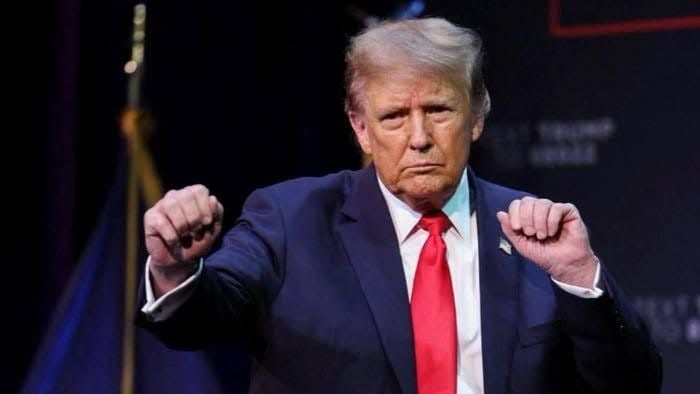
United States President, Donald Trump, has said Russia and China fear the United States because of the strength of his administration, arguing that American global influence is driven primarily by its military power and leadership.
Trump, in a post on Truth Social on Wednesday stated that rival powers would not take NATO seriously without the United States, claiming the alliance lacks deterrent force in the absence of American involvement.
He expressed doubts about whether NATO members would come to the aid of the US in a real crisis, despite Washington’s continued commitment to the alliance.
READ ALSO:Trump To Withdraw US From 66 UN, International Organisations
The president credited his leadership with rebuilding the US military during his first term and sustaining its strength, describing this as the key reason adversaries show respect and caution toward the country.
He maintained that America’s military dominance has played a central role in preserving global stability and saving lives.
Trump also argued that his administration forced NATO members to increase defence spending, saying many allies had previously failed to meet financial commitments while relying heavily on the US.
READ ALSO:Insecurity: US Congressman Riley Moore Reveals Trump’s Mission In Nigeria
He added that his actions helped prevent further escalation in Eastern Europe and contributed to the resolution of multiple conflicts.
According to Trump, the United States remains the only nation that commands genuine fear and respect from both Russia and China, a position he attributed to his administration’s approach to defence, diplomacy, and global leadership.
“He wrote partly, “The only Nation that China and Russia fear and respect is the DJT REBUILT U.S.A. MAKE AMERICA GREAT AGAIN!!! President DJT.”
Headline
Trump To Withdraw US From 66 UN, International Organisations
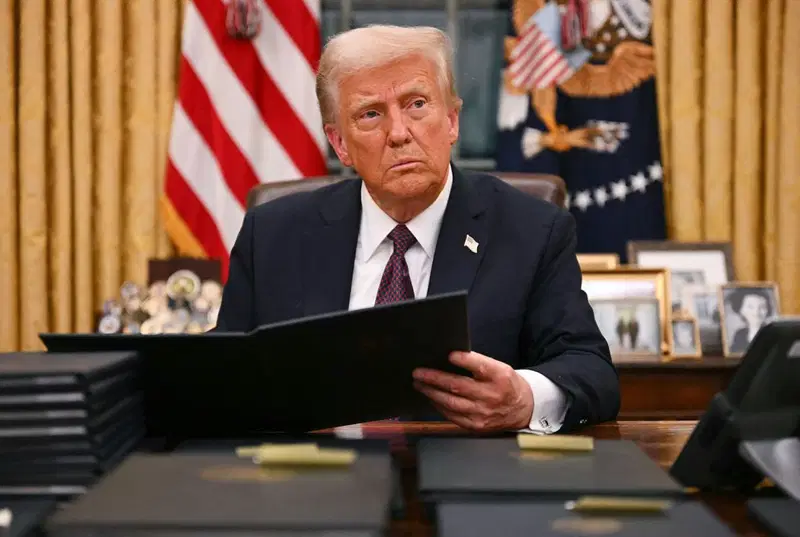
United States President, Donald Trump, has announced plans to withdraw the US from 66 United Nations and international organisations, including key global bodies focused on climate change, peace and democracy.
The decision was disclosed in a presidential memorandum released by the White House on Wednesday evening, following a review of which “organizations, conventions, and treaties are contrary to the interests of the United States.”
According to Trump, the move will see the US end its participation in the affected organisations and cut all related funding.
A list shared by the White House showed that 35 of the organisations are non-UN bodies, including the Intergovernmental Panel on Climate Change (IPCC), the International Institute for Democracy and Electoral Assistance, and the International Union for Conservation of Nature.
READ ALSO:Trump’s Airstrikes: Halt Military Cooperation With US Immediately – Sheikh Gumi Tells Tinubu Govt
Although listed as a non-UN body by the White House, the IPCC is a United Nations organisation that brings together leading scientists to assess climate change evidence and provide periodic reports to guide political leaders.
The memorandum also announced the US withdrawal from 31 UN entities, including the UN Framework Convention on Climate Change (UNFCCC), the UN Democracy Fund, and the UN Population Fund (UNFPA), which focuses on maternal and child health.
Several of the targeted UN bodies are involved in protecting vulnerable groups during armed conflicts, including the UN Office of the Special Representative of the Secretary-General for Children and Armed Conflict.
Reacting to the announcement, UN spokesperson Stephane Dujarric said in a note to correspondents on Wednesday evening that the organisation expected to issue a response by Thursday morning.
Despite repeatedly stating his desire to limit US involvement in UN forums, Trump has continued to exert influence on international decision-making.
READ ALSO:Trump Using FBI To ‘Intimidate’ Congress, US Lawmakers Cry Out
In October last year, he threatened to impose sanctions on diplomats who formally adopted a levy on polluting shipping fuels that had already been agreed to at an earlier meeting, a move that stalled the deal for 12 months.
The Trump administration also sanctioned UN special rapporteur Francesca Albanese after she released a report detailing the role of international and US companies in Israel’s genocidal war on Gaza.
During his first term in 2017, Trump similarly threatened to cut aid to countries that supported a draft UN resolution condemning the US decision to recognise Jerusalem as Israel’s capital.
As a permanent member of the UN Security Council, the US wields significant influence at the United Nations, including veto power, which it has repeatedly used to block efforts to end Israel’s war on Gaza before later mediating a ceasefire.
(Aljazeera)
Headline
UK Supported US Mission To Seize Russian-flagged Oil Tanker – Defense Ministry
The British Ministry of Defence said on Wednesday that it provided support to the United States in its operation to seize a Russian-flagged oil tanker in the North Atlantic.
US seized the tanker, which was being shadowed by a Russian submarine on Wednesday, after pursuing it for more than two weeks across the Atlantic as part of Washington’s efforts to block Venezuelan oil exports.
According to Britain, its armed forces gave pre-planned operational support, including basing following a US request for assistance.
READ ALSO:UK Introduces Powers To Seize Phones, SIM Cards From Illegal Migrants
The UK also said a military vessel provided support for the US forces pursuing the tanker, and the Royal Air Force provided surveillance support from the air.
Defence Secretary John Healey stated that the operation targeted a vessel with a nefarious history linked to Russian and Iranian sanctions evasion networks.
“This action formed part of global efforts to crack down on sanctions busting,” he said in a statement.
READ ALSO:Venezuelan Deportees: US Embassy Gives Reason For Reducing Visa Validity For Nigerians
According to him, the US was Britain’s closest defence and security partner.
“The depth of our defence relationship with the US is an essential part of our security, and today’s seamlessly executed operation shows just how well this works in practice,” he added.
The British government said that the Bella-1 tanker, now renamed Marinera, is sanctioned by the US under its counter-Iran sanctions,
The MoD statement said the support was provided in full compliance with international law.

 News4 days ago
What I Saw After A Lady Undressed Herself — Pastor Adeboye
- Headline4 days ago
PROPHECY: Primate Ayodele Reveals Trump’s Plot Against Tinubu
- Metro4 days ago
Armed Robbers Shot PoS Operator To Death In Edo
- Business3 days ago
NNPCL Reduces Fuel Price Again
- Metro3 days ago
AAU Disowns Students Over Protest
- Metro5 days ago
Joint Task Force Kills 23 Bandits Fleeing Kano After Attacks
- Politics4 days ago
2027: Rivers APC Pledges To Follow Wike’s Instructions
- Metro3 days ago
Edo: Suspected Kidnappers Kill Victim, Hold On To Elder Brother
- Metro3 days ago
Nine Soldiers Feared Dead In Borno IED Explosion
- Entertainment4 days ago
Anthony Joshua Returns To UK In Private Jet


