
News
Naval Officer In Face-off With Wike Breached The Law — SAN
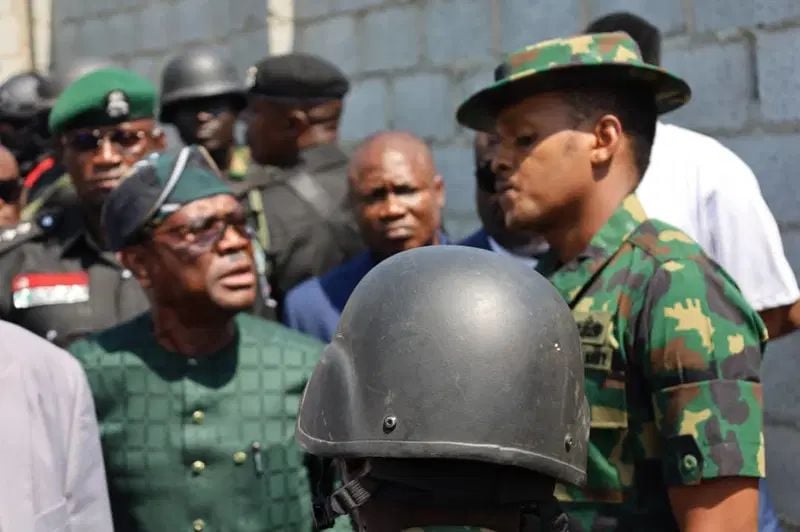
A Senior Advocate of Nigeria and constitutional law expert, Prof. Sebastine Hon, has faulted the conduct of Naval Officer A.M. Yerima in his confrontation with the Minister of the Federal Capital Territory, Nyesom Wike, describing the officer’s actions as a “breach of the law.”
Reacting to the incident in a Facebook post on Wednesday, Hon condemned the officer’s decision to obstruct Wike’s access to a disputed plot of land in Abuja, saying the act could not be justified under any lawful military order.
“Brushing sentiments aside, I hereby condemn in totality the actions of the Naval Officer, A.M. Yerima, who obstructed the FCT Minister from gaining access into that parcel of land, under the guise of ‘obeying superior orders.’
“The duty of a junior officer to obey the orders of his superiors, even though strongly upheld in military and paramilitary circles, has its own limitations recognised by no other authority but the Supreme Court of Nigeria,” he wrote.
Hon cited Supreme Court rulings in Onunze v. State (2023) 8 NWLR (Pt. 1885) 61 and Nigeria Air Force v. James (2002) 18 NWLR (Pt. 798) 295, which, according to him, clearly established that military officers are not bound to obey illegal or manifestly unjust orders.
READ ALSO:I’ll Support Trump To Fight Terrorism In Nigeria If… – Wike
“The illegality in that order stems primarily from the fact that no service law of the military permits a serving military officer to mount guard at the private construction site of his boss, especially under suspicious circumstances like this,” he stated.
He added that if security concerns existed, “the retired Naval Officer ought, under the circumstances, to have engaged the civil police.”
Hon further stressed that as the FCT minister, Wike exercises the powers of the President over land administration in Abuja, pursuant to Sections 297(2) and other provisions of the 1999 Constitution (as amended).
He said, “By Section 302 of the same Constitution, read together with other extant Acts of the National Assembly, the President of Nigeria has delegated all powers with respect to land administration in the FCT Abuja to the minister.
“Going by constitutional and administrative law, therefore, Mr Wike stood in loco of the President of Nigeria and Commander-in-Chief of the Nigerian Armed Forces on that fateful day.
READ ALSO:Nnamdi Kanu: Court Summons Wike, Buratai, T. Y Danjuma, Uzodinma, Others As Witnesses
“Consequently, even if the superior officer were still in service, he would not disobey Mr Wike or obstruct him from entering the land. This was an affront to the civil authority of Mr President.”
While acknowledging the minister’s method may be brash, he said Wike’s action “is legal and lawful in all respects.
“Rather, it is the officer who obstructed him that has breached not just the Nigerian Constitution, but also service and extant regulatory laws.
“For the avoidance of any doubt, Section 114 of the Armed Forces Act makes military personnel criminally liable for civil offences.
“This means the officer in question could be arraigned before a Court Martial for obstructing a public officer from performing his public duties, et cetera,” he added.
READ ALSO:Protest Rocks PDP National Secretariat As Wike-led Faction Takes Over
The law professor cautioned against celebrating the incident, warning that condoning such acts could embolden security personnel to disrespect civil authority.
“If such intolerable conduct by the young officer is not punished or is celebrated, this may unleash a reign of terror by the men in khaki against hapless civilians — with a grin or boast that ‘we did it to Wike and nothing happened,’” he concluded.
Hon is among the voices joining the public discourse following Tuesday’s heated clash between Wike and the naval officer at a disputed land site in Abuja.
The confrontation occurred at Plot 1946, Gaduwa District, Abuja, when officials of the Federal Capital Territory Administration, acting under Wike’s order, attempted to enforce a stop-work/demolition order over a lack of title documents.
Video of the encounter, which circulated widely on social media, shows the FCT Minister and his team being blocked by uniformed personnel and exchanging heated words with Yarima.
READ ALSO:Why Wike Is Always Attacking Peter Obi — Obidient Movement
Wike accused the soldiers and the developers of land grabbing and vowed not to be intimidated by any individual or group.
Addressing the press after the confrontation, the minister said he would not succumb to blackmail.
He recounted that the military intervened during the enforcement of FCT directives, which prompted the confrontation.
“When they came here, I was informed that the military came to chase them away, and I thought they were acting illegally.
“So today, while I was in the office, they came to implement the directive that was given to them by myself. I was told that the military had taken over the place, and I had to come by myself. It is really unfortunate.
“I do not understand how somebody who attained that position sees that he has a problem and cannot approach my office to say, ‘look, this is what is going on,’ but simply because he is a military man, he could use that to intimidate Nigerians. I am not one who will succumb to blackmail or intimidation,” Wike said.



News
Shatta Wale Bailed Burna Boy From Ghana Prison After Arrest For Smoking Weed – Captan

Ghanian singer, Captan, has claimed that his former record label boss, Shatta Wale, once bailed Nigerian singer Burna Boy out of prison in Ghana after he was allegedly arrested for smoking weed.
Speaking in a recent podcast interview, Captan claimed that Shatta Wale sent him and others to free Burna Boy from police custody.
He also claimed that Shatta Wale and his group once accommodated Burna Boy when he was being hunted by some dangerous men.
READ ALSO: Wale Edun Opens Up After Sack
Captan said, “I once bailed Burna Boy out of prison in Ghana when he was arrested for smoking weed. Shatta Wale sent me and some guys to go and free him from police custody.
“There was a time we also accommodated him when some people were after his life. We helped him settle the case.”
He added that he and Burna Boy are no longer in good terms after the Nigerian artist’s fallout with his mentor, Shatta Wale.
He, however, said he and Shatta Wale are open to reconciling with Burna Boy if he asks for it.
Watch the video here
News
Children’s Day: Chaos At Ogbe Stadium As Dozens Faint

Chaos erupted on Wednesday during the Children’s Day celebration as dozens of students reportedly collapsed following a stampede triggered by the use of pepper spray.
The event,
organised by the Edo State Ministry of Education at the Samuel Ogbemudia Stadium was disrupted after some male students of Ihogbe College allegedly made uncompromising advances towards female students at the venue.
A parent who identified himself as Oboh Emmanuel said, “the behaviour of those uncultured students attracted the attention of bouncers stationed at the stadium as they rebuked the male students.”
Oboh said the affected students later regrouped and attacked the bouncers, leading to a confrontation within the crowded arena.
READ ALSO:Children’s Day: Edo Commits To Child Protection
It was gathered that in the ensuing confusion, the bouncers were reported to have deployed pepper spray in an area occupied by a large number of students.
Several students, particularly female students, reportedly fainted after inhaling the substance, while others sustained injuries after being stepped on during the ensuing melee.
The panic was said to have spread across the stadium as students, teachers and parents scampered for safety.
Many of the affected students were reportedly rushed to the Edo Specialist Hospital for medical attention.
READ ALSO: Egor LG Chair, Ogbemudia, Vice, Osawe Impeached
Reacting to the incident, Chief Press Secretary to Governor Monday Okpebholo, Dr Patrick Ebojele, said the security personnel that fired the tear gas had been detained.
He said all the students, except two, that were rushed to the hospital have been discharged.
Ebojele stated that doctors wanted to observe the students till tomorrow before allowing them to go home.
“The two students are not seriously injured. Doctors want to observe them overnight. Permanent Secretary, Ministry of Education is still at the hospital. The man who used pepper spray has been detained.
“The incident did not happen the way it is being exaggerated. All modalities were put in place to ensure the children enjoyed their day.”
News
Okpebholo Salutes Edo Muslims, Seeks Continued Support, Prayers
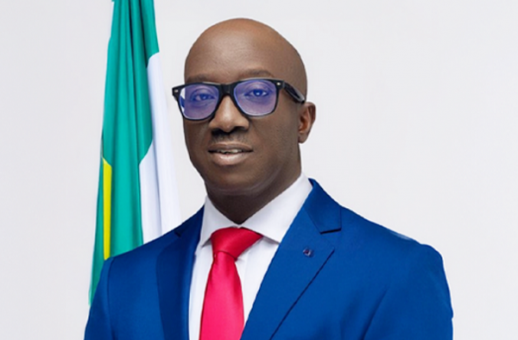
Governor Monday Okpebholo of Edo State has urged Muslims and all Nigerians to continue to pray for peace, unity and progress in the country even as they celebrate the annual Eid-al-Adha
The governor, who was represented by his deputy, Dennis Idahosa, stated this during the annual Eid-al-Adha celebration with Muslim faithfuls held at Government House in Benin City.
He reiterated his administration’s commitment to fairness, inclusivity and equal opportunities for all citizens irrespective of religion and tribe.
READ ALSO:ADC Penetrates Okpebholo’s District As Defections Strengthen Party in Edo Central
According to him, the present administration remains determined to building a government that reflects the diversity of Edo State, noting that competent and qualified Muslims have continued to play vital roles in his government because of their capacity, integrity and commitment to service.
“As a government, we remain committed to fairness, inclusivity and equal opportunity for every Edo citizen, irrespective of religion, ethnicity or political affiliation. This is why quality and competent Muslims are serving in key positions in our administration.”
Okpebholo appreciated the Muslim community in Edo State for their unwavering support and continuous prayers for his administration, noting that such prayers and support have contributed immensely to the peace and steady development being witnessed across the state.
READ ALSO:Okpebholo Felicitates Muslims On Eid-el-Fitr Celebration
He then called on all Nigerians to use the occasion of Eid-al-Adha to pray for the administration of President Bola Ahmed Tinubu, stressing that the country needs collective prayers, unity and cooperation to overcome its present economic and security challenges.
“I urge all Muslims and indeed all Nigerians to use this occasion to pray for our dear nation and for the administration of President Bola Ahmed Tinubu. Nigeria needs our collective prayers, unity and support as we strive to overcome our challenges and build a more prosperous future for all.”
In his remarks, the Chief Imam of Edo State, Abdulfatai Enabulele, applauded the governor for what he described as remarkable developmental strides recorded in less than two years in office.
The cleric commended the administration for ongoing infrastructural development and efforts geared towards improving governance in the state, but appealed to the government to revisit and complete some abandoned projects inherited from the previous administration for the benefit of the people.

 Metro5 days ago
My Husband Abandoned Me On Our Wedding Night To Attend Political Meeting, I Want Our Marriage Dissolved
- Headline4 days ago
Woman Passes Out After Receiving 100 Strokes Of Cane
- Headline4 days ago
JUST IN: White House Locked Down Briefly As Gunman Opens Fire At Security Checkpoint
- Politics5 days ago
Warri Ijaw Hail INEC Delineation Report, Call For Additional Electoral Wards, Others
- Politics3 days ago
Two Masked Men Gun Down Politician In His Rivers State Hotel
- Metro5 days ago
My Wife Stop Cooking My Food, Beats Me Black And Blue All the Time, Man Tells Court
- News5 days ago
Alleged Terrorism: Court Rejects Defendant’s Bid To Travel Abroad
- News3 days ago
More Pain For Nigerians As Cooking Gas Price Increases Nationwide
- News3 days ago
FG Declares Two Days Public Holiday For Eid-el Kabir Celebration
- Politics5 days ago
What I’ll Do As President Of Nigeria — Amaechi


