
Headline
Nigerian Workers Lament High Cost Of Food Items, Others
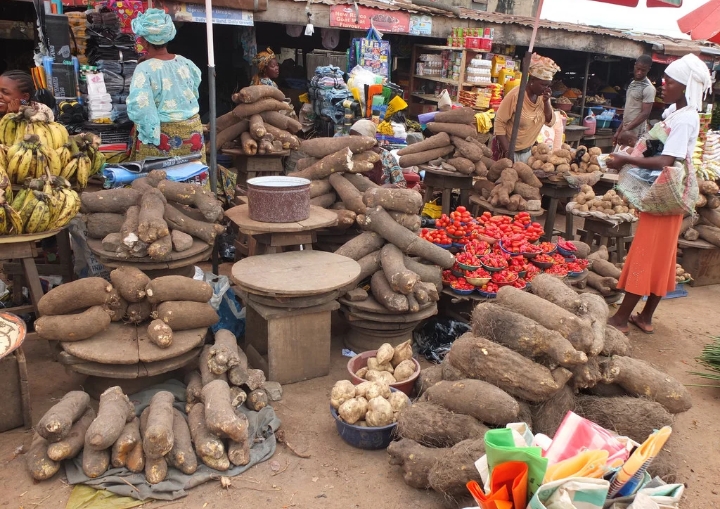
The standard of living of an average Nigerian under President Muhammadu Buhari government is steadily declining every day as prices of food continue to skyrocket daily.
Without any doubt, the current increase in prices of goods and services is tied to low farming activities, low productivity as a result of the worsening insecurity, especially in the Northern region. Many farmers flee their farms out of fear for their lives as bandits, Boko Haram, and herdsmen attack communities and kidnap families.
The current realities are forcing families into hunger, as an average Nigerian who could afford to feed three times in a day are now struggling to feed twice or less, because of the economic situation in the country.
On a monthly basis, prices of food items appear to be increasing in major cities in Nigeria. For example, the prices of flour products such as ‘bread’, grains such as ‘rice, beans, garri’, and regular beverages have experienced unimaginable hike in price within the last one month if compared with previous months within the year.
DAILY POST findings reveal that, “the price of the regular ready to eat can fish ‘Sardine’ sold at N300 now goes for N600 at the market and sell at N700 in supermarkets across the country. A bag of beans sold at N30,000 early last month ‘September’ now costs between N50,000 and N100,000. Also, sachets of beverages (e.g, milk, milo) sold at N700 now sells at N1200, cooking gas 5kg sold at N2000 now sells at N3000”. Bread that used to sell for between N350 to N400 now sells for N700. Almost all the prices of consumables have doubled within the last 1 month.
Millions of working-class Nigerians can no longer live a decent life on their income not to talk of those earning lower than the minimum wage. The question that brothers most Nigerians is, “how does a Nigerian who earns a minimum wage of N30,000 survive with the current hike in the price of food? How do families feed?” Sadly, these questions remain unanswered.
The country’s national minimum wage is N30,000 per month, mainly applicable to civil servants as some private sectors pay as low as N15,000 to workers. Also, many state governments are yet to implement the new minimum wage.
DAILY POST interacted with some Nigerians who expressed their sadness over the situation, calling on the government to act immediately.
A worker simply identified as Gloria said it’s been hard for her to feed as a spinster since the change in price.
She said, “I used to eat three times a day with breakfast but now I just manage to feed twice. During Goodluck time, I used to eat three times but now I eat once, my salary increase doesn’t even matter because I could afford more things years ago than I can now, but I spend way higher.”
Mr Dapo, a civil servant, lamented that he has two kids and is finding it hard to cater to them. He said, “I go to work every day and I cannot boast of my salary taking care of my family anymore. The lunch pack for my kids has reduced because even biscuits have increased. The other day, I went to buy gas for N10kg, it has increased too. My wife keeps complaining that the money she uses to feed the family for a month can barely sustain us for two weeks. What does Buhari want us to do? Is this the change he promised us? I don’t think we have anything like average Nigerians, it’s either you’re poor or rich under this Buhari government.”
One Mr Akin who works at a private company in Wuse 2 lamented that these days, he misses lunch break at work twice in a week because of the increase in prices of stuff in order not to be stranded before the end of the month. He said, “I wouldn’t lie to you madam, things are becoming worse oh! Imagine lunch I buy every day at N500 is now N700 and its even in smaller quantities. The woman in the canteen does not even sell N100 plantain; it starts from N200. How does Buhari want responsible workers to live a good life? As a young man, now I can’t even think of having a girlfriend not to talk of taking her on a date because of how expensive things are. This government just wants us to struggle and not be able to even live a decent life. I don’t even know what the government is doing to stop this, but they need to help us regulate these prices. We can’t live like this till 2023. Please help us talk to them, at least they’ll listen to the media”.
Recall that on October 1st, President Buhari during his Independence Day speech blamed the middlemen for the rise in food prices, stating that the middlemen have been buying and hoarding these essential commodities for profiteering. He directed the Ministry of Agriculture and Rural Development to rehabilitate the National Food Reserve Agency and also work with security agencies, the Nigerian Commodity Exchange, and the National Assembly to find a lasting solution to these disruptive and unpatriotic hoarding activities.
READ ALSO: ‘Buhari Has Finally Finished Us’, Nigerians Lament s ‘Pure Water’ Now Sells For N300, N400 Per Bag
The president said, “To further enhance food production, we have completed several new dams and are in the process of rehabilitating several River Basin Development Authorities to enhance groundwater supply for rainfed agriculture as well as surface water for irrigation agriculture”.
The House of Representatives, days ago also set up a special committee to conduct an investigative hearing with all critical stakeholders in the country and carry out the root cause analysis on the rising cost of food items.
But if the government fails to find a lasting solution to insecurity issues such as bandits attack in communities, herdsmen attacks on farmers and villages, the prices of food will continue to rise, and the unemployment rate will increase.
The current realities have caused businesses to shut down over the cost of production. Experts believe the trend has an adverse effect on unemployment rate which is already high.
DAILY POST observes that unemployment chain is already too high but the number of companies leaving Nigeria due to insecurity and lack of investors is pushing more Nigerians into unemployment while universities still churn out graduates.
Investors will consider countries where the security of their staff, property is guaranteed.

Headline
Why Europe Is Blocking More Nigerian Goods At Its Borders

Nigeria’s exports continue to face repeated rejection in European Union markets, a challenge caused by consistent quality failures, weak regulatory enforcement, and heavy dependence on raw commodities.
New trade figures further show that while export values expressed in naira have risen sharply, dollar earnings have continued to decline, undermining Nigeria’s competitiveness abroad.
Meanwhile, South Africa remains one of the African countries with the highest rate of export acceptance in Nigeria and the EU, highlighting the gaps between both economies’ standards and certification systems.
According to data from International Trade Centre (ITC) , Nigeria’s export earnings fell for a second consecutive year in 2024, dropping by 8.5% to $57.9 billion.
The figure had already declined from $63.3 billion in 2022 to $60.65 billion in 2023. In naira terms, however, total exports rose from ₦26.8 trillion in 2022 to ₦36 trillion in 2023 and surged to ₦77.4 trillion in 2024.
These increases reflect the naira’s steep depreciation, not an improvement in the volume or acceptance of Nigerian goods overseas.
Intelpoint data show that the naira weakened from ₦645.2 to the dollar at the end of 2023 to ₦1,478.9 in 2024, marking the sharpest yearly decline in a decade.
READ ALSO:US To Cut Military Aid To European Countries Near Russia — Official
EU border agencies have repeatedly rejected Nigerian agricultural and manufactured goods for failing to meet essential sanitary and phytosanitary requirements.
Frequent violations include excessive pesticide residue, poor traceability, contamination detected during inspection, and inconsistencies in certification documentation issued in Nigeria.
These failures stem largely from fragmented supply chains, weak monitoring capacity and a lack of internationally accredited laboratories.
South Africa, Morocco and Kenya maintain far stronger conformity systems, and South Africa in particular consistently delivers some of the highest acceptance rates across EU ports.
The ITC figures show that oil remains the backbone of Nigeria’s exports, contributing nearly 90 per cent of total earnings between 2022 and 2024. Over that period, the country earned $163.2 billion from crude oil out of total export revenues of $181.8 billion.
Despite this dominance, oil earnings have continued to fall, declining from $57.4 billion in 2022 to $55.6 billion in 2023 and then to $50.3 billion in 2024.
Because crude prices are determined externally and the product is exported with limited value addition, Nigeria gains little competitive advantage from currency depreciation.
READ ALSO:US To Cut Military Aid To European Countries Near Russia — Official
Non-oil exports recorded mixed fortunes. Cocoa earnings rose from $679 million in 2022 to $759 million in 2023 and climbed sharply to $2.6 billion in 2024.
Fertiliser exports fell from $1.9 billion in 2022 to $935.4 million in 2024. Ores and residues, however, increased from $158.6 million in 2023 to $824.4 million in 2024.
Despite positive growth in some sectors, quality problems have continued to undermine acceptance in Europe, particularly for foods such as beans, palm oil and processed crops.
Nigeria recorded stronger performance in African markets in 2024 due to the relative strength of the West African CFA franc.
Companies such as Unilever Nigeria, Cadbury Nigeria and Guinness Nigeria reported export sales of ₦22.8 billion in 2024, up from ₦9.92 billion in the preceding year. EU markets, however, maintain stricter inspection standards, and Nigeria’s structural weaknesses continue to limit penetration.
The country’s export structure remains heavily constrained by outdated processing technology, weak inspection capacity, irregular regulatory monitoring, and an overreliance on raw commodities.
READ ALSO:Putin Says Russia Ready For War, Blames Europe For Sabotaging Peace
Also, pipeline vandalism and crude theft also prevent Nigeria from meeting its production benchmark of 1.7 million barrels per day, despite a rise to 1.5 million barrels per day in 2024.
In December 2023, the Federal Government introduced the Trade Policy of Nigeria (2023–2027), aimed at aligning export regulations with World Trade Organisation rules and boosting global competitiveness.
The policy forms part of a wider reform agenda tied to the Medium-Term National Development Plan (2021–2025) and Agenda 2050.
Despite these initiatives, limited investment in quality assurance, industrial processing and standards enforcement continues to weaken Nigeria’s acceptance in high-value markets such as the EU.
Headline
US Imposes Visa Restrictions On Nigerians Linked To Religious Freedom Violations
The United States government on Wednesday announced visa restrictions targeting individuals involved in violations of religious freedom in Nigeria. The measures may also extend to immediate family members of the affected persons.
In a statement titled “Combating Egregious Anti-Christian Violence in Nigeria and Globally”, the Department of State said the restrictions were being implemented in response to mass killings and attacks on Christians by radical Islamic terrorists, Fulani militias, and other violent actors in Nigeria and elsewhere.
The statement explained that under Section 212(a)(3)(C) of the Immigration and Nationality Act, the State Department would now have the authority to deny visas to those who have “directed, authorised, significantly supported, participated in, or carried out violations of religious freedom,” with the policy potentially extending to their immediate family members.
READ ALSO:US Visa Adjudication Sparks Concerns Over Diplomatic Relations
It further cited former President Donald Trump’s remarks, noting that the United States “cannot stand by while such atrocities are happening in Nigeria, and numerous other countries.” The policy will apply to Nigeria and other governments or individuals implicated in violations of religious freedom.
The announcement follows growing international concern over attacks on religious communities in Nigeria, including targeted killings, abductions, and destruction of property attributed to armed groups.
Headline
Putin Says Russia Ready For War, Blames Europe For Sabotaging Peace
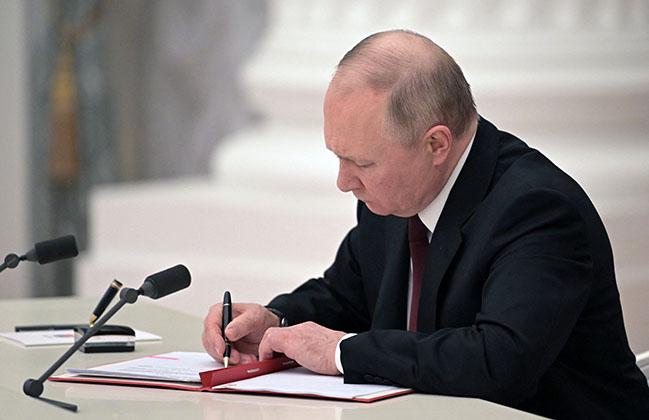
Russian President Vladimir Putin said on Tuesday that Russia was “ready” for war if Europe seeks one, accusing the continent’s leaders of trying to sabotage a deal on the Ukraine conflict before he met with US envoys.
The comments came as US envoy Steve Witkoff and President Donald Trump’s son-in-law Jared Kushner were in Moscow for high-stakes talks on ending the nearly four-year war, which were preceded by days of intense diplomacy.
“We are not planning to go to war with Europe, but if Europe wants to and starts, we are ready right now,” Putin told reporters in Moscow.
READ ALSO:Trump Blasts Ukraine For ‘Zero Gratitude’ Amid Talks To Halt War
“They have no peaceful agenda, they are on the side of war,” he added, repeating his claim that European leaders were hindering US attempts to broker peace in Ukraine.
He added that European changes to Trump’s latest plan to end the war “aimed solely at one thing — to completely block the entire peace process and put forward demands that are absolutely unacceptable for Russia”.
Washington has presented a 28-point draft to end the conflict, later amended after criticism from Kyiv and Europe, which viewed it as heeding to many of Russia’s maximalist demands.
READ ALSO:Trump Urged Ukraine To Give Up Land In Peace Deal Talks — Official
The plan to end the war is championed by Trump, but European countries fear it risks forcing Kyiv to cave in to Russian demands, notably on territory.
Fearing further Russian aggression, Europe has repeatedly said an unfair peace should not be imposed on Ukraine.
The Trump envoys are now seeking to finalise the plan with the approval of Moscow and Kyiv.
AFP

 News4 days ago
Insecurity: What Sheikh Gumi Told Me After Visiting Bandits Hideouts — Obasanjo
- News3 days ago
BREAKING: Ex-CDS Musa meets Tinubu At Aso Villa
- Politics5 days ago
Tinubu Sends Ex-INEC Chair, Former Oyo First Lady, 30 Additional Ambassadorial Nominees To Senate
- News4 days ago
FULL LIST: Wike revokes land belonging to Ilorin Emir, Lamido, Fayose, Iyabo Obasanjo, Others In Abuja
- News3 days ago
MOWAA: Why I Will Not Appear Before Edo Assembly Panel — Obaseki
- Headline4 days ago
US: Four Killed, 10 Others Wounded In California Shooting
- Metro3 days ago
Osun Monarch’s Burial Rites Turn Bloody
- Entertainment3 days ago
Facebook, Instagram Suspend Idris Abdulkareem’s Accounts After New Song, Open Letter To Donald Trump
- News4 days ago
VIDEO: Like Niger Delta Militants, Consider Amnesty To Bandits — ACF Chair Tells FG
- News3 days ago
JUST IN: Defence Minister, Badaru Mohammed Resigns


