

News
OPINION: A ‘Corruption-free’ Nigeria And Brazil As Hyena


By Festus Adedayo
Growing up, people of my generation matured into a fiery imagery painted of the wild and the animal world. We were fed on such frightening broths in folktales and fabulous novels like that of D. O. Fagunwa. They taught us that the wild is home of gnomes, predatory animals and human hunters who constitute a trinity in the forest ecosystem. One of the animals thus lionized was Ìkòokò, the hyena, one of Africa’s most merciless predators. He belonged to a family of wild doglike carnivores. The Ìkòokò was a wild, restless animal capable of inflicting so many brands of disasters on its prey. He was deadly, maniacal and daring.
One received ascription of the Ìkòokò is that he could crush meat and bone together with a fiery precision. It is why his faeces is cocaine-white. To fit this description, Yoruba curated a phrasal painting of him as “aje’ranje’gungun”. He was also a flesh devourer who cracked knotty flesh and cranium with his destructive incisors. In the process, Ìkòokò got decorated with a Yoruba honorific title of “Ìkòokò apanirun”. What stands him out is its ugliness and smell. Zoologists say the Ìkòokò, being a territorial animal, gets its pungent smell from marking and patrolling its territories. While doing this, he deposits on stalks of grass along his boundaries a strong-smelling substance produced by his anal glands.
Now, I find some similarities in the Ìkòokò and the bilateral meeting between Nigeria and Brazil which took place in Brazil last Monday. Itemizing similarities between the two countries can be likened to the aphorism which says that if the farmer’s okra plantation is within his reach, his okra cannot become too ripe for harvest. In other words, finding the countries’ similarities is handy. As in Nigeria, corruption in Brazil is a cankerworm permeating all strata of both societies. You do not need a telescope to see it; it meanders in an open dirty pond. It involves the highest echelon of political power in the two countries, to the smallest municipalities.
Operation Car Wash, a landmark anti-corruption probe that took place in Brazil in March 2014 uncovered slimy crippling maggots in the Brazilian central government. It began from a seemingly unobtrusive investigation of a small Brasilia car wash on allegation of money laundering. Conducted by an anti-trust team of federal prosecutors headed by Deltan Dallagnol, proceedings revealed a humongous corruption scheme. Of greatest revelation was a combine of sleaze that involved state-owned enterprises. A judge, Sergio Moro, heard how government officials took pleasure in deploying the prerogatives of their public offices in pursuit of rent-seeking activities. These range from siphoning funds from state-owned corporation for individual gains, to brazenly stealing public money. Nigeria can see itself in this mirror.
MORE FROM THE AUTHOR:OPINION: Is Èmil’ókàn Audacity Or Incantation Ritual?
One illustrations of Brazilian corruption was also shown in The Mensalao scandal. Therein, in exchange for vote support in congress, taxpayer funds were hemorrhaged by government officials to pay monthly allowances to members of congress. As Nigeria’s NNPCL is a cesspit of corruption wherein president after president dips their hands into for personal and group enrichment, Brazil’s Petrobas, a state-owned and state-run oil company, is a paradise for maggots where uncountable small maggotry of the political elite and the private sector raise hundreds of millions of Reals to fund personal fancies and political campaigns. In Nigeria recently, a roiling mess whose putrefaction is comparable to a hyena’s excrement hit the airwaves. An NNPCL top boss allegedly mentioned a top Aso Rock official in an EFCC investigation. Nigeria has since moved on. No word since then and there is calm on the home front.
The same way Nigeria battles a serious challenge of violence and crime, Brazil wears same pair of sloppy shoes. It is estimated that the country witnesses roughly 23.8 homicide cases of robberies, kidnappings, muggings and other gang violence per 100,000 residents. Like here, in Brazil, cases of police brutality are as widespread as poverty in an IDP camp.
Recent Panama Papers and Paradise Papers drilled deep down into the Brazilian own involvement with corruption. In the country, there is a complexity of corruption networks flavoured by mafia, drug traffic networks and terrorist activities. In Nigeria, the hyena excrement is sustained by access to government office. Invoice-padding is notorious in both countries. Known in Brazil as superfaturamento, its notoriety is buoyed by padded invoices and grand-scale inflated construction projects. Brazil’s Olympics and FIFA World Cup stadia and Nigeria’s coastal highway are examples. In a damning October 13, 2020 report, Transparency International said Brazil had a “progressive deterioration of the institutional anti-corruption framework” and lamented what it called a fatal setback in Brazil’s fight against corruption.
In both countries, politicians, in dalliance with corrupt private sector persons, are their countries’ top predators. Primarily scavengers of their nations’ common patrimony, like hyenas, a huge chunk of the two countries’ political class’ diets come from feeding greedily on direct and indirect kills. As hyenas’ feeds range from animals of various types and sizes, carrion, bones, vegetable matter, and other animal droppings, so is the gluttonous feeding habits of the political class of Brazil and Nigeria. For over a century, these human carnivores’ eating jaws have been strengthened to become as strong as hyenas’. It makes their political class fit to be ranked among the strongest national patrimony-devouring humans in the world.
MORE FROM THE AUTHOR:OPINION: You Be Terrorist, I No Be Terrorist!
As the Chief Hyenas of Brazil and Nigeria met, Nigeria’s boastfully proclaimed that there was “no more corruption” since he took office. This provoked cynics’ snigger. In a chorus, they say the Nigerian Chief Hyena was in a domain similar to his, where lying to the citizenry is a governmental culture, a walk in the park. There, Lie lies to Lie (Iróńpa’rófún’ró). It can be compared to Olupona’s cult of secrecy where devotees create the needed aura of sacredness to sustain a long tradition.
The truth that both Nigeria and Brazil shied from as they met last week was that, in both countries, corruption is as prevalent and destructive as an affliction of AIDS. Though a universal problem which afflicts the economies of developing and developed nations, corruption has far more debilitating effects in Africa, South and Latin America. It is even more precarious in Nigeria for the sake of her security. Since the September 11, 2001 bombing in America, corruption has been ostracized as a major pivot for transnational terrorism in the world.
But for esprit-de-corps and hypocrisy, nothing should have made Nigeria’s Chief Hyena hoist self up for the global mockery that followed. This is because the world is in possession of statistics of the mutating and multiplying cancerous cells of corruption in Nigeria. A few days ago, I was guest of Oyo State’s and Western Nigeria’s oldest television station, the BCOS. The discussion centered on damning verdicts of two frontline Nigerians, President Olusegun Obasanjo and Sultan of Sokoto, Muhammadu Sa’ad Abubakar III. As guest speaker at the Nigeria Bar Association (NBA) Annual General Conference in Enugu last Sunday, a day before the Nigerian Chief Hyena made that statement of zero corruption in Nigeria, the Sultan had warned that justice in Nigeria was increasingly becoming a “purchasable commodity”. He said, “Today, justice is increasingly becoming a purchasable commodity, and the poor are becoming victims of this kind of justice, while the rich commit all manner of crime and walk the streets scot-free”.
As if choreographed, Obasanjo too, in a new book entitled Nigeria: Past and Future, also lamented that Nigeria’s judiciary had been “deeply compromised”, and warned that judicial corruption had turned Nigerian courts into “a court of corruption rather than a court of justice.” A circulating August 19, 1976 New Nigerian newspaper’s lead story which screamed, “Judge arrested over N20 bribe”, where a judge was arrested and jailed for corruption in Benue State, tells how the internal mechanism for judicial correction has died in today’s Nigeria. What is the National Judicial Commission (NJC) doing today?
MORE FROM THE AUTHOR:OPINION: KWAM 1, Eccentricity And Big Man Syndrome
My submission during the interview was that, except we want to play the ostrich, there is indeed an erosion of judicial integrity in Nigeria. A huge percentage of litigants are sceptical that they could get justice in our temple of justice. But isolating the judiciary and leaving the media, the banks, civil service and so many other corruption-blossoming institutions in Nigeria will be unfair. Nigeria is one huge ball of corruption. However, all of us – the judicial system, civil society, media, etc, must get involved in re-calibrating this perception. This is because, the moment the courts suffer such rout in perception, we can as well call it a day as far as a country is concerned. We can afford to have everything perceived as dirty – the executive, the legislature – but not the river, the judiciary. It is the source of our national value. This is because, when anything is dirty, it is taken to the river to wash but when the river itself is dirty and you take your dirt to it for cleaning, you will be washing your dirt with the dirty. What you get therefrom is deep filth and disaster reminiscent of the AyiKwei Armah’s 1968 debut novel, The Beautyful Ones Are Not Yet Born hue.
It takes boldness and leadership sincerity to own up that things aren’t looking up. Nigeria is not anywhere corruption-free, whether at the micro or macro level. Corruption is pervasive here and its ubiquity is legendary. If Nigeria’s Chief Hyena based this sweepingly boastful claim on a recent Transparency International (TI) ranking and the few arrests made by the EFCC, he fell into the argumentative pitfall called fallacy of excluded middle. The law of excluded middle frowns on oversimplification. It is against forcing a complex situation into a false dichotomy while ignoring nuanced possibilities or state of affairs that are indeterminate. The fallacy of excluded middle occurs when you apply “true or false” situations to complex social issues and subjective judgments in situations where the predicate is ambiguous and not easily captured in a Yes or No situation.
So, it is true that TI, in its 2024 Corruption Perceptions Index (CPI), placed Nigeria 140th as against earlier 145th position in corruption in the world. It scored 26 out of 100, as against previous 25 out of 100. It is also true that Ola Olukoyede, the EFCC chair, recently succeeded in arresting some mushroom and tilapia of corruption, with a 2024 conviction figure of 4,111, the highest thus far. Two problems arose. One, where are the sharks and behemoth (the Arogidigba) of Nigerian corruption, most of whom attend the Federal Executive Council (FEC) and National Economic Council (NEC) meetings weekly and periodically? Second, to use these two – TI index and EFCC convictions – as indices of Nigeria’s zero corruption is deceptive.
MORE FROM THE AUTHOR:OPINION: Tell Your Papa As Spirit Of Rwanda’s Simon Bikindi
Economists say that systemic poverty is a harbinger of macro corruption. This variant of corruption is on the ascendancy in Nigeria today. Recently, the World Bank aggregated Nigeria’s systemic corruption as being on the ascendancy. In a widely publicized interview, a lawyer, Ndidi Edeogbon, also disagreed with Nigeria’s Chief Hyena. She said, “I found out yesterday that 60 to 70 % of Nigerians paid bribes for police help. 53 paid to avoid trouble with the police. 56 percent paid bribes to get government documents… And on the level of perceived corruption, 70% of Nigerians say the police are the most corrupt. This is followed by the Presidency with 62%, then parliament with 65%, local government councilors with 55% and judges with 54%.”
So, why play the ostrich by making such untrue statement of zero corruption in Nigeria? Can the hyena deodorize himself even thousands of kilometers away from home?




News
N5m, N10m Zero-interest Loans: SheVentures Opens Applications For Women Entrepreneurs


First City Monument Bank (FCMB) has opened a new round of applications for its SheVentures proposition, offering zero-interest loans of up to ₦10 million to women entrepreneurs to ease access to working capital and support business growth.
The facility provides loans ranging from ₦500,000 to ₦5 million under a general category, and ₦5 million to ₦10 million for sector-specific businesses, with funding capped at up to 50% of an applicant’s average monthly turnover.
At the centre of the offering is a 0% interest rate, with all charges embedded in a transparent structure.
Repayment is structured over four or six months, allowing businesses to match obligations with their cash flow cycles.
READ ALSO:I’ve Been Blacklisted In Music Industry For 13 Years – Seun Kuti
Yemisi Edun, Managing Director and Chief Executive of First City Monument Bank (FCMB), said the initiative reflects a deliberate approach to inclusive growth.
“Inclusive growth requires access to capital and the right conditions for businesses to deploy that capital effectively.
“Women-led enterprises are critical to economic activity, yet they face structural barriers.
This intervention aims to help close that gap by providing financing that supports job creation, business expansion, and long-term sustainability for women entrepreneurs.”
“Access to affordable finance remains a major constraint for women entrepreneurs,” said Nnenna Jacob-Ogogo, Group Head, SheVentures and Impact Segments at First City Monument Bank (FCMB).
READ ALSO:My Beef With Wizkid Is For Life – Seun Kuti
“By removing the cost barrier and offering quick, flexible funding, this zero-interest loan is designed to safeguard existing jobs, enable businesses to invest in growth initiatives, and foster resilience in challenging economic conditions.”
Women-owned businesses account for a significant share of Nigeria’s small and medium-sized enterprises but continue to face high borrowing costs and limited access to credit.
Through these efforts, SheVentures tackles persistent financing gaps facing women-led businesses, combining targeted funding with broader support to empower women entrepreneurs, encourage business innovation, and enhance their ability to compete on a national scale.
Applications for the zero-interest loan are now open.Apply now.
News
Xenophobic Attacks: Oshiomhole Tells FG To Retaliate Against South African Companies In Nigeria

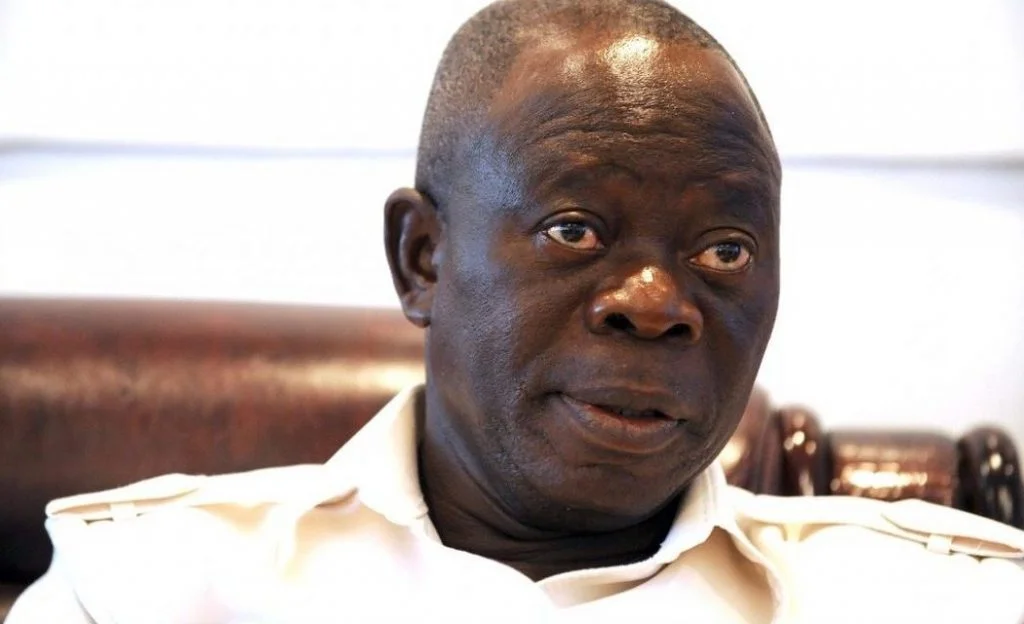
Senator Adams Oshiomhole has called on the Federal Government to retaliate against South African businesses operating in Nigeria following the recent attacks on Nigerians in South Africa.
Speaking during plenary on Tuesday, Oshiomhole said the Federal Government should consider revoking the working license of South African owned companies such as MTN and DSTV.
He argued that Nigeria must respond firmly to what he described as persistent hostility against its citizens.
READ ALSO:South Africa To Investigate ‘Mystery’ Of Planeload Of Palestinians
“I am not going to shed tears. If you hit me, I hit you. I think it is appropriate in diplomacy. It is an economic struggle,” Oshiomhole said.
He argued that while some South Africans accuse Nigerians of taking their jobs, Nigerians should return home and take over employment opportunities created by major South African companies operating in the country, including MTN and DSTV.
“When we hit back, the President of South Africa will not only talk but will also go on his knees to recognise that Nigeria cannot be intimidated.
READ ALSO:South African Ambassador Found Dead Outside Paris Hotel
“We will not condone any life being lost. If a crime has been committed under the South African law they have the right to bring any such person to justice, but to kill our people as if we are helpless, we will not allow that,” Oshiomhole added.
DAILY POST reports that several Nigerians in South Africa have reportedly been attacked, and their businesses destroyed, in ongoing xenophobic attacks in the country.
News
IGP Orders Officers Display Name Tag On Uniform, Gives Update On State Police

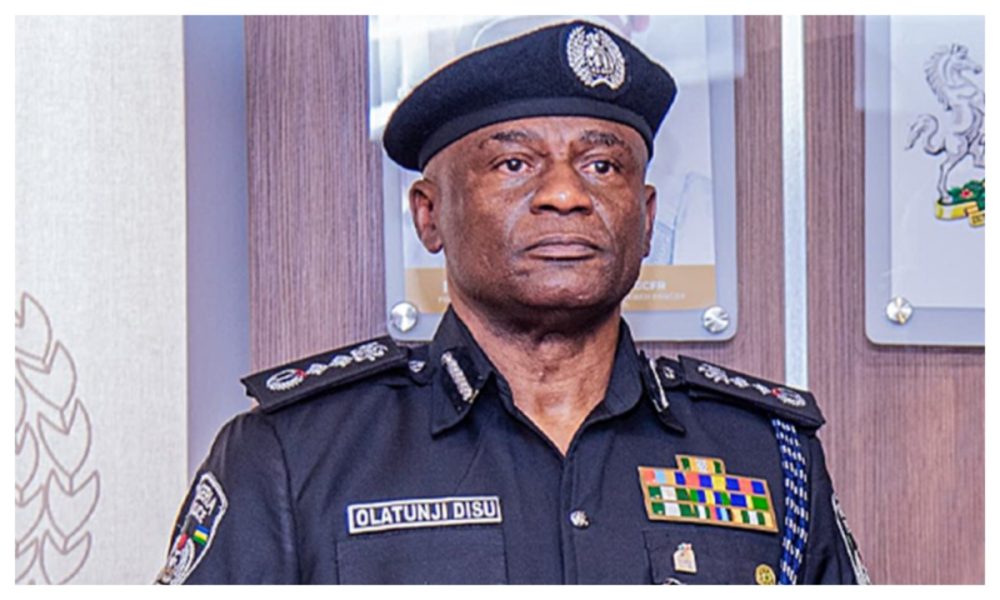
The Inspector General of Police, IGP, Tunji Disu, has ordered all police personnel to always have their name tags on their uniforms for easy identification.
Disu disclosed that only police personnel who are undercover are exempted from displaying their name tags.
Speaking on Tuesday, Disu said: “All police officers should have their name tags. All of us on the high table have our names apart from the undercover among us so if you look at all the Commissioners of Police we have our name tags, so it’s not our standard.
READ ALSO:
“All the Commissioners of Police are here and that is why we called this meeting, we have list of things like this that we will want to discuss with the Commissioners of Police, we have told them earlier and we will still let them know that every that happens within their area of jurisdiction falls under their control.”
On the issue of state police, the IGP said: “Since we got the signal that the Federal Government of Nigeria intend to establish State Police and since we are the federal police, we decided to take the bull by the horn and put down our own side of what we believe on how the state police should be run.
“A lot of things were taken into consideration, a lot of comparative analysis was done and it has been transmitted to the National Assembly.”
-

 Politics4 days ago
2027: Tinubu’s Re-election May Put An End To Nigeria — Baba Ahmed Warns
-

 Politics5 days ago
BREAKING: 2027: Former Adamawa APC Guber Candidate, Aishatu Binani Defects To NDC
-

 Business4 days ago
JUST IN: Nigerian Filling Stations Reduce Fuel Price After Hike
-

 Politics5 days ago
Senatorial Seat: Ogbakha-Edo Warns Against Imposition Of Candidates In Edo South
-

 Entertainment5 days ago
Actress Eniola Badmus Gets New Federal Appointment
-

 News2 days ago
BREAKING: Wike Picks Alabo George For Rivers Governorship
-

 News3 days ago
OPINION: Why South Africans Murder Nigerians In Cold Blood
-

 Politics4 days ago
NDC Speaks On Peter Obi, Kwankwaso Joining Party
-

 News4 days ago
2027: Pastor Adeboye Speaks On Nigeria’s Next President
-

 Politics5 days ago
2027: Pondi, Otuaro, Other Delta South Stakeholders, Endorse Senator Joel-Onowakpo For Second Term
