

News
OPINION: Awolowo And The North’s Latest Warning [Monday Lines]



By Lasisi Olagunju
When vultures surround you, stay awake so that you do not die stupid death. Whether you are in business or you are in politics or you are anything of value, stay alive and stay alert. People shave people’s heads in their absence. In 1938, Britain was rumoured to have toyed with the idea of donating Nigeria to Germany as one of its several offerings of appeasement to Hitler. I read of the “strong rumour” in Chief Obafemi Awolowo’s first book, ‘Path to Nigerian Freedom’, published in 1947 – page 38.
Hitler, two years earlier (September 11, 1936), insisted on “Germany’s right to colonies.” Nine months before Hitler’s insistence, his minister of propaganda, Goebbels, served a notice that “the time will come when we must demand colonies from the world.” In June 1938, Mary E. Townsend published her ‘The German Colonies and the Third Reich.’ She cited two successive editions of the London Times of October 1936 which reported that Hitler had “gained concessions in Africa.”
The German cup, as it turned out, passed from Nigeria. The rumoured offer to Hitler was eventually not consummated but the mere thought of it tells how ‘valued’ our country and its people were in the heart of those who possessed it. But it is needless to run from fate. You put destiny in a sheath, it destroys the sheath; you put it in a scabbard, it ruins the scabbard. If Nigeria missed being possessed by Germany’s Hitler in 1938, the country’s subsequent history of abduction and rape up to this moment is proof that our fathers were right with their theory of inevitability of fate. A snake swallowing its tail, and swallowing it hard is Nigeria. It is a pool of water-snakes feasting on hapless fishes.
On Friday this week, it will be 38 years since Chief Awolowo died. Two months before he died on 9 May, 1987, Awo spoke rather cryptically of his “continuing to serve even after death.” Almost 40 years after his transition, his views of Nigeria, his analyses of the systemic problems of the country and his solutions to them have remained the main issues of discussion.
Awolowo’s ‘Path to Nigerian Freedom’ has proved a worthy carrier of its title. But the path it shows has remained not taken. The late Pius Adesanmi once, at an Awolowo Foundation event, questioned the choice we make as a country. He spoke on what he called “Igbo ree; Ona ree (the bush is here; the path is here).” The choice was – and is – for us to make. We’ve consistently chosen the bush.
I read the Arewa Consultative Forum (ACF)’s boast of last week that the North had the muscle and the number to choose the next president for the other parts of the country. It reminded us that: “The North has 19 out of the 36 states. We also have the FCT as a veritable component. We have a majority in the Senate, the House of Representatives, the National Economic Council as well as the Council of State. The North occupies close to 75 percent of Nigeria’s land area and about 60 percent of the population. An area that is this big and this strong can never be subdued by any opponent…For the moment, it will suffice to say that Northern Nigeria is watching and auditing the actions of the elected and appointed officials, especially at the federal level.”
Northern leaders always flaunt their population and land mass to intimidate the South. Assets when not harnessed to profitability become liabilities. We say here that vulture may be a large bird, but what it feeds on is rotten flesh. The elephant in its ponderous majesty is as clumsy as they come. Àwòdì tí ń gbé adìẹ lọ́sàn-án ò sanra tó igún. I wonder why it did not occur to the ACF that kites that snatch chicks in broad daylight do not have vulture’s large frame. It is not by size.
Everything the ACF said was a threat directed at President Bola Tinubu on his second term ambition. Of course, the Tinubu pigeon got the full import of the incantations from the Northern raptor. He rushed to Katsina on Friday – two days after the warning shot was fired. He was there for two days, he even slept there. Tinubu should clap for himself. Did Buhari sleep one night anywhere in Southern Nigeria in his eight years? The visit was Tinubu’s appeasement offering to Hitler to avoid a ‘world war’. Let us hope the aggrieved are pacified now.
MORE FROM THE AUTHOR: OPINION: A Nation Of Defectors [Monday Lines]
Unlike what our teachers taught us, sovereignty is no longer the supreme will of the state; its locus is with any set of human beings “sufficiently strong to compel obedience” to their whims. The North self-assuredly thinks it is the Nigerian sovereign. It said so through the ACF and the president got the message.
The North thought Goodluck Jonathan was its problem; it got its traditional enemies in Benue and Plateau and the West to join it in removing Jonathan. The North thought having a northern president would solve its existential problems. It brought in Muhammadu Buhari. Under Buhari, the North’s problems multiplied in geometric proportions. It thought a Muslim Muslim ticket was what it needed to be safe and feed well. It brought in a ‘Muslim’ government in May 2023. Less than two years into the tenure of that government of faith, the North is grunting and grumbling very loudly; it shouts marginalization. A million change of government won’t help the north. It must help itself.
The ACF also expressed concern over insecurity in the North. It said the security challenges in the North were worsening by the day. It then called on the federal government to act swiftly “before it becomes too late.” I will be happy and dance if I find out that it is not already too late.
By now, it should be clear to the wise that the problem of the North is not, strictly, Bola Tinubu and his ways. The problem wasn’t Jonathan; neither was it Buhari. The problem of the North is the North – its bad ways. Why would a region not have problems of mass poverty when it spurns mass education of its mass children, youths who own tomorrow? Mass procreation plus mass illiteracy must equal mass misery. It is simple arithmetic. Why will there not be blistering insecurity where mass poverty reigns? If you turn your back to where the world faces, you won’t see what the world sees. How will a president relate with a people that take offence when asked to position their eyes towards the future? The best rules the rest in that country called Saudi Arabia. The elite there have used education to elevate their country and their faith. China’s huge population is a huge economic blessing to it. But, the key to northern Nigeria is in the hands of a band of clerics and dark elites who exploit their people’s unquestioning faith in their region and religion, warts and all.
MORE FROM THE AUTHOR: OPINION: For the Yoruba Of Northern Nigeria [Monday Line]
I read a beautiful piece on Saturday from a gentleman from the North, Idris Muhammed Abdullahi. He wanted a deliverer for northern Nigeria. Like the ACF and its leaders, Abdullahi didn’t write for Nigeria; his interest was the North. He lamented the decay and disappointment that rules his region. He cited the establishment of the Northwest Development Commission (NWDC). He said it was supposed to mark a turning point in the development of the region. “What then happened?” he asked and added that: “One man handpicked all its executives. The commission has now become a personal ATM, hemorrhaging funds meant for schools, irrigation, rural roads, and youth empowerment. It has transformed from a symbol of hope into yet another playground for elite looting.”
What the gentleman wrote of the North is true of everywhere in the country. And it is historical. Nigeria is an elite PoS – or the soup pot of the powerful. How each of our people reacts to it has also historically made the difference. Wrong, when accommodated, festers. Chief Awolowo said it in a more elegant and profound way 46 years ago. He told ‘Africa’ magazine in April 1979 that “since independence, our governments have been a matter of a few holding the cow for the strongest and most cunning to milk. Under the circumstances, everybody runs over everybody to make good at the expense of others.”
The most popular page in Awo’s ‘Path to Nigerian Freedom’ is page 47. That is where you find the famous quote: “Nigeria is not a nation. It is a mere geographical expression.” Seventy-seven years after that book was published, to be called Nigerian has remained “merely a distinctive appellation” distinguishing “those who live within the boundaries of Nigeria from those who do not.” Each constituent part of the country has held tight to its gene. When we talk or act, it is for where each of us comes from. Read the ACF statement again. It speaks about ‘us’ and ‘them’ and boasts of assets without discussing the liabilities.
The groups in the South think the North a pampered, pompous parasite. Think of why Max Siollun, author of ‘What Britain Did to Nigeria’, described Nigeria as “just a page in a colonial accounting ledger” and why the British officially took the 1914 amalgamation to be a marriage between a poor, hapless husband and a helpless “southern lady of means.”
Check the tone of the ACF complaints; the challenges of governance have been reduced to a North versus South battle. Now, I ask: For how long shall we remain so “tightly fragmented” and have our growth stunted?
In the 1947 book above, Chief Awolowo observed that the various nations that make up Nigeria cannot progress and prosper together unless they are properly organized in a federation. “The languages differ…Their cultural backgrounds and social outlooks differ widely; and their indigenous political institutions have little in common. Their present stages of development vary.” It is in that book that you read how, 77 years ago, the ethnic groups in the South readily embraced Western civilisation while “the extremely conservative” Hausas and Fulanis took “very reluctantly to Western civilization.” As it was in 1947, so it is in 2025. If thrown up a hundred years from now, the northern hand fan will land side down.
MORE FROM THE AUTHOR: OPINION: The President Is My Brother, I Shall Not Talk…
A copius quote from Chief Awolowo here: “All these incompatibilities among the various peoples in the country militate against unification. For one thing, they are bound to slow down progress in certain sections, and on the other hand they tend to engender unfriendly feelings among the diverse elements thus forced together.” Chief Awolowo warned that “incompatibilities such as we have enumerated are barriers which cannot be overcome by glossing over them, They are real, not imaginary obstacles. Those who place these groups under the same constitution ignore them at their peril – more so, as it appears that these incompatibilities tend to grow in size as those concerned become more educated and civilized.”
If you can find time to read the book, check what the author wrote while citing the Welsh and the Scottish peoples’ experiences and agitation for self-rule. Check his words on other positive examples and the reason some of us say we are postponing the evil day if we think elite looting facilitated by a unitarised Nigeria will ever bring peace and plenty. Listen to Chief Awolowo: “For upwards of seven hundred years, the Irish people struggled to, and eventually did break away from England in spite of the fact that the latter did everything possible to give the former equal status within the British Constitution.” When you read him, you discover that, indeed, two of the three other examples he cited, Yugoslavia and Czechoslovakia, have already unravelled as he predicted; the third, the Dutch-speaking Flemings of Belgium, despite several constitutional interventions, still demand degrees of autonomy. Some of them, in fact, have not stopped chanting “Let My People Go.”
So, what is the solution?
The solution is knowing that there is no regeneration in spring water flowing towards the desert. Tell the North, tell the South. “Whatever would direct itself after the setting sun, an ashen death lies in wait for it” (Ayi Kwei Armah). Chief Awolowo pointed at the empirical facts of history which he said “are enough to guide us.” He posited that it had been shown beyond all doubts “that the best constitution for… diverse peoples is a federal constitution.” He pointed at the Constitution of Switzerland, which he said “is acclaimed to be the best and the most democratic in the world since it gives complete autonomy to every racial group within the framework.”
In a truly federal Nigeria, there won’t be allegations of Muhammadu Buhari regime marginalising the South; neither will there be a Bola Tinubu government suffering the stigma of being a Yoruba government. A weak centre will be too unattractive to attract do-or-die politics; neither will it serve as a fetter holding down any part that wants to run. It will serve any one content with crawling to continue to crawl – as we compulsorily do today.
But can we take a redemptive bend? The wise would say we are too far gone to retrace our steps. “No spring changes the desert. The desert remains” – that, again, is from Armah. Creating a workable system – a system that works – is what we have refused to come up with. We know what it is and how it will serve us, but we just won’t go for it. For us, the bush is the way.




News
Xenophobic Attacks: Oshiomhole Tells FG To Retaliate Against South African Companies In Nigeria

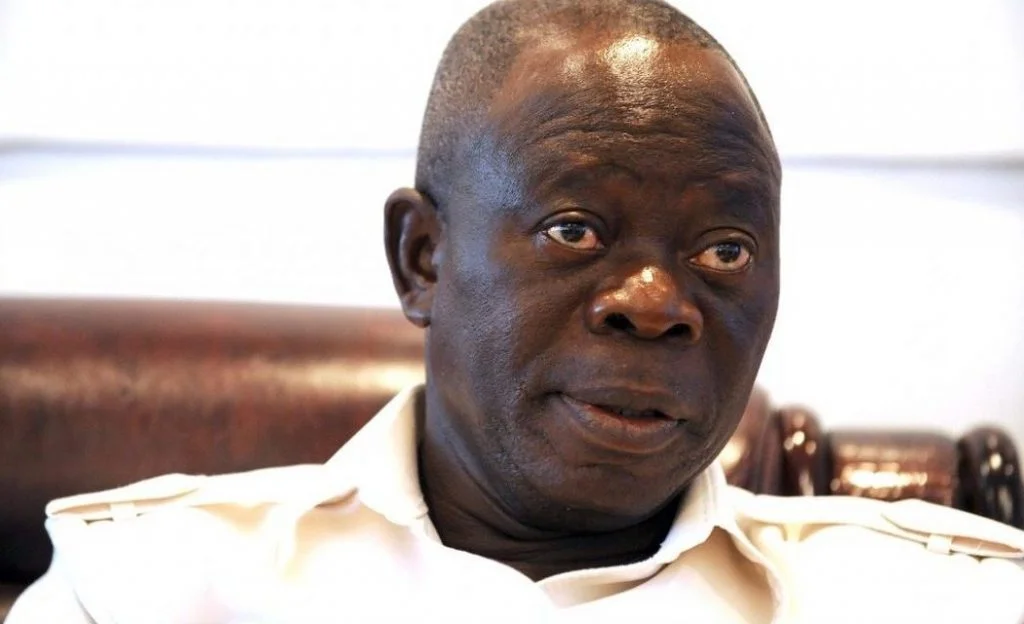
Senator Adams Oshiomhole has called on the Federal Government to retaliate against South African businesses operating in Nigeria following the recent attacks on Nigerians in South Africa.
Speaking during plenary on Tuesday, Oshiomhole said the Federal Government should consider revoking the working license of South African owned companies such as MTN and DSTV.
He argued that Nigeria must respond firmly to what he described as persistent hostility against its citizens.
READ ALSO:South Africa To Investigate ‘Mystery’ Of Planeload Of Palestinians
“I am not going to shed tears. If you hit me, I hit you. I think it is appropriate in diplomacy. It is an economic struggle,” Oshiomhole said.
He argued that while some South Africans accuse Nigerians of taking their jobs, Nigerians should return home and take over employment opportunities created by major South African companies operating in the country, including MTN and DSTV.
“When we hit back, the President of South Africa will not only talk but will also go on his knees to recognise that Nigeria cannot be intimidated.
READ ALSO:South African Ambassador Found Dead Outside Paris Hotel
“We will not condone any life being lost. If a crime has been committed under the South African law they have the right to bring any such person to justice, but to kill our people as if we are helpless, we will not allow that,” Oshiomhole added.
DAILY POST reports that several Nigerians in South Africa have reportedly been attacked, and their businesses destroyed, in ongoing xenophobic attacks in the country.
News
IGP Orders Officers Display Name Tag On Uniform, Gives Update On State Police

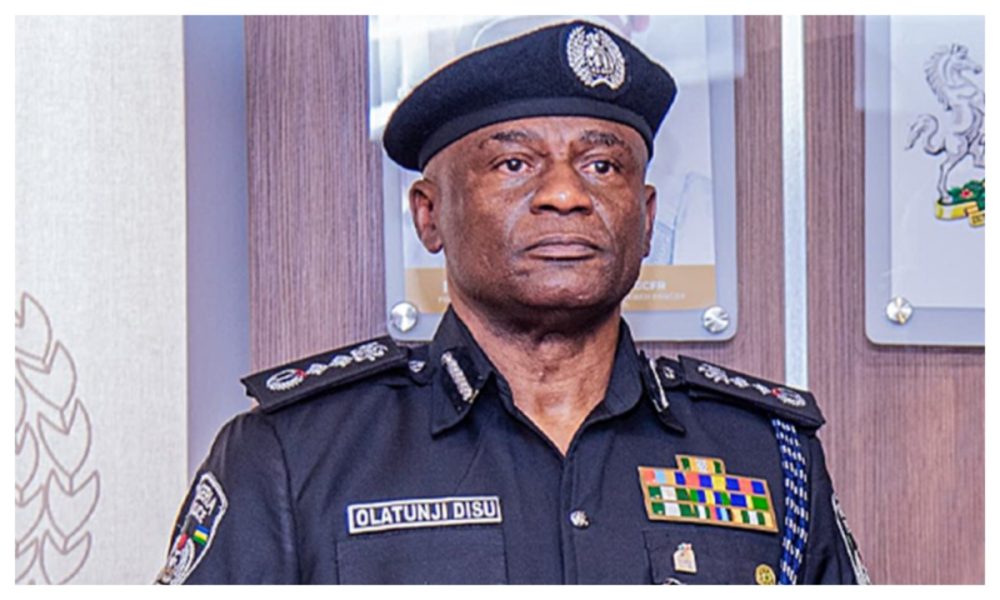
The Inspector General of Police, IGP, Tunji Disu, has ordered all police personnel to always have their name tags on their uniforms for easy identification.
Disu disclosed that only police personnel who are undercover are exempted from displaying their name tags.
Speaking on Tuesday, Disu said: “All police officers should have their name tags. All of us on the high table have our names apart from the undercover among us so if you look at all the Commissioners of Police we have our name tags, so it’s not our standard.
READ ALSO:
“All the Commissioners of Police are here and that is why we called this meeting, we have list of things like this that we will want to discuss with the Commissioners of Police, we have told them earlier and we will still let them know that every that happens within their area of jurisdiction falls under their control.”
On the issue of state police, the IGP said: “Since we got the signal that the Federal Government of Nigeria intend to establish State Police and since we are the federal police, we decided to take the bull by the horn and put down our own side of what we believe on how the state police should be run.
“A lot of things were taken into consideration, a lot of comparative analysis was done and it has been transmitted to the National Assembly.”
News
Court Orders SERAP To Pay DSS Operatives N100m For Defamation
The High Court of the Federal Capital Territory has ordered a non-governmental organization, the Socio-Economic Rights and Accountability Project, SERAP, to pay N100 million as damaged to two operatives of the Department of the State Services, DSS, for unjustly defaming them in some publications.
The court also ordered SERAP to tender public apologies to the defamed officers,
Sarah John and Gabriel Ogundele, in two national newspapers, two television stations and its website.
Besides, the organization was also ordered to pay the two operatives N1 million as cost of litigation and 10 percent post-judgment interest annually on the judgment sum until it’s fully liquidated.
Justice Yusuf Halilu of the High Court of the Federal Capital Territory gave the order on Tuesday while delivering judgment in a N5.5 billion defamation suit instituted against SERAP by the DSS operatives.
The judge found SERAP liable for unjustly defaming the two DSS operatives with allegations that they unlawfully invaded its Abuja office, harassed and intimidated its staff, in September 2024.
READ ALSO:How We Arrested Terror Suspect Who Threatened To Kill Students, Teachers In Abuja — DSS
In the offending publication on its website and Twitter handle, SERAP alleged that the two operatives unlawfully invaded and occupied its office with sinister motives.
The judge held that the publication was in bad taste especially from an organization established to promote transparency and accountability, as nothing in the publication was found to be truthful.
The DSS staff had listed SERAP as 1st defendant in the suit marked CV/4547/2024. SERAP’s Deputy Director, Kolawole Oluwadare, was listed as the 2nd defendant.
In the suit, the claimants – Sarah John and Gabriel Ogundele – accused the two defendants of making false claims that they invaded SERAP’s Abuja office on September 9, 2024..
Counsel to the DSS, Oluwagbemileke Samuel Kehinde, had while adopting his final address in the mater urged the judge to grant all the reliefs sought by his client in the interest of justice.
READ ALSO:DSS Arrests Suspected Gunrunner, Recovers 832 Rounds Of Ammunition
He admitted that although the names of the two claimants were not mentioned in the defamation materials, they had however established substantial circumstances that they are the ones referred to in the published defamation article by SERAP on its website.
The counsel submitted that all ingredients of defamation have been clearly established and the offending publication referred to the two officials of the secret police.
However, SERAP, through its counsel, Victoria Bassey from Tayo Oyetibo, SAN, law firm, asked the court to dismiss the suit on the ground that the two claimants did not establish that they were the ones referred to in the alleged defamation materials.
She said that SERAP used “DSS officials” in the alleged offending publication, adding that the two claimants must establish that they are the ones referred to before their case can succeed.
Similar arguments were canvassed by Oluwatosin Adefioye who stood for the second defendant, adding that there was no dispute in the September 9, 2024 operation of DSS in SERAP’s office.
READ ALSO:Alleged Cyberstalking: DSS Plays Video Evidence In Sowore’s Trial
He said that since SERAP in the publication did not name any particular person, the claimants must plead special circumstances that they were the ones referred to as the DSS officials.
Besides, he said that there is no organization by name Department of State Services in law, hence, DSS cannot claim being defamed adding that the only entity known to law is National Security Agency.
The claimants had in the suit stated that the alleged false claim by SERAP has negatively impacted on their reputation.
The DSS also stated, in the statement of claim, that, in line with the agency’s practice of engaging with officials of non-governmental organisations operating in the FCT to establish a relationship with their new leadership, it directed the two officials – John and Ogunleye – to visit SERAP’s office and invite them for a familiarization meeting.
The claimants added that in carrying out the directive, John and Ogunleye paid a friendly visit to SERAP’s office at 18 Bamako Street, Wuse Zone 1, Abuja on September 9 and met with one Ruth, who upon being informed about the purpose of the visit, claimed that none of SERAP’s management staff was in the country and advised that a formal letter of invitation be written by the DSS.
READ ALSO:DSS, Police Partner NCCSALW To End Terrorism, Mop Up Illegal Arms
John and Ogundele, who claimed that their interactions with Ruth were recorded, said before they immediately exited SERAP’s office, Ruth promised to inform her organisation’s management about the visit and volunteered a phone number – 08160537202.
They said it was surprising that, shortly after their visit, SERAP posted on its X (Twitter) handle – @SERAPNigeria – that officers of the DSS are presently unlawfully occupying its office.
The claimant added, “On the same day, the defendants also published a statement on SERAP’s website, which was widely reported by several media outfits, falsely alleging that some officers from the DSS, described as “a tall, large, dark-skinned woman” and “a slim, dark skinned man,” invaded their Abuja office and interrogated the staff of the first defendant (SERAP).
John and Ogundele stated that “due to the false statements published by the defendants, the DSS has been ridiculed and criticised by international agencies such as the Amnesty International and prominent members of the Nigerian society, such as Femi Falana (SAN)”.
“Due to the false statements published by the defendants, members of the public and the international community formed the opinion that the Federal Government is using the DSS to harass the defendants.”
READ ALSO:SERAP To Court: Stop CBN From ‘Implementing ‘Unlawful, Unjust ATM Fee Hike’
They added that the defendants’ statements caused harm to their reputation because the staff and management of the DSS have formed the opinion that the claimants did not follow orders and carried out an unsanctioned operation and are therefore, incompetent and unprofessional.
The claimants therefore prayed the court for the following reliefs: “An order directing the defendants to tender an apology to the claimants via the first defendant’s (SERAP’s) website, X (twitter) handle, two national daily newspapers (Punch and Vanguard) and two national news television stations (Arise Television and Channels Television) for falsely accusing the claimants of unlawfully invading the first defendant’s office and interrogating the first defendant’s staff.
“An order directing the defendants to pay the claimants the sum of N5 billion as damages for the libellous statements published about the claimants.
“Interest on the sum of N5b at the rate of 10 percent per annum from the date of judgment until the judgment sum is realised or liquidated.
“An order directing the defendants to pay the claimants the sum of N50 million as costs of this action.”
-

 Politics4 days ago
2027: Tinubu’s Re-election May Put An End To Nigeria — Baba Ahmed Warns
-

 Metro5 days ago
I’m A Street Girl’ – Bimbo Ademoye Clashes With Area Boys [VIDEO]
-

 Politics4 days ago
Senatorial Seat: Ogbakha-Edo Warns Against Imposition Of Candidates In Edo South
-

 Politics4 days ago
BREAKING: 2027: Former Adamawa APC Guber Candidate, Aishatu Binani Defects To NDC
-

 Business3 days ago
JUST IN: Nigerian Filling Stations Reduce Fuel Price After Hike
-

 Entertainment4 days ago
Actress Eniola Badmus Gets New Federal Appointment
-

 News5 days ago
10 African Countries With Highest Petrol Prices In Prices In April 2026
-

 News1 day ago
BREAKING: Wike Picks Alabo George For Rivers Governorship
-

 News3 days ago
2027: Pastor Adeboye Speaks On Nigeria’s Next President
-

 Politics4 days ago
2027: Pondi, Otuaro, Other Delta South Stakeholders, Endorse Senator Joel-Onowakpo For Second Term
