
News
[OPINION] Awolowo: Legacies And Prophecies

By Lasisi Olagunju
An old firm of architects with a rich history of project design and delivery sent a letter to the Sierra Leonean government on September 15, 1960. In that letter, the firm listed some of the projects it was handling in Nigeria. The multi-storey building called Cocoa House in Ibadan was on that list.
But the story of Cocoa House began long before that letter was written. The 26-storey structure did not emerge as an idle elephant on Ibadan’s skyline. It was Obafemi Awolowo’s answer to the need for a total-package commercial edifice. The architects described it as a multipurpose venture “aimed at providing office space as well as leisure facilities through a nightclub, swimming pool and cinema complex.”
That perhaps explains why the skyscraper came with a roof garden and has in its shadows, what the Transnational Architecture Group describes as “a circular building clad in mosaic, topped with a dome,” complete with “a splayed cantilevered entrance leading to a swimming pool with beautiful concrete diving boards and viewing gallery.”
For a government that had worked hard at providing free education for all, putting affordable healthcare and food security as priorities, with “life more abundant” as its central mantra, a space for work and leisure was simply the icing on the cake, the crown on a kingdom of values.
There were many more edifical monuments in brick and policy from that government. But because time kills witnesses to history, counter-historians are, today, on the prowl, poisoning public memory with insidious distortions. To what end, we can only speculate.
Late American sociologist and professor, C. Wright Mills describes “the present as history and the future as responsibility.” Because revisionists continue to undermine the past, poison the present, and threaten the future with deliberate inversions of truth, I put a date to what I started with and insert dates into what comes next.
The Nigerian government established a commission in April 1959 to project the country’s tertiary education requirements for the following 20 years. At the head of that commission was a British botanist and educator, Sir Eric Ashby. The commission did its work and submitted its report. But the report ignored the educational aspirations of the Western Region.
READ MORE FROM THE AUTHOR: OPINION: APC’s Politics Of Consensus
Professor J. F. Ade Ajayi wrote in 1975 that the majority report of the Ashby Commission recommended that the jointly owned University College, Ibadan, was sufficient to serve the educational needs of the Western Region while other regions could have brand-new universities. The commission, Ajayi said, failed to grasp the urgency with which the West viewed universities as instruments of regional development.
The response of the Western Region under Chief Obafemi Awolowo was swift. The West immediately assembled its own team to work on its own university. The result was the establishment of the University of Ife, today known as Obafemi Awolowo University. Significantly, the solid policy foundation for that university had already been firmly laid before Awolowo left office as Premier of the Western Region on December 12, 1959.
The story of the University of Ife best explains Awolowo’s philosophy of education and development. Education, to Awolowo, was central to human and societal progress. He valued it, mobilised his people around it and funded it robustly throughout his years as Premier. Western Nigeria still preens like a peacock today because, at its foundation, it had a leadership that understood the meaning of knowledge and the place of education in the making of a valuable future. Those who lacked that grace are today a problem to everyone. As philosopher Alfred North Whitehead warned: “In the conditions of modern life, the rule is absolute: the race which does not value trained intelligence is doomed.”
A remembrance service holds every May 9 in honour of Awolowo and in celebration of his good deeds. This year’s was held last Saturday with the Bishop of Remo and Archbishop of the Lagos Ecclesiastical Province of the Church of Nigeria (Anglican Communion), the Most Reverend Michael Olusina Fape, saying in fewer words, and in a more elegant way what I have struggled to say above: remembrance in all cultures comes either as honour or infamy. “Nobody will want Judas to come again. Only the righteous are remembered fondly for their deeds.”
“There’s something special about Chief Obafemi Awolowo,” the bishop continued. “He was a man of faith who believed in God wholeheartedly, and this reflected in his leadership, which impacted positively on the people. His name has continued to re-echo in all spheres of human endeavour — education, agriculture, health and many others.”
Preaching on the theme, “What Will You Be Remembered For?” the cleric, with a heavy heart, expressed disappointment with politicians who parade themselves as progressives and disciples of Awolowo without reflecting his values in governance. According to him, many who wear the progressive label today are, in reality, retrogressive because they make life harder for the people they govern.
READ MORE FROM THE AUTHOR:OPINION: Ibadan, Makinde And Tinubu
‘Progressive,’ like ‘democracy,’ has become a debased and abused word in Nigeria — loudly proclaimed, but rarely reflected in governance or in the condition of the people. I recommend ‘The So-Called Progressive Movement: Its Real Nature, Causes and Significance’ by Charles M. Hollingsworth to anyone watching today’s powers loudly parade themselves as progressives. Hollingsworth argued that the progressive movement was not always truly progressive in the historical sense, but often quite the opposite. Nor was it genuinely democratic or constitutional in spirit; rather, it was essentially a class movement aimed at the arbitrary control of other classes.
The heart of progressivism is selfless service; otherwise, the badge becomes a mask for masquerades plundering the sacred grove. No one becomes good suddenly. Goodness is rooted either in nature, in nurturing, or in both – upbringing and legacy.
As we remember Awolowo almost four decades after his transition, we should look at the tree from which came the beneficial fruit.
Writing under the pen name, John West, in the Daily Service of March 8, 1959, Alhaji Lateef Jakande gave remarkable insight into the making of the man called Awolowo:
“To understand Obafemi Awolowo, one must know his father. For he is a chip of the old block if anybody ever was. Those who knew him say David Shopolu Awolowo was one of the first Christian converts in Ikenne. He was converted in 1896. His industry was proverbial: he was honest, truthful, hated hypocrisy and never minced his words. A successful farmer and sawyer, Awolowo was also a capable organiser and was the president of about five thrift societies.
“David was not a politician. But his own father was; the latter having acquired a taste for public life from his grandfather. David’s father was head of the Iwarefa, the Executive Council of the Oshugbos who were the rulers of the town in those days. And in this office, he left a record of strict impartiality and firmness in the administration of justice. His own grandfather was also an astute politician. He was the Oluwo of Ikenne, next in rank to the Alakenne and head of the Oshugbos — and wielded great power and influence in the public life of his day.
“And so we have all the ingredients that go to make up the Awolowo we know. It is given to few to combine so well all the sterling qualities of his noble ancestors.”
That heritage produced a leader who understood both the psychology of colonial domination and the tragedy of post-colonial failure. In ‘Path to Nigerian Freedom’, published in 1947, Awolowo wrote with painful foresight: “Given a choice from among white officials, chiefs, and educated Nigerians, as the principal rulers of the country, the illiterate man, today, would exercise his preference for the three in the order in which they are named. He is convinced, and has good reason to be, that he can always get better treatment from the white man than he could hope to get from the chiefs and the educated elements.”
READ MORE FROM THE AUTHOR:OPINION: ‘I Am Jagaban, They Can’t Scare Me’
How hauntingly relevant does that sound today? Across the country, 66 years after independence, swelling numbers of disappointed Nigerians now openly romanticise colonial order — not because colonialism was good, but because post-colonial leadership has failed to justify independence in the eyes of ordinary citizens. Some even sadly ask Donald Trump to come and rescue them from Nigeria the way Moses rescued the Israelites from Egypt.
George Grant (1918–1988) did a reading of Socrates and concluded that the price of goodness is the heavy burden borne by those who choose to stand for truth and morality in societies ruled by injustice. To be good in a bad world, Grant argued, often demands sacrifice, suffering and, sometimes, personal ruin. Awolowo did well and, because he did well in a perverse world, he had to endure severe emotional torture and physical restriction. He was falsely accused; witnesses were called against him before a commission of inquiry, yet he was denied the opportunity to cross-examine them. He suffered, but survived it all.
Where did he get the strength?
John West’s 1959 piece provides a window into that defining trait of Awolowo. According to him, Chief Awolowo had been taught by his father “the Shakespearean injunction, to beware of entering into a fight but once in, never to disengage himself from it until he has beaten his opponent or he himself has been worsted in the encounter.” John West added that anyone who had Awolowo as an opponent knew “to his cost that that lesson was not taught in vain.”
In one moment of deep emotional reflection, William Shakespeare wrote in Julius Caesar that, “The evil that men do lives after them; the good is oft interred with their bones.” Yet, in the case of Awolowo, the reverse is very true. Thirty-nine years after his transition, the good he did continues to define standards of leadership, governance and public morality in Nigeria.
Perhaps that is the ultimate meaning of legacy. It is someone’s deep thought that long after power fades, after wealth disappears and after noise quietens, what survives is character, vision and sacrifice. Awolowo understood this truth early. That is why, decades after his passing, Nigeria still invokes his name whenever leadership fails, whenever governance loses direction and whenever the people search for standards against which to measure those who govern them today.



News
Six Corps Members Receive N10m Grants To Boost Agribusiness
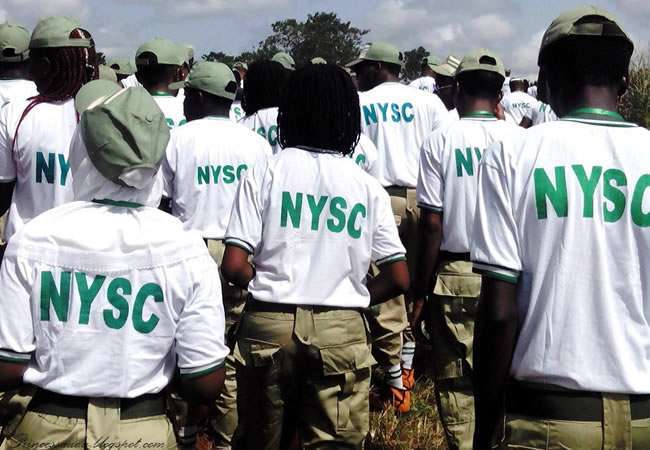
Six members of the National Youth Service Corps (NYSC) have received a total of N10 million in grants to expand their agribusiness ventures under the Farmers for the Future Programme.
The programme was organised on Monday by the British American Tobacco Nigeria Foundation (BATNF) in collaboration with the NYSC to encourage young Nigerians to embrace agriculture and develop sustainable businesses.
Presenting the cheques to the beneficiaries in Abuja, the NYSC Director-General, Brigadier General Olakunle Nafiu, urged Corps members to maximise the opportunities provided by the service year by venturing into commodity marketing and other viable businesses.
Nafiu said agribusiness remained a viable avenue for young people to build sustainable enterprises, create employment and generate wealth.
READ ALSO: NYSC Swears In 1,600 Corps Members In Bauchi
He also stressed the importance of value addition to the success and sustainability of business ventures, while commending BATNF for placing Nigerian youths at the centre of its entrepreneurship initiatives through value-chain development, employment creation and its partnership with the NYSC.
“I charge you to spread the news around. We have seen the outcome, and it is a good idea,” he said.
The beneficiaries are Dominic Olufemi (FC/25C/1143), who received N3 million; Temitope Adewole (ED/26A/2251), N2 million; Abdulwaheed Bala (ED/25B/1402), N2 million; Olanike Mayungbe (OG/26B/1037), N1 million; Kingsley Udoeyen (KG/26A/1735), N1 million; and Lorember Lorsue (JG/25B/1742), N1 million.
Speaking on the selection process, the Acting Director, Skills Acquisition and Entrepreneurship Development (SAED), Mrs Winifred Shopeka, said the programme began with an online registration portal through which Corps Members engaged in agribusiness submitted their business plans.
READ ALSO: NCCSALW Deploys NYSC Members In Fight Against Illegal Arms In Northeast
She said nearly 3,000 Corps members applied and underwent a rigorous selection process that produced 20 finalists.
According to her, the finalists participated in a boot camp and a final pitching session, which produced the 10 best presenters before the six ultimate winners were selected.
Shopeka said the beneficiaries had also been mentored and attached to established market operators to assist them in marketing their products.
She added that Corps Members who did not make the final stage of the competition were also trained by BATNF.
The BATNF Team Lead, Mr Oludare Odusanya, congratulated the beneficiaries and urged Corps Members engaged in agribusiness to master the fundamentals and acquire the knowledge and skills necessary to succeed.
“We are happy with our collaboration with the NYSC, and it will continue,” he said.
READ ALSO: NYSC Lauds Gov. Mohammed’s Intervention In Fence Collapse
Odusanya explained that BATNF was an independent organisation established to contribute to poverty reduction in Nigeria through sustainable agricultural practices and other interventions.
He said the Farmers for the Future Programme was instituted in collaboration with the NYSC to encourage Corps Members to venture into agribusiness and become job creators.
He added that the beneficiaries would be attached to mentors who would guide them towards achieving success in their respective businesses.
According to him, the programme has, since its inception, continued to enhance the entrepreneurial capacity of Corps Members.
News
CBN Reduces Interest Rate To 23%

The Central Bank of Nigeria (CBN) on Tuesday announced the reduction of the interest rate, also known as Monetary Policy Rate (MPR) to 23 percent.
Briefing the media in Abuja, the Governor of the CBN, Mr. Olayemi Cardoso, said at the 307th MPC meeting held on September 22, 2026 agreed the resetting of the MPR and recaliberation of the monetary policy market.
According to Cardoso, the committe is satisfied with the disinflation progress, adding that members noted stable banking sector following successful recapitalisation.
READ ALSO: CBN Monetary Tightening Worsening Nigeria’s N50tn Development Finance Gap – Group
Meanwhile, according to Nigerian Tribune, reports that that the MPC, at its 306th meeting in July 2026, disclosed its resolution to retain the interets at 26.5 percent.
According to the Governor of the CBN, Olayemi Cardoso, “the Committee’s decision to maintain the current policy stance followed a thorough assessment of the balance of risks. Although headline inflation moderated marginally in June 2026, global uncertainties have heightened, due mainly to the renewed hostilities in the Middle East.
“In view of the evolving developments, maintaining a cautious monetary policy stance remains appropriate. In arriving at its decision, the Committee noted the recent resurgence of hostilities in the Middle East, with particular attention to its spillover effects on global energy prices and the potential pass-through to domestic inflation.”
News
NURTW: KWAM1 Settles Long-time Rift Between MC Oluomo, Tafa Sego
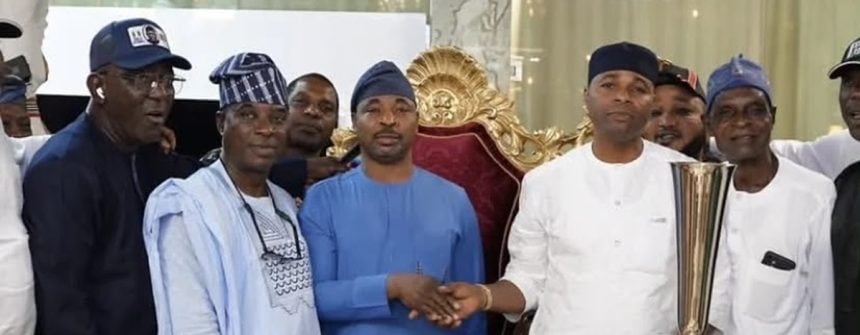
Nigerian Fuji musician, Wasiu Ayinde Marshal, popularly known as KWAM1, has brokered a peace deal between the National Union of Road Transport Workers (NURTW) National President, Musiliu Akinsanya, popularly known as MC Oluomo, and the Lagos State Chairman of the union, Mustapha Adekunle, aka Tafa Sego.
The reconciliation took place at Ojusagbola in Ijebu, Ogun State, where several NURTW chieftains gathered for the meeting.
The development was announced on Tuesday on KWAM1’s digital media page on Instagram, alongside photographs from the meeting.
According to the post, the two union leaders have resolved their differences after years of strained relations.
READ ALSO: Why FG Named KWAM 1 Aviation Security Ambassador — Keyamo
“After years of an age-long rift, MC Oluomo and Tafa Sego have finally settled their differences. And from what we know now, this is final,” the post said.
The musician was said to have intervened as the Mayegun of Yorubaland, with the aim of bringing an end to the longstanding disagreement between the two NURTW figures.
“K1 acted in his role as the Mayegun of Yorubaland by seeking an end to the long-standing rift, once and for all,” it said.
The post also described the meeting as a significant step beyond previous public displays of reconciliation.
READ ALSO: FG Gives KWAM 1 Aviation Appointment, After Airport Incident
“This time, it was not just another handshake for the cameras. The two old friends and colleagues came together at Ojusagbola, with King Wasiu Ayinde Marshal (K1) playing the peacemaker.”
Both MC Oluomo and Tafa Sego were reported to be pleased with the outcome of the intervention.
“Both parties are delighted about the new development,” the post said.
The two men had previously been allies and prominent figures within the Lagos NURTW before their relationship became strained amid disagreements linked to leadership of the union in the state.

 News2 days ago
BREAKING: Tinubu Extends Working Vacation
- News3 days ago
Six Hidden Health Benefits Of Unsweetened Zobo
- News5 days ago
Edo: Council Chairman Under Fire For Threatening Commercial Drivers Who Refuse To Wear APC Insignia
- News5 days ago
Edo: Ekpeson Redeems N20m Pledge To Family Of Fallen Soldier
- News3 days ago
2027: Step-by-step Guide To Applying For INEC Ad Hoc Staff Recruitment
- News3 days ago
Jehovah’s Witnesses Announce New Position On Blood Transfusion Policy
- News5 days ago
OPINION: Nigerian Pastors, Imams And Their Sex Sermon Obsession
- News3 days ago
How 36 Nigerian States Got Their Names
- Headline2 days ago
How To Format An Academic CV For US Master’s, PhD Applications
- News5 days ago
Otuaro Harps On Academic Excellence As Another 31 PAP Scholarship Beneficiaries Leave For UK


