
News
OPINION: Clerics, Politicians, And Election Money

By Lasisi Olagunju
Chief S. L. Akintola, post-independence Premier of the Western Region, knew that when money entered politics, trust could develop wings. There is a story of how he once sent two trusted associates to some people in the Ondo area. The message they carried was accompanied by money.
The emissaries went and returned with assurances that both message and money had been safely delivered.
Days later, Akintola called the same men and gave them another consignment of money for the same people. Again, they went; again, they returned with reports of successful delivery.
A week later, Akintola summoned the two men once more. There was another package for the same people. But this time, the old politician added a message for the messengers themselves.
“Take this to the same people. I sent you the first time, they did not get in touch to say thanks. I sent you the second time, and it did not look like that money reached its destination. Kindly make sure they come to say thanks for this one o. (A rán yín lákọ̀ọ́kọ́, wọn ò wá dúpẹ́; a rán yín lẹ́ẹ̀kejì, kò dàbí pé kínni ọ̀hún dé ọ̀hún. Ẹ dákùn, ẹ jẹ́ kí wọ́n wá dúpẹ́ èleyí o).”
Street-smart, politically alert Akintola did not accuse his trusted men of theft. He did not ask for an account. He merely asked that the beneficiaries remember to say thank you. The guilty, if they were guilty, would understand. That is real politics: rebuke wrapped in humour; suspicion without rupture.
The late Dr Omololu Olunloyo, Akintola’s protégé who would later become governor of old Oyo State, told some of us that story. He repeated it many times as we discussed how to maintain followership in the treacherous, shark-infested waters called politics.
Ahead of the 2027 general elections, we are already reading fairy tales of mega bucks thrashing about like hooked fish and doing somersaults for the ambitious.
In March 2026, an Islamic cleric in the North, Khalil, was quoted online with a claim that N500 billion had been budgeted to secure the support of northern Muslim clerics and traditional rulers for the return of Alhaji Bola Tinubu in the 2027 presidential election. The online medium that published the story quoted presidential spokesperson, Bayo Onanuga, dismissing the cleric’s claim as fictitious: “Whoever believes that can believe anything; including tales by moonlight.”
The amount truly looks mountainous enough to read like fiction. If you use an elephant as bait in a trap, I wonder what animal you hope to catch. Someone told me these ‘wild’ claims could be clerical come-buy-me adverts.
READ MORE FROM THE AUTHOR: OPINION: Tinubu, Atiku, Ige And A 1998 Story
Now, there is a fresh ‘disclosure’ of five meetings: three in Kaduna, one in Abuja and one in Jigawa. Our democracy is a bazaar.
Sahara Reporters last week quoted a viral video of an unnamed northern cleric who alleged that about 500 religious leaders were mobilised at five meetings where millions of naira were distributed to secure support for President Tinubu’s re-election.
At one of the meetings in Abuja, the cleric claimed, each participant received N3 million; at another, attendees were handed parcels containing undisclosed sums. These are wild claims. Where is the proof? The cleric offered none. But this is politics, where fires burn without smoke and smoke billows without fire.
The cleric then offered Nigerians a curious piece of counsel for the coming campaigns: “Any politician that brings money, collect it; it’s permissible by God, but do not vote for them.” Imagine that advice from a man of God. Promise them your vote, collect their money, then renege on the bargain. Would that not be a sin? And how could God permit you to obtain money by false pretence?
Where, then, is the moral difference between the pious sheikh who is paid by politicians to play, and the more pious one who collects their money but refuses to play? One sells his piety and delivers; the other takes the price but withholds the goods. Is the latter holier simply because he cheats the buyer? Should religious leaders become Chinua Achebe’s Eneke the bird, forever changing its survival strategy because the hunter has changed his own?
In Southern Nigeria, obtaining property by false pretence is an offence under Section 419 of the Criminal Code; in Northern Nigeria, the Penal Code calls it “cheating.” Overarching both is the Advance Fee Fraud and Other Fraud Related Offences Act. If a cleric collects my money and backs my opponent next year, I will report him to the law. But what does the law say about me using private or public funds to buy clean clerics for my election?
Should religious leaders be purchasable in the first place? Do not mind me. What do I know? Wise political animals would not blame politicians for buying clerics. They know where the votes live. These men of God are not mere voters; they are the real electors of the husbands of our animal farm. No amount spent on them is money wasted.
Besides, religion inhabits the realm of miracles, and money performs miracles in politics. Authors Nic Cheeseman and Brian Klaas devote a chapter of their book, ‘How to Rig an Election’ to those miracles. They call it “Buying Hearts and Minds: The Art of Electoral Bribery.” Before that chapter is another which discusses how politicians rig elections before the election day. The chapter has the title: “Invisible Rigging: How to Steal an Election Without Getting Caught.” Across the pages are stories of what money can buy before an election, what it can purchase on election day and, sometimes, what it can procure even after the votes have been cast.
So, forget the textbook definitions of political systems. In practice, democracy here is often less about the people than about the money deployed to persuade, purchase and manage them.
READ MORE FROM THE AUTHOR: OPINION: Fayose’s Bedroom Electrification
Using our Akintola story to interrogate the northern cleric’s disclosure may be interesting. If there is some truth in his claim, his exposé could produce unintended complications, particularly if what was delivered was less than what was dispatched. Questions will arise: Who met the clerics? How were the beneficiaries selected? How much were the messengers given to distribute? Did they deliver as instructed? If they did not, what could the sender do? Very little. He must never be heard to complain publicly that money meant to buy holy men of God was short-delivered or stolen wholesale.
Every knowledgeable politician understands this dilemma. You cannot succeed in politics here if you insist on personally delivering every political largesse. Politics requires intermediaries. You must know when to use friends and associates; trusted hands who know the people, the terrain and the routes to the intended destinations. The danger is that the messenger who carries your money may also carry away a portion of it. But refuse to use intermediaries and you may lose people, lose money and lose ground.
We hear today a lot of political stories similar to what Akintola experienced at the hands of those he trusted with money. Money leaves the coast but does not berth at the designated harbour. Somewhere between the giver and the receiver, the cargo changes ownership.
Perhaps that is inevitable in a politics organised as a voyage to Treasure Island. The politician wants the treasure of office; his followers expect their share of the loot buried somewhere in the vaults of the State House. Everyone aboard the ship, the Hispaniola, has an eye on the chest in the hold.
As you read the Electoral Act and INEC’s Guidelines, create quality time to read R. L. Stevenson’s ‘Treasure Island’. Read that 1883 novel because every political Hispaniola breeds its Long John Silvers — one-eyed, “one-legged seamen with parrots perched on their shoulders.” They sign on as loyal crewmen, they sail with you towards the treasure; but while they keep one eye on the captain, their other eye is on the gold in the hold. The politician loads the ship and calls the crew loyalists; somewhere at sea, some loyalists become pirates.
Akintola apparently understood that sea. That was why, on the third voyage, he did not accuse his sailors of piracy. He simply asked them to make sure the people at the harbour came to say thank you.
If nobody came, he would know where the treasure went.
You can contest an election in Nigeria, but you cannot win one without having the election stakeholders. Wherever you turn, there are the police; there is INEC; there are thugs; there are marabouts. Each has a place in the arithmetic of those who seek power. They must eat. We say in Yoruba: Ọmọdé ò jẹ obì, àgbà ò jẹ oyè (if the young are denied kola nut, the elder will be denied the chieftaincy title). Those who have money and know where and how to spend it are the ones who have people. And those who have people are very often the ones smiling at the collation centres. It can be as simple (and as troubling) as that.
I have friends on all sides of old and recent elections. Ekiti State; Osun State. Especially Osun State. They always tell stories of big money and big heists. I have people in virtually all the major parties at the federal level. A casual discussion with them on previous election management easily drifts into stories of money that left home but never arrived at its destination. Some candidates blame their losses on such mishaps. The fortunate ones, blessed with relatively honest messengers, are the ones who end up celebrating victory.
READ MORE FROM THE AUTHOR: OPINION: FAAC Soup For Sick States
Election money has its own mortality rate. Some bucks die in the pocket of the first messenger. Some survive the first messenger but expire with the second. Some get to the ward but never reach the unit. Some reach the unit but are lighter than when they began the journey. And when defeat comes, everybody produces an explanation except the missing money.
If you’ve not stepped beyond your father’s farm, you would boast around the village that your dad is the biggest farmer around. There were bullion vans in Tinubu’s Bourdillon in Lagos on February 22, 2019, the eve of that year’s presidential election. If the contents of those vehicles were naira, the coming shiploads on the high seas of 2027 carry crisp, mint dollars.
In 2019, “What is your headache?” was Tinubu’s answer to busybody questions that followed the bullion vans to his Bourdillon residence. Really, what should be our headache with bullion vans owned by the godfather? What happened there does not happen only here in Nigeria. As we do on earth, so they do in heaven.
In April 2013, Ugandan President Yoweri Museveni attended a televised youth-group event. In the full glare of the cameras and the crowd, he held aloft a white sack containing 250 million Ugandan shillings (then worth about $100,000) and handed it to the leader of the group. The BBC, which reported the spectacle, said “there were loud cheers” as Museveni raised the sack for all to see.
Yes, God sees all we do, but in politics, you exhibit for the eyes of God and the eyes of man. That exactly was the explanation Museveni’s Minister for the Presidency, Frank Tumwebaze, offered for the unusual theatre of the donation: “Quite a few times people have requested the president for money (for the youths) and have stolen it. Giving it in broad daylight means that the youths can see who has their money.”
As preparations begin for the next set of elections in Nigeria in January and February 2027, many shiploads of money will leave political harbours. Some will sink midstream; many more will be seized by ugly pirates hired to guard the cargo. At the end of everything, victorious candidates will count votes; defeated candidates will count losses; the agents of both will count profits.
May my friends be lucky next year with their messengers.
Somebody say Amen!
And may the messengers remember Akintola’s plea: this time, let the people come and say thank you.
Amin.



News
Six Corps Members Receive N10m Grants To Boost Agribusiness
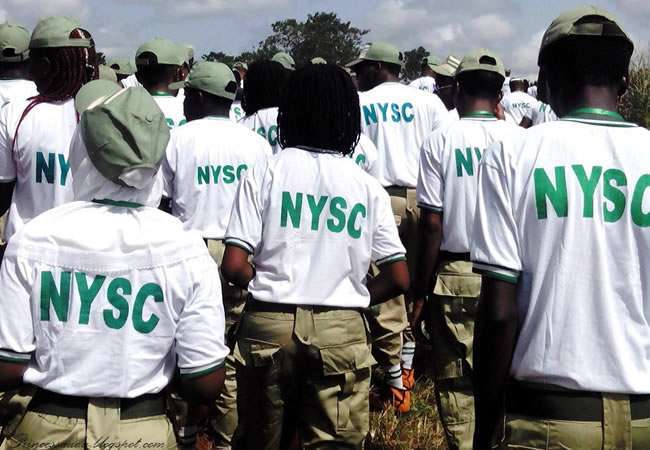
Six members of the National Youth Service Corps (NYSC) have received a total of N10 million in grants to expand their agribusiness ventures under the Farmers for the Future Programme.
The programme was organised on Monday by the British American Tobacco Nigeria Foundation (BATNF) in collaboration with the NYSC to encourage young Nigerians to embrace agriculture and develop sustainable businesses.
Presenting the cheques to the beneficiaries in Abuja, the NYSC Director-General, Brigadier General Olakunle Nafiu, urged Corps members to maximise the opportunities provided by the service year by venturing into commodity marketing and other viable businesses.
Nafiu said agribusiness remained a viable avenue for young people to build sustainable enterprises, create employment and generate wealth.
READ ALSO: NYSC Swears In 1,600 Corps Members In Bauchi
He also stressed the importance of value addition to the success and sustainability of business ventures, while commending BATNF for placing Nigerian youths at the centre of its entrepreneurship initiatives through value-chain development, employment creation and its partnership with the NYSC.
“I charge you to spread the news around. We have seen the outcome, and it is a good idea,” he said.
The beneficiaries are Dominic Olufemi (FC/25C/1143), who received N3 million; Temitope Adewole (ED/26A/2251), N2 million; Abdulwaheed Bala (ED/25B/1402), N2 million; Olanike Mayungbe (OG/26B/1037), N1 million; Kingsley Udoeyen (KG/26A/1735), N1 million; and Lorember Lorsue (JG/25B/1742), N1 million.
Speaking on the selection process, the Acting Director, Skills Acquisition and Entrepreneurship Development (SAED), Mrs Winifred Shopeka, said the programme began with an online registration portal through which Corps Members engaged in agribusiness submitted their business plans.
READ ALSO: NCCSALW Deploys NYSC Members In Fight Against Illegal Arms In Northeast
She said nearly 3,000 Corps members applied and underwent a rigorous selection process that produced 20 finalists.
According to her, the finalists participated in a boot camp and a final pitching session, which produced the 10 best presenters before the six ultimate winners were selected.
Shopeka said the beneficiaries had also been mentored and attached to established market operators to assist them in marketing their products.
She added that Corps Members who did not make the final stage of the competition were also trained by BATNF.
The BATNF Team Lead, Mr Oludare Odusanya, congratulated the beneficiaries and urged Corps Members engaged in agribusiness to master the fundamentals and acquire the knowledge and skills necessary to succeed.
“We are happy with our collaboration with the NYSC, and it will continue,” he said.
READ ALSO: NYSC Lauds Gov. Mohammed’s Intervention In Fence Collapse
Odusanya explained that BATNF was an independent organisation established to contribute to poverty reduction in Nigeria through sustainable agricultural practices and other interventions.
He said the Farmers for the Future Programme was instituted in collaboration with the NYSC to encourage Corps Members to venture into agribusiness and become job creators.
He added that the beneficiaries would be attached to mentors who would guide them towards achieving success in their respective businesses.
According to him, the programme has, since its inception, continued to enhance the entrepreneurial capacity of Corps Members.
News
CBN Reduces Interest Rate To 23%
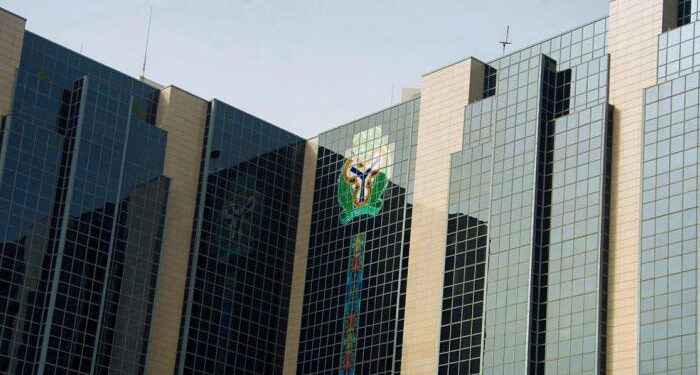
The Central Bank of Nigeria (CBN) on Tuesday announced the reduction of the interest rate, also known as Monetary Policy Rate (MPR) to 23 percent.
Briefing the media in Abuja, the Governor of the CBN, Mr. Olayemi Cardoso, said at the 307th MPC meeting held on September 22, 2026 agreed the resetting of the MPR and recaliberation of the monetary policy market.
According to Cardoso, the committe is satisfied with the disinflation progress, adding that members noted stable banking sector following successful recapitalisation.
READ ALSO: CBN Monetary Tightening Worsening Nigeria’s N50tn Development Finance Gap – Group
Meanwhile, according to Nigerian Tribune, reports that that the MPC, at its 306th meeting in July 2026, disclosed its resolution to retain the interets at 26.5 percent.
According to the Governor of the CBN, Olayemi Cardoso, “the Committee’s decision to maintain the current policy stance followed a thorough assessment of the balance of risks. Although headline inflation moderated marginally in June 2026, global uncertainties have heightened, due mainly to the renewed hostilities in the Middle East.
“In view of the evolving developments, maintaining a cautious monetary policy stance remains appropriate. In arriving at its decision, the Committee noted the recent resurgence of hostilities in the Middle East, with particular attention to its spillover effects on global energy prices and the potential pass-through to domestic inflation.”
News
NURTW: KWAM1 Settles Long-time Rift Between MC Oluomo, Tafa Sego
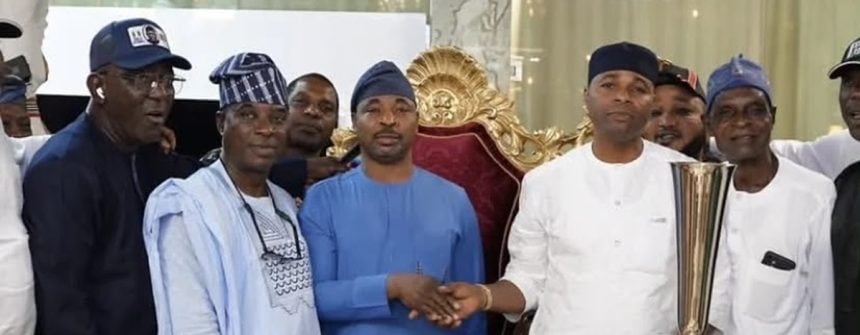
Nigerian Fuji musician, Wasiu Ayinde Marshal, popularly known as KWAM1, has brokered a peace deal between the National Union of Road Transport Workers (NURTW) National President, Musiliu Akinsanya, popularly known as MC Oluomo, and the Lagos State Chairman of the union, Mustapha Adekunle, aka Tafa Sego.
The reconciliation took place at Ojusagbola in Ijebu, Ogun State, where several NURTW chieftains gathered for the meeting.
The development was announced on Tuesday on KWAM1’s digital media page on Instagram, alongside photographs from the meeting.
According to the post, the two union leaders have resolved their differences after years of strained relations.
READ ALSO: Why FG Named KWAM 1 Aviation Security Ambassador — Keyamo
“After years of an age-long rift, MC Oluomo and Tafa Sego have finally settled their differences. And from what we know now, this is final,” the post said.
The musician was said to have intervened as the Mayegun of Yorubaland, with the aim of bringing an end to the longstanding disagreement between the two NURTW figures.
“K1 acted in his role as the Mayegun of Yorubaland by seeking an end to the long-standing rift, once and for all,” it said.
The post also described the meeting as a significant step beyond previous public displays of reconciliation.
READ ALSO: FG Gives KWAM 1 Aviation Appointment, After Airport Incident
“This time, it was not just another handshake for the cameras. The two old friends and colleagues came together at Ojusagbola, with King Wasiu Ayinde Marshal (K1) playing the peacemaker.”
Both MC Oluomo and Tafa Sego were reported to be pleased with the outcome of the intervention.
“Both parties are delighted about the new development,” the post said.
The two men had previously been allies and prominent figures within the Lagos NURTW before their relationship became strained amid disagreements linked to leadership of the union in the state.

 News2 days ago
BREAKING: Tinubu Extends Working Vacation
- News4 days ago
Six Hidden Health Benefits Of Unsweetened Zobo
- News4 days ago
Jehovah’s Witnesses Announce New Position On Blood Transfusion Policy
- News4 days ago
2027: Step-by-step Guide To Applying For INEC Ad Hoc Staff Recruitment
- News4 days ago
How 36 Nigerian States Got Their Names
- Headline4 days ago
Nigerian Man Jailed After Masturbating In Front Of Woman On UK Train
- Headline2 days ago
How To Format An Academic CV For US Master’s, PhD Applications
- News4 days ago
Stop Acid Reflux Pain: Foods You Must Ban From Your Kitchen
- Headline4 days ago
Nigerian Woman Arrested, Charged Over Illegal Voting In US
- News3 days ago
[OPINION] Wike-APC: Fights Always End Adultery


