
News
OPINION: Elumelu And A Bank Culture Gone Wrong

By Lasisi Olagunju
“Come, Lasisi. Come and see this.” I turned towards the voice. It was a female corps member beckoning to me in the newsroom. I looked at the young lady and, gesturing with my right palm, asked if she was referring to me. She said yes. I opened my mouth, and while I contemplated whether to close it or say something, the air around me stopped moving. That was in September 2011, twenty-one years after I left the university. A 22-year-old corps member had just called me by my first name, in my own office, and condescendingly asked me to come to her and see something on a piece of paper.
There were gasps from those who heard the lady say what she said and how she said it. Then silence descended on the newsroom. I did not have to say anything. My female colleagues took over and put the corps member in her proper place. It was as if the ground should open its mouth and swallow her. Embarrassed by her conduct and humbled by the rebuke she received, she came to me and said sorry.
The young lady grew from that moment of impudence to become a very resourceful, generally respectful corps member so much so that I got her employed after her youth service.
Fifteen years after my experience, the social media exploded last week discussing another young woman who had walked into a fiercer cultural storm. This time, the man at the other end was a very big man, Mr. Tony Elumelu, until some days ago, Chairman of the UBA Group.
At UBA’s Graduate Management Accelerated Programme graduation ceremony on Thursday last week, a young female graduate picked the microphone and greeted her chairman, Mr Elumelu with “Good morning, Tony.” That was gross, strong and molten enough to provoke a volcanic eruption. Elumelu promptly corrected her, asking to be addressed as “Mr Elumelu” or “TOE” and declaring that he did not subscribe to that kind of “Oyinbo life.” The brief exchange sparked a huge debate over culture, respect, seniority and the (in)appropriateness of the culture of first-name informality in certain Nigerian workplaces.
Rebuke is the price paid for infractions. And the rebuke of the lady has been enough for even the longest of lifetimes. But while we sit in judgment over her conduct, how about we look at the why of the matter? And here, I discuss context.
I read that lady’s face, gait and stride standing up. I did not see a young woman who set out to be rude. I saw a genuinely naive girl, who got a rule book and read and chewed and swallowed it. While I was thinking about what went wrong, reading and searching for clues, I came across Punch newspaper columnist, Tunde Odesola’s Facebook post chastising the lady. On that thread, a certain gentleman quietly dropped his own experience of working in the same environment in which the lady spoke:
“I was trained in UBA training school, Kano, before joining the bank in 2007. We were trained to call everyone by their first name and this we were told included Tony. I believe this was what was taught the lady in question too. Anyone blaming her should get to know the root of the matter first. If the bank doesn’t want it again, they should scrap it off their curriculum in the training school.”
READ MORE FROM THE AUTHOR: OPINION: Politicians Who Sell Their Own Toes
That was Sunday Ademola Ojelabi.
If what Ojelabi wrote is true, I would pity that girl. How do you sweep a witch’s yard and live after the act? If you do not sweep it clean, she complains; if you sweep it too clean, she complains. Now, let me ask: If you spend weeks teaching your young trainees a culture of informality, can you in good conscience blame them for practising it? What should a workplace expect if it flattens hierarchy linguistically, telling trainees that the company’s first-name culture encourages openness and makes junior employees less afraid of senior executives?
And, beyond the less-than-three-minute clip, what else happened? I watched a longer clip showing that the conversation between Tony and the young lady ended well. She asked her question; her billionaire employer answered like a boss who understood what happened. Shakespeare would watch the final act and smile: “All’s well that ends well.”
That bank has weathered its own first-name policy storm; others will soon run into theirs except they learn and change.
An X user (a chartered accountant, I presume), recalling a similar experience, wrote: “In my first year at work, I called one of the partners by his three-letter initials in public. He quietly called me into his office and said, ‘Ṣe bí ọmọ Yorùbá ni wọ? L’ọ wá ń pè mí ní XYZ. Má ṣe ṣe bẹ́ẹ̀ mọ́ láéláé.’ Since then, I called him Alhaji, even during client meetings.” (translation: But you are a Yoruba, and you called my name just like that. Don’t ever do that again). Contradiction? Or, hypocrisy?
Now, a few words on the lessons. The uproar over the “Good morning, Tony” drama has undoubtedly reset the ‘first-name/no-sirs’ policy of that bank. In the concluding clip, I could hear the young lady saying “sir” at the end of virtually every sentence. Going forward, it will be strange if other workers in that establishment do not take a cue from her experience. An organisation cannot deliberately dismantle the linguistic markers of hierarchy in training and then cry “Oyinbo life!” when the taught comes out bearing the corpse of the hierarchy she was taught to bury.
The critic in me would look at the whole thing, bring down the gavel and deliver a verdict: corporate accident. Who collapses the staircase of age in Africa? In Africa, sacred is the gradation, the hierarchy, the culturally recognised ascent that comes with age. To collapse that staircase is to flatten distinctions divinely ordered.
Respect for age is a black man’s heritage. Nancy S. Jecker, in her “African Conceptions of Age-Based Moral Standing,” cites a World Health Organisation report which found that, in nations outside the Global North, “older people are generally shown more respect.” That respect begins with how age is addressed. It is this inheritance that some corporate people assault in their eagerness to keep up with the Joneses of the West.
The X commenter’s mention of “ọmọ Yorùbá” is a reminder of the ethnic dimension the discourse could take. I saw it across cyberspace. I may be too culturally illiterate to speak for others, but I have spent the whole of my existence washing my hands; so I eat with elders and partake of the gems of their thoughts. The Yoruba have a carefully structured culture, with clearly defined codes of behaviour and relationships.
READ MORE FROM THE AUTHOR: OPINION: From Emilokan To Bulldog Brower
I am a Yoruba and I know that in my cultural space, the politics and sociology of naming in greeting is a course taught from the womb. Everyone knows their place in the social order, and every relationship comes with its terms, privileges and obligations. My older male siblings and people of their generation are my Bùòdá. The way I respect my blood relations is the way I must respect their contemporaries outside our lineage.
Age commands deference. A younger person does not address an elder by their personal name. It is a taboo. There are words for people, and there are people for particular words. A woman who is ìyálé (senior wife) must never be addressed simply as ìyàwó (wife). A husband may call his wife (or wives) by their personal names; the wife cannot do the same with her husband. In this culture, words know their owners. To give the wrong word to the right person is itself an offence.
In the Yoruba past, as it was with age, so it was (and still is) among women married into the same compound.
A girl preparing for marriage is taught the etiquette of married life, including the rule that if a (senior) co-wife is older than her mother, she must address her as “Mother” — Bí orogún ẹni bá ju ìyá ẹni lọ, ìyá ni à ń pè é. This is such a well-known Yoruba convention that it would be difficult to find a real Yoruba person who has never heard it.
Again, here, among wives, seniority was/is determined not necessarily always by age but by the order of marriage into the family, nuclear and extended.
William R. Bascom, the American anthropologist who studied Yoruba society in the 1930s and 1940s, gives us a fascinating window into this world. In his essay, ‘The Principle of Seniority in the Social Structure of the Yoruba,’ published in American Anthropologist for January-March 1942, Bascom shows how seriously the Yoruba took the language of hierarchy.
Among co-wives, he found that using the wrong form of address could have serious consequences. He noted that the offence might lie in showing too little respect, but, interestingly, it could also lie in showing too much. Bascom said context, rank and tone mattered. A fifth wife addressing the first wife merely as “my senior wife” (ìyálé mi), rather than “my mother” (ìyá mi), committed an offence that diminished a status custom had already settled.
If a woman did that, Bascom recreates what might follow:
“Are you speaking to me?” the first wife would ask indignantly.
If the fifth wife answered “Yes” then from the elder would come the rebuke that would send her back home, indicting her upbringing:
READ MORE FROM THE AUTHOR: OPINION: Adeleke And His Saturday Bulldozer
“What do you mean? Go to your house and learn wisdom, or is there no elder in the house where you come from?”
The offender was being told that her misconduct could only have come from a child married from a home without elders, or with elders who had failed to teach her manners.
Bascom asked his Yoruba informants what would happen if the fifth wife went beyond calling the first wife “my senior wife” (instead of “my mother”) and actually addressed her by her personal name. Their reaction was one of astonishment:
“Ah! She would be flogged!”
The household would take over. Family members would first ask whether they had heard her correctly, they would give the woman yet another opportunity to retreat. If she insisted on the insult, the household would collapse the whole world on her. The disgraced wife may even be asked to pack her belongings and return to her parents.
But going to her parents’ home would not end the matter. While her parents would work hard to save the marriage, they would work harder rebuking their daughter for putting them to shame. The anthropologist says they would ask their daughter why she has decided to act “like a person who has not been taught (àbíìkọ́) or like a person who has been taught but does not listen (akọ́ọ̀gbà).” It was that serious. Even today, it remains a serious matter. The head is the head: no one, however modern, uses it to walk.
A lot has shifted since Bascom wrote his piece 84 years ago. Despite the corrosion wrought by modernity (ọ̀làjú), relationships in Yorubaland still have names, just as ranks have terms, and the choice of language has consequences. A word is never merely chosen and uttered to fill a void; it is a construct that locates the speaker and the person spoken to within a moral and social order. In other words, in the Yoruba world, social peace depends, in part, on everyone knowing not only who everyone else is, but also what they are to one another. This is expressed through the way we address them.
Even the use of the English word “you” (ìwọ) for an elder or older person can become an issue in certain contexts. “You” is too singular, too socially unmarked, to carry the weight of ‘ẹ̀yin’, the honorific form reserved for age, rank and position. English says “you” to everyone; Yoruba does not. In Yoruba, the pronoun itself can bow, and must bow before age and authority. For instance, how do you look at His Imperial Majesty in the eyes and call him simply “you”? A scrambled “sir” uttered after it is never enough to mitigate the sacrilege.
It has been an interesting discourse, online and offline, since the blast of the whistle on this drama. But the question needs to be asked, and I ask it: How does this controversy, and the conversations around it, improve the lives we live as Nigerians? My answer is that Nigeria is mired in crises partly because of the contradictions in our ways: people make rules and avoid being caught by them; people demand respect without giving it; people exercise authority without accepting responsibility; they claim rights without acknowledging obligations. They teach what should never be taught. They learn what should never be learnt. They import alien conventions that collide with indigenous codes of morality, age, rank and respect. They flaunt the wrong culture and elevate the wrong values. One such value is the corporate first-name policy. Those who venerate it should now know that its fashionable flame can consume even their own huts.
Now, back to the iron in the fire. I end with the advice of former First Bank chairman, Pastor (Mrs) Ibukun Awosika. Her words have travelled with the same wildfire that carried the UBA girl’s story: “Your office may say, ‘Call everyone by their first name,’ …don’t throw away the culture of respect… Understand the context of where you’re operating. Understand the environment that you’re functioning in and learn how to play to win in that environment.”



News
Six Corps Members Receive N10m Grants To Boost Agribusiness
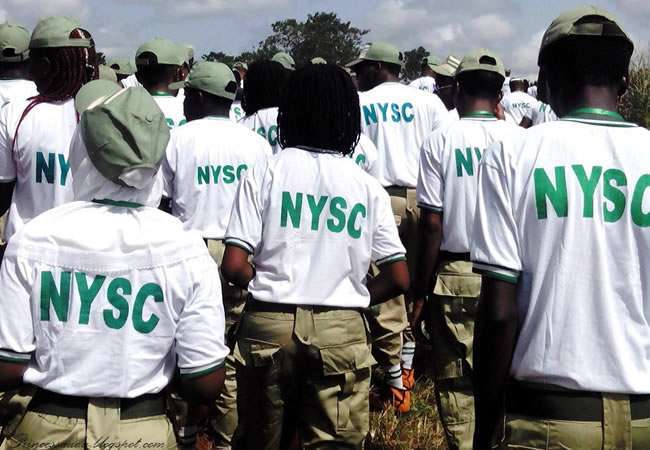
Six members of the National Youth Service Corps (NYSC) have received a total of N10 million in grants to expand their agribusiness ventures under the Farmers for the Future Programme.
The programme was organised on Monday by the British American Tobacco Nigeria Foundation (BATNF) in collaboration with the NYSC to encourage young Nigerians to embrace agriculture and develop sustainable businesses.
Presenting the cheques to the beneficiaries in Abuja, the NYSC Director-General, Brigadier General Olakunle Nafiu, urged Corps members to maximise the opportunities provided by the service year by venturing into commodity marketing and other viable businesses.
Nafiu said agribusiness remained a viable avenue for young people to build sustainable enterprises, create employment and generate wealth.
READ ALSO: NYSC Swears In 1,600 Corps Members In Bauchi
He also stressed the importance of value addition to the success and sustainability of business ventures, while commending BATNF for placing Nigerian youths at the centre of its entrepreneurship initiatives through value-chain development, employment creation and its partnership with the NYSC.
“I charge you to spread the news around. We have seen the outcome, and it is a good idea,” he said.
The beneficiaries are Dominic Olufemi (FC/25C/1143), who received N3 million; Temitope Adewole (ED/26A/2251), N2 million; Abdulwaheed Bala (ED/25B/1402), N2 million; Olanike Mayungbe (OG/26B/1037), N1 million; Kingsley Udoeyen (KG/26A/1735), N1 million; and Lorember Lorsue (JG/25B/1742), N1 million.
Speaking on the selection process, the Acting Director, Skills Acquisition and Entrepreneurship Development (SAED), Mrs Winifred Shopeka, said the programme began with an online registration portal through which Corps Members engaged in agribusiness submitted their business plans.
READ ALSO: NCCSALW Deploys NYSC Members In Fight Against Illegal Arms In Northeast
She said nearly 3,000 Corps members applied and underwent a rigorous selection process that produced 20 finalists.
According to her, the finalists participated in a boot camp and a final pitching session, which produced the 10 best presenters before the six ultimate winners were selected.
Shopeka said the beneficiaries had also been mentored and attached to established market operators to assist them in marketing their products.
She added that Corps Members who did not make the final stage of the competition were also trained by BATNF.
The BATNF Team Lead, Mr Oludare Odusanya, congratulated the beneficiaries and urged Corps Members engaged in agribusiness to master the fundamentals and acquire the knowledge and skills necessary to succeed.
“We are happy with our collaboration with the NYSC, and it will continue,” he said.
READ ALSO: NYSC Lauds Gov. Mohammed’s Intervention In Fence Collapse
Odusanya explained that BATNF was an independent organisation established to contribute to poverty reduction in Nigeria through sustainable agricultural practices and other interventions.
He said the Farmers for the Future Programme was instituted in collaboration with the NYSC to encourage Corps Members to venture into agribusiness and become job creators.
He added that the beneficiaries would be attached to mentors who would guide them towards achieving success in their respective businesses.
According to him, the programme has, since its inception, continued to enhance the entrepreneurial capacity of Corps Members.
News
CBN Reduces Interest Rate To 23%

The Central Bank of Nigeria (CBN) on Tuesday announced the reduction of the interest rate, also known as Monetary Policy Rate (MPR) to 23 percent.
Briefing the media in Abuja, the Governor of the CBN, Mr. Olayemi Cardoso, said at the 307th MPC meeting held on September 22, 2026 agreed the resetting of the MPR and recaliberation of the monetary policy market.
According to Cardoso, the committe is satisfied with the disinflation progress, adding that members noted stable banking sector following successful recapitalisation.
READ ALSO: CBN Monetary Tightening Worsening Nigeria’s N50tn Development Finance Gap – Group
Meanwhile, according to Nigerian Tribune, reports that that the MPC, at its 306th meeting in July 2026, disclosed its resolution to retain the interets at 26.5 percent.
According to the Governor of the CBN, Olayemi Cardoso, “the Committee’s decision to maintain the current policy stance followed a thorough assessment of the balance of risks. Although headline inflation moderated marginally in June 2026, global uncertainties have heightened, due mainly to the renewed hostilities in the Middle East.
“In view of the evolving developments, maintaining a cautious monetary policy stance remains appropriate. In arriving at its decision, the Committee noted the recent resurgence of hostilities in the Middle East, with particular attention to its spillover effects on global energy prices and the potential pass-through to domestic inflation.”
News
NURTW: KWAM1 Settles Long-time Rift Between MC Oluomo, Tafa Sego
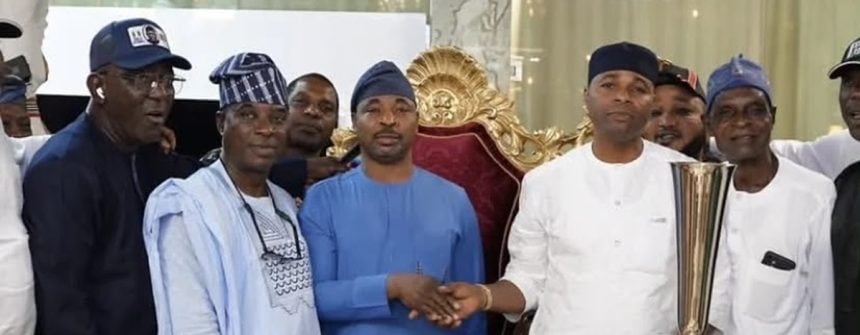
Nigerian Fuji musician, Wasiu Ayinde Marshal, popularly known as KWAM1, has brokered a peace deal between the National Union of Road Transport Workers (NURTW) National President, Musiliu Akinsanya, popularly known as MC Oluomo, and the Lagos State Chairman of the union, Mustapha Adekunle, aka Tafa Sego.
The reconciliation took place at Ojusagbola in Ijebu, Ogun State, where several NURTW chieftains gathered for the meeting.
The development was announced on Tuesday on KWAM1’s digital media page on Instagram, alongside photographs from the meeting.
According to the post, the two union leaders have resolved their differences after years of strained relations.
READ ALSO: Why FG Named KWAM 1 Aviation Security Ambassador — Keyamo
“After years of an age-long rift, MC Oluomo and Tafa Sego have finally settled their differences. And from what we know now, this is final,” the post said.
The musician was said to have intervened as the Mayegun of Yorubaland, with the aim of bringing an end to the longstanding disagreement between the two NURTW figures.
“K1 acted in his role as the Mayegun of Yorubaland by seeking an end to the long-standing rift, once and for all,” it said.
The post also described the meeting as a significant step beyond previous public displays of reconciliation.
READ ALSO: FG Gives KWAM 1 Aviation Appointment, After Airport Incident
“This time, it was not just another handshake for the cameras. The two old friends and colleagues came together at Ojusagbola, with King Wasiu Ayinde Marshal (K1) playing the peacemaker.”
Both MC Oluomo and Tafa Sego were reported to be pleased with the outcome of the intervention.
“Both parties are delighted about the new development,” the post said.
The two men had previously been allies and prominent figures within the Lagos NURTW before their relationship became strained amid disagreements linked to leadership of the union in the state.

 News2 days ago
BREAKING: Tinubu Extends Working Vacation
- News3 days ago
Six Hidden Health Benefits Of Unsweetened Zobo
- News5 days ago
Edo: Council Chairman Under Fire For Threatening Commercial Drivers Who Refuse To Wear APC Insignia
- News5 days ago
Edo: Ekpeson Redeems N20m Pledge To Family Of Fallen Soldier
- News3 days ago
Jehovah’s Witnesses Announce New Position On Blood Transfusion Policy
- News3 days ago
2027: Step-by-step Guide To Applying For INEC Ad Hoc Staff Recruitment
- News5 days ago
OPINION: Nigerian Pastors, Imams And Their Sex Sermon Obsession
- News3 days ago
How 36 Nigerian States Got Their Names
- Headline3 days ago
Nigerian Man Jailed After Masturbating In Front Of Woman On UK Train
- Headline2 days ago
How To Format An Academic CV For US Master’s, PhD Applications


