

News
OPINION: Every democracy ‘Murders Itself’




By Lasisi Olagunju
In ‘Jokes and Targets’ by Christie Davies, a Soviet journalist interviews a Chukchi man:
“Could you tell us briefly how you lived before the October revolution?”
“Hungry and cold.”
“How do you live now?”
“Hungry, cold, and with a feeling of deep gratitude.”
This sounds like Nigeria’s malaria victims thanking mosquitoes for their love and care. Between democracy and its opposite, reality has blurred the lines.
Last week, a group of White House pool reporters travelled with President Donald Trump on Air Force One as he returned from his U.K. state visit. At the beginning of the journey, actor Trump sauntered into the rear section of the plane, the traditional part for the press. He granted an interview and ended it with a morbid wish: “Fly safely. You know why I say that? Because I’m on the flight. I want to get home. Otherwise I wouldn’t care.”
Ten years ago, if a US president said what Trump told those poor reporters, his presidency would suffer immediate cardiac arrest. But this is Colin Crouch’s post-democracy era: the leader, whether in the US or in Nigeria, in Africa or elsewhere, is the law; whatever he does or says, we bow in gratitude.
I live in a Nigeria of gratitude and surrender. In the North-West and the North-East, traumatised communities are grateful to bandits and their enablers. They invite them to the negotiation table and thank the murderous gunmen for honouring the invitation. A grateful nation anoints and weeps at the feet of terrorists. In emergency-weaned Rivers State, its remorseful governor is effusive in appreciation of a second chance. The reinstated is ever thankful for the favours of a six-month suspension. From the North to the South, on bad roads and in death-wracked hospital wards, sonorous hymns of appreciation for big mercies ooze. The legislature and the judiciary, even the fourth estate, are all in congregation, singing songs of praise of the benevolent executive. Is this still a democracy?
American political scientists, Suzanne Mettler and Robert C. Lieberman in 2020 wrote ‘The Fragile Republic’ for The Foreign Affairs. In that essay, they list four symptoms of democratic backsliding. Prime among the four are economic inequality and excessive executive power. “Excessive executive power” is a three-word synonym for autocratization of democracy. It is a by-word for a democracy hanging itself.
The second president of the United States of America, John Adams, saw today; he warned of democracy decaying and dying: “Remember, democracy never lasts long. It soon wastes, exhausts, and murders itself. There never was a democracy yet that did not commit suicide.” Adams was not alone. There was also William Blake, 18th/19th century English poet, who said “if men were wise, the most arbitrary princes could not hurt them. If they are not wise, the freest government is compelled to be a tyranny.” This reads like it was written today and here. If you disagree, I ask: Is it wise (and normal) for the tormented to thank the tormentor?
MORE FROM THE AUTHOR:OPINION: A Minister’s Message To Me
Listening to what Trump wished the reporters, we could see that big brother America now leads in democratic ‘erantship’, the Third World merely follows. An enormous country, strong enough to appropriate the name of an entire continent, America, in 2025, is blessed with a strongman that is armed with a licence to rule as it pleases his whim; a president who does what he likes and says what he likes or ‘jokes’ about it without consequences. The result is an imperial presidency that has redefined democracy across the world.
We say here that the yam of the one who is vigilant never gets burnt. The American system used to be very resilient in providing a leash on presidential excesses. It still does, although under a very difficult situation. Donald Trump, in his first term between 2017 and 2021, signed 220 Executive Orders. In his ongoing second term that began in January 2025, he has, as of September 18, 2025, already signed 204 Executive Orders upturning this balance, rupturing that tendon. An American friend told me that he could no longer recognise his country. But the good news is that those who should talk and act are not surrendering their country to Trump and his faction of the populace. Because it is America (and not Nigeria), there are over 300 lawsuits challenging Trump’s executive orders or policies in his second term.
The active legal challenges view the Trump orders either as unconstitutional, exceeding statutory power, or violating rights. And the courts are also doing their job as they should. A 2025 study found some 150 judicial decisions concerning these orders. Some are preliminary injunctions, others are full rulings. President Bola Tinubu last week acknowledged the existence of “over 40 cases in the courts in Abuja, Port Harcourt, and Yenagoa, to invalidate” his Rivers State emergency order. Our courts, especially the Supreme Court, are yet to acknowledge any of the cases with trials, rulings and orders.
It is easy for presidents with unrestrained executive powers to assume imperial airs. In the past, when they did, they feared losing their link with the people and a fall from power. Today, they are on very solid ground, no matter what they do with their people. Midway into his term as US president, an increasingly unpopular Jimmy Carter reassessed himself, and in lamentation told Washington Post’s David Broder that he (Carter) had “fallen into the trap of being ‘head of the government’ rather than ‘leader of the people.’” Today is not that yesterday of sin and punishment. We have surrendered to the point of giving ourselves away. Today’s leaders know that what they need is the government, its power and privileges, certainly not the people. And they keep working hard at it such that America has Trump, and is not the only country that has a Trump. There are Trumps everywhere. We have them in Africa, from the north to the coast.
What democracy suffers in America it suffers more in Africa. Former President Goodluck Jonathan said at the weekend that “democracy in the African continent is going through a period of strain and risk of collapse unless stakeholders come together to rethink and reform it.” He said politicians manipulate the electoral system to perpetuate themselves in office even when the people don’t want them. “Our people want to enjoy their freedom. They want their votes to count during elections. They want equitable representation and inclusivity. They want good education. Our people want security. They want access to good healthcare. They want jobs. They want dignity. When leaders fail to meet these basic needs, the people become disillusioned.” That is from Jonathan who was our president for six years. Did he say these new things because he wants to come back?
Democracy is like water; a wrong dose turns it to poison. If disillusionment has a home, it is in Africa. It is the reason why the youths of the continent are bailing out for succour, and the reason for Trump’s $100,000 fee on work visas.
In The North American Review of November 1910, Samuel J. Kornhauser reproduced a quotation that contains warnings of what threat a people could constitute to their own freedom: “The same tendencies to wanton abuse of power which exist in a despot or a ruling oligarchy may be expected in a democracy from the ruling majority, because they are tendencies incidental to human nature.” The solution was “a free people setting limitations upon the exercise of their own will” so that they would not “turn democracy into a curse instead of a blessing.”
MORE FROM THE THE AUTHOR:OPINION: HID Awolowo And The Yoruba Woman
In his 1904 essay, ‘The Relation of the Executive to the Legislative Power’, James T. Young, observed a dramatic shift in American governance: while Woodrow Wilson had earlier warned of “Congressional supremacy,” Young argued that “we now live under a system of executive supremacy,” showing how the traditional checks and balances had failed to maintain equilibrium among the branches. That was in 1904, a hundred and twenty one years ago.
Someone said a leader’s ability to lead a society successfully is dependent on their capacity to govern themselves. It is that self-governing capacity that is lacking in our power circles. Plus the leaders don’t think they owe history anything. “From the errors of others, a wise man corrects himself…The wise man sees in the misfortune of others what he should avoid.” Publilius Syrus (85–43 BC), the Roman writer credited with uttering those nuggets, was a master of proverbs and apophthegm. We don’t listen to such words; we don’t mind being tripped by the same stone, and it does not matter falling into the same pit.
A democracy can enthrone emperors and kings but it is not that easy to ask them to dismount the high horse of the state without huge costs. We elect leaders and for unsalutory reasons, we let them roam freely with our lives, our safety and our comfort. We promote and defend them with our freedom. I hope we know the full import (and consequences) of the seed we are planting today. A Pharaoh will come who won’t remember that there was ever a Joseph.
A Roman emperor called Caligula reigned from 16 March, 37 AD until he was put to sleep on 24 January, 41 AD. ‘Caligula’ was not the name his parents gave him; it was an alias, “a joke of the troops” which trumped his real identity: He was named after popular Julius Caesar.
Roman historian, Claudius Suetonius, records in his ‘The Lives of the Caesars’ that Caligula became emperor after his father’s death and then “full and absolute power was at once put into his hands by the unanimous consent of the senate and of the mob, which forced its way into the House.” The new leader came popular with a lot of the people’s hope invested in him. Suetonius says the young man “assumed various surnames (for he was called ‘Pious,’ ‘Child of the Camp,’ ‘Father of the Armies,’ and ‘Greatest and Best of Caesars’). Soon the fawning appellations entered his head and he became the opposite of what his people wanted in their leader. One day, Emperor Caligula chanced “to overhear some kings who had come to Rome to pay their respects to him” doing what Yoruba kings love doing: He found them arguing at dinner about whose throne, among them, was the greatest and the highest in nobility. The emperor heard them and cried: “Let there be one Lord, one King.” He called them to order and from that point, it was clear to everyone that republican Rome now had one Lord, one king, and that was Caligula.
The man said and did things that frightened even the heartless. At a point during his reign, Caligula saw a mass of Roman people, the rabble, applauding some nobles whom he detested. He voiced his hatred for what the people did and said what he thought should be their punishment: “I wish the Roman people had but a single neck so I could cut it through at one blow.” That statement became a quote which has, through centuries, defined his place in history.
It would appear that 79-year old Donald Trump defined himself for history last week with his “fly safely…because I’m on the flight” statement. A leader, a father and grandfather said he did not care if a plane-load of young men and women perished (without him) in a crash. And he told them so.
MORE FROM THE AUTHOR:OPINION: On El-Rufai, Aláròká And Terrorists
A Twi proverb suggests that “the chief feels the heat only when his own roof is on fire.” Trump’s unfortunate remark is said to be a joke. Even as a joke, what the US president said sits in a long tradition of expensive jokes. Trump’s cruel ‘jest’ couldn’t be funny to any people even if they were under the spell of the leader. History and literature are full of such costly quips that come light from the tongue but which reveal something raw about power and rulers: power does not agree that all human beings possess equal worth, equal dignity, and equal rights. Power talks, and whenever it talks, it sets itself apart.
King Louis XV of France is remembered for uttering the line: “Après moi, le déluge (After me, the flood).” Some commentators say it was a joke, some others say it was a shrug. History interpreted what Louis XV said as the king not caring a hoot whatever might happen to France after he was gone. That statement is a sound bite that has clung to him forever as Abraham Lincoln’s mother’s prayer clung to her son.
When Louis XV said it, no one saw what the king said as a prophecy, grim and ghastly. I am not sure he also knew the full import of what he said. But it was prescient; fifteen years after his reign, the “flood” came furious with the 1789 revolution culminating in the effective abolition of the French monarchy by the proclamation of the First Republic on September 21, 1792.
Emperor Nero of Rome is remembered forever for playing the fiddle while Rome was burning. In William Shakespeare’s Henry VI, we read a verse that ends with “Nero, Play(ing) on the lute, beholding the towns burn.” What is remembered of Nero is the image of a leader who ‘enjoyed the life of his head’ while his empire got destroyed by fire set at it by the enemy. But did the emperor really do that? Read this from the Encyclopaedia Britannica: “So, did Nero fiddle while Rome burned? No. Sort of. Maybe. More likely, he strummed a proto-guitar while dreaming of the new city that he hoped would arise in the fire’s ashes. That isn’t quite the same thing as doing nothing, but it isn’t the sort of decisive leadership one might hope for either.”
I have roamed from imperial Rome to medieval France, to democratic America and its Nigerian side-kick. What is next here is to go back, and salute John Adams with this his dispraise of democracy: “It is in vain to say that democracy is less vain, less proud, less selfish, less ambitious, or less avaricious than aristocracy or monarchy.” A system or a country becomes a joke when its leaders toy with its destiny; when they make light of the fears of their people.
The Akan of Ghana warn that if you sit on comfortable rotten wood to eat pawpaw, your bottom gets wet and your mouth also gets wet. This is to say that there are consequences for choices made. A kabiyesi democracy is an autocratic monarchy. And what does that feel like? I read of a king who joked to his courtiers during famine: “Hunger has no teeth sharp enough to bite me in my palace.” It was a careless statement of a monarchy that has found its way into the mouth of our democracy. I saw it where I read it that the ‘joke’ “was remembered bitterly by the starving commoners who later sang satirical songs about the unfeeling king.” Some jokes outlive their laughter.




News
Xenophobic Attacks: Oshiomhole Tells FG To Retaliate Against South African Companies In Nigeria

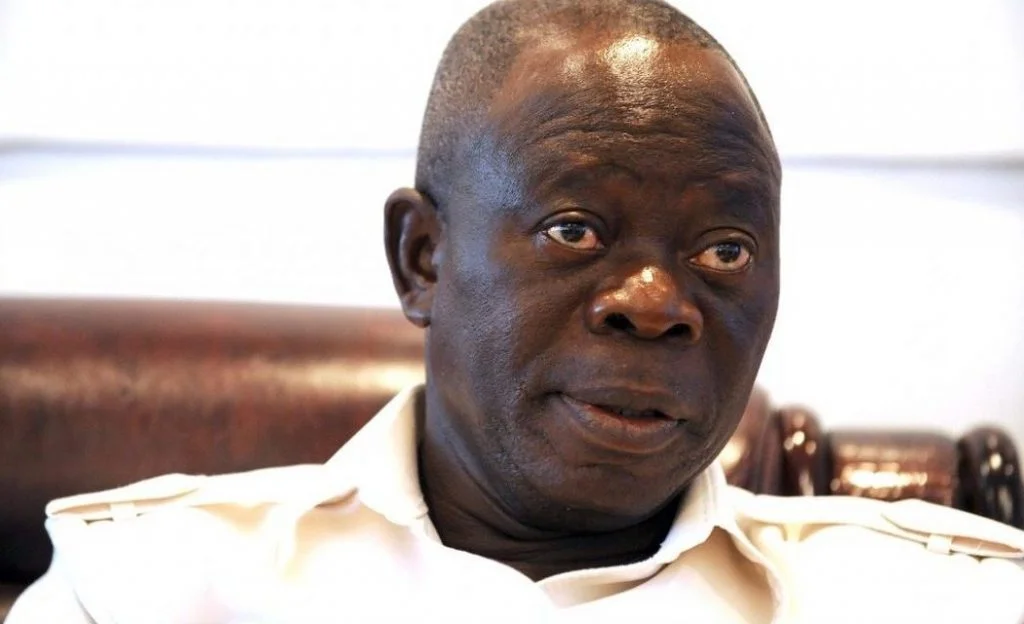
Senator Adams Oshiomhole has called on the Federal Government to retaliate against South African businesses operating in Nigeria following the recent attacks on Nigerians in South Africa.
Speaking during plenary on Tuesday, Oshiomhole said the Federal Government should consider revoking the working license of South African owned companies such as MTN and DSTV.
He argued that Nigeria must respond firmly to what he described as persistent hostility against its citizens.
READ ALSO:South Africa To Investigate ‘Mystery’ Of Planeload Of Palestinians
“I am not going to shed tears. If you hit me, I hit you. I think it is appropriate in diplomacy. It is an economic struggle,” Oshiomhole said.
He argued that while some South Africans accuse Nigerians of taking their jobs, Nigerians should return home and take over employment opportunities created by major South African companies operating in the country, including MTN and DSTV.
“When we hit back, the President of South Africa will not only talk but will also go on his knees to recognise that Nigeria cannot be intimidated.
READ ALSO:South African Ambassador Found Dead Outside Paris Hotel
“We will not condone any life being lost. If a crime has been committed under the South African law they have the right to bring any such person to justice, but to kill our people as if we are helpless, we will not allow that,” Oshiomhole added.
DAILY POST reports that several Nigerians in South Africa have reportedly been attacked, and their businesses destroyed, in ongoing xenophobic attacks in the country.
News
IGP Orders Officers Display Name Tag On Uniform, Gives Update On State Police


The Inspector General of Police, IGP, Tunji Disu, has ordered all police personnel to always have their name tags on their uniforms for easy identification.
Disu disclosed that only police personnel who are undercover are exempted from displaying their name tags.
Speaking on Tuesday, Disu said: “All police officers should have their name tags. All of us on the high table have our names apart from the undercover among us so if you look at all the Commissioners of Police we have our name tags, so it’s not our standard.
READ ALSO:
“All the Commissioners of Police are here and that is why we called this meeting, we have list of things like this that we will want to discuss with the Commissioners of Police, we have told them earlier and we will still let them know that every that happens within their area of jurisdiction falls under their control.”
On the issue of state police, the IGP said: “Since we got the signal that the Federal Government of Nigeria intend to establish State Police and since we are the federal police, we decided to take the bull by the horn and put down our own side of what we believe on how the state police should be run.
“A lot of things were taken into consideration, a lot of comparative analysis was done and it has been transmitted to the National Assembly.”
News
Court Orders SERAP To Pay DSS Operatives N100m For Defamation
The High Court of the Federal Capital Territory has ordered a non-governmental organization, the Socio-Economic Rights and Accountability Project, SERAP, to pay N100 million as damaged to two operatives of the Department of the State Services, DSS, for unjustly defaming them in some publications.
The court also ordered SERAP to tender public apologies to the defamed officers,
Sarah John and Gabriel Ogundele, in two national newspapers, two television stations and its website.
Besides, the organization was also ordered to pay the two operatives N1 million as cost of litigation and 10 percent post-judgment interest annually on the judgment sum until it’s fully liquidated.
Justice Yusuf Halilu of the High Court of the Federal Capital Territory gave the order on Tuesday while delivering judgment in a N5.5 billion defamation suit instituted against SERAP by the DSS operatives.
The judge found SERAP liable for unjustly defaming the two DSS operatives with allegations that they unlawfully invaded its Abuja office, harassed and intimidated its staff, in September 2024.
READ ALSO:How We Arrested Terror Suspect Who Threatened To Kill Students, Teachers In Abuja — DSS
In the offending publication on its website and Twitter handle, SERAP alleged that the two operatives unlawfully invaded and occupied its office with sinister motives.
The judge held that the publication was in bad taste especially from an organization established to promote transparency and accountability, as nothing in the publication was found to be truthful.
The DSS staff had listed SERAP as 1st defendant in the suit marked CV/4547/2024. SERAP’s Deputy Director, Kolawole Oluwadare, was listed as the 2nd defendant.
In the suit, the claimants – Sarah John and Gabriel Ogundele – accused the two defendants of making false claims that they invaded SERAP’s Abuja office on September 9, 2024..
Counsel to the DSS, Oluwagbemileke Samuel Kehinde, had while adopting his final address in the mater urged the judge to grant all the reliefs sought by his client in the interest of justice.
READ ALSO:DSS Arrests Suspected Gunrunner, Recovers 832 Rounds Of Ammunition
He admitted that although the names of the two claimants were not mentioned in the defamation materials, they had however established substantial circumstances that they are the ones referred to in the published defamation article by SERAP on its website.
The counsel submitted that all ingredients of defamation have been clearly established and the offending publication referred to the two officials of the secret police.
However, SERAP, through its counsel, Victoria Bassey from Tayo Oyetibo, SAN, law firm, asked the court to dismiss the suit on the ground that the two claimants did not establish that they were the ones referred to in the alleged defamation materials.
She said that SERAP used “DSS officials” in the alleged offending publication, adding that the two claimants must establish that they are the ones referred to before their case can succeed.
Similar arguments were canvassed by Oluwatosin Adefioye who stood for the second defendant, adding that there was no dispute in the September 9, 2024 operation of DSS in SERAP’s office.
READ ALSO:Alleged Cyberstalking: DSS Plays Video Evidence In Sowore’s Trial
He said that since SERAP in the publication did not name any particular person, the claimants must plead special circumstances that they were the ones referred to as the DSS officials.
Besides, he said that there is no organization by name Department of State Services in law, hence, DSS cannot claim being defamed adding that the only entity known to law is National Security Agency.
The claimants had in the suit stated that the alleged false claim by SERAP has negatively impacted on their reputation.
The DSS also stated, in the statement of claim, that, in line with the agency’s practice of engaging with officials of non-governmental organisations operating in the FCT to establish a relationship with their new leadership, it directed the two officials – John and Ogunleye – to visit SERAP’s office and invite them for a familiarization meeting.
The claimants added that in carrying out the directive, John and Ogunleye paid a friendly visit to SERAP’s office at 18 Bamako Street, Wuse Zone 1, Abuja on September 9 and met with one Ruth, who upon being informed about the purpose of the visit, claimed that none of SERAP’s management staff was in the country and advised that a formal letter of invitation be written by the DSS.
READ ALSO:DSS, Police Partner NCCSALW To End Terrorism, Mop Up Illegal Arms
John and Ogundele, who claimed that their interactions with Ruth were recorded, said before they immediately exited SERAP’s office, Ruth promised to inform her organisation’s management about the visit and volunteered a phone number – 08160537202.
They said it was surprising that, shortly after their visit, SERAP posted on its X (Twitter) handle – @SERAPNigeria – that officers of the DSS are presently unlawfully occupying its office.
The claimant added, “On the same day, the defendants also published a statement on SERAP’s website, which was widely reported by several media outfits, falsely alleging that some officers from the DSS, described as “a tall, large, dark-skinned woman” and “a slim, dark skinned man,” invaded their Abuja office and interrogated the staff of the first defendant (SERAP).
John and Ogundele stated that “due to the false statements published by the defendants, the DSS has been ridiculed and criticised by international agencies such as the Amnesty International and prominent members of the Nigerian society, such as Femi Falana (SAN)”.
“Due to the false statements published by the defendants, members of the public and the international community formed the opinion that the Federal Government is using the DSS to harass the defendants.”
READ ALSO:SERAP To Court: Stop CBN From ‘Implementing ‘Unlawful, Unjust ATM Fee Hike’
They added that the defendants’ statements caused harm to their reputation because the staff and management of the DSS have formed the opinion that the claimants did not follow orders and carried out an unsanctioned operation and are therefore, incompetent and unprofessional.
The claimants therefore prayed the court for the following reliefs: “An order directing the defendants to tender an apology to the claimants via the first defendant’s (SERAP’s) website, X (twitter) handle, two national daily newspapers (Punch and Vanguard) and two national news television stations (Arise Television and Channels Television) for falsely accusing the claimants of unlawfully invading the first defendant’s office and interrogating the first defendant’s staff.
“An order directing the defendants to pay the claimants the sum of N5 billion as damages for the libellous statements published about the claimants.
“Interest on the sum of N5b at the rate of 10 percent per annum from the date of judgment until the judgment sum is realised or liquidated.
“An order directing the defendants to pay the claimants the sum of N50 million as costs of this action.”
-

 Politics4 days ago
2027: Tinubu’s Re-election May Put An End To Nigeria — Baba Ahmed Warns
-

 Metro5 days ago
I’m A Street Girl’ – Bimbo Ademoye Clashes With Area Boys [VIDEO]
-

 Politics5 days ago
BREAKING: 2027: Former Adamawa APC Guber Candidate, Aishatu Binani Defects To NDC
-

 Business4 days ago
JUST IN: Nigerian Filling Stations Reduce Fuel Price After Hike
-

 Politics5 days ago
Senatorial Seat: Ogbakha-Edo Warns Against Imposition Of Candidates In Edo South
-

 Entertainment4 days ago
Actress Eniola Badmus Gets New Federal Appointment
-

 News5 days ago
10 African Countries With Highest Petrol Prices In Prices In April 2026
-

 News2 days ago
BREAKING: Wike Picks Alabo George For Rivers Governorship
-

 News3 days ago
OPINION: Why South Africans Murder Nigerians In Cold Blood
-

 Politics3 days ago
NDC Speaks On Peter Obi, Kwankwaso Joining Party
