

News
OPINION: Fela’s Wizkid




By Lasisi Olagunju
The Cambridge English dictionary defines ‘Wizkid’ as “a young person who is very clever and successful.” Collins Dictionary defines it as “a person who is outstandingly successful for his or her age.” Wisdom Library says “’Wiz’ is a shortened form of ‘wizard,’ connoting skill, talent, and expertise, while ‘kid’ implies youthfulness or being junior. When combined, ‘Wizkid’ suggests a young, talented, and skilled individual, particularly in a specific field.”
Fela and Wizkid? The space between the nose and the forehead is not as short as it appears. A noisy digital skirmish: a torrent of online exchanges; an endless war of words. All between Seun Kuti and Afrobeat super star, Wizkid, with his fans, over a reported off-hand tweet that super-rich Wizkid had surpassed Fela Anikulapo Kuti in music and social stature.
Seun Kuti is reported to have remarked that “it’s an insult to Fela to call Wizkid the new Fela.” Apparently in frustration with the back and forth over the inanity on the Internet, the living star is reported to have retorted: “Ok. I big pass your Papa!!! Wetin u wan do? Fool at 40.” That “igán” was the spark that caused the conflagration.
It is a needless quarrel. Wizkid is not Fela. He is Fela’s wizkid. The fight is stupid because the truth is self-evident. A child may own as many garments as an elder, but he cannot possess the same number of rags. Time, not tailoring, produces experience. But, there is nothing that the Internet and its warriors cannot weaponise. And, the undiscerning is easily conscripted into the raucous army. Wizkid himself understands the distance involved. So, let no one summon tension where harmony is the musical key.
MORE FROM THE AUTHOR:OPINION: Trump And The Ruin Of Kurunmi
The younger wizard knows the source of his tumultuous river; he has never denied where it flows from. In a May 3, 2017 interview with English DJ and author, Semtex, Wizkid traced the arc of his musical influences with disarming candour. “So I was influenced by rap, reggae, Bob Marley, Fela… like good music, some big names,” he said. Yet he admitted that Fela’s music did not immediately appeal to him. His parents played Fela and King Sunny Ade at home, but the young Wizkid, by his own account, was “not old enough to understand or enjoy the music.” He wasn’t alone with that judgment. Even Fela’s mother, at the experimental beginning of his career, told him: “Start playing music your people understand, not jazz.”
Time, however, has a way of teaching the tentative how to stand firm and take their share of what life offers. Wizkid, the young man who once declared that he did not want to be “just an African star” grew into a global figure by climbing the ladder of destiny mounted on the shoulders of global giants. He mentions them in that Semtex interview: Bob Marley of Reggae, and unmistakably, Fela Anikulapo Kuti of Afrobeat.
Another old interview is unearthed by the present noise. In it, Wizkid speaks to the Fela matter with humility and clarity: “We can’t compare, let’s not use that word because it is like disrespect when you’re mentioning Wizkid and Fela in the same sentence. You can’t compare. Fela is someone that inspires me. I have him tattooed on me. Fela’s face is all over my body. Everything he did with his music, his legacy, inspires me to be great and to want to do more.”
Wizkid is big because he is wise. Reading him, hearing him, tells that the young man enjoys the benefit of good upbringing. There is his ‘Ojuelegba’ line:
“Ti isu eni ba dele
A f’owo bo je…”
And he remembers to tell his interviewer that underneath that line is the timeless advice he got from his mother: “When I was like younger my Mama told me, you when God blesses you, you should be smart enough to know that you should be more cautious. That’s when you should get more cautious of what you say, what you do and how you move.” To be cautious is to act with care, with prudence. The synonym is wisdom. What Wizkid says his mother told him is the same as what Kahlil Gibran tells us: “Travel and tell no one, live a true love story and tell no one, live happily and tell no one, people ruin beautiful things.”
MORE FROM THE AUTHOR:OPINION: Saraki’s Persona In Bolaji’s Book
The young wizard is wise. Wizkid is lucky he has a mother who prays. He sings:
“See eh, e kira fun mummy mi o,
Ojojumo lo n s’adura…”
He is as lucky as Abraham Lincoln who said the same: “I remember my mother’s prayers and they have always followed me. They have clung to me all my life.”
Now, if there is a positive gain for me in the ‘childish’ fight over which is bigger and deeper between the Atlantic and the Lagos Lagoon, it is the opportunity to read and know more about the music of the youth, and the chance to throw long-owed libation at the king of waters. In celebrating Fela, therefore, we celebrate a king of songs whose insistence is that art must not be for art’s sake; that music must matter, that it must speak when politics lies, and that it must disturb the comfort of the powerful.
The difference between fire and light is in what is done with them. Some music is not meant to entertain alone, but to awaken. The music of Fela is fire and light combined; it is a force that moves more than bodies; it moves minds. He created Afrobeat; he made music, and with it, made life and living into sound and resistance. His everything is a fine blend, whether of assonance or of alliteration; he made sense out of nonsense. His ‘Zombie’, for instance, has not stopped teaching us that when power stops thinking, rhythm must do the thinking for it.
Fela sang the outrage of today and the rage of tomorrow yesterday. Like NASA’s Perseverance Rover on Mars, the Afrobeat king orbited power with defiance. He was at once coarse and smooth, abrasive and balmy in the same breath.
The Yoruba know that when you sing wahala softly, you can get an entire city dancing. Call it iboosi if you like, trouble turned into tune. Fela sang “Palaver” and made it sound sweet; even his “Yeepa” sounds so sweet that it pirouetted the sonics of chaos into pleasure. Where there is “Sorrow, Tears and Blood”, Fela trained his voice and drum not to keep quiet; and they never did; they still are not quiet. In the moral urgency of African chant, Fela’s music sings and dances; and as it dances, it indicts. When he winks his wings make meaning. His clenched fist circles the earth; his art is an eraser that continually cleans off the boundary between stage and street, between rhythm and revolt. You listen to his ‘Alagbon Close’ lyrics, you hear his sax speak the language of condemnation, while his drum sings defiance to state captors.
MORE FROM THE AUTHOR:OPINION: Gov Makinde, His Sons And His ‘Friends’
The Gen Z fighting on X over which star is the biggest in the cosmos should know this: Fela was one spirit who stretched tradition until it screamed. He was the potter who scooped mounds of Yoruba earth and, from it, moulded an impossible steed for the battlefield of the world. In his sax, step and sup, music became the language of war and peace. His truth is dense, his anger repetitive, his chant hypnotic. In his dance steps are disclaimers that deprecate the chaos of Nigeria’s politics. In 1975, he flung defiantly rebellious “Expensive Shit” at power and its police; the steel-hearted swooned in pain. Fela’s truth is eternally too heavy for weak stomachs.
He acted alone in his rebellion. “Solitude sometimes is best society,” says John Milton. Fela’s choice of road to tread almost obeys that Milton poetry. He was not a gentleman, and he sang it into our skulls: “A no be gentleman at all o.” His songs, like his life, wear no borrowed manners. Every Fela song is a sermon rudely delivered; every performance a trial of societal evils; every arrest a verse added to an unfinished composition on power and freedom. His eclecticism, with his synthesis, and his defiance, give his music oxygen. They are what make Fela endure.
In Fela’s biological musical children, “heirs of fame,” and in the wizard kids who sing his legacy, he lives. The Abami Eda spirit pulses through Femi and Seun Kuti; their blazing saxophones and militant energy carry forward the torch of political Afrobeat. This paragraph is a product of reading and asking. In reading and exploring, I got to know so much about this subject: Fela’s legendary drummer, Tony Allen, was right here, modifying the rhythms, making the music irresistible. Beyond his fecund loins, Fela’s immortality is heard in the sounds of contemporary stars: Burna Boy, Wizkid, Davido, Tiwa Savage, Yemi Alade, Rema, Joeboy, and Olamide. In these stars, Afrobeat’s pulse blends seamlessly with the aplomb of Afropop, hip-hop, and global pop. Singly or in pairs, they speak to new audiences, while across the world, fans feel Fela in the music of Benin’s Angélique Kidjo, UK-based Afro B, and even Major Lazer. And, writing and reading this paragraph again, I realize I have convinced myself that decades after death yanked Fela’s fingers from the pot of world music, his creation, Afrobeat, still walks the streets loud, stubborn, and unbowed
A thoroughly studied phenomenon; in one text, Academy Award winner, Joseph Patel, says “Fela Kuti is the truth.” In another line, American writer, Knox Robinson, describes him as “the original Afronaut.” Music scholar and historian, Peter Guralnick and Douglas Wolk, published a survey of turn-of-the-millennium music in 2002. In it, they make the bio of “irreducible” Fela read like a political chant. Now, read them and chant along:
“Fela Kuti: 77 albums, 27 wives, over 200 court appearances. Harassed, beaten, tortured, jailed. Twice-born father of Afrobeat. spiritualist, pan-Africanist. Commune King. Composer, saxophonist, keyboardist, dancer… There will never be another like him.”




News
Xenophobic Attacks: Oshiomhole Tells FG To Retaliate Against South African Companies In Nigeria

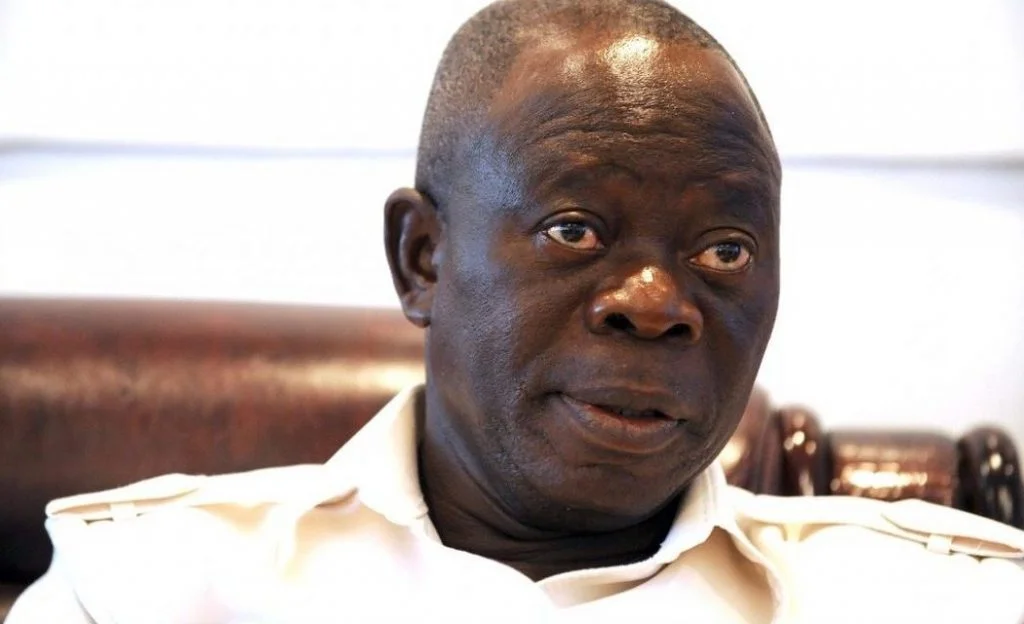
Senator Adams Oshiomhole has called on the Federal Government to retaliate against South African businesses operating in Nigeria following the recent attacks on Nigerians in South Africa.
Speaking during plenary on Tuesday, Oshiomhole said the Federal Government should consider revoking the working license of South African owned companies such as MTN and DSTV.
He argued that Nigeria must respond firmly to what he described as persistent hostility against its citizens.
READ ALSO:South Africa To Investigate ‘Mystery’ Of Planeload Of Palestinians
“I am not going to shed tears. If you hit me, I hit you. I think it is appropriate in diplomacy. It is an economic struggle,” Oshiomhole said.
He argued that while some South Africans accuse Nigerians of taking their jobs, Nigerians should return home and take over employment opportunities created by major South African companies operating in the country, including MTN and DSTV.
“When we hit back, the President of South Africa will not only talk but will also go on his knees to recognise that Nigeria cannot be intimidated.
READ ALSO:South African Ambassador Found Dead Outside Paris Hotel
“We will not condone any life being lost. If a crime has been committed under the South African law they have the right to bring any such person to justice, but to kill our people as if we are helpless, we will not allow that,” Oshiomhole added.
DAILY POST reports that several Nigerians in South Africa have reportedly been attacked, and their businesses destroyed, in ongoing xenophobic attacks in the country.
News
IGP Orders Officers Display Name Tag On Uniform, Gives Update On State Police


The Inspector General of Police, IGP, Tunji Disu, has ordered all police personnel to always have their name tags on their uniforms for easy identification.
Disu disclosed that only police personnel who are undercover are exempted from displaying their name tags.
Speaking on Tuesday, Disu said: “All police officers should have their name tags. All of us on the high table have our names apart from the undercover among us so if you look at all the Commissioners of Police we have our name tags, so it’s not our standard.
READ ALSO:
“All the Commissioners of Police are here and that is why we called this meeting, we have list of things like this that we will want to discuss with the Commissioners of Police, we have told them earlier and we will still let them know that every that happens within their area of jurisdiction falls under their control.”
On the issue of state police, the IGP said: “Since we got the signal that the Federal Government of Nigeria intend to establish State Police and since we are the federal police, we decided to take the bull by the horn and put down our own side of what we believe on how the state police should be run.
“A lot of things were taken into consideration, a lot of comparative analysis was done and it has been transmitted to the National Assembly.”
News
Court Orders SERAP To Pay DSS Operatives N100m For Defamation
The High Court of the Federal Capital Territory has ordered a non-governmental organization, the Socio-Economic Rights and Accountability Project, SERAP, to pay N100 million as damaged to two operatives of the Department of the State Services, DSS, for unjustly defaming them in some publications.
The court also ordered SERAP to tender public apologies to the defamed officers,
Sarah John and Gabriel Ogundele, in two national newspapers, two television stations and its website.
Besides, the organization was also ordered to pay the two operatives N1 million as cost of litigation and 10 percent post-judgment interest annually on the judgment sum until it’s fully liquidated.
Justice Yusuf Halilu of the High Court of the Federal Capital Territory gave the order on Tuesday while delivering judgment in a N5.5 billion defamation suit instituted against SERAP by the DSS operatives.
The judge found SERAP liable for unjustly defaming the two DSS operatives with allegations that they unlawfully invaded its Abuja office, harassed and intimidated its staff, in September 2024.
READ ALSO:How We Arrested Terror Suspect Who Threatened To Kill Students, Teachers In Abuja — DSS
In the offending publication on its website and Twitter handle, SERAP alleged that the two operatives unlawfully invaded and occupied its office with sinister motives.
The judge held that the publication was in bad taste especially from an organization established to promote transparency and accountability, as nothing in the publication was found to be truthful.
The DSS staff had listed SERAP as 1st defendant in the suit marked CV/4547/2024. SERAP’s Deputy Director, Kolawole Oluwadare, was listed as the 2nd defendant.
In the suit, the claimants – Sarah John and Gabriel Ogundele – accused the two defendants of making false claims that they invaded SERAP’s Abuja office on September 9, 2024..
Counsel to the DSS, Oluwagbemileke Samuel Kehinde, had while adopting his final address in the mater urged the judge to grant all the reliefs sought by his client in the interest of justice.
READ ALSO:DSS Arrests Suspected Gunrunner, Recovers 832 Rounds Of Ammunition
He admitted that although the names of the two claimants were not mentioned in the defamation materials, they had however established substantial circumstances that they are the ones referred to in the published defamation article by SERAP on its website.
The counsel submitted that all ingredients of defamation have been clearly established and the offending publication referred to the two officials of the secret police.
However, SERAP, through its counsel, Victoria Bassey from Tayo Oyetibo, SAN, law firm, asked the court to dismiss the suit on the ground that the two claimants did not establish that they were the ones referred to in the alleged defamation materials.
She said that SERAP used “DSS officials” in the alleged offending publication, adding that the two claimants must establish that they are the ones referred to before their case can succeed.
Similar arguments were canvassed by Oluwatosin Adefioye who stood for the second defendant, adding that there was no dispute in the September 9, 2024 operation of DSS in SERAP’s office.
READ ALSO:Alleged Cyberstalking: DSS Plays Video Evidence In Sowore’s Trial
He said that since SERAP in the publication did not name any particular person, the claimants must plead special circumstances that they were the ones referred to as the DSS officials.
Besides, he said that there is no organization by name Department of State Services in law, hence, DSS cannot claim being defamed adding that the only entity known to law is National Security Agency.
The claimants had in the suit stated that the alleged false claim by SERAP has negatively impacted on their reputation.
The DSS also stated, in the statement of claim, that, in line with the agency’s practice of engaging with officials of non-governmental organisations operating in the FCT to establish a relationship with their new leadership, it directed the two officials – John and Ogunleye – to visit SERAP’s office and invite them for a familiarization meeting.
The claimants added that in carrying out the directive, John and Ogunleye paid a friendly visit to SERAP’s office at 18 Bamako Street, Wuse Zone 1, Abuja on September 9 and met with one Ruth, who upon being informed about the purpose of the visit, claimed that none of SERAP’s management staff was in the country and advised that a formal letter of invitation be written by the DSS.
READ ALSO:DSS, Police Partner NCCSALW To End Terrorism, Mop Up Illegal Arms
John and Ogundele, who claimed that their interactions with Ruth were recorded, said before they immediately exited SERAP’s office, Ruth promised to inform her organisation’s management about the visit and volunteered a phone number – 08160537202.
They said it was surprising that, shortly after their visit, SERAP posted on its X (Twitter) handle – @SERAPNigeria – that officers of the DSS are presently unlawfully occupying its office.
The claimant added, “On the same day, the defendants also published a statement on SERAP’s website, which was widely reported by several media outfits, falsely alleging that some officers from the DSS, described as “a tall, large, dark-skinned woman” and “a slim, dark skinned man,” invaded their Abuja office and interrogated the staff of the first defendant (SERAP).
John and Ogundele stated that “due to the false statements published by the defendants, the DSS has been ridiculed and criticised by international agencies such as the Amnesty International and prominent members of the Nigerian society, such as Femi Falana (SAN)”.
“Due to the false statements published by the defendants, members of the public and the international community formed the opinion that the Federal Government is using the DSS to harass the defendants.”
READ ALSO:SERAP To Court: Stop CBN From ‘Implementing ‘Unlawful, Unjust ATM Fee Hike’
They added that the defendants’ statements caused harm to their reputation because the staff and management of the DSS have formed the opinion that the claimants did not follow orders and carried out an unsanctioned operation and are therefore, incompetent and unprofessional.
The claimants therefore prayed the court for the following reliefs: “An order directing the defendants to tender an apology to the claimants via the first defendant’s (SERAP’s) website, X (twitter) handle, two national daily newspapers (Punch and Vanguard) and two national news television stations (Arise Television and Channels Television) for falsely accusing the claimants of unlawfully invading the first defendant’s office and interrogating the first defendant’s staff.
“An order directing the defendants to pay the claimants the sum of N5 billion as damages for the libellous statements published about the claimants.
“Interest on the sum of N5b at the rate of 10 percent per annum from the date of judgment until the judgment sum is realised or liquidated.
“An order directing the defendants to pay the claimants the sum of N50 million as costs of this action.”
-

 Politics3 days ago
2027: Tinubu’s Re-election May Put An End To Nigeria — Baba Ahmed Warns
-

 Metro4 days ago
I’m A Street Girl’ – Bimbo Ademoye Clashes With Area Boys [VIDEO]
-

 News5 days ago
VIDEO: Moment S’Court Recognises David Mark-led ADC Leadership
-

 Politics4 days ago
BREAKING: 2027: Former Adamawa APC Guber Candidate, Aishatu Binani Defects To NDC
-

 Politics4 days ago
Senatorial Seat: Ogbakha-Edo Warns Against Imposition Of Candidates In Edo South
-

 Business3 days ago
JUST IN: Nigerian Filling Stations Reduce Fuel Price After Hike
-

 Entertainment4 days ago
Actress Eniola Badmus Gets New Federal Appointment
-

 Metro5 days ago
Robbers Raid Imo Catholic Church, Steal Holy Communion Materials
-

 News4 days ago
10 African Countries With Highest Petrol Prices In Prices In April 2026
-

 Metro5 days ago
VIDEO: Policemen Filmed Assaulting Individual In Viral Clip
