
News
OPINION: Fulani, Hausa And Yoruba Truths [Monday Lines]

By Lasisi Olagunju
We say in Yoruba that if we do a census of slaves, slaves will be sad. History, an account of facts of the past, is always injurious to the health of sick nations. And, Nigeria is sick. We’ve all become ethnic nationalists – especially after the coming of the last regime. Questions previously unasked are now being asked. What is the meaning of the name of my ethnic group? And my neighbours’? How did the word ‘Fulani’ come to be? How about the meanings of ‘Yoruba’, ‘Hausa’, Igbo’, ‘Nupe’? Who coined those names? You and I know you bear a name but have you ever asked who truly suggested that name? Your parents? A relation? Or a neighbour? Or is it just a plain alias?
On the last day of 2024, our Minister of Education, Tunji Alausa, announced on Channels Television that from 2025, History would be reintroduced in our primary and secondary schools as a subject of study. “We now have people up to 30 years old totally disconnected from our history. It doesn’t happen in any part of the world. From 2025, our students in primary and secondary schools will have that as part of their studies,” he declared.
I heard him and wondered which ‘history’ would be taught in our schools that won’t ignite a ‘civil war’? The one written by my conquerors proving how inferior I am to them or the one written by me that affirms my tribe’s superiority over my neighbours’?
We are a nation that will never agree on anything. Not on history; not even on truth. Towards the end of last year, three ‘historians’ wrote on what is true about Yoruba history and each of the three accounts cancelled out the others. First it was Kemi Badenoch (a Yoruba and leader of the Conservative Party in the United Kingdom), who said she should not be lumped with northern Nigeria because she had nothing in common with that part of the country. “Being Yoruba is my true identity, and I refuse to be lumped with northern people of Nigeria, who were our ethnic enemies, all in the name of being called a Nigerian,” she announced.
Then came a reaction from Nigerian-American professor of communication, Farooq Kperogi, a Bariba (Baatonu) from the north central who mocked Kemi’s position and told her that her Yoruba ethnic group owed its name and a chunk of its history and language to northern Nigeria. Kperogi wrote in his 21 December, 2024 Saturday Tribune column that even “the term Yoruba… originates from — of all places — northern Nigeria!” For effects, he dug down and declared that “‘Yoruba’ is, after all, an exonym first bestowed upon the Oyo people by their northern neighbours, the Baatonu (Bariba) of Borgu, before it was shared with the Songhai (whose scholar by the name of Ahmad Baba has the distinction of being the first person to mention the name in print as “Yariba” in his 1613 essay titled “Al-kashf wa-l-bayān li-aṣnāfmajlūb al-Sūdān”).” Kperogi went further to give examples of many Yoruba words that were borrowed from Hausa or Arabic or other northern Nigerian languages.
Kperogi’s position on ethnic identity and on who named whom generated considerable interest all through the last weeks of 2024. I read a commenter on LinkedIn who reacted to Kperogi with “Bariba is the father of the Yoruba.” I read counter posts. Reactions depended on the ethnic identity of the person reacting.
Nigerian-American Arts History professor, Moyo Okediji of the University of Texas at Austin soon joined the fray. He wrote on Monday, 23 December, 2024, that he was grateful to Kemi Badenoch for distancing herself, as a Yoruba, from northern Nigeria because of the terrorism there. Kemi’s remark, Okediji said, echoed what millions of Yoruba people had in mind but dared not say “in a country in which you get arrested and criminally prosecuted for saying what you consider to be plain truth.” Okediji noted reactions from the north on what Kemi said. He then dwelt extensively on Kperogi’s piece. He gave his own truth on the origin of the name ‘Yoruba’ quoting his grandmother: “Yoruba is a shortened form of ‘A yọ orù bá wọn dáná ọmọ tuntun.’ It is a panegyric phrase for both Ọ̀ṣun and Ọya, but especially for Ọ̀sun.” On the borrowed words, Okediji disagreed again with Kperogi. He wrote: “Would it occur to him— and others like him who have made similar claims in the past, and who continue to espouse that sentiment—that those foreigners could have borrowed the words from Yoruba people rather than the other way round? Why do they assume that if x is found in Yoruba language and it is also found in the Arabic language, x must be an Arabic word by default, but not a Yoruba word?” Okediji titled his piece ‘Of Kemi Badenoch and Yoruba etymologies.’ It was widely shared by Yoruba ‘nationalists’ across social media platforms.
I read Kperogi and told him I would try to add my voice to the discourse. He said he would read me. While I was reading him, I thought I should seek answers to similar questions of what meaning have the names Hausa and Fulani, the obvious point of reference of both Kemi and Okediji.
In his ‘The Wanderers’ published in African Affairs in January 1946, M. D. W. Jeffreys argues that many present-day tribal names were nicknames. He then proceeds to “show how widespread in Africa is a tribal name whose meaning boils down to “wanderers, migrants, nomads, foreigners, or strangers…”
MORE FROM THE AUTHOR: OPINION: Pastor Adeboye, Owners Of Nigeria And 2025 [Monday Lines]
The name ‘Hausa’, what does it mean? Getting an answer to that question has been of interest to researchers even before the last century. We see an effort in ‘The Origin of the Name ‘Hausa” authored by Neil Skinner and published in the Journal of the International African Institute in July 1968. Skinner suggested that the name was from the Songhay which held sway in Sub-Sahara Africa between the 15th and the 17th centuries. He wrote: “The Songhai word for ‘east’ is hausa, which would seem to be fairly conclusive. ‘Hausa’ also has the connotations of ‘left bank of river ‘ and ‘bush’ (in the West African sense of ‘wild, uncultivated country’); and it may be that for Songhai-speakers there was an added pejorative significance of ‘bushmen ‘ – a term of abuse in modern West African pidjin.”
Indeed, 58 years earlier, A. J. N. Tremearne, in his ‘Notes on The Origin of the Hausas’ published in the Journal of the Royal Society of Arts in July 1910, traced the root of the name and concluded that “the word ‘Habeshi’ was a term of contempt applied by Arabs to mixed races, and Hausa (ba-haushe) is a modification.” I wonder how many Hausas will agree to this history today.
The Fulani know that their traditional ethnic identity name is Fulbe but they have accepted to be called ‘Fulani’, the name their Hausa neighbours gave them. What does that mean? In ‘L’origine du nom Fulani’ published in 1944, Jeffreys tells us that the words ‘Philistine’ and ‘Fulani’ “come from a common root F-L which in the Indo-European languages means ‘foreigner, stranger, alien’ and, by a secondary meaning, ‘inferior.’” It is also from Jeffreys (1946) that we learn that ‘Nupe’ carries almost the same meaning. To state what ‘Nupe’ means, Jeffreys uses a Nupe tale of origin. He writes that: “‘Nupe’ itself means ‘stranger, fugitive, wanderer’. Among the Nupe, there is a legend to this effect, that a certain stranger, a hunter, called Abduazizi, travelling from the East, arrived with his family at the town of Doko Daji, where he settled among the Beni. He was given the title of Nefiu, the Arabic word for fugitive, whence arises the corruption Nufe (Nupe).” He apparently took that from O. Temple and Charles Lindsay Temple’s ‘Notes on the Tribes, Provinces, Emirates and States of the Northern Provinces of Nigeria’ (1919).
M.D.W. Jeffreys, quoted in the narratives above, was British government’s official anthropologist and colonial administrator in Southern Nigeria from 1915 to 1932. He did very extensive research into the histories and cultures of ethnic groups in southern Nigeria and is acknowledged as having published hundreds of articles on the subject “in specialist journals including ‘Africa’, ‘Man’, Folklore’ and the ‘Journal of the Royal African Society’.”
MORE FROM THE AUTHOR: OPINION: Mass Murder On River Niger[Monday Lines]
Like Kperogi, I am not a historian but I have always been interested in that part of his (Kperogi’s) piece on where and how the Yoruba got the name ‘Yoruba’. We had a back and forth exchange on it on the pages of the Tribune five years ago. In my column of 28 October, 2019, I engaged Kperogi on his claim that his Baatonu (Bariba) people gave the Yoruba people the name ‘Yoruba’. I suggested then that given what professional historians, ethnographers and anthropologists had done in that area, the name ‘Yoruba’ may have existed long before the Bariba and the Yoruba had cause to meet. I challenged his thesis then by asking if he did not think the existence of ‘Yoru’ or ‘Yorubu’ in his Baatonu (Baruba) language could be as a result of the very long history of interaction between Baruba and the Yoruba dating back to the sack of Oyo Ile by the Nupe and the exile of the Alaafin to Borgu in about 1535 (See Richard Smith’s ‘The Alaafin in Exile: A Study of the Igboho Period in Oyo History’ published in The Journal of African History, Vol. 6, Issue 1, March 1965 from pages 57 – 77). Could it be that the word was an export that accompanied the Alaafin to Baruba’s Borgu which then became corrupted to Yoru/Yorubu? Again, can Kperogi examine Sultan Bello’s and other researchers’ findings which indicate that the word ‘Yarba’ or ‘Yaarba’ may have existed outside sub-Sahara Africa long before Yoruba-Baruba and Yoruba-Hausa/Fulani interactions?
I have in the last one week reread eminent historian, Professor J.A. Atanda’s ‘The Historian and The Problem of Origins of Peoples in Nigerian Society’ published in December 1980. Atanda writes that “Sultan Bello’s account of the origin of the Yoruba people derived inspiration from an old Arabic text, ‘Azhar al-Ruba fi Akhbar Bilad Yoruba’ written by one Dan Masani, a noted scholar of Katsina, who lived in the seventeenth century and died in 1667.” Atanda explains further, with references, that even Dan Masani is believed to have “obtained his information from Yoruba converts to Islam.” What this suggests is ‘Yoruba’ as an endonym – the reverse of Kperogi’s exonymic explanation of the name.
Kperogi was sure that some illustrious Basorun of Oyo, including Basorun Gaa were not Yoruba. Kperogi wrote that “well-regarded Basoruns like Magaji, Worudua, Biri, Yamba, Jambu, and Gaa who helped extend Oyo’s frontiers were of Borgu origin.” He said he “was shocked to read recently that even Ibadan, the administrative capital of Western Nigeria, was founded by a northern Nigerian of Borgu origins. Oluyole, the founder of modern Ibadan, was the scion of Bashorun Yau Yamba, who was of Borgu ancestry.” That is from Kperogi. First, Oluyole did not found Ibadan. He came and joined the founders after 1830. Read Toyin Falola’s ‘Ibadan: Foundation, Growth and Change: 1830-1960. Available historical facts say that Oluyole’s father was a noble man in Old Oyo (Oyo Ile) called Olukuoye Ajala while his mother was a daughter of Alaafin Abiodun. Iwe Itan Ibadan published in 1911 by I. B. Akinyele, who later became an Olubadan, gives some clarity on this. Akinwumi Ogundiran’s ‘The Yoruba: A New History’ published in 2020 says so too on page 395.
MORE FROM THE AUTHOR: OPINION: Tinubu, Atiku And The Lion’s Share [Monday Lines 2]
Professor Kperogi’s claim is more intriguing when he described the six Basorun he listed as Bariba. History says until 1783, Borgu, the country of the Bariba, was under the rule of Oyo Ile. That fact is in grand old I. A. Akinjogbin’s 1963 PhD thesis titled: ‘Dahomey and its Neighbours 1708-1818’. This fact he reinforces in his ‘The Oyo Empire in The 18th Century’ published in 1966, on page 453. History, however, agrees that there is a long tradition of interaction between Oyo and Borgu people – an Alaafin actually lived and died in exile in Borgu after Oyo Ile was sacked by the Nupe. But it is also true that that friendship ended in fracas and fiasco. Read Robert Smith’s ‘Alaafin in Exile’, 1965: page 61-63. The hostility was very evident when Richard and John Lander visited Borgu in around 1830. The explorers were quoted by Robin Hallet (1965:112) as noting that: “perhaps no two people in the universe residing so near each other, differ more widely in their habits and customs, and even in their natures, than the natives of Yariiba (Yoruba) and Borgoo (Borgu). The former are perpetually engaged in trading with each other from town to town; the latter never quit their towns except in case of war, or when engaged in predatory excursions…”
So, I find Kperogi’s claim of a succession of non-Yoruba Basorun of Oyo, Alaafin’s second-in-command, quite worthy of scientific interrogation by historians.
Kperogi mentioned a Basorun Worubia, whom, because of his name, he took to be Bariba. Well, ‘Woru’ exists as a Yoruba name among the Sabe Yoruba community. The Sabe Yoruba are in Benin Republic surrounded by Borgu people. Olasope Oyelaran’s ‘Orita Borgu: The Yoruba and the Baatonu down the Ages’ (2018) says so on page 245. Yau Yamba (Yamba bi Ekun), mentioned variously by Kperogi, is described by Samuel Johnson in his ‘The History of the Yorubas’ (page 174) as “one of the most famous men in Yoruba history.” Yamba is said to be Basorun Gaa’s father (or ancestor). This presupposes that he was Basorun long before 1754 when Gaa became Basorun. This fact also means that both of them were Basorun at a time the Borgu country was a vassal of Old Oyo. So, at what point did a subject (before 1783) and an enemy or rival (post 1783) become so involved and indispensable that they started supplying candidates for Oyo Empire’s prime ministership?
A foremost authority on Yoruba history, Professor Banji Akintoye wrote in his ‘A History of the Yoruba People’ published in 2010 that “most of the greatest warriors of Yoruba history were produced by Oyo Empire.” He proceeded to name one of such warriors as “Iba Magaji, who served both Obalokun and Ajagbo as Basorun and commanded the earliest campaigns that conquered most of Nupe and Bariba countries.” So, would a Bariba lead outsiders to conquer his own people? Akintoye named a Basorun Akindein – his name is clearly Yoruba. He mentioned another – “the Basorun under the Alaafin Ojigi, the personage known to history by the nickname Yau Yamba…” (see page 242). It is possible that some of the Basorun of Oyo listed by Kperogi as Borgu (Bariba) merely used aliases possibly derived from the interactions they had with their non-Yoruba neighbours. As suggested by Akintoye, their real Oyo-Yoruba names may have been lost to history.
MORE FROM THE AUTHOR: OPINION: Desperate Crowds And Foods Of Death [Monday Lines]
There is no agreement on this – even among well established Yoruba historians. Kperogi’s claim on the Basoruns appear to draw its roots from Akinwumi Ogundiran’s ‘The Yoruba: A New History’, cited earlier. Ogundiran wrote on what he called “the revitalized Oyo polity after 1570” which “bore the strong marks of power sharing” between the Oyo (Yoruba) on the one hand and the Bariba, Nupe, Songhai, Mossi, and others who “adopted the Oyo political identity and by extension became members of the Yoruba community of practice” (page 191). Ogundiran agreed that in post 1570 Oyo, Bariba families started controlling the office of Basorun, and the Nupe families, the Alapinni, head of the egungun cult. Ogundiran did not cite any authority to back this claim.
Kperogi also wrote that the Bariba (Baatonu) founded many Yoruba towns in present Oyo State. History says that what some Yorubanised Baribas founded were ruling dynasties, not towns and kingdoms. Kperogi mentioned Ogbomoso. There are three versions of the tradition of origin of that town. None of them says that Soun Ogunlola, the Bariba-Yoruba man, founded Ogbomoso. Ogunlola met people at that military post although his valour later gave the name ‘Ogbomoso’ to the settlement. Read Babatunde Agiri’s ‘When was Ogbomoso Founded’ published by the Transafrican Journal of History in 1976. You can also read N.D. Oyerinde’s ‘Iwe Itan Ogbomoso’ published in 1934.
I read something from Kperogi about “Kishi, another major town in Oyo State” being “founded by a Borgu prince by the name of Kilishi Yeruma.” Well, I have an eighty-something-year-old friend, a very literate man, who hails from Kishi. We say here that no one can carry a baby better than its mother. And, so, to my octogenarian friend I went in search of the truth in the history of Kishi. He disagreed with Kperogi; he gave to me what he knew to be the truth of that aspect of his people’s history. This is how he put it:
“As I sought to say sometime ago about Kishi, Kilishi met people already living in our town at Ilé Ògoríodó and his people exclaimed: “So, people are hiding here—Kìrìsí!” Kishi (Kisi) is thus derived from Kirisi. That is the origin of the name of the town. Otherwise, if the town was founded by Ìbàrùbá how come our language is pure Yoruba and so is our mode of dressing and our culture and not the way of the Ìbàrùbá? The Ìbàrùbá ethnic group still inhabit their own land in Borgu…?” So, how did the Borgu man, Kilishi Yeruma come to start the dynasty ruling Kishi till tomorrow? My aged friend told me: “What we were told as children by our great and grand parents was that Kilishi was a brave and valiant warrior. The people lived in an era of wars. He was, therefore, asked to lead them in their frequent wars. That was how the lineage of Kishi kings came from them, and instead of referring to the king as Oba, he is called Iba. So we have Iba of Kishi and not Oba of Kishi. Along the line, one of the Ibas married one of the daughters of an Alaafin called Àdàsóbo. From then the Iba became entitled to wearing a crown bestowed by the Alaafin.
“When Igboho was under siege, and similarly Shaki, by the Fulanis in the course of Ilorin’s expansionism, it was Kishi that went to the rescue of the two towns. The song that arose from the Kishi warding off the invaders went as follows:
Tí kò bá sí Lágbùlú,
Shakí a run, Ìgbòho a bàjé;
Shakí a run, Ìgbòho a bàjé!
“Lagbulu was Kishi’s lead warrior. Now, you would want to ask why that song was not rendered in Bariba if truly Kishi is a Bariba town? Even a Bariba-Yoruba won’t sing such deep lyrics.
“Kìshí became the fortress protecting Yorùbá land in the North-Western part of Yorùbáland. When Òyó’lé disintegrated, an arm of the Aláàfin Ruling House moved to Kìshí and they were given abode and land to cultivate onions,àlùbósà eléwé! Their compound is called Ilé Alálùbósà (the house in which onion is cultivated and grown). Indeed, by our own history, it was the reluctance of the Òyómèsì to pick one of the princes from Kishi to succeed Alaafin Atiba that led to the rebellion of Kúrúnmi at Ìjàyè more known as Ìjàyè War. After the war, a majority of the fighters from Kishi decided to settle at Ibadan. Their wives started Ojà-Iba (Ojà’ba). Many people including historians thought and believed Ojà’ba was founded by or named after Basorun Olúyòlé. What made the market to be markedly different was that it was a night market that would open by say 7pm and close by 10pm.
“The Kishi people in Ibadan founded Màpó – named after Òkè Màpó (Iya Mapo) back home in Kishi. Molete is the other area of Ibadan where fighters of Kishi descent who participated in the Ìjàyè war settled. The Molete people in Ibadan are from Molete area in Kishi. The point I am getting at, therefore, is that Farooq Kperogi got only the popular angle of the stories, not the actual, true angle.”
So, if the Nigerian government will reintroduce history as a subject in primary and secondary schools in 2025, whose history will that be? Who will write it? Even among the vociferous Yoruba, there is no consensus on what Yoruba history is. Samuel Johnson’s monumental ‘The History of the Yorubas’, to some critics, is Oyo-centric.
But then, “why does history matter?” A Polish dipomat asked himself that question in 2004. The man provided the answer; he said “knowledge about the past can, and should, influence the course of current and future developments” while “negligence of the wisdom that history offers to us can lead to fateful consequences.” But, there are dire consequences for saying certain truths in Nigeria. Because of such consequences, we can only teach compromised facts as history. And what purpose will that serve? I think we should just continue doing what we are doing – hiding the fire even when we do not know what to do with the smoke.



News
Migration Agency Warns Migrants Against Irregular Travel Routes
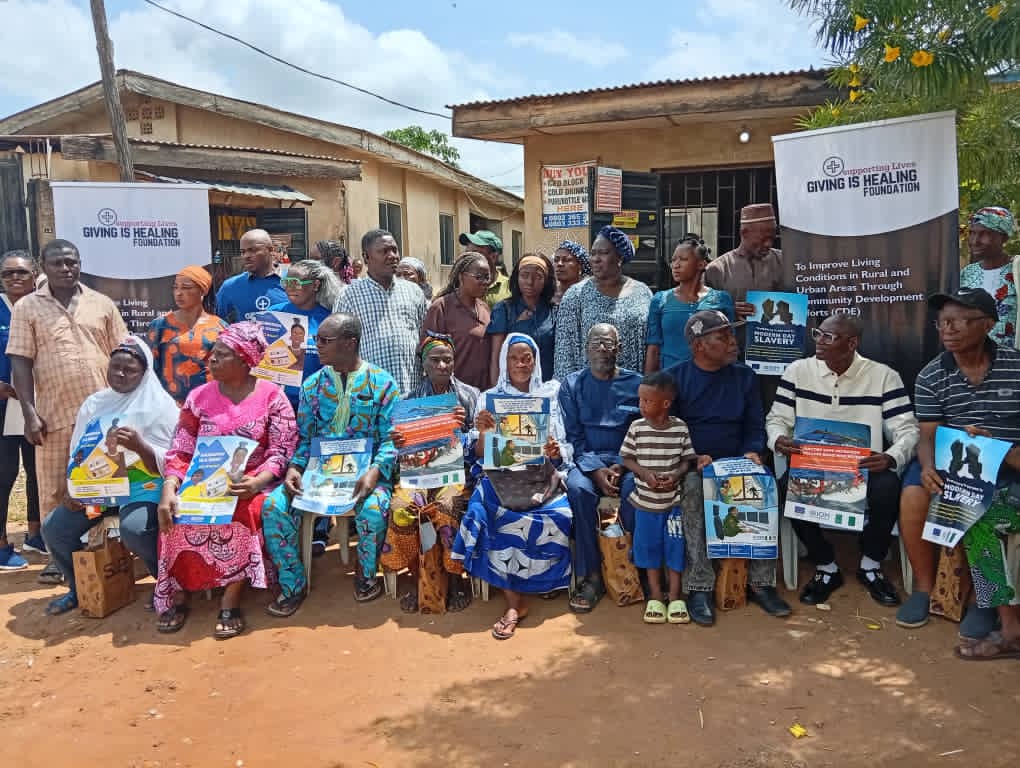
The International Organisation for Migration (IOM), in collaboration with Giving is Healing Foundation, has sensitised residents of Ayobo in Alimosho Local Government Area of Lagos State on the dangers of irregular migration and the need to embrace legal travel procedures.
Speaking during a sensitisation programme held at Megida Ifelodu Community Development Association in Ayobo, the founder of Giving is Healing Foundation, Mr. Gbolahan Ayediran, warned intending migrants against using illegal travel routes.
Ayediran said many Nigerians desire to migrate abroad in search of better opportunities but often ignore proper procedures, thereby exposing themselves to several dangers.
“Lots of people want to migrate and most of them do it in the wrong direction. The reason for the programme is for us to advise people on how they can migrate in the right way. As much as migration is their right, they should do it correctly,” he said.
READ ALSO:How Wike Rescued Me From Political Oblivion — Oshiomhole
He advised intending travellers to obtain the necessary travel documents before embarking on any journey, noting that such documents include international passports, visas, flight tickets and yellow cards, depending on the destination country.
According to him, migrants should also gather adequate information about their destination countries to enable them make informed decisions before travelling.
Ayediran further highlighted some of the dangers associated with irregular migration, including abuse, exploitation, discrimination and forced labour.
Also speaking, the Chairman of Megida Ifelodu Community Development Association, Elder Mathews Amusan, commended the organisers for enlightening members of the community on safe migration practices.
READ ALSO: He Can’t Fix His Party Let Alone Nigeria – Oshiomhole Blasts Atiku
He urged residents planning to travel abroad to always follow legal migration procedures to avoid falling victim to human trafficking and other migration-related challenges.
One of the participants, Mr. Kolawole Adenoko, said the programme enlightened him on the dangers of irregular migration and the importance of travelling through the proper channels.
He added that he would also educate his relatives and friends on the risks associated with illegal migration.
News
Shatta Wale Bailed Burna Boy From Ghana Prison After Arrest For Smoking Weed – Captan

Ghanian singer, Captan, has claimed that his former record label boss, Shatta Wale, once bailed Nigerian singer Burna Boy out of prison in Ghana after he was allegedly arrested for smoking weed.
Speaking in a recent podcast interview, Captan claimed that Shatta Wale sent him and others to free Burna Boy from police custody.
He also claimed that Shatta Wale and his group once accommodated Burna Boy when he was being hunted by some dangerous men.
READ ALSO: Wale Edun Opens Up After Sack
Captan said, “I once bailed Burna Boy out of prison in Ghana when he was arrested for smoking weed. Shatta Wale sent me and some guys to go and free him from police custody.
“There was a time we also accommodated him when some people were after his life. We helped him settle the case.”
He added that he and Burna Boy are no longer in good terms after the Nigerian artist’s fallout with his mentor, Shatta Wale.
He, however, said he and Shatta Wale are open to reconciling with Burna Boy if he asks for it.
Watch the video here
News
Children’s Day: Chaos At Ogbe Stadium As Dozens Faint

Chaos erupted on Wednesday during the Children’s Day celebration as dozens of students reportedly collapsed following a stampede triggered by the use of pepper spray.
The event,
organised by the Edo State Ministry of Education at the Samuel Ogbemudia Stadium was disrupted after some male students of Ihogbe College allegedly made uncompromising advances towards female students at the venue.
A parent who identified himself as Oboh Emmanuel said, “the behaviour of those uncultured students attracted the attention of bouncers stationed at the stadium as they rebuked the male students.”
Oboh said the affected students later regrouped and attacked the bouncers, leading to a confrontation within the crowded arena.
READ ALSO:Children’s Day: Edo Commits To Child Protection
It was gathered that in the ensuing confusion, the bouncers were reported to have deployed pepper spray in an area occupied by a large number of students.
Several students, particularly female students, reportedly fainted after inhaling the substance, while others sustained injuries after being stepped on during the ensuing melee.
The panic was said to have spread across the stadium as students, teachers and parents scampered for safety.
Many of the affected students were reportedly rushed to the Edo Specialist Hospital for medical attention.
READ ALSO: Egor LG Chair, Ogbemudia, Vice, Osawe Impeached
Reacting to the incident, Chief Press Secretary to Governor Monday Okpebholo, Dr Patrick Ebojele, said the security personnel that fired the tear gas had been detained.
He said all the students, except two, that were rushed to the hospital have been discharged.
Ebojele stated that doctors wanted to observe the students till tomorrow before allowing them to go home.
“The two students are not seriously injured. Doctors want to observe them overnight. Permanent Secretary, Ministry of Education is still at the hospital. The man who used pepper spray has been detained.
“The incident did not happen the way it is being exaggerated. All modalities were put in place to ensure the children enjoyed their day.”

 Headline4 days ago
Woman Passes Out After Receiving 100 Strokes Of Cane
- Politics5 days ago
Warri Ijaw Hail INEC Delineation Report, Call For Additional Electoral Wards, Others
- Headline4 days ago
JUST IN: White House Locked Down Briefly As Gunman Opens Fire At Security Checkpoint
- Politics3 days ago
Two Masked Men Gun Down Politician In His Rivers State Hotel
- Metro4 days ago
Police Reject N500m Bribe, Recover N7.8bn Illicit Drugs In Lagos
- News3 days ago
More Pain For Nigerians As Cooking Gas Price Increases Nationwide
- Politics5 days ago
What I’ll Do As President Of Nigeria — Amaechi
- News3 days ago
FG Declares Two Days Public Holiday For Eid-el Kabir Celebration
- Politics3 days ago
‘Tinubu’s Borrowing In 24 Months Surpasses 55 Years’ Debt Record’
- Politics2 days ago
Court Clears Goodluck Jonathan To Contest 2027 Presidential Election


