
News
OPINION: In Defence Of Nepotism [Monday Lines]

By Lasisi Olagunju
Wahala no dey finish for Nigeria. Because President Bola Tinubu appointed an acting Chief of Army Staff last week, my northern friend sent me a WhatsApp message from Zaria: “It comes as a surprise as Oduduwa takes over the lead agencies of the critical safety sector: Army (military), Police (security), DSS (Intelligence), EFCC (anti-corruption).”
My friend was talking fairness. I heard him and remembered the quaint saying about equity and clean hands. So, I replied him: “Can you name those who served in those four positions under Buhari and where they came from?”
John Milton, legendary blind poet of seventeenth century England, said something about truth and falsehood grappling. Truth, the stronger, will always put the weaker to the worse. My friend thought he had the facts on his side, and so, he answered me: “Buhari picked those security chiefs across the north east, north west and north central…”
That was a half-truth, and I’ve heard it said many times that a half-truth will always mean a half-lie. And a half-lie is a lie nicely dressed. I asked my friend: “When you people met in Kaduna earlier on Monday and took a position on VAT, rejecting Tinubu’s tax reform bills, did you meet as three zones? No. You met as one North, one region. Those appointments made by Buhari were for that one North.” As I typed that response, I remembered that ‘One North, One Destiny, One People, Irrespective of Religion, Rank or Tribe’ was the motto of the Northern People’s Congress (NPC), the North’s ruling party at independence. NPC may be long dead, but the North has dutifully kept its flame glowing. We still feel the spirit in every inter-regional discourse.
My friend argued more forcefully. He spoke as a northerner. I responded as a Yoruba man, not as a southerner, because there is nothing so called. I told him he was obviously not speaking for the other two zones in the South. I asked him if the North wanted the Chief of Army Staff position to go to the Igbo of the South-East. His response was that there was a time under Buhari when he campaigned for that arrangement. I asked him to speak for time present, not time past. “Would you want a South-East/South-South person to be Chief of Army Staff or Inspector-General of Police?” My friend did not reply me. He did not answer that question. I asked how he would feel if the positions go to the North today. He replied me with silence.
Finally, my friend quipped: “Personally, I pray for Tinubu to succeed but he doesn’t need to be nepotistic like Buhari, the disaster.”
MORE FROM THE AUTHOR: OPINION: The Waist Beads Of Olajumoke [Monday Lines]
Has Tinubu been unduly favoring the Yoruba in his appointments? Personal aides, yes. Security appointments, no. A list of 22 security appointees was circulated online at the weekend. Fifteen of them are from the North, five from the South-West, one from the South-East, one from the South-South. If anyone would complain of inadequate representation here, it should be the South-East/South-South corridor.
Sixty-four years after independence, Nigeria has remained a very delicate union of bickering partners. Despite several state creation exercises, the division along the original three regional lines has remained very strong. Today, the three arms of Nigeria’s armed forces have their chiefs chosen from the West (Army; East (Navy); North (Airforce). This would be fair enough except we are saying that one service chief is bigger than the others.
Army, SSS, Police, EFCC. For his complaint, why would my friend pick just four out of the 22 identified positions? Read my friend again. He described the four as “critical safety sector.” Buhari set the precedent by filling those posts with northerners; Tinubu has also filled them with westerners. If the East produces a president tomorrow, he will most possibly fill them with his regional brothers. But why?
Adebayo Faleti, late Yoruba playwright and culture scholar, wrote in his 1968 short story ‘Ogun Awitele’ (Foretold War) that war does not kill the coward; it also does not kill the fearless. The one who gets killed by war is the one who is careless (ogun kì í pa ojo; ogun kì í pa akin; aláìfòrànpòràn ni ogun npa). My playwright says war kills the careless. I will use the experience of Buhari’s predecessor, Goodluck Jonathan, to discuss this. When Jonathan became president, he, like most of his predecessors, was very careful not to rupture the tenuous tendons of whatever we had as a country. But Jonathan overdid it. He apparently wanted to be another national hero and proceeded to make many strategic appointments which undid him. Jonathan’s 2015 election time Inspector-General of Police was a gentleman from the north. When it mattered most, the falcon refused to hear the falconer. The super cop did not just see his kinsman, Muhammadu Buhari, to victory, he publicly followed him to collect his Certificate of Return from INEC in April 2015. The gentleman officer abandoned his defeated Commander-in-Chief. Blood is thicker than water. The policeman came out three years later to celebrate what he did. He declared that the police under him forced Jonathan to concede victory to Buhari. Hearing him in an August 2018 interview gives reasons for appreciating the true meaning of blood and water and what made one thicker than the other. The former IGP said: “We forced those who lost elections to accept the results. The Nigeria Police forced those who lost elections to accept the outcome. It was the action of the police that made them to have a change of mind and accept the results. The heroes of that election should have been the police…I attended the presentation of certificate to the president-elect…”
MORE FROM THE AUTHOR: OPINION: The Shuffle In Abuja [Monday Lines]
Nigeria was deflowered in 2015. The hymen of innocence, once lost is lost forever. If the police were strategic in determining election winners, what wise president would then hand its rein to ‘outsiders’? Jonathan’s successor, Buhari, learnt from the Ijaw man’s fatal error. He inherited Solomon Arase from Edo State as IGP, kept him for one year and as the stakes were getting high, he quickly took the position ‘home’ and gave it to Ibrahim Kutigi from Niger State. From then on till he left in 2023, the baton passed from one northern state to another. Was Buhari being street-wise to have kept the Inspector-General’s position in his regional pocket for seven out of his eight years in power? If Buhari was not wrong that time, should we expect Tinubu to do today what Jonathan did which burnt his nimble fingers day before yesterday?
Jonathan’s ‘harakiri’ in politics started long before that appointment. He did several things which no one had ever done before. It was therefore not a surprise that his eyes saw what no one ever saw before. The Ijaw man made Fulani man, Attahiru Jega, INEC chairman in an election in which his main opponent was a Fulani. The man was praised by his nemesis and he enjoyed it. As the West African Pilot of 2 April, 1964 warned in an editorial: “The road to ruin is often smooth. Those who travel it pay the fare.” Three years after he was dusted and ousted, Jonathan wrote in his ‘My Transition Hours’ (page 75): “For some inexplicable reasons, the INEC had been able to achieve near 100% distribution of Permanent Voter Cards in the North, including the North-East which was under siege with the Boko Haram insurgency, but it (INEC) failed to record similar level of distribution in the South which was relatively more peaceful.” Because Buhari was no Jonathan, when it was time for him to replace Jega in November 2015, the Fulani man from Katsina went for a Fulani man from Bauchi. After eight years of uncommon tutorial from Muhammadu Buhari on how to (mis)manage a people’s diversity, it is not possible for any subsequent president (from the south) to do bobo nice again – especially with appointments strategic to their personal and political survival. A new INEC chairman is due for appointment in November next year (2025). Watch out for Tinubu. He will not be a Jonathan.
MORE FROM THE AUTHOR: OPINION: Poverty, Professors, And Policy [Monday Lines]
Key security appointments have become an armour for the president of Nigeria. The lesson taught by history is that a leader, while cuddling his neighbour, must never allow kin-blood to be diluted with water of whatever colour.
The politics of appointment into the head of the army started soon after independence. How did the government of Tafawa Balewa handle it? Sidi H. Ali, author of ‘Power of Powers: A biography of Alhaji Muhammadu Ribadu’, Nigeria’s first minister of defence, wrote about the intense ethnic maneuverings and bitterness that attended the appointment of the country’s very first indigenous head of the army when the last expatriate, Major General Christopher Welby-Evarard, left in February 1965. “The four possible candidates were all brigadiers at the time. They were Ironsi, Ademulegun, Ogundipe and Maimalari. Ironsi was the most senior of all…After all the bickering, Ribadu came out to announce the appointment of Ironsi as the commanding officer of the Nigerian Army. This, of course, was received with mixed feelings…” (page 18). If Balewa were to come back from the dead today and is asked to pick his army chief, would he still go for Ironsi? Among the four gentlemen officers of 1964, who do you think Balewa’s choice would be?
Balewa is not coming back but his democratic successor was Shehu Shagari who came in 1979 and had Lt.-General Alani Akinrinade as his Chief of Army Staff. Shagari soon replaced the Yoruba man with his kinsman, Gibson Jalo. Jonathan inherited a chief of army staff, Abdulrahman Dambazau, from his late boss, Umaru Yar’Adua. He couldn’t sleep until he picked someone from his area, Azubuike Ihejirika, to man that goal post.
Every elected Nigerian leader since the end of the first republic knows why crab does not sleep. What it stays awake doing is 24/7 recce for the safety of its head. Its eyes should be its binoculars – and they are. Even Olusegun Obasanjo as civilian president did not deny himself that wisdom, although he was very nuanced about it. He had three Inspectors-General of Police and all three were from his western region. His DG SSS from 1999 to 2007 was Colonel Kayode Are, his Abeokuta kinsman. For the army, Obasanjo, a southern Christian, in eight years, had four gentlemen as his Chief of Army Staff. He started in 1999 with Victor Malu, a Christian from the North; then he moved south and picked Alexander Ogomudia, a southern minority. After two years, two months, Obasanjo took the position back to the North. But he did not give it to those who might use it to injure him. He picked Martin Luther Agwai, a southern Kaduna minority Christian. Three years down that road, he went south again and picked Andrew Owoye Azazi, another southern minority. It was clear that he was deliberate about what he did. He was wide awake, mixing his nationalist broth with condiments of small nepotism here, a little of altruism there. The Obasanjo experience ended almost twenty years ago. This is the age of reason, apology to Thomas Paine. The gloves are off.
MORE FROM THE AUTHOR: OPINION: ‘I am Here to Plunder’ [Monday Lines]
But, I think the people who are reading north and south into today’s appointments had better shine their eyes and see where the real danger is. The fish gets rotten from the head – and it is always progressive. Under Buhari, the president’s wife ran the alternate presidency while a regional cabal revved up the old engine of the man we elected. Today, we are not sure whether it is the man we elected or the wife or the son (with their business friends) that is at the top. After this set, we may have grafted on the trunk of our democracy a hereditary oligo-monarchy.
And we cannot say a president should not have a family – and friends. Wither the way then? Igbó rèé, òna rèé (the bush is here, the road is here). Where should we face?
The founding fathers of the United States feared what we see now. In her review of Adam Bellow’s ‘In Praise of Nepotism: A Natural History’, Joanne B. Ciulla says “nepotism was very much on the minds of America’s founding fathers. The last thing they wanted in their new country was hereditary rule.” She writes further (and this is interesting) that “one of the many qualities that made George Washington attractive as the first president was the fact that he did not have any children (who would share his powers or even seek to succeed him). When John Adams ran against Thomas Jefferson, his detractors feared that, because Adams had a son, he might try to start a dynasty.” Indeed, in that election dubbed ‘Revolution of 1800’, Jefferson, who did not have a son, defeated incumbent President John Adams.
But that cautious beginning notwithstanding, America has evolved to mint its own brand of ‘safe’ nepotism. Ciulla writes: “Let’s cut to the 2000 presidential election in the U.S. It pitted a son of a president against the son of a senator. When George W. Bush won, he appointed Michael Powell, son of Colin Powell, to be chairman of the FEC; Elaine Cho, wife of Senator Mitch McConnell, to be Secretary of Labor; and Eugene Scalia, son of Supreme Court Justice Antonin Scalia, to be the chief labor attorney. In addition to these appointments, Bush made the Vice President’s daughter, Elizabeth Cheney, deputy assistant secretary of state, and her husband chief counsel for the Office of Management and Budget. At the request of Senator Strom Thrumond (and to the dismay of some people), Bush gave Thurmond’s twenty-eight-year-old son the job of U.S. Attorney for South Carolina.” The American system, from the above, draws a line between “bad nepotism and good nepotism.” Ciulla says the US now defines nepotism “not as hiring a relative but as hiring an incompetent relative…”
That is in the US. Here in Nigeria, competence is discounted. The concern is more on the history and the geography of the hired and the motive of the appointing authority.
In all these nepotism matters, the peace of the country and the happiness of the people are the casualties. Every hour spent by the leader ignoring competence but checking the bloodline or the ethnicity of the man for the next post is the hour just before darkness. And, if the nepotist succeeds in burying his long heel in this sand, it is bye bye to peace and amity. As Olusegun Obasanjo said in 2019 at the height of Buhari’s glass ceiling-bursting nepotism: “If you cannot trust me, why should I trust you?…The person who is our leader now is saying he cannot allow another ethnic group to work with him because he cannot trust them. If he cannot trust my tribe or your tribe, of what benefit is he? And he is saying my tribe and yours should come and vote for him. He can ask for our votes, but he cannot trust us to work in good positions. Life is give and take.”



News
Children’s Day: Chaos At Ogbe Stadium As Dozens Faint

Chaos erupted on Wednesday during the Children’s Day celebration as dozens of students reportedly collapsed following a stampede triggered by the use of pepper spray.
The event,
organised by the Edo State Ministry of Education at the Samuel Ogbemudia Stadium was disrupted after some male students of Ihogbe College allegedly made uncompromising advances towards female students at the venue.
A parent who identified himself as Oboh Emmanuel said, “the behaviour of those uncultured students attracted the attention of bouncers stationed at the stadium as they rebuked the male students.”
Oboh said the affected students later regrouped and attacked the bouncers, leading to a confrontation within the crowded arena.
READ ALSO:Children’s Day: Edo Commits To Child Protection
It was gathered that in the ensuing confusion, the bouncers were reported to have deployed pepper spray in an area occupied by a large number of students.
Several students, particularly female students, reportedly fainted after inhaling the substance, while others sustained injuries after being stepped on during the ensuing melee.
The panic was said to have spread across the stadium as students, teachers and parents scampered for safety.
Many of the affected students were reportedly rushed to the Edo Specialist Hospital for medical attention.
READ ALSO: Egor LG Chair, Ogbemudia, Vice, Osawe Impeached
Reacting to the incident, Chief Press Secretary to Governor Monday Okpebholo, Dr Patrick Ebojele, said the security personnel that fired the tear gas had been detained.
He said all the students, except two, that were rushed to the hospital have been discharged.
Ebojele stated that doctors wanted to observe the students till tomorrow before allowing them to go home.
“The two students are not seriously injured. Doctors want to observe them overnight. Permanent Secretary, Ministry of Education is still at the hospital. The man who used pepper spray has been detained.
“The incident did not happen the way it is being exaggerated. All modalities were put in place to ensure the children enjoyed their day.”
News
Okpebholo Salutes Edo Muslims, Seeks Continued Support, Prayers
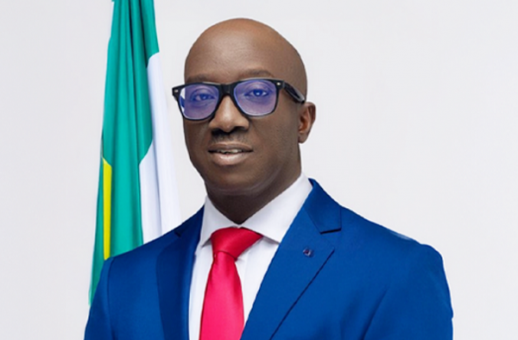
Governor Monday Okpebholo of Edo State has urged Muslims and all Nigerians to continue to pray for peace, unity and progress in the country even as they celebrate the annual Eid-al-Adha
The governor, who was represented by his deputy, Dennis Idahosa, stated this during the annual Eid-al-Adha celebration with Muslim faithfuls held at Government House in Benin City.
He reiterated his administration’s commitment to fairness, inclusivity and equal opportunities for all citizens irrespective of religion and tribe.
READ ALSO:ADC Penetrates Okpebholo’s District As Defections Strengthen Party in Edo Central
According to him, the present administration remains determined to building a government that reflects the diversity of Edo State, noting that competent and qualified Muslims have continued to play vital roles in his government because of their capacity, integrity and commitment to service.
“As a government, we remain committed to fairness, inclusivity and equal opportunity for every Edo citizen, irrespective of religion, ethnicity or political affiliation. This is why quality and competent Muslims are serving in key positions in our administration.”
Okpebholo appreciated the Muslim community in Edo State for their unwavering support and continuous prayers for his administration, noting that such prayers and support have contributed immensely to the peace and steady development being witnessed across the state.
READ ALSO:Okpebholo Felicitates Muslims On Eid-el-Fitr Celebration
He then called on all Nigerians to use the occasion of Eid-al-Adha to pray for the administration of President Bola Ahmed Tinubu, stressing that the country needs collective prayers, unity and cooperation to overcome its present economic and security challenges.
“I urge all Muslims and indeed all Nigerians to use this occasion to pray for our dear nation and for the administration of President Bola Ahmed Tinubu. Nigeria needs our collective prayers, unity and support as we strive to overcome our challenges and build a more prosperous future for all.”
In his remarks, the Chief Imam of Edo State, Abdulfatai Enabulele, applauded the governor for what he described as remarkable developmental strides recorded in less than two years in office.
The cleric commended the administration for ongoing infrastructural development and efforts geared towards improving governance in the state, but appealed to the government to revisit and complete some abandoned projects inherited from the previous administration for the benefit of the people.
News
Children’s Day: Edo Commits To Child Protection
The Edo State Government has reaffirmed its commitment to protecting the rights of children, promoting quality education, and strengthening sports development across the state.
This assurance was given by the governor of Edo State, Monday Okpebholo, during the 2026 Children’s Day Celebration and Governor’s Cup Finale held on Wednesday at the Samuel Ogbemudia Stadium, Benin City.
Addressing pupils, students and teachers,
the governor described children as the pride of Edo State and the future of the nation.
The governor, represented by his deputy, Dennis Idahosa,
noted that the annual celebration provides an opportunity to honour their dreams, talents, and limitless potential.
READ ALSO:Eid-el-Kabir: Edo Deputy Gov Solicits prayers For Okpebholo
Speaking on this year’s Children’s Day theme, “Choose Kindness, Reject Bullying,” the governor said the message was timely and significant, as it emphasizes the need to create safe, supportive, and inclusive environments for children both in schools and communities.
He stated that bullying in all forms — physical, verbal, emotional, or online — has no place in society, adding that the Edo State Government remains fully committed to protecting the rights and dignity of every child.
According to him, the administration will continue to strengthen policies and programmes that promote child protection, discipline, mutual respect, and positive learning environments across schools in the State.
The governor urged children to embrace kindness, compassion, teamwork, and respect for one another, stressing that true strength lies not in intimidation but in empathy, good character, and mutual understanding.

 Metro5 days ago
My Husband Abandoned Me On Our Wedding Night To Attend Political Meeting, I Want Our Marriage Dissolved
- Headline4 days ago
Woman Passes Out After Receiving 100 Strokes Of Cane
- Headline4 days ago
JUST IN: White House Locked Down Briefly As Gunman Opens Fire At Security Checkpoint
- Politics3 days ago
Two Masked Men Gun Down Politician In His Rivers State Hotel
- Politics5 days ago
Warri Ijaw Hail INEC Delineation Report, Call For Additional Electoral Wards, Others
- News5 days ago
Alleged Terrorism: Court Rejects Defendant’s Bid To Travel Abroad
- News3 days ago
More Pain For Nigerians As Cooking Gas Price Increases Nationwide
- Metro5 days ago
My Wife Stop Cooking My Food, Beats Me Black And Blue All the Time, Man Tells Court
- Politics5 days ago
What I’ll Do As President Of Nigeria — Amaechi
- Politics3 days ago
‘Tinubu’s Borrowing In 24 Months Surpasses 55 Years’ Debt Record’


