
News
OPINION: Jonathan’s Betrayal And Askaris In Nigerian Politics

By Festus Adedayo
Poor Goodluck Ebele Jonathan! Last Thursday, at the 70th birthday of his ex-Chief of Staff, Chief Mike Aiyegbeni Oghiadomhe, in Benin, Edo State, the former Nigerian president revealed the underbelly of Nigerian politics. At that event, Jonathan opened up a wound he had nursed since he lost the 2015 presidential election. It was his ordeals in the hands of political Askaris. “Politics in the Nigerian standard is about betrayals. I have witnessed a lot of betrayal during 2015 election,” he said.
Apart from politics, in liberation struggles, betrayers and betrayals are rife. During South Africa’s apartheid era, a number of former activists, or “comrades” who formed a bulwark of resistance against white minority rule, turned coat. A sedimentation of betrayals could be found in the Azanian People’s Liberation Army (APLA) and the African National Congress (ANC’s) military wing, Umkhonto we Sizwe (MK). Either bought or forced through torture, “Comrades” of the struggle morphed into operatives for the Apartheid regime, squealing on their ex-comrades and acting as police agents. Many even participated in death squads against their former allies. They were then given the derogatory label of Askari. Initially a moniker for police in Swahili, ‘Askari’ stuck on Apartheid era turncoats.
My first opportunity of meeting Jonathan, the man who would be president of Nigeria, was in 2005 at Idah, (I guess) Kogi State. Ostensibly seeking ties to the apron strings of then PDP National Chairman, Dr. Ahmadu Ali, Jonathan had come to Idah for Ali’s child’s wedding ceremony. It was at the thick of the crisis of Diepreye Solomon Alamieyeseigha who was subsequently removed by the Bayelsa State House of Assembly.
The Jonathan I saw at Idah was as harmless and peaceful as the white pigeon, a mythical bird Yoruba call Adaba. The people even deified Adaba with an ancient tag which holds that if she perches on your rooftop, peace had made it its hibernation.
In Idah that day, Jonathan appeared to me as wearing the innocence of a child. He cut the visor of a man alien to the scorched-earth hearts of Nigerian politicians. Over the years however, I presumed Jonathan’s participation at the highest echelon of Nigerian politics had sufficiently scarred his heart. My assumption was predicated on an ancient saying of my people, to wit that, until you acquire the status of the elderly, you will constantly frolic with children who then stomp on you like one desecrating a sacred shrine, (B’á ò nínkàn àgbà, bí èwe l’àárí).
MORE FROM THE AUTHOR:OPINION: A ‘Corruption-free’ Nigeria And Brazil As Hyena
Last week however, Jonathan seemed to have come of age. He wore the full plumage of Nigerian politics. The truth is that, in Nigerian politics today, at least since the First Republic, there has been a confetti of betrayals. It has got to an epidemic level, so much that trust, tired of abuse, developed wings and flew out of Nigerian politics. Politicians laugh at anyone who expresses surprise at serial betrayals among them. The situation today is that men and women of honour take a flight from it.
In the Yoruba society and in the people’s everyday life, trust and betrayal are very fundamental as well. Virtually all of their relationships are woven round trust, for cohesion, peace and societal stability. Because experience showed them that deviants exist who break the cord of trust, covenants called Ìmùlè, literally meaning ‘drinking (from) the water of the earth’ and Májèmú, whose literal translation is, ‘drinking from a calabash bowl’, are used to suborn agreements. In both agreements of Ìmùlè and Májèmú made between parties, the earth – which Yoruba Apala bard, Ayinla Omowura, in a deployment of a Hausa epithet, called, ‘gidan kowa’ – home of all – is invoked to witness and ensure abidance.
When either of the parties reneges from these covenants, the Yoruba say, Ó dalè. The one who wrongs the other is then the Òdàlè, or in translation, “betrayer of the earth”. The consequence of betrayal in Yorubaland isn’t benign. Either said during the agreement process or not, the phrase, “whosoever betrays the earth will disappear with the earth” (enit’óbá dalè, á báilè lo” is a poignant reminder that silent as the earth, the witness, may be during agreements (verbal or non-communicated) the earth is a dangerous mystical personality which reserves punishment for violation of agreements made while standing on it – “ilè ògéré af’okó ye’rí, alápò ìkà”.
In social or political relations, some deviants have however had a history of undermining the concept of trust by attempting to put a lie to land’s mystical personality. On many occasions when they did that, they have been recipients of catastrophic comeuppances. While there are so many examples in individual social relations, political examples will aptly illustrate the trust deficit which Goodluck Jonathan said was as rare as the teeth of a hen in Nigerian politics.
MORE FROM THE AUTHOR:OPINION: Is Èmil’ókàn Audacity Or Incantation Ritual?
Take for instance the experience of Chief Obafemi Awolowo. While the political successes of this Yoruba people’s recent ancestor have remained legendary till today, seldom is a dig done into the betrayals that dogged his political career. When he chose to vacate Western Nigeria to contest to be Nigeria’s Prime Minister, unable to secure the needed votes, one of his associates said this of him, as recorded by Awolowo himself: “I warned him when he was going to contest the Federal Elections – ‘Do not go to the Federal House, sit down like the Sardauna of Sokoto in the Northern Region, sit down like Dr. Azikiwe in the East.’ He would not listen, he wanted to become the Prime Minister. Now he has failed and since his failure the man has become insane. Since his failure, the man has become sick. So I appeal to the Prime Minister to put him in an asylum.” The man was one Chief E. O. Okunowo, representing Ijebu Central of the Western Region, at the First Republic Federal House of Representatives. You will find it on page 167 in Awolowo’s The travails of democracy and the rule of law (1987).
Awo’s closest political allies plotted his political ruin and death. They sent him to jail and gloated about the loss of his first son. Their plan was for him not to return from the Calabar prison. During the second republic, the stench of betrayal did not abate. Some of his closest allies had even begun angling to run for presidency in the proposed 1987 election.
Chief Ayo Rosiji, Awolowo’s main lieutenant and one of the founders of the Action Group, also gave him the Julius Caesar’s Brutus stab. This brilliant engineer and lawyer resigned his position as Publicity Secretary of the Action Group and ported to the opposition party. Rosijiit was who told his biographer, Australia-born historian, Dr. Nina Mba, in the biography, Man With Vision, of another betrayal that could have assumed Nigeria-wide shock. According to Mba, Rosiji told her that sometime in late 1958, Nigeria’s Prime Minister, Tafawa Balewa, was about to betray his political godfather, Ahmadu Bello, the Sardauna of Sokoto. Writes Mba, “According to Rosiji,… Balewa confided in him that he was fed up with being prime minister and of being harassed by the Sardauna, and that he was thinking of resigning.” Rosiji said he then attempted to convince Balewa to, rather than dump Bello and return to his teaching job as he threatened, join Awolowo’s Action Group. While Balewa thought that was an outlandish suggestion, Rosiji asked him to “think about it.”
S. L.Akintola is another. Till today, the reason for the schism between him and Awolowo remains mythic. While Chief Bola Ige, in his People, politics and politicians of Nigeria (1995) said the reason was trust deficit as Awolowo “(left) in charge of his base a deputy and Premier whom he did not quite trust and who was not his choice,” some scholars like Bill Dudley and EghosaOsaghae said it was ideological differences.
In Jonathan’s lamentation of betrayal in Nigerian politics, there is however the need to draw a line between the wickedness of godfatherism and self-liberation of godsons cloaked as betrayals. As I wrote in the piece, “His Excellency the godfather” (June 24, 2018) what is termed political betrayal in 4th Republic Nigerian politics is actually godfatherism gone sour. In 2003 Anambra State for instance, Chris Uba, the barely literate but stupendously wealthy businessman, exposed the destructive phenomenon. He had financed the election of Chris Ngige to be governor, pulling him by the nape of his trousers to the Okija shrine to swear by an oath of abidance. When it was time to start drawing from his “investment,” Ngige reneged, details of which became a global embarrassment to Nigerian politics.
MORE FROM THE AUTHOR:OPINION: You Be Terrorist, I No Be Terrorist!
After the 2007 handover to lackeys by the 1999 governors set, the cookies began to crumble. Some of the cookies were immediate while many took longer time. In Lagos’ Bola Tinubu and the trio of Raji Fashola, AkinwumiAmbode and JideSanwo-Olu, what many earlier saw was a matrimony worthy of an example. Tinubu continued to reap the dividends of his ‘investments’ in his handpicked successors. He determines the political barometer of Lagos politics and holds the lids of its finance. Not until the re-election campaign of Fashola and Ambode and Sanwo-Olu’s alleged cash gift to Tinubu’s political enemies did the cracks begin to be noticeable. Tinubu himself is said to parade a graveyard of those who betrayed him.
In many other states subsequently, the matrimony became a bedlam almost immediately. In Enugu, for instance, Sullivan Chime was still a governor-elect when he started to undo all that his mentor and godfather did. Orji Kalu suffered same fate in Abia, where his erstwhile Chief of Staff, T. A. Orji eventually emerged governor. Orji spent his years in government firing ballistic missiles at Kalu who had spent billions of state funds to skew the process in his favour. This ‘betrayal’ has since then been replicated in virtually all the states, with anointed godsons, having mutated to become godfathers themselves, attempting to foist their own godsons too as successors. In Anambra, Peter Obi, while shopping for a godson, walked into the supposedly sane banking hall as he searched for an urbane, corporate world executive. He got Willie Obiano, a mirthless character. Less than a year after, the strange, somber-looking Obiano transmuted from the gentleman who couldn’t hurt a fly into a stone-hearted political pall-bearer who strenuously attempted to preside over Obi’s political funeral. It was same story in Kano State where Umar Ganduje, erstwhile Rabiu Kwankwaso’s lickspittle, became a hydra who sought to swallow his ex-boss.
The list is endless. The most recent is the stench of the Nyesom Wike-SiminalayiFubara ‘betrayal’ claim in Rivers State. In all these however, a few have remained true to their predecessors, like the Kogi State governor. This is regardless of the predecessor’s betrayal of the people of his state.
The chestnut I’m pulling out of the fire today is that, from the Goodluck Jonathan betrayal story of last Thursday, you cannot get a morality tale in which the lines between heroes and villains are clearly drawn. Jonathan himself betrayed some political appendages when he went into bed with Tinubu in the 2015 elections. Tinubu the godfather also betrayed his party’s presidential candidate, Nuhu Ribadu, for Jonathan. Ribadu, as a result, won only Osun state for his ACN party. The morality of judging who is the betrayer between a godfather and godson becomes even dud when you ask whether the money used to finance those elections that birthed “the betrayers” were not stolen wealth of the people. In which case, the people’s prayer is that, like the “eni” – the dew that hangs on leaves by bush-part sidewalks in the morning – the amity of the godfather and godson must never last beyond sunrise.
The dilemma of this surfeit of betrayals is however that, unless Nigerian politics becomes an engagement of honesty, trust, truth and fidelity, decent people will continue to flee from it. In all the betrayals, the grand betrayal I see is the one against the Nigerian people whose lives have backtracked in 26 years of the 4th Republic.

News
Otuaro: Baseless Allegations, Disregard Them, Group Urges Public
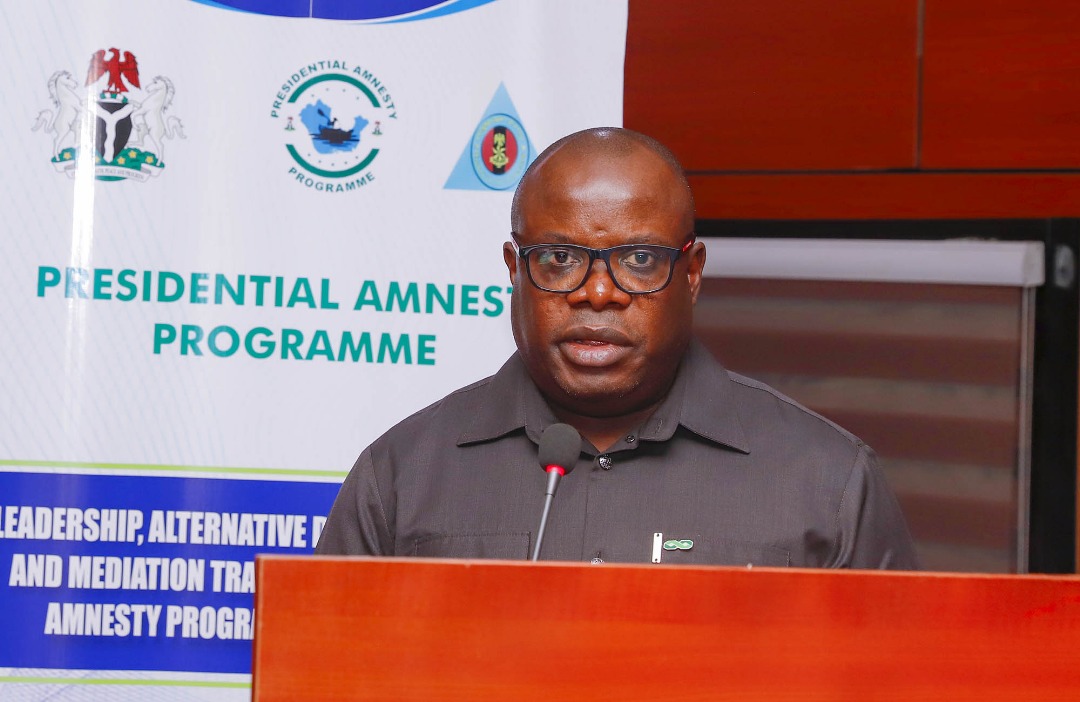
The Ijaw People’s Development Initiative, IPDI has reacted to a statement circulating online regarding the Presidential Amnesty Programme (PAP), describing it as baseless.
The statement under the disguise ‘Niger Delta Stakeholders Forum and Niger Delta Ethnic Nationalities,’ had demanded accountability regarding the management of the Programme and its administrator, Dr Dennis Otuaro.
Reacting to the statement, National President, IPDI, Comrade Austin Ozobo, said: “We consider it necessary to respond point by point to correct misconceptions, reject unsubstantiated claims, and keep the record straight in the interest of PAP beneficiaries, stakeholders, and the general public.
“It is worthy of note that the PAP operates under strict federal financial regulations and is subject to routine audits by the Office of the Auditor-General of the Federation, the Ministry of Finance, and other oversight bodies.
“All disbursements, including stipends, vocational training, education support, and third-party contracts, are processed through the Treasury Single Account, TSA, with verifiable records”, the statement read.
READ ALSO:PAP Sends Additional 15 Scholarship Beneficiaries For Post-Graduate Studies In UK
According to the IPDI, the Programme welcomes lawful criticism and scrutiny at any time. However, linking such a call to specific individuals without evidence amounts to trial by the media and undermines due process.
“Dr Dennis Otuaro, administrator of the Presidential Amnesty Programme has maintained a good record of financial management, hence no formal petition with verifiable evidence has been submitted to any anti-graft agency till date”.
“It may interest you to know that the N65,000 monthly stipend is fixed by the Appropriation Act and can only be reviewed through a budgetary process approved by the National Assembly and the Presidency.
‘The PAP management has consistently conveyed beneficiaries’ concerns on cost of living to relevant authorities”.
“Again, claims that allocations to the Programme have risen significantly while stipends remain unchanged misrepresents the budget structure.
READ ALSO:PAP: N’Delta Stakeholders Laud Otuaro’s 2 Years Of Strategic Reforms
“Note, increased allocations in recent years have been tied to expanded reintegration programs, education sponsorships, skills acquisition, and infrastructure support for training centers, not solely to stipend payments”.
The group reiterated that the allegation that the Amnesty Programme Office “kidnaps and detains delegates” is false, reckless, and defamatory, adding that the PAP has no paramilitary or law enforcement mandate, nor does it operate detention facilities and that any incident involving law enforcement is outside the control and purview of the Programme.
“We challenge the authors to provide verifiable details of time, place, and persons involved so the matter can be addressed through appropriate legal channels,” the group said
On Claims of Selective Empowerment and 500% Payment Increases, the group maintained that payments to contractors, ex-agitator leaders, and service providers were governed by existing contracts and agreements predating the current administration.
“No individual or camp has received unilateral increases without contractual basis or due process. Allegations of 500% increases are unsubstantiated and designed to stoke division among beneficiaries,” it added.
READ ALSO:Otuaro Links Increase In PAP Scholarship Beneficiaries To Tinubu
“The current administration has maintained a policy of transparency in engagement with leaders and has expanded inclusion by verifying and capturing previously omitted beneficiaries where due“, IPDI added.
The group further said, “The PAP remains a neutral, peace-building institution established under the 2009 Amnesty Declaration. Its mandate is to coordinate disarmament, demobilization, and reintegration. The Office does not engage in political victimization, intimidation, or exclusion of stakeholders. Engagement with ex-agitator leaders and community structures is conducted based on their role in maintaining peace and facilitating reintegration, not political alignment”.
“The PAP under Chief Denis Otuaro’s leadership remains committed to transparency, fairness, and the original mandate of the Amnesty Programme. Constructive criticism is welcome and has informed policy adjustments in the past. However, campaigns of calumny, unverified allegations, and attempts to drag the Programme into commercial or political disputes do not serve the interest of peace in the Niger Delta”, IPDI said.
“We urge all stakeholders to channel grievances through the established engagement channels of the Programme and to avoid statements that threaten the fragile stability we have worked to sustain”.
Consequently, the IPDI urges members of the public to disregard what its described as “flimsy and unsubstantiated allegations, misconception, and missives by faceless groups above“.
News
[OPINION] Olukoyede’s EFCC: Taming The ‘Fantastically-Corrupt’

Since its creation 23 years ago, by Chief Olusegun Obasanjo, as president of Nigeria, Africa’s most populous and influential country, the Economic and Financial Crimes Commission (EFCC), had apparently not gotten a head, who had piloted the affairs of the commission, like Mr. Olanipekun Olukoyede, its Executive Chairman, a chief-operations-officer of the Commission.
It could be said that Olukoyede, the Czar thief catcher and arrestor of economic saboteurs, has given the EFCC’s enemies such a tough time as he has taking the anti-graft fight to the doorsteps of the high-profile individuals across the country. These range from former state governors, serving and former ministers, retired and serving civil servants, businessmen, clergies, traditional rulers, cyber-influencer, entertainers, professionals and numerous others.
Olukoyede brings years of experience in law, fraud management, and business intelligence to bear on the position. Before him, Mallam Nuhu Ribadu was EFCC’s inaugural chair; succeeded by the first and only female, Mrs. Farida Waziri; Ibrahim Lamorde, Ibrahim Magu, and Abdul Rasheed Bawa.
The anti-graft agency has its hands full with massive financial fraud and money laundering cases. In the clause of “physicians, look at thyself”, EFCC in its resolve is known to have been flushing out officers within the body, who run foul to the law.
In the past, before Olukoyede’s appointment, it was widely believed that it was only the “fries and not the big fishes”, who the Commission could summon the courage to prosecute; and that most culprits were also left from the hook, because of compromise by some corrupt officers of the Commission, and feeble litigation processes.
Mr. Godwin Emefiele, former Governor of the Central Bank of Nigeria (CBN), happened to have opened to Olukoyede’s a deluge of “big-men and women”, who have been arrested, investigated and cooling their feet in detention or those bailed, that are facing severe court trials. There is the biggest 19-count charge at the Ikeja Special Offences Court, involving an alleged $4.5 billion fraud.
Immediate-paste governor of Kogi State, Yahaya Bello, faces two massive, but separate legal battles totalling over N190 billion on fraud allegation. EFCC secured from the Court of Appeal, forfeiture of 14 properties and huge money linked to him.
Abubakar Malami (former Attorney-General of the Federation), with his son, Abdulaziz and his wife, is currently charged on a-16-count of money laundering. The court has stayed interim forfeiture of 57 properties valued at over N213 billion.
MORE FROM THE AUTHOR:OPINION: Contesting The Portable Vs Carter Efe’s Cruel Ring-fight
EFCC had also secured the arrest of Sadiya Umar-Farouq, a female former Minister of Humanitarian Affairs, and a former Permanent Secretary, through a Federal High Court, on a 21-point alleged fraud and corruption charge, involving $1.3 million and N746.6m and others amounting to 37.1 billion.
Uju Kennedy-Ohanenye, also female and former Minister of Women Affairs, was removed from office by President Bola Tinubu, over alleged misappropriation and diversion of N138.4 million, and had been under EFCC questioning.
A recent discovery, which startled Nigerians and the world, the Commission (EFCC) had reportedly arrested a serving Director-General of the Energy Commission of Nigeria, Dr. Mustapha Abdullahi, over alleged money laundering involving about ₦500 billion.
Somewhat, this had deflated the claim that those arrested and persecuted are political opponents and not serving officers of the Tinubu’s government.
EFCC is a “Nigerian law enforcement and anti-graft agency that investigates financial crimes, such as advance fee fraud (419 Fraud) and money laundering. It was also set up to fight against corruption and to protect the country from economic saboteurs”.
The Commission, whilst responding to pressures from the Financial Action Task Force on Money Laundering (FATF), that named Nigeria as one of 23 countries not cooperating in the international community’s efforts to fight money laundering, had revved in performance, in a bid to roll back the blights.
And so, it is a strenuous goal for EFCC, as entrenched in the ‘EFCC Establishment Act 2004’, which gives it specialist jurisdiction against severe financial and commercial crime – covering multiple high and lower levels.
MORE FROM THE AUTHOR:OPINION: Tenebe Could Deprive Tinubu From Winning Edo Election
Born on 14 October 1969, Olukoyede, a civil servant, has had a clear break from past, where past executive chairmen of the Commission had left the Commission, where all serving officers were drafted from the Nigerian Police Force (NPF). However, President Bola Ahmed Tinubu is widely commended for Olukoyede’s appointment to the position, with the Senate also eulogized for screening him.
Whilst briefing the Press in Abuja, on his two-year activities in office, on October 23, 2025, the Commission’s boss certainly made unprecedented progress in the fight against economic and financial crimes. He spoke through the Director of Public Affairs of the Commission, Wilson Uwujaren, as he listed the recovery of N566 billion, alongside other currencies and assets, among the achievements of the Commission.
He further revealed that the Commission received over 19,000 petitions, conducted 29,240 investigations, filed 10,525 cases in court, and secured 7,503 convictions.
Olukoyede asserted that the Commission recovered ₦566,319,820,343.40, $411,566,192.32, £71,306.25, €182,877.10, and other foreign currencies from proceeds of financial and economic crimes. Added to this was the recovery of 1,502 non-monetary assets, comprising 402 properties in 2023, 975 in 2024, and 125 so far in 2025.
“Among these recovered assets are two notable landmarks: the final forfeiture of 753 units of duplexes in Lokogoma, Abuja, and the forfeiture of Nok University, now the Federal University of Applied Sciences, Kachia, Kaduna State,” he said.
He listed several high-profile cases prosecuted within the period, including those involving former governors Willie Obiano, Abdulfatah Ahmed, Darius Ishaku, Theodore Orji, and Yahaya Bello. Others are former ministers Olu Agunloye, Mamman Saleh, Hadi Sirika, Charles Ugwu, and former Central Bank Governor, Godwin Emefiele.
EFCC was also said to have reentered and invigorated some longstanding fraud cases, such as ones linking Fred Ajudua, former People Democratic Party, PDP National Chairman Haliru Bello Mohammed, ex-National Security Adviser Sambo Dasuki, and former Nigerian Social Insurance Trust Fund, NSITF boss, Ngozi Olojeme.
MORE FROM THE AUTHOR:OPINION: The Rough Games Arewa Bourgeoisies Play With The Talakawas
The EFCC said it arrested 792 suspects involved in asset and cryptocurrency frauds in Lagos, among who were 192 foreigners who were prosecuted and deported.
A Task Force on Naira Abuse and Dollarisation of the Economy was established by EFCC, which accordingly, had notable impacts in sanitizing money actions countrywide. “The campaign against naira abuse, racketeering, and speculative currency trading has helped reduce pressure on the naira and complemented the Central Bank’s efforts in stabilizing the economy,” he said.
Olukoyede also spoke on the Commission’s strengthened partnerships with foreign law enforcement agencies, including the Korean Police, Royal Canadian Mounted Police, Spanish Police, and German Police.
He also mention benefitting synergy with the FBI, the UK’s National Crime Agency (NCA), INTERPOL, and Japan’s JICA, in subsequent joint investigations and the repatriation of stolen assets to victims from Spain, Canada, and the United States.
Strengthening EFFC’s mandate at the regional level, and in Africa, Olukoyede and the Commission are said to be up and doing. For instance, a thing that had never happened to EFFC, he had been twice elected as President of the Network of National Anti-Corruption Institutions in West Africa (NACIWA), which led to the founding of a permanent secretariat in Abuja.
A strong media presence is needed to successfully inform the public of the ideals of EFCC and its update activities. And so, ‘EFCC Radio 97.3FM’, Nigeria’s first anti-corruption radio station, was established Olukoyede. EFCC should count itself very lucky for having in its fold, tested, diligent and veteran journalists who are ostensibly seasoned in the ideals and watchdog principles of the Commission.
News
APC Primaries: Johnny Rallies Support For Senator Thomas’ Re-election Bid
A chieftain of the All Progressives Congress in Delta State, Chief Michael Johnny, has called on Delta South Senatorial District’s party faithful to come out in large tomorrow and vote for Senator Joel-Onowakpo Thomas (JOT) in the party senatorial primary election.
Johnny, widely regarded as a leader par excellence within the APC, described the primary election as a critical moment that will determine the political stability, unity, and future direction of Delta South.
According to him, Delta South needs a detribalized leader with the capacity to unite people beyond ethnic sentiments and political divisions.
He warned against leaders whose style of politics promotes ethnic division and unnecessary tension within the region.
READ ALSO:Violence Rocks APC Reps Primary In Ekiti Ward, Exercise Declared Inconclusive
Chief Johnny stated that Senator Thomas has continued to distinguish himself as a leader who carries everyone along, irrespective of tribe, political background, or local government affiliation.
He noted that JOT’s leadership style has strengthened cooperation, peace, fairness, and political inclusion across Delta South.
Speaking further, Chief Johnny declared that the Ijaw people have resolved to stand firmly behind Thomas because fairness, justice, and political balance must prevail in Delta South.
“As Ijaw people, we have decided to support Senator Joel because this is the turn of the Isoko nation, and Ijaw stands for truth. That is our position,” he stated.
READ ALSO:APC Clears Wike Loyalists, Disqualifies All Fubara-aligned Aspirants For State Assembly
He also appreciated what he described as “genuine Itsekiri sons and daughters” who believe in fairness, equity, and peaceful coexistence, adding that Delta South can only move forward when the various ethnic nationalities work together in unity and mutual respect.
Chief Johnny maintained that the senatorial district must not be dragged backward by divisive politics or ethnic interests capable of weakening the collective strength of the region.
He stressed that all APC members in Delta South must remain united in their support for Senator Joel-Onowakpo Thomas.
“Delta South is bigger than personal interests. This election is about unity, stability, fairness, and the future of our people. Senator JOT represents continuity, experience, and inclusive leadership for all ethnic groups in Delta South,” Chief Johnny added.

 News4 days ago
Gun Battle In Oyo Forest As Police Disrupt ₦10m Ransom Collection Plot
- Politics3 days ago
Four Fubara Loyalists Disqualified As APC Clears 21 For Rivers Reps Primaries
 Metro4 days ago
Drama As Teenagers Stage Secret Wedding With N3,000 Bride Price
- Politics3 days ago
2027: Court Rebukes Plaintiff, Lawyer In Suit Against Jonathan, Awards N1m Fine
- News3 days ago
Lagos Sanctions 15 Money Lending Companies For Sharp Practices
- Politics5 days ago
2027: Daniel-Abiodun Feud Deepens Over Senatorial Ticket For Ogun East
- News4 days ago
PAP Sends Additional 15 Scholarship Beneficiaries For Post-Graduate Studies In UK
- Sports4 days ago
CAF Introduces New Laws After Chaotic AFCON Final In Morocco
- Entertainment5 days ago
Grammy Announces Date For 2027 Awards Nominations
- News5 days ago
Sleep Timing Irregularity Could Double Risk Of Heart Attack, Experts Warn


