
News
OPINION: Mike Ejeagha And The Power Of Music

Tunde Odesola
I grew up hating my name, Isaac, after listening to Fela Anikulapo-Kuti’s song, Upside Down, which he did with his American soulmate, Sandra Isidore, in 1976. Apart from his mother, the king-dethroning Madam Olufunmilayo Ransome-Kuti, Sandra was a major influence in the radicalisation of Fela, burnishing his art and heart with the socio-political wildfires called Blackness and Africanness spreading across the US, Europe and Africa to other parts of the world at the time.
Harnessing the genius of multi-talented designer, artist, painter and illustrator, Lemi Ghariokwu, whose brush drenched the sleeves of Fela’s albums in rainbowy colours, the Afrobeat god granted Ghariokwu the artistic licence to design and write the lyrics of his songs on his album sleeves. Ghariokwu made the best of the opportunity presented by Fela, soaring to world acclaim. The sleeve designs of ‘Yellow Fever’, ‘Zombie’ and ‘Beasts of No Nation’ are still vividly etched in my memory.
Not novel to the Nigerian music industry, the illustrations and lyrics on Fela’s album sleeves made it easy for his lovers and haters to understand the anger in his protest songs. Personally, the illustrations and lyrics made me internalise his gospel, though I was young.
Despite being a consummate Christian, my father, who was his fan, didn’t know he was planting the seeds of Black African consciousness in me by buying Fela’s albums. I remember my mother also bought the 1973 album of St Gregory’s College teenage students’ group, Ofege, titled ‘Try and Love’.
Leader of the group, Melvin Ukachi, revealed that Ofege was an abridged form of ‘O fo gate’, which means ‘he jumped the gate,’ a term used for Army deserters on French leave aka AWOL or students who left the dormitory without permission.
Isaac!? “No, I’m not sick,” I would say – in derision of my name – and would tell whoever cared to listen how wrong it was for me, a Yoruba, to bear a Jewish name when Jews don’t bear Yoruba names. In my fledgling ideological radicalism, I saw reason in Fela and Sandra, who sang in ‘Upside Down’ that, “Englishman get English name, American man get American name, German man get German name, Russian man get Russian name, Chinese man get Chinese name, but African man no dey get African name…everything disorganise, patapata…”
MORE FROM THE AUTHOR: OPINION: Does Sparing The Rod Spoil The Child?
As a youngster, I never plucked up the courage to tell my parents how much I disliked the Isaac name. Who born me? But when I came of age, I did tell my father how kobo-wise and naira-foolish I think it was for anyone to go to Jerusalem or Mecca on pilgrimage in the hope of making it to Paradise. I also told him how illogical I think it was for Nigerians to communicate with God in foreign languages such as Arabic, Italian, Hebrew etc when God understands all languages.
Fela intended his songs as a tool for social change. With the cult following he enjoyed, Fela knew his songs would sprout disciples in many nations. Though I didn’t smoke marijuana, I became a disciple of Fela’s gospel, always leaving my shirt unbuttoned at the chest, a behaviour which often fetched my mother’s swift ‘ifakun’ slap on my flat-screen chest, ‘twai’; ‘it’s not in this house you will become a Fela disciple! Button up, you goat!’
Just 18 when he met Fela, Ghariokwu had done a portrait of the Abami Eda and went to present the work to him. Fela reportedly offered Ghariokwu four times the worth of the painting but the creative turned down the money, thus earning a lifetime ticket to Kalakuta Republic.
As a result of his diligence with Fela, self-taught Ghariokwu achieved international repute, exhibiting in major museums across the globe, granting interviews to global media organisations, including CNN and designing album covers for Bob Marley, Osita Osadebe, Kris Okotie, Lucky Dube, Miriam Makeba etc. Also, he designed album covers for 2Face, Lagbaja, Sound Sultan, Falz, Brymo and record labels such as EMI, CBS and Ivory Music. He also recorded a song, Omolakeji, in 1992, featuring Daniel Wilson aka Mr Ragamuffin.
At 94, folklorist and master guitarist – Gentleman Mike Ejeagha – is at the Departure Lounge of Life International Airport, awaiting his last flight. A soft female voice wafted through the airport’s Public Address System, saying: “Passenger No 01-08-1932, Pa Mike Ejeagha, your attention is needed. You are about to board the wrong flight. Please, go back to the Arrival Lounge, a convoy is waiting to take you back home, courtesy of popular comedian, Brain Jotter.”
MORE FROM THE AUTHOR: OPINION: How I Quit Smoking (1)
And Gentleman Ejeagha burst into tears.
In music, folderol is a refrain with no meaning though it may be rhythmic. ‘Gwo, gwo, gwo, ngwo’ is a folderol, just as ‘Eweku ewele’, the Yoruba version of ‘Gwo, gwo, gwo, ngwo’ is. ‘Gwo, gwo, gwo, ngwo’ and ‘Ewku ewele’ are refrains in the Igbo and Yoruba folktales that showcase how little Tortoise differently tricked the almighty Elephant. ‘A o m’erin j’oba’ is the Yoruba version of the folktale. At best, both refrains signify the footfalls of the Elephant: ‘Gwo, gwo, gwo, ngwo’, ‘Eweku ewele’.
Ejeagha had only been known within the resilient Biafra enclave until fate blew fame his way recently, after his 1983 song, Ka Esi Le Onye Isi Oche, became the 14th most searched song in the world because the song went viral when Brain Jotter created a funny dance step and used the song in his comic skit.
In Igbo land, the name Mike Ejegbha is synonymous with storytelling such that whenever someone is engaging in a long speech, the audience would say, ‘Akuko Mike Ejeagha,’ meaning ‘Storytelling like Mike Ejeagha’.
Ejeagha simply means ‘Safe journey’. As a nonagenarian, one of the prayers of the Imezi Owa-born indigene of Enugu State would include a safe journey back home to his Maker for he had run a good race, fought a good fight and was waiting on his Lord before Brain Jotter appeared in the sky to give him fresh wings to fly, once again, among stars. It’s destined that Ejeagha’s song would be sung by this generation.
You can’t enjoy Ka Esi Le Onye Isi Oche if you play it on mobile devices. Get the music on a stereo and hear the booming ‘udu’ tempering the classic guitar work played on D major scale. It’s crazy.
Over the years, degeneration in moral values has seen Nigerian society abandon didactic musical messages for the current hurricane of irritatingly noisy music full of fury, materialism, sex, ritualism and outright stupidity.
MORE FROM THE AUTHOR: OPINION: How I Quit Smoking (2)
Music is powerful. I should add ‘very’ to the power of music. The walls of Jericho fell to music. David won the heart of God with music. Music is the food of love. It’s also the fuel for war. Music made me hate Isaac till tomorrow. Music is very powerful. Music is making Gentleman Ejeagha float on cottony clouds in the evening of his life, fulfilling the prayer of Everyman – to finish well in life; to not wear rags after donning coats of many colours, to not eat bone after eating choice meat.
By the way, who invented music? Who invented dance? There’s no historical evidence as to who invented music but dance, one of the most expressive physical art forms, evolved from prehistoric times as a celebratory worship form in spiritual rituals, creating family and communal bonds. Egypt and India are believed to be the earliest roots of dance.
There’s an unmistakable affinity between Igbo and Yoruba languages despite the political wedge being driven between the two great peoples. The Igbo call the elephant ‘enyi’ while the Yoruba call it ‘erin’. The mouth is ‘onu’ in Igbo, it’s ‘enu’ in Yoruba just as the ear, called ‘nti’ in Igbo, bears ‘eti’ in Yoruba. The hand is ‘aka’ in Igbo and goes by ‘apa’ in Yoruba while the nose is ‘imi’ in Igbo and ‘imu’ in Yoruba. Torotoro is turkey in Igbo while it’s tolotolo in Yoruba. Goat, ‘ewu’ in Igbo, is ‘ewure’ in Yoruba. Corn is ‘oka’ in both languages just as fever is ‘iba’ in both.
In 2019, the Ooni of Ife, Oba Enitan Ogunwusi, and Ohaneze Ndigbo agreed that the Igbo once lived in Ife. The Ooni, who said the Yoruba were aborigines of Ile-Ife, added, “We have to say the truth and the truth must set us all free, we (Yoruba and Igbo) are blood brothers.” But the National Deputy Publicity Secretary of Ohanaeze Ndigbo, Chuks Ibegbu, said the Igbo were the original occupants and owners of Ife before the arrival of the Yoruba. Historians should shed light on the issue.
A retired Associate Professor of English, Obafemi Awolowo University, Bolaji Aremo, whose research affirmed both Igbo and Yoruba languages were from the same parent language, said the similarities suggest that both languages lived in the same community at a time and that both ethnic groups were of the same ancestral stock.
Ejeagha is Igbo, yet the Yoruba dance ‘Gwo, gwo, gwo, ngwo’. The Igbo danced to Sina Peters’ ‘Ace’. Music is the powerful food of love.
Email: tundeodes2003@yahoo.com
Facebook: @Tunde Odesola
X: @Tunde_Odesola



News
Migration Agency Warns Migrants Against Irregular Travel Routes
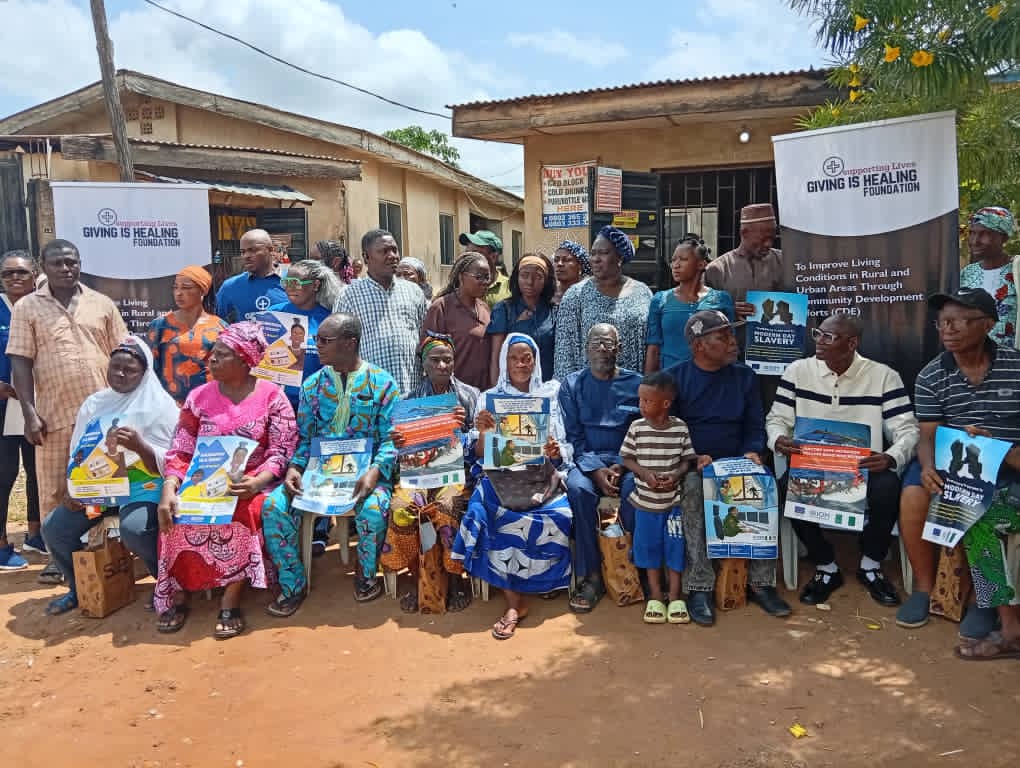
The International Organisation for Migration (IOM), in collaboration with Giving is Healing Foundation, has sensitised residents of Ayobo in Alimosho Local Government Area of Lagos State on the dangers of irregular migration and the need to embrace legal travel procedures.
Speaking during a sensitisation programme held at Megida Ifelodu Community Development Association in Ayobo, the founder of Giving is Healing Foundation, Mr. Gbolahan Ayediran, warned intending migrants against using illegal travel routes.
Ayediran said many Nigerians desire to migrate abroad in search of better opportunities but often ignore proper procedures, thereby exposing themselves to several dangers.
“Lots of people want to migrate and most of them do it in the wrong direction. The reason for the programme is for us to advise people on how they can migrate in the right way. As much as migration is their right, they should do it correctly,” he said.
READ ALSO:How Wike Rescued Me From Political Oblivion — Oshiomhole
He advised intending travellers to obtain the necessary travel documents before embarking on any journey, noting that such documents include international passports, visas, flight tickets and yellow cards, depending on the destination country.
According to him, migrants should also gather adequate information about their destination countries to enable them make informed decisions before travelling.
Ayediran further highlighted some of the dangers associated with irregular migration, including abuse, exploitation, discrimination and forced labour.
Also speaking, the Chairman of Megida Ifelodu Community Development Association, Elder Mathews Amusan, commended the organisers for enlightening members of the community on safe migration practices.
READ ALSO: He Can’t Fix His Party Let Alone Nigeria – Oshiomhole Blasts Atiku
He urged residents planning to travel abroad to always follow legal migration procedures to avoid falling victim to human trafficking and other migration-related challenges.
One of the participants, Mr. Kolawole Adenoko, said the programme enlightened him on the dangers of irregular migration and the importance of travelling through the proper channels.
He added that he would also educate his relatives and friends on the risks associated with illegal migration.
News
Shatta Wale Bailed Burna Boy From Ghana Prison After Arrest For Smoking Weed – Captan

Ghanian singer, Captan, has claimed that his former record label boss, Shatta Wale, once bailed Nigerian singer Burna Boy out of prison in Ghana after he was allegedly arrested for smoking weed.
Speaking in a recent podcast interview, Captan claimed that Shatta Wale sent him and others to free Burna Boy from police custody.
He also claimed that Shatta Wale and his group once accommodated Burna Boy when he was being hunted by some dangerous men.
READ ALSO: Wale Edun Opens Up After Sack
Captan said, “I once bailed Burna Boy out of prison in Ghana when he was arrested for smoking weed. Shatta Wale sent me and some guys to go and free him from police custody.
“There was a time we also accommodated him when some people were after his life. We helped him settle the case.”
He added that he and Burna Boy are no longer in good terms after the Nigerian artist’s fallout with his mentor, Shatta Wale.
He, however, said he and Shatta Wale are open to reconciling with Burna Boy if he asks for it.
Watch the video here
News
Children’s Day: Chaos At Ogbe Stadium As Dozens Faint

Chaos erupted on Wednesday during the Children’s Day celebration as dozens of students reportedly collapsed following a stampede triggered by the use of pepper spray.
The event,
organised by the Edo State Ministry of Education at the Samuel Ogbemudia Stadium was disrupted after some male students of Ihogbe College allegedly made uncompromising advances towards female students at the venue.
A parent who identified himself as Oboh Emmanuel said, “the behaviour of those uncultured students attracted the attention of bouncers stationed at the stadium as they rebuked the male students.”
Oboh said the affected students later regrouped and attacked the bouncers, leading to a confrontation within the crowded arena.
READ ALSO:Children’s Day: Edo Commits To Child Protection
It was gathered that in the ensuing confusion, the bouncers were reported to have deployed pepper spray in an area occupied by a large number of students.
Several students, particularly female students, reportedly fainted after inhaling the substance, while others sustained injuries after being stepped on during the ensuing melee.
The panic was said to have spread across the stadium as students, teachers and parents scampered for safety.
Many of the affected students were reportedly rushed to the Edo Specialist Hospital for medical attention.
READ ALSO: Egor LG Chair, Ogbemudia, Vice, Osawe Impeached
Reacting to the incident, Chief Press Secretary to Governor Monday Okpebholo, Dr Patrick Ebojele, said the security personnel that fired the tear gas had been detained.
He said all the students, except two, that were rushed to the hospital have been discharged.
Ebojele stated that doctors wanted to observe the students till tomorrow before allowing them to go home.
“The two students are not seriously injured. Doctors want to observe them overnight. Permanent Secretary, Ministry of Education is still at the hospital. The man who used pepper spray has been detained.
“The incident did not happen the way it is being exaggerated. All modalities were put in place to ensure the children enjoyed their day.”

 Headline4 days ago
Woman Passes Out After Receiving 100 Strokes Of Cane
- Headline4 days ago
JUST IN: White House Locked Down Briefly As Gunman Opens Fire At Security Checkpoint
- Politics5 days ago
Warri Ijaw Hail INEC Delineation Report, Call For Additional Electoral Wards, Others
- Politics3 days ago
Two Masked Men Gun Down Politician In His Rivers State Hotel
- Metro4 days ago
Police Reject N500m Bribe, Recover N7.8bn Illicit Drugs In Lagos
- News3 days ago
More Pain For Nigerians As Cooking Gas Price Increases Nationwide
- News5 days ago
Alleged Terrorism: Court Rejects Defendant’s Bid To Travel Abroad
- Politics5 days ago
What I’ll Do As President Of Nigeria — Amaechi
- News3 days ago
FG Declares Two Days Public Holiday For Eid-el Kabir Celebration
- Politics3 days ago
‘Tinubu’s Borrowing In 24 Months Surpasses 55 Years’ Debt Record’


