
News
OPINION: Osoba’s Short Spoon Dinner With Obasanjo
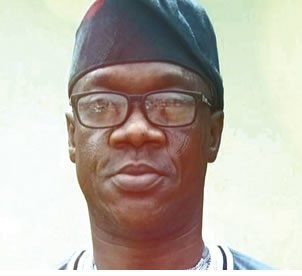
By Suyi Ayodele
Two Yoruba ‘living ancestors’ are at each other’s throats at the moment.
The two personages have made great and indelible marks in life. They are giants in their own ways, and both are supposed to be close relatives like the proverbial ìyekan Alábahun (close-knitted relatives of Tortoise). They hail from the same town and are both answerable to the same Oba.
The underpinning axiom that established their common domain says: Ègbá méjì kìí ja ara won níyàn: bí ìkan bá ní bai sí, ìkejì á ní báa wà (two Egba men don’t argue on any matter; if one asks ‘is it not so?’; the other will respond: ‘it is so’).
So, what is the matter with the former governor of Ogun State, Aremo Olusegun Osoba, and his kinsman, the former military Head of State and two-term civilian President of Nigeria, Chief Olusegun Obasanjo?
Let me confess my filthiness here so that the elders of the land will find clean apparel for me. I am too young in all ramifications of life to teach the two old combatants the rudiments of Yoruba philosophy. Whatever I do here, therefore, is purely out of curiosity. May Èsù Elégbára not allow curiosity to kill my cat. Àse!
Aremo Osoba wrote a memoir, “BATTLELINES: Adventures in Journalism and Politics”, in 2019. The book did not generate any heat seven years ago, when it was first published. Suddenly, an excerpt from the book, sub-titled: “How Obasanjo Deceived Us In 2003” (pp.280-294), surfaced a week ago. Heaven itself knows that the earth is witnessing yet another battle among the children of Oòduà.
I love Èsù.
He is my muse. If those pushing for my excommunication succeeded, you would likely find me pouring libations at the shrine of Ògiri-Òkò, Èsù Láàlú!
Of course, I would serve Him alongside the Father of Wisdom, Òrúnmìlà, the very one who teaches man wisdom like one’s sibling (Akóni l’óràn bíi ìyekan eni).
When the Gospel, in James 1:5-6, says whoever lacks wisdom should ask God, the writer of those verses, most probably, must have had Láaróyè (Èsù) and Àgbonìrègún (Ifá) in mind. Both are the end of wisdom. Heresy? We shall know shortly.
Geoffrey Chaucer (c1343-25 October 1400), the English poet, as far back as 1386, wrote glowingly about Èsù in his The Canterbury Tales. That was four and half decades before Bishop Samuel Ajayi Crowther (1809-1891), translated the English Bible to Yoruba Language and ‘demonised’ the Yoruba trickster deity, Èsù, as the Jewish devil that is full of all evils.
Chaucer, in The Squire’s Tale, says this of Èsù: Therfore bihoveth hire a ful long spoon / That shal ete with a feend (see “The Canterbury Tales”, pgs. 405-424). Interpreted to the Modern-Day English Language, Chaucer’s poetic line reads: ‘Therefore beloved, hire a full long spoon if you must eat with a trickster fellow.’
READ MORE FROM THE AUTHOR: [OPINION] : Ìyá Alákàrà: The Poor Can’t Fry Their Way Out Of Poverty
The Chaucerian admonition is repeated by Williams Shakespeare in The Comedy of Errors (Act 4, scene 3) and in The Tempest (Act 2, Scene 2). The three instances above are mere confirmation of the age-old Yoruba saying: Eni máa bá Èsù jeun, síbí è á gùn (he who will dine with Èsù must have a long spoon).
For an average old Yoruba man or woman who spent quality time in the countryside, the moral lesson that one must be circumspect when dealing with a dangerous, or cunning or sometimes, a wicked fellow, cannot be lost.
Èsù falls into the category of the Oral Literature characterization of an A-heroic personage, who, though, has the capacity to do evil and good at the same time, pitches his tent more with the underdog in any contest.
Èsù also remains so dynamic that none can predict Him. That character trait of the noble deity is the reason one is warned to look for a long spoon whenever one intends to have a dealing with the one who answers the name: Abániw’óràn bá’ò rí dá (one who procures trouble for the person who lacks one). Èsù does that pro bono, and with great enthusiasm!
Again, I repeat here: I love Èsù. I have taken time to research on why the deity is most feared among the Yoruba pantheon of Irúnmolè. His unpredictability stands Him out. Good-natured, affable and unassuming, Èsù strikes when one least expects. And once He elects to strike, Èsù takes no prisoner; He gives the opponent no chance for survival. Èsù can be mean, wicked and at the same time meek, vulnerable and very compassionate.
I have read the excerpt from Osoba’s memoir a couple of times. On each occasion, my mind raced to Èsù. I also tried to recall the 2003 governorship election that swept off Osoba (Ogun), Chief Bisi Akande (Osun), Chief Adebayo Adefarati (Ondo), Alhaji Lam Adesina (Oyo) and Otunba Niyi Adebayo (Ekiti).
I tried to review the television images of Chief Adefarati as he attempted some stunts to show that he was not as old as he was said to be, and how Chief Osoba ascribed the tag of arrogance pinned on him to his ‘well-starched’ agbada and the journalism profession. I wanted to laugh but I remembered Èsù. On whose side is the deity in these not-too-good public outings by the two prominent Ègbá chiefs?
I do not doubt everything Chief Osoba said in the excerpt. Every single letter speaks to the personality of Chief Obasanjo. But I have my reservations about certain elements therein. Chiefly among them is the fact that many of the people Chief Osoba mentioned as his witnesses to the ‘agreement’ with Obasanjo are dead. That fact puts an end to any attempt to verify or dispute whatever claim the former Ogun State governor made.
But more curiously for me is how Chief Osoba and his fellow governors of the defunct Alliance for Democracy (AD) fell for the ‘tricks’ of Obasanjo. Of them all (Osoba, Adefarati, Akande, Adesina and Adebayo), only the former Ekiti State governor, Adebayo, could be said to be ‘politically naïve’ not to have known that whoever would go into any negotiation or agreement with Obasanjo, would need more than a long spoon.
Chief Osoba, I believe, can write a whole book on Obasanjo. Chief Bisi Akande, ‘to the best of my ignorance’ as Tony Afejuku would say, has more than enough experience with Obasanjo; ditto the late Chief Adefarati. Even Niyi Adebayo must have heard so many tales about Obasanjo from his (Adebayo’s) late father, General Robert Adeyinka Adebayo. So, how did they all fall for the Owu man’s ‘tricks’?
READ MORE FROM THE AUTHOR: OPINION: Oríire Pupils, Makinde And The Children Of Ọ̀rúnmìlà
I am not saying this because I believe that Chief Obasanjo ‘betrayed’ the AD governors in 2003. But when a man answers the appellations: Fox, Ebora Owu and the rest, somebody in Chief Osoba’s class should have known better. My little understanding, given my age bracket, tells me that what Obasanjo saw in 2003 was nothing but another war! What are the characteristics of a man of war in the class of Obasanjo? Who was his muse while at the negotiation table if not Èsù Elégbára?
Chief Osoba wrote about how Obasanjo came to his house, ate and repeated the visit. Did the Akínrógun of Ègbá take those visits for courtesy? Did Obasanjo not visit the late Audu Ogbe at home, where he ate the Idoma man’s pounded yam and ended up forcing the man to resign as the National Chairman of the Peoples Democratic Party (PDP)? Did Osoba not read that 2005 account before writing his memoir?
What about the late Dr. Chuba Wilberforce Okadigbo? Did Obasanjo not eat, drink and engage in spousal dance exchanges with the former Senate President? What happened the next day on the floor of the Senate? Were the same Obasanjo’s boys, who were present at the all-night party, not the ones that shoved Okadigbo aside, and got him replaced as Senate President? Where were Chief Osoba and his fellow ‘negotiators’ when that Okadigbo incident happened?
Truth be told: there were many factors responsible for the political calamity that befell the AD governors of the South-West in 2003. Those issues were far beyond Obasanjo and his perceived ‘cunning’ ways. However, the greatest of them all is how Chief Osoba and his fellow governors and ‘negotiators’ came to the dining table with Obasanjo without bringing long spoons.
The current President, Bola Ahmed Tinubu, who was also an AD governor of Lagos State alongside Osoba and the other four, realised that he needed more than a long spoon. Rather than bringing a long spoon to the negotiation dining table with Obasanjo, Tinubu came with the blacksmith forge itself. Little wonder the Lagos Boy was the only one who survived the political annihilation!
I don’t want to be Obasanjo’s devil’s advocate here. But, from whichever angle one looks at it, Obasanjo’s training as a General in the Army and a warlord would have been suspect if he did not do what he did to the AD governors in 2003! You will understand this if you remember that Èsù takes no prisoners.
Ebora Owu was fighting the battle of his life in 2003. He knew that he could not afford to have the thunder strike him a second time and on the same spot. He lost the South-West in the 1999 election. The simple implication is that he had no home support.
He alluded to that as one of the factors that emboldened his Vice-President, Atiku Abubakar, to challenge him. Going for a re-election without the home support was suicidal. Unfortunately, Obasanjo is not someone, even now, who wants to die anytime soon. He acted, and in doing that, he ruined other people’s cocoyam for his kolanut plantation to thrive! Vintage Èsù Òdàrà.
An old fox like Obasanjo would not sit back and allow the rug to be pulled off his feet. He did not learn the art and act of war for nothing! He is also a traditional man. Obasanjo must have read more about Èsù, his ways and tactics. There are various instances where Èsù played the fool to win a contest. The former President knew that, and he played the dumb for Osoba and his men to enter the trap!
Too bad; too painful that Chief Osoba and his friends did not read much about Èsù. They did not realise that the deity wears the veneer of vulnerability when he is, in fact, most vindictive and dangerous. This is why Èsù is called: Kò je, kò jé kí eni tó je gbé mì; as’òtún s’òsì láì ní ìtìjú (he who refuses to eat but will also not allow the one who eats to swallow what he eats; the one who supports both parties without remorse).
READ MORE FROM THE AUTHOR: OPINION: Minister Umahi And The Woman From òkè òhún
That is the character of the man, whom Chief Osoba said: “Obasanjo jumped at that opportunity to make a solemn promise that he will do everything possible to make sure that the elections were conducted well, to the satisfaction of all parties. It was on this note that the meeting ended.” As how? Pardon my resort to street lingo here!
How Chief Osoba, a well-read man, did not apply John Lyly’s Euphues: The Anatomy of Wit (1578), where it is implied that in a matter like the 2003 election, ‘the rules of fair play do not apply in love and war’ in his various ‘negotiations’ with Obasanjo beats my imagination.
How the Aremo and his fellow governors failed to realise that the only principle that guided (then), and guides, (even now), Obasanjo’s dealings with friends and foes alike, is the Frank Smedley’s submission in his 1850 novel, Frank Fairleigh, where the English novelist posits: “All is fair in love and war.”
This is why, Obasanjo, curiously, in his response to Osoba’s claims, found it convenient to drag Atiku Abubakar to the messy controversy. But for a man who shares the same character portrait with Èsù Láàlú, the former President could have replied to Chief Osoba without bringing in his ex-vice-president.
But because Èsù takes no prisoners in His battles, Chief Obasanjo must remind Nigerians that Atiku Abubakar, “From the first day as Vice-President, he raised campaigners for his presidency. On the Friday, he invited Na’Abba; he gave him 5 million naira to begin his impeachment work.” That insertion is for a purpose, which is known only to Obasanjo!
The unending waterboarding of Atiku by Obasanjo is typical of Èsù, whose pastime is war of attrition against His enemy. The political implication of the reference to Atiku should not be lost here. The man has an election against the incumbent President Tinubu in January 2027. Portraying him as a serial betrayer is a message that is pregnant with meaning.
And since we cannot pin Èsù to any particular party in a crisis, Him being an as’òtún s’òsì láì ní ìtìjú (the one who supports both parties without remorse), we cannot say precisely who the Obasanjo jab is intended to favour as the race for the 2027 presidential elections heats up! The one who does evil is the one who knows to what effect (oníkùn lò mo ìkà), is a popular saying among the elders of my place. May God not allow us to see Èsù in His element (kí Olórun má jê kí á rí’jà Èsù). Àmín!
But beyond the above, I think Yorubaland deserves some semblance of peace at this critical moment. The entire landscape is facing an existential problem caused by the invasion of our forests by some felons who kidnap, behead and commit all manner of crimes against our people. This is the time we need all our elders to come together to find a lasting solution to the problem.
Only Èsù himself knows why a book written seven years ago is now generating heat in Yorubaland today. Only Láaróyè knows why those who exhumed the buried corpse did what they did. My appeal here is another praise name of Èsù, and I do this on behalf of all peace-loving children of Oòduà: Èsù má se wá n’ílè Yòrùbá, omo elòmíràn ni o se!



News
Six Corps Members Receive N10m Grants To Boost Agribusiness
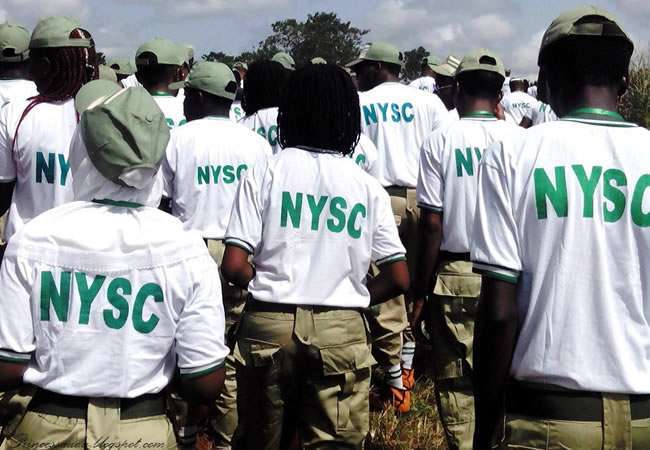
Six members of the National Youth Service Corps (NYSC) have received a total of N10 million in grants to expand their agribusiness ventures under the Farmers for the Future Programme.
The programme was organised on Monday by the British American Tobacco Nigeria Foundation (BATNF) in collaboration with the NYSC to encourage young Nigerians to embrace agriculture and develop sustainable businesses.
Presenting the cheques to the beneficiaries in Abuja, the NYSC Director-General, Brigadier General Olakunle Nafiu, urged Corps members to maximise the opportunities provided by the service year by venturing into commodity marketing and other viable businesses.
Nafiu said agribusiness remained a viable avenue for young people to build sustainable enterprises, create employment and generate wealth.
READ ALSO: NYSC Swears In 1,600 Corps Members In Bauchi
He also stressed the importance of value addition to the success and sustainability of business ventures, while commending BATNF for placing Nigerian youths at the centre of its entrepreneurship initiatives through value-chain development, employment creation and its partnership with the NYSC.
“I charge you to spread the news around. We have seen the outcome, and it is a good idea,” he said.
The beneficiaries are Dominic Olufemi (FC/25C/1143), who received N3 million; Temitope Adewole (ED/26A/2251), N2 million; Abdulwaheed Bala (ED/25B/1402), N2 million; Olanike Mayungbe (OG/26B/1037), N1 million; Kingsley Udoeyen (KG/26A/1735), N1 million; and Lorember Lorsue (JG/25B/1742), N1 million.
Speaking on the selection process, the Acting Director, Skills Acquisition and Entrepreneurship Development (SAED), Mrs Winifred Shopeka, said the programme began with an online registration portal through which Corps Members engaged in agribusiness submitted their business plans.
READ ALSO: NCCSALW Deploys NYSC Members In Fight Against Illegal Arms In Northeast
She said nearly 3,000 Corps members applied and underwent a rigorous selection process that produced 20 finalists.
According to her, the finalists participated in a boot camp and a final pitching session, which produced the 10 best presenters before the six ultimate winners were selected.
Shopeka said the beneficiaries had also been mentored and attached to established market operators to assist them in marketing their products.
She added that Corps Members who did not make the final stage of the competition were also trained by BATNF.
The BATNF Team Lead, Mr Oludare Odusanya, congratulated the beneficiaries and urged Corps Members engaged in agribusiness to master the fundamentals and acquire the knowledge and skills necessary to succeed.
“We are happy with our collaboration with the NYSC, and it will continue,” he said.
READ ALSO: NYSC Lauds Gov. Mohammed’s Intervention In Fence Collapse
Odusanya explained that BATNF was an independent organisation established to contribute to poverty reduction in Nigeria through sustainable agricultural practices and other interventions.
He said the Farmers for the Future Programme was instituted in collaboration with the NYSC to encourage Corps Members to venture into agribusiness and become job creators.
He added that the beneficiaries would be attached to mentors who would guide them towards achieving success in their respective businesses.
According to him, the programme has, since its inception, continued to enhance the entrepreneurial capacity of Corps Members.
News
CBN Reduces Interest Rate To 23%

The Central Bank of Nigeria (CBN) on Tuesday announced the reduction of the interest rate, also known as Monetary Policy Rate (MPR) to 23 percent.
Briefing the media in Abuja, the Governor of the CBN, Mr. Olayemi Cardoso, said at the 307th MPC meeting held on September 22, 2026 agreed the resetting of the MPR and recaliberation of the monetary policy market.
According to Cardoso, the committe is satisfied with the disinflation progress, adding that members noted stable banking sector following successful recapitalisation.
READ ALSO: CBN Monetary Tightening Worsening Nigeria’s N50tn Development Finance Gap – Group
Meanwhile, according to Nigerian Tribune, reports that that the MPC, at its 306th meeting in July 2026, disclosed its resolution to retain the interets at 26.5 percent.
According to the Governor of the CBN, Olayemi Cardoso, “the Committee’s decision to maintain the current policy stance followed a thorough assessment of the balance of risks. Although headline inflation moderated marginally in June 2026, global uncertainties have heightened, due mainly to the renewed hostilities in the Middle East.
“In view of the evolving developments, maintaining a cautious monetary policy stance remains appropriate. In arriving at its decision, the Committee noted the recent resurgence of hostilities in the Middle East, with particular attention to its spillover effects on global energy prices and the potential pass-through to domestic inflation.”
News
NURTW: KWAM1 Settles Long-time Rift Between MC Oluomo, Tafa Sego
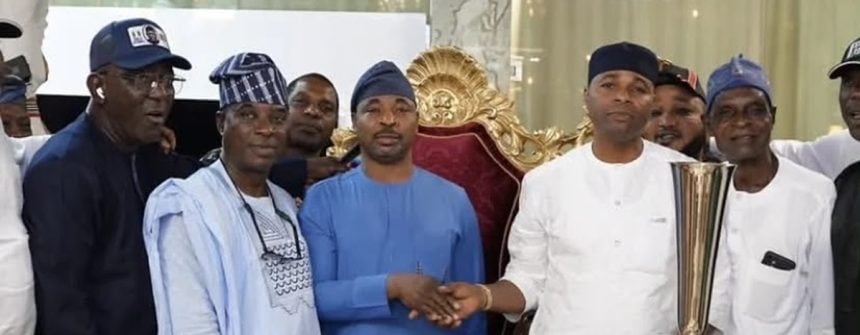
Nigerian Fuji musician, Wasiu Ayinde Marshal, popularly known as KWAM1, has brokered a peace deal between the National Union of Road Transport Workers (NURTW) National President, Musiliu Akinsanya, popularly known as MC Oluomo, and the Lagos State Chairman of the union, Mustapha Adekunle, aka Tafa Sego.
The reconciliation took place at Ojusagbola in Ijebu, Ogun State, where several NURTW chieftains gathered for the meeting.
The development was announced on Tuesday on KWAM1’s digital media page on Instagram, alongside photographs from the meeting.
According to the post, the two union leaders have resolved their differences after years of strained relations.
READ ALSO: Why FG Named KWAM 1 Aviation Security Ambassador — Keyamo
“After years of an age-long rift, MC Oluomo and Tafa Sego have finally settled their differences. And from what we know now, this is final,” the post said.
The musician was said to have intervened as the Mayegun of Yorubaland, with the aim of bringing an end to the longstanding disagreement between the two NURTW figures.
“K1 acted in his role as the Mayegun of Yorubaland by seeking an end to the long-standing rift, once and for all,” it said.
The post also described the meeting as a significant step beyond previous public displays of reconciliation.
READ ALSO: FG Gives KWAM 1 Aviation Appointment, After Airport Incident
“This time, it was not just another handshake for the cameras. The two old friends and colleagues came together at Ojusagbola, with King Wasiu Ayinde Marshal (K1) playing the peacemaker.”
Both MC Oluomo and Tafa Sego were reported to be pleased with the outcome of the intervention.
“Both parties are delighted about the new development,” the post said.
The two men had previously been allies and prominent figures within the Lagos NURTW before their relationship became strained amid disagreements linked to leadership of the union in the state.

 News1 day ago
BREAKING: Tinubu Extends Working Vacation
- News3 days ago
Six Hidden Health Benefits Of Unsweetened Zobo
- News4 days ago
Edo: Council Chairman Under Fire For Threatening Commercial Drivers Who Refuse To Wear APC Insignia
- News4 days ago
Edo: Ekpeson Redeems N20m Pledge To Family Of Fallen Soldier
- News3 days ago
2027: Step-by-step Guide To Applying For INEC Ad Hoc Staff Recruitment
- News4 days ago
OPINION: Nigerian Pastors, Imams And Their Sex Sermon Obsession
- News3 days ago
Jehovah’s Witnesses Announce New Position On Blood Transfusion Policy
- News4 days ago
Otuaro Harps On Academic Excellence As Another 31 PAP Scholarship Beneficiaries Leave For UK
- News3 days ago
How 36 Nigerian States Got Their Names
- News4 days ago
Malnutrition: US Support Reaches Over 40,000 Children In Bauchi — UNICEF


