
News
OPINION: ‘Our Doc, Who Art In The National Palace’

On April 23, 1971, the New York Times did a feature on Haitian tyrant, Francois Duvalier, infamously known as Papa Doc. It reported Duvalier as getting Haitian children indoctrinated with a political catechism which parodied Christians’ The Lord’s Prayer, thus: “Our Doc, who art in the National Palace for life, Hallowed be Thy name by present and future generations. Thy will be done at Port‐au‐Prince and in the provinces. Give us this day our new Haiti and never forgive the trespasses of the anti patriots who spit every day on our country; let them succumb to temptation, and under the weight of their venom, deliver them not from any evil . . .”
Since the antonym of democracy is autocracy, is Nigeria sliding into autocracy? Ex-President Olusegun Obasanjo didn’t explicitly say so but believes democracy is dead in Nigeria. Peter Obi shared same view. At a symposium to mark the 60th birthday of former Deputy Speaker of the House of Representatives, Hon Emeka Ihedioha, Obasanjo proclaimed the death of democracy, not only in Nigeria but Africa. In 2008, in an assessment of the state of democracy in Africa, Larry Diamond, American political sociologist and scholar who specializes in democracy studies, submitted that, “the statistics (of the practice of democracy in Africa) tell a grim story.” I will visit these grim statistics presently. Argentine economist, Danielçccc Kaufman and his colleagues at the World Bank, developed six measures with which we can assess the quality of democracy in any country. Africa, Nigeria recorded dismal failure in virtually all of them.
One of the measurements is, voice and accountability. Voice entails freedom of expression and citizen participation in governance. In other words, governmental tolerance for dissent is a major kernel of democracy. In the fawning stampedes by Delta State government apparati last week to defend federal power, you can glean the enveloping tyrannic character of the current Nigerian state. Officials of government had earlier fought mere Nursing school girls’ tantrums in the “See your Mama” viral video against First Lady Remi Tinubu in Asaba. You would think it was a world war. Though minute and seemingly insignificant, but for immediate massive responses on social media, threats to deal with the students would have been activated. I will cite a historical example of tolerance for dissent that showcases the Asaba attempt to silence voices as indicative of undemocratic attitude.
At the Adeseun Ogundoyin Polytechnic convocation lecture I delivered in 2022 with the title, Re-inventing polytechnic education for 21st-century Nigeria, I cited the example of the first civilian governor of Oyo State, Chief Bola Ige. Sometime between 1979 and 1983, Ige had visited the Ibadan Main Campus of the polytechnic. In their characteristic tantrums, the students became rude and uncontrollable. In an unsparing tongue-lash characteristic of the man widely credited for his lingual exceptionalism, the governor landed the students a fusillade of vitriolic attack. He said: “I am happy your Rector is a holder of a PhD in Animal Science; he will apply it on all of you!” Decency will not permit the reproduction here of the vile and insulting reply, laced with thunderous howls and delivered as a song, with which the students replied Ige. Not long after, some primary school pupils paid Ige a courtesy visit. He ostensibly saw it as an opportunity to even the score. So, in advising the pupils on their life trajectory, the governor told them that whilst walking towards Sango, a street in the capital city, (as metaphor for furthering their education) rather than make a detour towards Ijokodo, (where Ibadan Polytechnic is located) they should rather go straight to Ojoo. Ojoo is the route that leads to the University of Ibadan. That was where it ended. No institutional sanction against Ibadan Poly students.
MORE FROM THE AUTHOR: OPINION: MultiChoice’s Price Hike
Last week, Nigeria erupted in discussions on whether the practice of democracy in Africa, Nigeria had failed. Though concerns about democracy in Nigeria predate Bola Tinubu, they have reached feverish pace today. As we speak, the name Natasha Akpoti-Uduaghan is almost becoming a legislative history in Nigeria. In our very before, a dalliance of senatorial leadership impunity, in cahoots with Kogi government’s democratic irreverence, is about to produce a sour broth that Nigerians will be forced to swallow. The only recourse the people have is to look skywards, with tears coursing down their cheeks and mutter, “Let them cover themselves with the shroud of a thick mortar after shooting an arrow into the sky; if the king of this earth does not apprehend them, the King in heaven surely will.”
In the same vein, a few weeks ago, an NYSC member who complained about the deteriorating state of Nigerians’ well-being was threatened into submission. I submit that the Asaba event and an earlier Seyi Tinubu’s quest to turn his father into the father of Nigeria in Adamawa State are fatherlizing and motherlizing attempts which are no happenstances. It is the beginning of the mutation of the cells of the opposite of democracy. Duvalier pioneered this seemingly benign misbiology in Haiti. At the beginning of his tyranny, he got his own Villaswill Akpabio-led rubber‐stamp legislature to proclaim him as “Spiritual Father of the Nation.” In the capital city, Port‐au Prince, Duvalier ordered “spontaneous” demonstrations of affection towards him, as it is done on the social media today where thousands of largely illiterate and desperately poor Haitians were tricked to frenziedly scream, “Du‐val‐yeah!” and “Viva Papa Doc!”
The federal government’s infamous odyssey in Rivers State in close to two years now is perceived by watchers of Nigeria’s tottering democracy as a manifestation of a totalitarian tendency. Its cells will spread presently. When they do, we will all be in trouble. The recent tactic was to make a Bukar Suka Dimka of Rivers’ ex-Head of Service, George Nwaeke and claim that he was a witness to suspended governor, Siminalayi Fubara’s alleged treasonable plan to bomb oil installations. The ultimate script is to finally try Fubara for treason. Dimka, you will recall, was the coup plotter who, after his capture in March, 1976, sang like canary to implicate, among others, Major General Illiya Bisalla. His claims were never corroborated, leading to Bisalla’s execution. The viral video of Nwaeke’s wife which affirmed a guerrilla capture of her husband by federal forces so as to incriminate Fubara must have let Nigeria into the window of a frightening re-calibration of Duvalier in Nigeria. Robert Mugabe didn’t just leap into tyranny; he grew, like a mustard seed, into it.
MORE FROM THE AUTHOR: OPINION: Nasir El-Rufai And The Philosophy Of Nothing
A cartoon which went viral last week explains the configuration of Nigeria’s present “democracy”. A man with huge double pockets, depicted as “executive,” had inside the pockets castrated urchins tagged as “legislature” and “judiciary”. To explain this unholy matrimony, ex-vice President Atiku Abubakar did away with niceties and diplomatese that are the handmaidens of Nigerian politicians. The Senate President and the National Assembly, he pronounced, are compromised and corrupt. To corroborate Abubakar and the newspaper cartoon, a little over a week ago, taciturn President Goodluck Jonathan drew his own cartoon strokes of the current state of Nigeria’s “democracy”. He accused the three arms of government as being a tripartite axis of evil who were complicit in the Rivers imbroglio. He said: “No businessman can bring his money to invest in a country where the judiciary is compromised; where government functionaries can dictate to judges what judgment they will give.” Jonathan deployed an Indian version of a Yoruba anecdote that illustrates a Nero fiddling while Rome was burning. It tells the story of someone falsely simulating sleep who the Yoruba call Apiroro. The Apiroro is always difficult to wake up. Jonathan’s summary of the power calculus on the Rivers crisis is that, “They are pretending to sleep and waking up such a person is extremely difficult.”
While the typhoon of illicit relationship between the three arms of government was yet raging, a photograph of Supreme Court Justice Emmanuel Akomaye Agim and Minister of the Federal Capital Territory, Nyesom Wike, at the University of Calabar’s Golden Jubilee Special Convocation surfaced on the social media. Immediately I saw it, my mind went to Justice Olumuyiwa Jibowu (1899 – 1959). Jibowu was a fierce judge. The first African to serve in the Supreme Court of Nigeria, first Nigerian High Court Judge and one-time Chief Justice of the Western Region, Jibowu demonstrated that there must never be any unholy concourse between a judge, a lawyer who has matter before him and litigants. He once demonstrated this while he was Judge in the Ondo High Court. Counsel in a matter before him and Federal General Secretary of the Action Group Party, Ayotunde Rosiji, was slated to appear before him sometime in the early 1950s. They were both acquainted as Jibowu had paid Rosiji a visit when the latter came back from his legal studies in Britain. So, the evening before he was to appear before him, Rosiji decided to visit Jibowu in his home. Renowned for his uprightness and probity, though Justice Jibowu attended to Rosiji, when he was to deliver his judgment, he lifted up a sheaf of papers for all to see, which he said was a copy of the judgment he had stayed all night to write. Then, to the shock of everyone, the judge tore the papers into shred. All because counsel to one of the parties had come to see him in his house.
Former Chairman of the National Human Rights Commission (Nigeria), Prof. Chidi Odinkalu, in his anger at this anomaly, cited an earlier pronouncement of such public togetherness as incestuous by Justice Niki Tobi. In his ruling in Buhari vs. Independent National Electoral Commission & Ors (2008), the late Supreme Court Justice warned that “The two professions (law and politics) do not meet and will never meet at all in our democracy… If they meet, the victim will be democracy, and that will be bad for sovereign Nigeria.”
MORE FROM THE AUTHOR:OPINION: Now That Natasha Has Made Akpabio Happy
Let me illustrate the calamity that Justice Tobi foretold with the market. Like any human endeavour, the market has a philosophy. It is constituted by a tripod: the brick and mortar stalls (Oja), marketers (pate-pate) and traders (Onina’ja). On market days, when merchants advertise their merchandise, the soul of the market is not the merchants nor their merchandise. It is the market, which is the people, the traders or the Onina’ja. So, when the market is over, you may see merchants and their merchandise or even the stalls but the soul of the market is gone (oja ti tu). So it is in a democracy. The moment a democracy harbours a complicit judiciary, an adulterous legislature in bed with the executive, the way President Jonathan painted it, the market is over. What is left are mere wares and merchandise (T’oja ba ti tu, a ku pate-pate). When you look, you see democracy on paper, the way you see a mass of quills and feathers on a masquerade, when, in actual fact, the masquerade is long gone. Late dramatist Hubert Ogunde verbalized this flight of democracy when he sang in Yoruba, “Iye l’e o ma wo l’eyin eye o….”
Nigeria’s situation today can be compared to Senegal’s under Abdoulaye Wade. With Wade, rather than rule of law, it was rule of person, otherwise called personal rule. A longtime Senegalese opposition leader, when Wade won the presidency in 2000, as many did in the current government, hopes were quite high for democracy in Senegal. Rather than this, however, Wade drew power and resources to himself and those of his family. By 2007, criticisms from journalists, political activists, singers, and marabouts (Muslim spiritual leaders) or any word from the opposition earned physical intimidation from his goons. Last week, as riposte to Peter Obi’s criticism of present slide towards autocracy, Nigerian presidency told him that, that he could talk freely was a presidential grace. Today, Nigeria grapples with a lackluster economic performance just like under Wade. The Senegalese leader also, like here in Nigeria, mobilized support, according to Larry Diamond, by corrupting and co-opting “religious figures, civil society leaders, local administrators, military officers… with money, loans, diplomatic passports, and other favors.”
Said a responder to Diamond, “He has destroyed all the institutions, including political parties. He has taken opposition with him and manipulated the parliament. People are so poor and Wade controls everything. If you need something, you have to go with him.” Nigerians must see themselves in that Wade mirror.
Apart from the above indices, there are other measurements of the state of health of a democracy. They include political stability (absence of violence), government effectiveness (of public services and public administration), quality of government regulation, the rule of law. Recourse to violence as means of settling social discord has risen in Nigeria and governments are absent in the lives of the people, leading to self-help. The Uromi, Edo State incineration of travelling northerners is on my mind here. Though another famous theorist of democracy, Richard Sklar, in his “Democracy in Africa” (1983): African Studies Review, Vol. 26, No. 3/4, said “democracy dies hard,” he also submitted that it could “bleed and die” on the altars of repressive rule and lack of accountability. He concluded by saying, “The true executioner of democracy has neither sword nor scepter, but a baneful idea.”
In Nigeria today, democracy might not have died but its balance sheet is scary. Democracy is not in periodic elections, appointments into offices or its persistent mouthing like a refrain. Democracy is about the people. Obasanjo made this known at the Ihedioha colloquium. When, rather than the people, a small clique of politicians are sole beneficiaries of democracy and there is this mass of misery, what we have can better be described as politicians-cracy. There is a regression of democratic culture in Nigeria and hunger is blanketing Nigerians. Human development statistics regress daily, life expectancy is nosediving while dismal level of governance and violent conflicts seize our country by the jugular.
The good news is that, Larry Diamond said that democracy cannot die. He, however, imputed that it could suffer fatal seizures. It is obvious that today, the Nigerian democracy is gasping for breath.



News
Children’s Day: Chaos At Ogbe Stadium As Dozens Faint

Chaos erupted on Wednesday during the Children’s Day celebration as dozens of students reportedly collapsed following a stampede triggered by the use of pepper spray.
The event,
organised by the Edo State Ministry of Education at the Samuel Ogbemudia Stadium was disrupted after some male students of Ihogbe College allegedly made uncompromising advances towards female students at the venue.
A parent who identified himself as Oboh Emmanuel said, “the behaviour of those uncultured students attracted the attention of bouncers stationed at the stadium as they rebuked the male students.”
Oboh said the affected students later regrouped and attacked the bouncers, leading to a confrontation within the crowded arena.
READ ALSO:Children’s Day: Edo Commits To Child Protection
It was gathered that in the ensuing confusion, the bouncers were reported to have deployed pepper spray in an area occupied by a large number of students.
Several students, particularly female students, reportedly fainted after inhaling the substance, while others sustained injuries after being stepped on during the ensuing melee.
The panic was said to have spread across the stadium as students, teachers and parents scampered for safety.
Many of the affected students were reportedly rushed to the Edo Specialist Hospital for medical attention.
READ ALSO: Egor LG Chair, Ogbemudia, Vice, Osawe Impeached
Reacting to the incident, Chief Press Secretary to Governor Monday Okpebholo, Dr Patrick Ebojele, said the security personnel that fired the tear gas had been detained.
He said all the students, except two, that were rushed to the hospital have been discharged.
Ebojele stated that doctors wanted to observe the students till tomorrow before allowing them to go home.
“The two students are not seriously injured. Doctors want to observe them overnight. Permanent Secretary, Ministry of Education is still at the hospital. The man who used pepper spray has been detained.
“The incident did not happen the way it is being exaggerated. All modalities were put in place to ensure the children enjoyed their day.”
News
Okpebholo Salutes Edo Muslims, Seeks Continued Support, Prayers
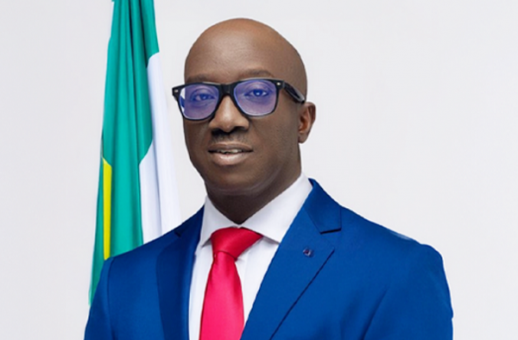
Governor Monday Okpebholo of Edo State has urged Muslims and all Nigerians to continue to pray for peace, unity and progress in the country even as they celebrate the annual Eid-al-Adha
The governor, who was represented by his deputy, Dennis Idahosa, stated this during the annual Eid-al-Adha celebration with Muslim faithfuls held at Government House in Benin City.
He reiterated his administration’s commitment to fairness, inclusivity and equal opportunities for all citizens irrespective of religion and tribe.
READ ALSO:ADC Penetrates Okpebholo’s District As Defections Strengthen Party in Edo Central
According to him, the present administration remains determined to building a government that reflects the diversity of Edo State, noting that competent and qualified Muslims have continued to play vital roles in his government because of their capacity, integrity and commitment to service.
“As a government, we remain committed to fairness, inclusivity and equal opportunity for every Edo citizen, irrespective of religion, ethnicity or political affiliation. This is why quality and competent Muslims are serving in key positions in our administration.”
Okpebholo appreciated the Muslim community in Edo State for their unwavering support and continuous prayers for his administration, noting that such prayers and support have contributed immensely to the peace and steady development being witnessed across the state.
READ ALSO:Okpebholo Felicitates Muslims On Eid-el-Fitr Celebration
He then called on all Nigerians to use the occasion of Eid-al-Adha to pray for the administration of President Bola Ahmed Tinubu, stressing that the country needs collective prayers, unity and cooperation to overcome its present economic and security challenges.
“I urge all Muslims and indeed all Nigerians to use this occasion to pray for our dear nation and for the administration of President Bola Ahmed Tinubu. Nigeria needs our collective prayers, unity and support as we strive to overcome our challenges and build a more prosperous future for all.”
In his remarks, the Chief Imam of Edo State, Abdulfatai Enabulele, applauded the governor for what he described as remarkable developmental strides recorded in less than two years in office.
The cleric commended the administration for ongoing infrastructural development and efforts geared towards improving governance in the state, but appealed to the government to revisit and complete some abandoned projects inherited from the previous administration for the benefit of the people.
News
Children’s Day: Edo Commits To Child Protection
The Edo State Government has reaffirmed its commitment to protecting the rights of children, promoting quality education, and strengthening sports development across the state.
This assurance was given by the governor of Edo State, Monday Okpebholo, during the 2026 Children’s Day Celebration and Governor’s Cup Finale held on Wednesday at the Samuel Ogbemudia Stadium, Benin City.
Addressing pupils, students and teachers,
the governor described children as the pride of Edo State and the future of the nation.
The governor, represented by his deputy, Dennis Idahosa,
noted that the annual celebration provides an opportunity to honour their dreams, talents, and limitless potential.
READ ALSO:Eid-el-Kabir: Edo Deputy Gov Solicits prayers For Okpebholo
Speaking on this year’s Children’s Day theme, “Choose Kindness, Reject Bullying,” the governor said the message was timely and significant, as it emphasizes the need to create safe, supportive, and inclusive environments for children both in schools and communities.
He stated that bullying in all forms — physical, verbal, emotional, or online — has no place in society, adding that the Edo State Government remains fully committed to protecting the rights and dignity of every child.
According to him, the administration will continue to strengthen policies and programmes that promote child protection, discipline, mutual respect, and positive learning environments across schools in the State.
The governor urged children to embrace kindness, compassion, teamwork, and respect for one another, stressing that true strength lies not in intimidation but in empathy, good character, and mutual understanding.

 Metro5 days ago
My Husband Abandoned Me On Our Wedding Night To Attend Political Meeting, I Want Our Marriage Dissolved
- Headline4 days ago
Woman Passes Out After Receiving 100 Strokes Of Cane
- Headline4 days ago
JUST IN: White House Locked Down Briefly As Gunman Opens Fire At Security Checkpoint
- Politics3 days ago
Two Masked Men Gun Down Politician In His Rivers State Hotel
- Politics5 days ago
Warri Ijaw Hail INEC Delineation Report, Call For Additional Electoral Wards, Others
- News3 days ago
More Pain For Nigerians As Cooking Gas Price Increases Nationwide
- News5 days ago
Alleged Terrorism: Court Rejects Defendant’s Bid To Travel Abroad
- Metro5 days ago
My Wife Stop Cooking My Food, Beats Me Black And Blue All the Time, Man Tells Court
- News3 days ago
FG Declares Two Days Public Holiday For Eid-el Kabir Celebration
- Politics5 days ago
What I’ll Do As President Of Nigeria — Amaechi


