
News
OPINION: Sending Ooni Of Ife To Tinubu

By Lasisi Olagunju
One day, I will have the courage to ask the immaculate Ooni of Ife, Oba Enitan Ogunwusi, how he feels each time he travels on the horrible Ibadan-Ife road. Ben Okri, ‘The Famished Road’ storyteller, finds his own ‘road’ a torment – he says it “leads home and then away from it, without end.” Okri thinks the road a torment because he meets it “with too many signs and no direction.” The Ife-Ibadan road has signs, it has directions – and I find them very treacherously significant because they interlock fingers while road users lose life and limbs. The road has signs and directions to the very bowel of hell.
Olojo, the guardian divinity of the House of Oduduwa, is the famed owner of two machetes: with one machete, he prepares the field for the plants of tomorrow; with the other, he clears the road for prosperity (Ó fì’kan sán’ko/ Ó fì kan yè’nà). Those weapons must either now be blunt or lost. An Odu Ifa tells us something about Ile Ife and roads. It affirms that well-paved open roads start from Ile Ife. That affirmation today can only be treated on the operating theatre of irony. Could it be that truth has an expiry date and Ogbe’s truth of good, open roads in Ile Ife has expired? What we see today from the capital of Yorubaland (Ibadan) to the historical source of Yoruba people is the torment of a closed road that mocks the pathfinder-spirit of Oduduwa. The road does worse with its gaping craters and their threats of morphing into greater gullies. And it is a federal road.
Has the Ooni ever told the president that the worst road in the universe leads to his kingdom? Has he told the president that the N79.8 billion contract for the reconstruction of Ibadan-Ife-Ilesa road awarded in September, 2019 by his friend and villa mate, Muhammadu Buhari, has remained a contract for ghosts? Has he invited the president’s attention to the truth that since last year when he took over, the road has sunk even deeper in the mire of decrepitude? And, that even FERMA, a perennially rich agency that pretends giving palliatives on federal roads, has since seen the futility of stitching this rag? Or could it be that Kabiyesi does what our presidents since 1999 do – escaping road users’ pains by flying over our heads?
FROM THE AUTHOR: OPINION: Bobrisky’s Masque, Yahaya Bello’s Boa
The reigning culture here is rooted in the ragged soils of our toil. I admit that badness is not peculiar to the Ife-Ibadan-Ilesa road. It is a national affliction that can’t be cured because of the greed of doctors who treat sick roads with fake and expired drugs.
We work hard to build roads that wear out before they are inaugurated. We have the interminable construction mess called Lagos-Ibadan Expressway. When did construction start there? When will it end – if it will ever end? How much have we sunk there? And, is it not a shame that the road is ready already for corrective surgery even before its makers are done making it? If you are a woman, and you are pregnant and your doctor tells you dancing is a ‘safe and fun way to exercise’, do not dance to the break beats of that road. It is made for abortion.
Ben Okri says “all roads lead to death” and “some roads lead to things which can never be finished.” Is that why our federal government’s roads are forever ongoing, none is ever finished or completed? Federal government’s statistics says out of Nigeria’s national road network of 200,000 kilometers, 36,289 km belong to it. Now, you ask Abuja which of its other roads, apart from the one from the Villa to Abuja airport, is good? Ask them why almost all roads that wear federal tags suffer neglect, abandonment or crass abuse.
My NYSC journey to the far north 34 years ago was on the Ibadan-Ilorin-Jebba-Mokwa-Yauri road. It was an experience in pleasantness. It is, today, a monument to frustration, a shrine to demons that feed on losses -human and material. The Ibadan-Oyo-Ogbomoso part of that road is one major reason why Nigeria should not have a federal government – or have roads managed by the Federal Government. There should be a coroner’s inquest on why that road was killed and who killed it. Without the states, the vehicle of Nigeria would have long lost its chassis. States keep doing what heart surgeons do when arteries are found blocked. They create bypasses, byways. A brand new 78-kilometre Iseyin-Ogbomosho road has just been built by Seyi Makinde’s Oyo State to escape the Federal Government’s death trap along that axis. A commenter online wrote: “The road has helped us to link northern Nigeria without using the dangerous Oyo-Ilorin road that has consumed so many lives…” The Oyo-Ilorin road of death spoken of here belongs to the government in Abuja.
FROM THE AUTHOR: OPINION: For Yoruba Muslims And Pentecostals
Potholes jolt us to appreciate what bad roads represent in our lives. They tell us why the tyres of our country never last and why our rides are forever bumpy. Asking questions on why our roads are perennially bad is living the times of Ayi Kwei Armah’s ‘Two Thousand Seasons’: “A thousand seasons wasted wandering amazed along alien roads, another thousand spent finding paths to the living way.” Like Ouroboros, the self-tail-devourer, Nigeria’s ‘alien roads’ cyclically keep consuming the ‘living way.’
It is time to pound yam for the household, the idler among us goes for the heaviest pestle. This is better said in Yoruba: Òle bàá tì, ó gb’ódó nlá. There are abandoned federal roads everywhere which directly affect millions of Nigerians, but the government has moved the money to a 700km super coastal highway that will cost N15.6 trillion. The first phase is 47 kilometres, starting somewhere and ending nowhere, at a cost of N1.06 trillion. Should I just say that that N1 trillion will start and complete the reconstruction of decrepit Ibadan-Ife-Ilesa Road (224km), Ilorin to Bida (244.9km) and Shagamu to Benin (492km) if wisdom wills? Even at an inflated cost of N1 billion per kilometre, our husbands will achieve these and will even ‘collect change’. And Tinubu would have become very popular with it. But he wants a white elephant and has moved our money to purchase it.
White elephants are always expensive! Poet and journalist, Mathew Wills, in his ‘The Original White Elephant’ defines ‘white elephant’ as “something excessive that turns out to be valueless.” James A. Robinson and Ragnar Torvik in 2005 published an interesting article about the third world and deliberate bad investments – they titled their article: ‘White Elephants’. In that piece, they hold that politicians around here would always go for “white elephants” as against “socially efficient projects” because “the political benefits are large compared to the surplus generated by efficient projects.” That piece says much more than this. It is published in the Journal of Public Economics 89 (2005: 197-210). I think you should read it.
‘The Stolen White Elephant’ by Mark Twain is an interesting story on the cost of investing in big, expensive loss centres. It is the story of a fictional Kingdom of Siam. A reviewer says Siam is blessed with a “national appetite for fraud”. Another says it has officers of “pompous assumption of infallibility and ridiculous inappropriate procedures.” The “pointless” story is about an expensive search for a stolen white elephant, a further loss of hundreds of thousands of dollars in compensation and the eventual discovery of the rotting corpse of the supposedly stolen animal. The story ends with the duped narrator celebrating the man who duped him. It ends as the man pronounces himself “a ruined man and a wanderer in the earth.” In Studies in American Humour, Peter Messent (1995) does a lot of justice to it in his ‘Keeping Both Eyes Open.’ The whole story sounds Nigerian; what Fela called “expensive shit.” But I can argue that though we wander today, the past was a better experience.
FROM THE AUTHOR: OPINION: FG’s N90 Billion Hajj Politics
“How can you develop a country rapidly if you can’t get about it?” Sir Rex Niven, pre-independence Speaker of Northern Nigeria House of Assembly, asked that question 69 years ago in relation to the state of roads in Nigeria. On January 27, 1955, Riven was asked to brief the Royal African Society and the Royal Empire Society in London on “Recent Developments in Nigeria.” He gave a very detailed account of himself as a British participant in the affairs of a key component of the Nigerian federation. Sector by sector, he spoke about efforts and failures. He particularly spoke on roads which he described as “the most important of the great aspects of development.” He said as he was speaking (in 1955), Nigeria had over 30,000 miles of roads whereas in 1920, “she had hardly any at all.” Then he used Kabba (in present Kogi State) to illustrate what he was saying: “The first province I went to, the newly constituted Kabba Province, had exactly 4 miles of road…but when I left Kabba four years later, there were over 200 miles of road.” Thirteen years later, the same Niven, in retirement, told the Commonwealth section of the Royal African Society on 11 November, 1969 that Nigeria had 40,000 miles of quality roads. That figure was even in spite of the ongoing civil war. Now, you ask: Why are our golden years always in the past? The past was obviously better handled.

News
Six Corps Members Receive N10m Grants To Boost Agribusiness
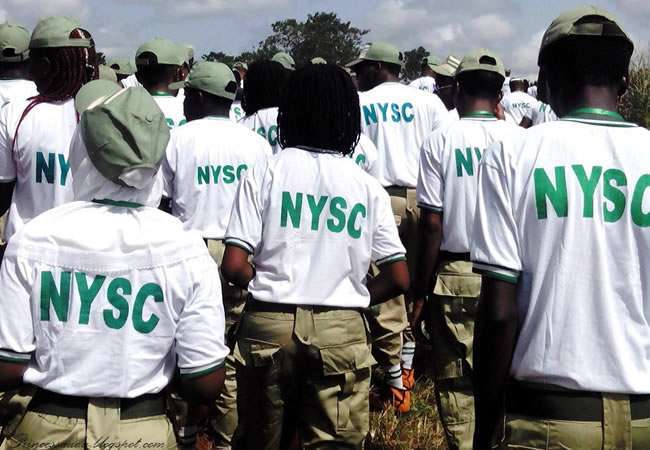
Six members of the National Youth Service Corps (NYSC) have received a total of N10 million in grants to expand their agribusiness ventures under the Farmers for the Future Programme.
The programme was organised on Monday by the British American Tobacco Nigeria Foundation (BATNF) in collaboration with the NYSC to encourage young Nigerians to embrace agriculture and develop sustainable businesses.
Presenting the cheques to the beneficiaries in Abuja, the NYSC Director-General, Brigadier General Olakunle Nafiu, urged Corps members to maximise the opportunities provided by the service year by venturing into commodity marketing and other viable businesses.
Nafiu said agribusiness remained a viable avenue for young people to build sustainable enterprises, create employment and generate wealth.
READ ALSO: NYSC Swears In 1,600 Corps Members In Bauchi
He also stressed the importance of value addition to the success and sustainability of business ventures, while commending BATNF for placing Nigerian youths at the centre of its entrepreneurship initiatives through value-chain development, employment creation and its partnership with the NYSC.
“I charge you to spread the news around. We have seen the outcome, and it is a good idea,” he said.
The beneficiaries are Dominic Olufemi (FC/25C/1143), who received N3 million; Temitope Adewole (ED/26A/2251), N2 million; Abdulwaheed Bala (ED/25B/1402), N2 million; Olanike Mayungbe (OG/26B/1037), N1 million; Kingsley Udoeyen (KG/26A/1735), N1 million; and Lorember Lorsue (JG/25B/1742), N1 million.
Speaking on the selection process, the Acting Director, Skills Acquisition and Entrepreneurship Development (SAED), Mrs Winifred Shopeka, said the programme began with an online registration portal through which Corps Members engaged in agribusiness submitted their business plans.
READ ALSO: NCCSALW Deploys NYSC Members In Fight Against Illegal Arms In Northeast
She said nearly 3,000 Corps members applied and underwent a rigorous selection process that produced 20 finalists.
According to her, the finalists participated in a boot camp and a final pitching session, which produced the 10 best presenters before the six ultimate winners were selected.
Shopeka said the beneficiaries had also been mentored and attached to established market operators to assist them in marketing their products.
She added that Corps Members who did not make the final stage of the competition were also trained by BATNF.
The BATNF Team Lead, Mr Oludare Odusanya, congratulated the beneficiaries and urged Corps Members engaged in agribusiness to master the fundamentals and acquire the knowledge and skills necessary to succeed.
“We are happy with our collaboration with the NYSC, and it will continue,” he said.
READ ALSO: NYSC Lauds Gov. Mohammed’s Intervention In Fence Collapse
Odusanya explained that BATNF was an independent organisation established to contribute to poverty reduction in Nigeria through sustainable agricultural practices and other interventions.
He said the Farmers for the Future Programme was instituted in collaboration with the NYSC to encourage Corps Members to venture into agribusiness and become job creators.
He added that the beneficiaries would be attached to mentors who would guide them towards achieving success in their respective businesses.
According to him, the programme has, since its inception, continued to enhance the entrepreneurial capacity of Corps Members.
News
CBN Reduces Interest Rate To 23%
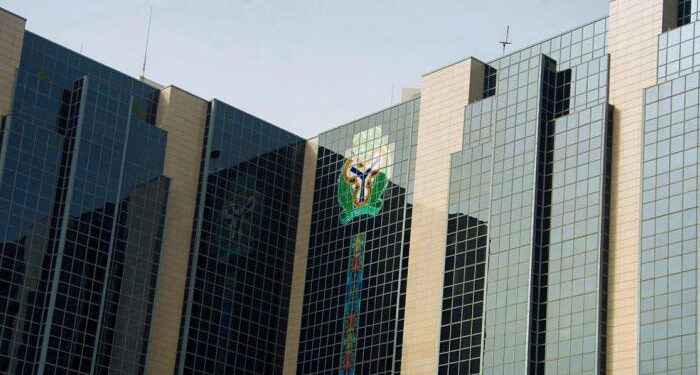
The Central Bank of Nigeria (CBN) on Tuesday announced the reduction of the interest rate, also known as Monetary Policy Rate (MPR) to 23 percent.
Briefing the media in Abuja, the Governor of the CBN, Mr. Olayemi Cardoso, said at the 307th MPC meeting held on September 22, 2026 agreed the resetting of the MPR and recaliberation of the monetary policy market.
According to Cardoso, the committe is satisfied with the disinflation progress, adding that members noted stable banking sector following successful recapitalisation.
READ ALSO: CBN Monetary Tightening Worsening Nigeria’s N50tn Development Finance Gap – Group
Meanwhile, according to Nigerian Tribune, reports that that the MPC, at its 306th meeting in July 2026, disclosed its resolution to retain the interets at 26.5 percent.
According to the Governor of the CBN, Olayemi Cardoso, “the Committee’s decision to maintain the current policy stance followed a thorough assessment of the balance of risks. Although headline inflation moderated marginally in June 2026, global uncertainties have heightened, due mainly to the renewed hostilities in the Middle East.
“In view of the evolving developments, maintaining a cautious monetary policy stance remains appropriate. In arriving at its decision, the Committee noted the recent resurgence of hostilities in the Middle East, with particular attention to its spillover effects on global energy prices and the potential pass-through to domestic inflation.”
News
NURTW: KWAM1 Settles Long-time Rift Between MC Oluomo, Tafa Sego
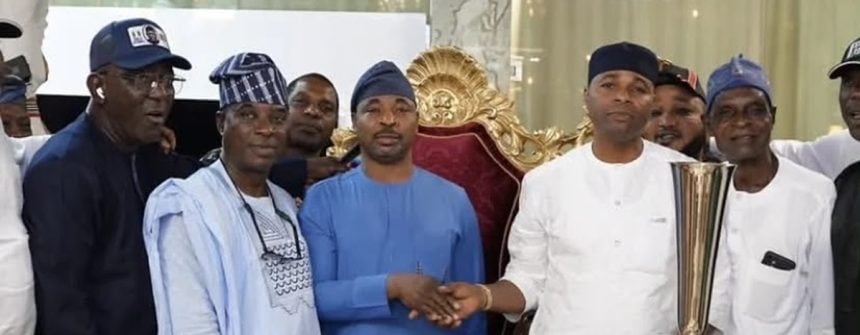
Nigerian Fuji musician, Wasiu Ayinde Marshal, popularly known as KWAM1, has brokered a peace deal between the National Union of Road Transport Workers (NURTW) National President, Musiliu Akinsanya, popularly known as MC Oluomo, and the Lagos State Chairman of the union, Mustapha Adekunle, aka Tafa Sego.
The reconciliation took place at Ojusagbola in Ijebu, Ogun State, where several NURTW chieftains gathered for the meeting.
The development was announced on Tuesday on KWAM1’s digital media page on Instagram, alongside photographs from the meeting.
According to the post, the two union leaders have resolved their differences after years of strained relations.
READ ALSO: Why FG Named KWAM 1 Aviation Security Ambassador — Keyamo
“After years of an age-long rift, MC Oluomo and Tafa Sego have finally settled their differences. And from what we know now, this is final,” the post said.
The musician was said to have intervened as the Mayegun of Yorubaland, with the aim of bringing an end to the longstanding disagreement between the two NURTW figures.
“K1 acted in his role as the Mayegun of Yorubaland by seeking an end to the long-standing rift, once and for all,” it said.
The post also described the meeting as a significant step beyond previous public displays of reconciliation.
READ ALSO: FG Gives KWAM 1 Aviation Appointment, After Airport Incident
“This time, it was not just another handshake for the cameras. The two old friends and colleagues came together at Ojusagbola, with King Wasiu Ayinde Marshal (K1) playing the peacemaker.”
Both MC Oluomo and Tafa Sego were reported to be pleased with the outcome of the intervention.
“Both parties are delighted about the new development,” the post said.
The two men had previously been allies and prominent figures within the Lagos NURTW before their relationship became strained amid disagreements linked to leadership of the union in the state.

 News2 days ago
BREAKING: Tinubu Extends Working Vacation
- News3 days ago
Six Hidden Health Benefits Of Unsweetened Zobo
- News5 days ago
Edo: Council Chairman Under Fire For Threatening Commercial Drivers Who Refuse To Wear APC Insignia
- News5 days ago
Edo: Ekpeson Redeems N20m Pledge To Family Of Fallen Soldier
- News3 days ago
2027: Step-by-step Guide To Applying For INEC Ad Hoc Staff Recruitment
- News5 days ago
OPINION: Nigerian Pastors, Imams And Their Sex Sermon Obsession
- News3 days ago
Jehovah’s Witnesses Announce New Position On Blood Transfusion Policy
- News3 days ago
How 36 Nigerian States Got Their Names
- Headline2 days ago
How To Format An Academic CV For US Master’s, PhD Applications
- News5 days ago
Malnutrition: US Support Reaches Over 40,000 Children In Bauchi — UNICEF


