

News
OPINION: The Judicial Adultery In Kano



By Lasisi Olagunju
The falcon no longer hears the falconer. A commercial flight landed in Asaba on Sunday but its cabin crew welcomed passengers to Nnamdi Azikiwe Airport, Abuja. A certified true copy of an Appeal Court judgment last week gave victory to both the respondents and the appellants. Nigeria of today is the textbook definition of confusion.
I seek to describe what the Court of Appeal did with the Kano governorship case as judicial adultery. I also seek to call it an adulteration of justice. I write with the help of my dictionary which has pointed it out to me that ‘adulterate’ and ‘adultery’ come from the same Latin root, adulterare, meaning “to falsify, corrupt.” Rodents of karma peed into the soup pot of the absolute monarchs in our court halls last week. A court that chops knuckles with parties before it is sure to deliver hybrid judgments – a little to the right, a little to the left; a salad of poisonous confusion. Fuji megastar, Kollington Ayinla, sang decades ago about indecorous mating in music-sphere. The product, he says, will have the face of the lead singer; the arms and legs of the child will belong to the drummer; the head will go to the gong man (Oju l’oju Kola/Apa l’apa Social/Ese l’ese Aromire/Ori l’ori Jimoh Agogo/Eti l’eti Marcus…).
Scholars after scholars have stressed, repeatedly, that the role of a judge in a case is to “transform the uncertainty about the facts into the certainty of the verdict.” A judge that leaves parties before it uncertain and confused after judgement has failed at doing his work. He deserves neither his pay nor a pat nor the usual allowances of reverence. Like the hybrid child in Kollington Ayinla’s ‘Ta ni o jo’ song, the Kano governorship judgement birthed a shapeshifter; a certified true copy that carved the verdict’s trunk in the image of the APC respondents while the gavel head of the bull goes to the NNPP appellants. It is the first hybrid judgment in the history of the world and the court system.
Every reasonable Nigerian was shocked to know of this case. The Court of Appeal sitting in Abuja heard and decided an appeal on the governorship of Kano State. It read its judgement in the open court sacking the incumbent governor who was the appellant in the case. Five days later, the party that lost got a certified true copy (CTC) of the judgement but saw that the decision and orders of the court on the document actually gave them the crown of victory. On the face of the CTC of the judgment signed by the chairman of the panel, the court resolved “live issues” in the case in favour of the respondents (APC) and dismissed the Appeal. It then scandalously proceeded to resolve “all issues” in favour of the appellants (NNPP) – the party it had earlier pronounced losers. The court went further on that route of confusion setting aside the judgement of the tribunal that had earlier sacked the governor and which it had earlier affirmed. It went farther further awarding costs against the APC, the party it had earlier pronounced winners: “The sum of N1,000,000.00 (one million naira only) is hereby awarded as costs in favour of the appellant and against the 1st respondent,” the CTC read. Was that an error or two parallel judgements of the same case, one grafted onto the other by karma?
FROM THE AUTHOR: OPINION: Powerful Lagos, Powerless Osun State
Judges are traditionally like eagles – they are not expected to flock and join the crowd to make silly mistakes. That is perhaps the reason why the Romans said an Eagle does not catch flies. When a court judgement has the type of ‘mistakes’ you find in exam scripts of below-average pupils, know that the Eagle of the nation now flies down to hunt flies. The poet is a prophet. William Butler Yeats (1865 – 1939) saw this Kano conundrum over 100 years ago. His poet-persona speaks in ‘The Second Coming’ of “a shape with lion body and the head of a man…” That is a monster – the image of a judgement that says both parties have won.
Cynthia Gray was the director of the Centre for Judicial Ethics of the American Judicature Society. In 2004, she published in the Hofstra Law Review an article on ‘The line between legal error and judicial misconduct: balancing judicial independence and accountability.’ A Nigerian judge reading the piece would be happy to cite it as a proof that misbehaviour in the temple of justice is not copyrighted for Nigeria. There are cases cited there that leaves mouths unclosed – like more than one judge caught deciding cases by lot in the open court. One judge decided a child custody case by flipping a coin; another asked the courtroom to vote on the guilt or otherwise of a man charged with battery: “If you think I ought to find him not guilty, will you stand up?” When that judge was charged with misconduct, his defence was that he called for an audience vote to “involve the public in the judicial process.” Some of those errant judges argued that they were right; some said they did not know it was wrong to be wrong. If a judge has no clue as to which is the way between the bush and the road, we should know that the society is in trouble. As Gray argues “it would be incongruous if the principle: ‘ignorance of the law is no excuse’ applies to everyone but those charged with interpreting and applying the law to others.”
The day the Kano CTC scandal broke, I sat down with my Nigerian-American friend for a sad chat on the Kano fiasco. What is this? The court explained it as a “clerical error” but my friend said: “That’s neither a faux pas nor a slip of judgement. That’s a revelation!” A revelation?! I thought that was deep. W.B. Yeats probably saw this too and also told us how it may end: “Surely some revelation is at hand; Surely, the Second Coming is at hand.” Even non-Christians know the implication of the ‘second coming’. It signposts, first, the coming of the “rough beast” slouching “towards Bethlehem”, then the end of the world.
FROM THE AUTHOR: OPINION: Helen Paul And Other Bastardy Stories
A convulsing world denies its terminal illness. It is not true that if you find yourself in a hole you should stop digging. If you dig horizontally you may escape the enemy’s snare at the end of your tunnel. The appeal court appeared to have done exactly that. It doubled down, boring a tunnel of explanations on how its cock turned to a bull within five days. It said the sin it committed was a mere “clerical error.” Could three whole paragraphs carefully written with words correctly spelt be called a ‘clerical error’. The World Law Dictionary defines ‘clerical error’ as “a small mistake (eg a spelling mistake) made by accident in a document.” No one, apart from the judges who sat in that court, knows exactly what happened. We can only guess. The court should just go quietly into the night. It is a very bad, low moment for Nigeria itself.
Where else can this “clerical error” be found in the history of court judgements? I spent the weekend doing some searches for similar errors in history and around the world. The nearest I could find was the 1941 Bastajian v Brown case decided by the United States Supreme Court. On May 14, 1936, a trial judge made a decision entry in the court records. It was his conclusion on a real estate case. He wrote: “395524. Blanche H. Comstock v. James E. Brown, et al. Cause heretofore tried and submitted, the court now orders judgement for defendants.” Court records showed that “a year expired during which time no findings of fact and conclusions of law were submitted to the court. On about May 11, 1937, findings of fact and conclusions of law and a judgment prepared by C. P. Von Herzen, one of plaintiff’s attorneys, were filed by him with the clerk to be presented to the judge; they were signed by the judge and filed on June 4, 1937.” It turned out that what the judge signed was the direct opposite of his May 1936 decision and entry. The cheated side read what was signed and complained to the judge. They called his attention to what the decision truly was. On September 29, 1937, the judge issued a corrective order agreeing with the complainant/defendants that the said judgment was signed by his court “inadvertently and by mistake, and did not express the intent of this court nor the true judgment rendered herein, and that the signing of the same by said court constituted a clerical mistake.” The judge further held that the plaintiffs’ “presentation of said Findings of Fact and Conclusions of Law and said Judgment to this Court for signature constituted a fraud and deception practiced upon this Court in misrepresenting and misstating the true decision of the court after the lapse of a long period of time…” The case became a very controversial one that went up to the Supreme Court. On December 19, 1941, the Supreme Court ruled that the judge properly exercised his powers by “vacating the judgement and the finding of fact and conclusions of law upon which the judgement was rested.” Friends and beneficiaries of the Nigerian Appeal Court would read this case and say: “you see, there is no new thing under the sun.” They would refer us to the author of the book of Ecclesiastes: “The thing that hath been, it is that which shall be; and that which is done is that which shall be done: and there is no new thing under the sun.”
FROM THE AUTHOR: OPINION: A Yoruba King’s Sodom And Gomorrah
But I think they should wait: A layman like me will easily see that the contentious judgement in the US case was drafted by the counsel of the plaintiffs for the judge to sign. And he signed. Anyone in Nigeria who would seek to benefit from that case should prepare to explain how judges of the second highest court in the land wrote ‘yes’ when they meant to write ‘no’. The Court of Appeal has not disowned the authorship of the judgement; it wrote and signed it. It even, after its delivery, dotted the i’s and crossed the t’s for more than four days before releasing the CTC The court has not told us how the “error” crept into its spick and span work.
It is so nice that this case has moved up to the Supreme Court. We should all look forward to reading how the apex court will “transform the uncertainty” of the case to the certainty of untainted reasoning. One thing, however, appears true here: The poet is a prophet. Chinua Achebe’s ‘Things Fall Apart’ derives its title from the poetic prescience of W. B. Yeats. It foretells the horrific “error” that was certified by the Court of Appeal last week. I will be surprised if anyone says things are alright with the Nigerian system. With every passing day, sheets of darkness unfurl. The innocent have long lost their innocence; an epidemic of guilt without shame distresses the land. That is why you would hear the unclad Court of Appeal, while sacking Bauchi State Speaker on Friday accusing INEC of “dancing naked in the market”. Before “the Second Coming”, Yeats says the falcon will no longer hear the falconer. Where succour used to be, what you see is anarchy. The poet foretells all that. As the gyre widens, we feel the silence of philosophers and the ignorant chatter of promoters of vile excuses. The best in Nigeria today “lack all conviction”; the worst is “full of passionate intensity.”




News
Xenophobic Attacks: Oshiomhole Tells FG To Retaliate Against South African Companies In Nigeria

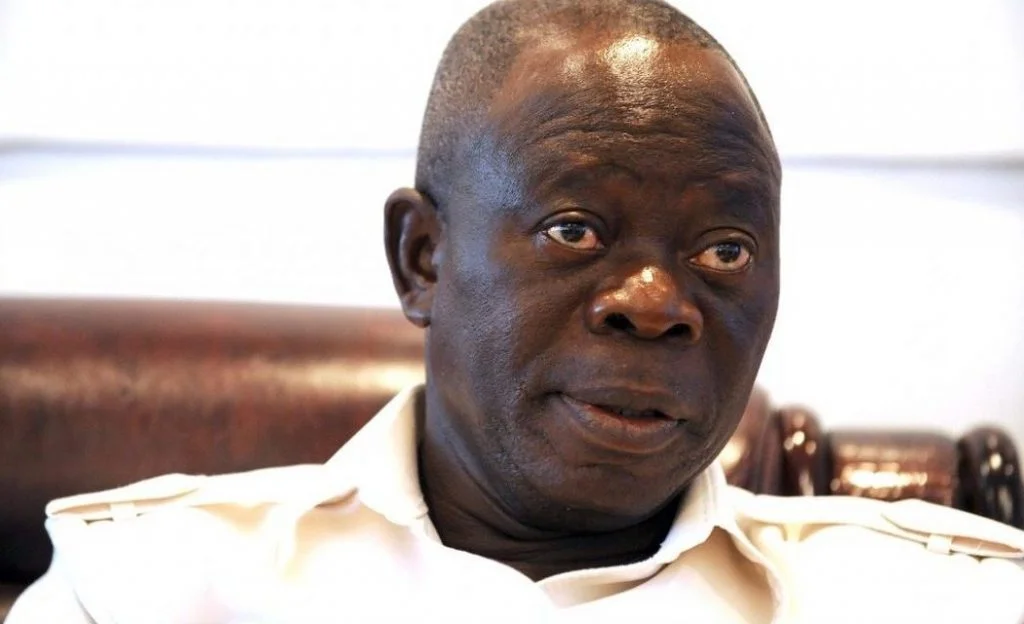
Senator Adams Oshiomhole has called on the Federal Government to retaliate against South African businesses operating in Nigeria following the recent attacks on Nigerians in South Africa.
Speaking during plenary on Tuesday, Oshiomhole said the Federal Government should consider revoking the working license of South African owned companies such as MTN and DSTV.
He argued that Nigeria must respond firmly to what he described as persistent hostility against its citizens.
READ ALSO:South Africa To Investigate ‘Mystery’ Of Planeload Of Palestinians
“I am not going to shed tears. If you hit me, I hit you. I think it is appropriate in diplomacy. It is an economic struggle,” Oshiomhole said.
He argued that while some South Africans accuse Nigerians of taking their jobs, Nigerians should return home and take over employment opportunities created by major South African companies operating in the country, including MTN and DSTV.
“When we hit back, the President of South Africa will not only talk but will also go on his knees to recognise that Nigeria cannot be intimidated.
READ ALSO:South African Ambassador Found Dead Outside Paris Hotel
“We will not condone any life being lost. If a crime has been committed under the South African law they have the right to bring any such person to justice, but to kill our people as if we are helpless, we will not allow that,” Oshiomhole added.
DAILY POST reports that several Nigerians in South Africa have reportedly been attacked, and their businesses destroyed, in ongoing xenophobic attacks in the country.
News
IGP Orders Officers Display Name Tag On Uniform, Gives Update On State Police


The Inspector General of Police, IGP, Tunji Disu, has ordered all police personnel to always have their name tags on their uniforms for easy identification.
Disu disclosed that only police personnel who are undercover are exempted from displaying their name tags.
Speaking on Tuesday, Disu said: “All police officers should have their name tags. All of us on the high table have our names apart from the undercover among us so if you look at all the Commissioners of Police we have our name tags, so it’s not our standard.
READ ALSO:
“All the Commissioners of Police are here and that is why we called this meeting, we have list of things like this that we will want to discuss with the Commissioners of Police, we have told them earlier and we will still let them know that every that happens within their area of jurisdiction falls under their control.”
On the issue of state police, the IGP said: “Since we got the signal that the Federal Government of Nigeria intend to establish State Police and since we are the federal police, we decided to take the bull by the horn and put down our own side of what we believe on how the state police should be run.
“A lot of things were taken into consideration, a lot of comparative analysis was done and it has been transmitted to the National Assembly.”
News
Court Orders SERAP To Pay DSS Operatives N100m For Defamation
The High Court of the Federal Capital Territory has ordered a non-governmental organization, the Socio-Economic Rights and Accountability Project, SERAP, to pay N100 million as damaged to two operatives of the Department of the State Services, DSS, for unjustly defaming them in some publications.
The court also ordered SERAP to tender public apologies to the defamed officers,
Sarah John and Gabriel Ogundele, in two national newspapers, two television stations and its website.
Besides, the organization was also ordered to pay the two operatives N1 million as cost of litigation and 10 percent post-judgment interest annually on the judgment sum until it’s fully liquidated.
Justice Yusuf Halilu of the High Court of the Federal Capital Territory gave the order on Tuesday while delivering judgment in a N5.5 billion defamation suit instituted against SERAP by the DSS operatives.
The judge found SERAP liable for unjustly defaming the two DSS operatives with allegations that they unlawfully invaded its Abuja office, harassed and intimidated its staff, in September 2024.
READ ALSO:How We Arrested Terror Suspect Who Threatened To Kill Students, Teachers In Abuja — DSS
In the offending publication on its website and Twitter handle, SERAP alleged that the two operatives unlawfully invaded and occupied its office with sinister motives.
The judge held that the publication was in bad taste especially from an organization established to promote transparency and accountability, as nothing in the publication was found to be truthful.
The DSS staff had listed SERAP as 1st defendant in the suit marked CV/4547/2024. SERAP’s Deputy Director, Kolawole Oluwadare, was listed as the 2nd defendant.
In the suit, the claimants – Sarah John and Gabriel Ogundele – accused the two defendants of making false claims that they invaded SERAP’s Abuja office on September 9, 2024..
Counsel to the DSS, Oluwagbemileke Samuel Kehinde, had while adopting his final address in the mater urged the judge to grant all the reliefs sought by his client in the interest of justice.
READ ALSO:DSS Arrests Suspected Gunrunner, Recovers 832 Rounds Of Ammunition
He admitted that although the names of the two claimants were not mentioned in the defamation materials, they had however established substantial circumstances that they are the ones referred to in the published defamation article by SERAP on its website.
The counsel submitted that all ingredients of defamation have been clearly established and the offending publication referred to the two officials of the secret police.
However, SERAP, through its counsel, Victoria Bassey from Tayo Oyetibo, SAN, law firm, asked the court to dismiss the suit on the ground that the two claimants did not establish that they were the ones referred to in the alleged defamation materials.
She said that SERAP used “DSS officials” in the alleged offending publication, adding that the two claimants must establish that they are the ones referred to before their case can succeed.
Similar arguments were canvassed by Oluwatosin Adefioye who stood for the second defendant, adding that there was no dispute in the September 9, 2024 operation of DSS in SERAP’s office.
READ ALSO:Alleged Cyberstalking: DSS Plays Video Evidence In Sowore’s Trial
He said that since SERAP in the publication did not name any particular person, the claimants must plead special circumstances that they were the ones referred to as the DSS officials.
Besides, he said that there is no organization by name Department of State Services in law, hence, DSS cannot claim being defamed adding that the only entity known to law is National Security Agency.
The claimants had in the suit stated that the alleged false claim by SERAP has negatively impacted on their reputation.
The DSS also stated, in the statement of claim, that, in line with the agency’s practice of engaging with officials of non-governmental organisations operating in the FCT to establish a relationship with their new leadership, it directed the two officials – John and Ogunleye – to visit SERAP’s office and invite them for a familiarization meeting.
The claimants added that in carrying out the directive, John and Ogunleye paid a friendly visit to SERAP’s office at 18 Bamako Street, Wuse Zone 1, Abuja on September 9 and met with one Ruth, who upon being informed about the purpose of the visit, claimed that none of SERAP’s management staff was in the country and advised that a formal letter of invitation be written by the DSS.
READ ALSO:DSS, Police Partner NCCSALW To End Terrorism, Mop Up Illegal Arms
John and Ogundele, who claimed that their interactions with Ruth were recorded, said before they immediately exited SERAP’s office, Ruth promised to inform her organisation’s management about the visit and volunteered a phone number – 08160537202.
They said it was surprising that, shortly after their visit, SERAP posted on its X (Twitter) handle – @SERAPNigeria – that officers of the DSS are presently unlawfully occupying its office.
The claimant added, “On the same day, the defendants also published a statement on SERAP’s website, which was widely reported by several media outfits, falsely alleging that some officers from the DSS, described as “a tall, large, dark-skinned woman” and “a slim, dark skinned man,” invaded their Abuja office and interrogated the staff of the first defendant (SERAP).
John and Ogundele stated that “due to the false statements published by the defendants, the DSS has been ridiculed and criticised by international agencies such as the Amnesty International and prominent members of the Nigerian society, such as Femi Falana (SAN)”.
“Due to the false statements published by the defendants, members of the public and the international community formed the opinion that the Federal Government is using the DSS to harass the defendants.”
READ ALSO:SERAP To Court: Stop CBN From ‘Implementing ‘Unlawful, Unjust ATM Fee Hike’
They added that the defendants’ statements caused harm to their reputation because the staff and management of the DSS have formed the opinion that the claimants did not follow orders and carried out an unsanctioned operation and are therefore, incompetent and unprofessional.
The claimants therefore prayed the court for the following reliefs: “An order directing the defendants to tender an apology to the claimants via the first defendant’s (SERAP’s) website, X (twitter) handle, two national daily newspapers (Punch and Vanguard) and two national news television stations (Arise Television and Channels Television) for falsely accusing the claimants of unlawfully invading the first defendant’s office and interrogating the first defendant’s staff.
“An order directing the defendants to pay the claimants the sum of N5 billion as damages for the libellous statements published about the claimants.
“Interest on the sum of N5b at the rate of 10 percent per annum from the date of judgment until the judgment sum is realised or liquidated.
“An order directing the defendants to pay the claimants the sum of N50 million as costs of this action.”
-

 Politics3 days ago
2027: Tinubu’s Re-election May Put An End To Nigeria — Baba Ahmed Warns
-

 Metro4 days ago
I’m A Street Girl’ – Bimbo Ademoye Clashes With Area Boys [VIDEO]
-

 Politics4 days ago
Senatorial Seat: Ogbakha-Edo Warns Against Imposition Of Candidates In Edo South
-

 Politics4 days ago
BREAKING: 2027: Former Adamawa APC Guber Candidate, Aishatu Binani Defects To NDC
-

 Business3 days ago
JUST IN: Nigerian Filling Stations Reduce Fuel Price After Hike
-

 Entertainment4 days ago
Actress Eniola Badmus Gets New Federal Appointment
-

 Metro5 days ago
Robbers Raid Imo Catholic Church, Steal Holy Communion Materials
-

 News4 days ago
10 African Countries With Highest Petrol Prices In Prices In April 2026
-

 Headline5 days ago
UK-based Nigerian Jailed 17 Years For Raping 19-year-old
-

 News5 days ago
NASU, SSANU Begin Indefinite Strike Friday
