
News
OPINION: The War Of Governors And Deputies
By Suyi Ayodele
On Friday, July 29, 1910, the Owa Obokun of Ijesaland was told by his messenger: “Aiyé ti bàjé (the world is spoiled). The oba responded curtly: “Mo j’Owá lónìí (‘I become Owa today’).”
That is how British anthropologist, Professor J. D.Y. Peel, documented how the palace responded to the death of Ijesha war commander, Chief Ògèdèngbé Agbógungbórò. He was the king’s deputy, the Obaala of Ilesa.
The Owá reportedly rebuked the messenger for announcing the death of his second in command as if it was a loss to the palace.
Why would a king rejoice at the death of his subject? Or, more appropriately, why would the Owá intone that he truly became the king only at the death of his deputy?
Ògèdèngbé Agbógungbórò was the Obaálá of Ijeshaland in the present Osun State. He was the king’s second-in-command. The reigning Owá of Ijeshaland then was Owá Atáyéro. Ògèdèngbé was a great warrior. He was also a temperamental being. By virtue of his dexterity at the war fronts, everybody feared him. Owá himself feared Ògèdèngbé. The Yoruba war ended officially in 1893, but Ogedengbe continued to command the town and the palace. The Oba lived under the shadows of the warrior. Ògèdèngbé was the de facto Owá, the king was king only in name.
J. D. Y Peel’s “Ijeshas and Nigerians: The Incorporation of a Yoruba Kingdom, 1890s-1970s” is an interesting account of the politics of persons and personalities in Ijesaland in the early to mid-20th century.
An account was given of two men who had a quarrel over farmland. The rightful owner was said to have approached Owá Atáyéro for justice. The Owá-in-Council, who knew the history of the disputed farmland, assured the right party of justice. Meanwhile, his contender had approached Ògèdèngbé for support. The warrior also assured him that he would deliver the farmland to him.
On the day the Palace was to adjudicate on the matter, Ògèdèngbé was said to have come late for the meeting. Many historians of that singular act believed that the warrior came late because he wanted to show how powerful he was. The Owá-in-Council listened to the two parties. The Council rebuked the impostor who wanted to inherit a farmland that did not belong to him.
And for destroying the crops on the land unlawfully, the Palace asked the aggressor to kneel in one corner while his punishment was being decided. It was at that moment that Ògèdèngbé’ walked in. Agbógungbórò was said to have been livid on seeing the one he promised ‘protection’ being punished. He roared! He ordered the man to get up and asked his opponent to take his position. One bold chief reminded Ògèdèngbé that it was the Owá who ordered the man to kneel.
Ògèdèngbé retorted that vultures would pluck the eyes of the courageous chief and the man who ordered the wrong party to kneel! Silence! The Owá was reported to have shaken his head, got up and entered the inner recess of the palace. No other chief dared to follow him. Ògèdèngbé then proceeded to preside over the ‘court’. He awarded the disputed farmland to the wrong party, who approached him for support and protection. Case closed! The rightful owner could only thank his stars that his head was not demanded of him.
MORE FROM THE AUTHOR: General Lagbaja: Rise, Deities Of Vengeance [OPINION]
History teaches lessons. One of the lessons modern-day politicians learn is never to have strong’ men as their deputies. Politicians, especially governors of this dispensation have one name they don’t want to answer: Obádípè (The king appeals). No! The king makes no appeal. Kings command (Obápase), and their words become law. The current democracy has witnessed a lot of clashes between deputy governors and their principals, the governors. One begins to wonder if there is any need for a deputy governor!
Chief Bisi Akande, former governor of Osun State, has a good description of who or what a deputy governor is. The old man quipped that a deputy governor is like a spare tyre of a vehicle. In his native wisdom, Chief Akande said that unless any of the “real” tyres is bad, nobody uses or remembers the spare tyre.
Akande made the remarks at the peak of the conflict of confidence between him and his deputy, Iyiola Omisore. The Ila-Orangun-born politician ensured that Omisore remained a spare tyre almost all through his deputy governorship. He made the office of the deputy governor redundant, ineffective and almost paralysed.
Chief Akande has a younger brother in Ayodele Fayose, who, as the governor of Ekiti State, dispensed with his deputy governor at will. Fayose started the journey with Abiodun Aluko on May 29, 2003. Two and half years later, Fayose was tired of his co-captain in their sinking boat. Without batting an eyelid, the one who answers the street lingo, ‘Oshokomole’ (whatever that means), threw Aluko off the boat.
He simply cherry-picked an old ally, a female, Abiodun Olujimi, as replacement. The relationship did not last. But before the duo could enter the ring, General Olusegun Obasanjo (Rtd), who was the President and Commander-in-Chief then, offloaded them to the Nigerian political wilderness through a state of emergency!
MORE FROM THE AUTHOR: OPINION: For Tribune And Our National Grid
In the South-East, Orji Uzor Kalu, now a senator, could not withstand the cerebral postures of his deputy, Enyinnaya Abaribe. Pronto, he threw him off the ship. When Abaribe saw the handwriting of impeachment on the wall, he turned in his resignation letter which the governor and the Abia State House of Assembly ‘rejected’. Kalu would rather have his deputy ‘impeached’ less than three months to the completion of their first term in March 2003, than accord him the dignity of resignation. In replacement, Chima Nwafor was brought in, and he remained Kalu’s deputy till the latter died in March 2006.
The trio of Akande, Fayose and Kalu are ‘learners’ in the act and art of changing deputies when compared to the feats achieved in that turf by their ‘grandmaster’, Bola Ahmed Tinubu, the current President. While he held sway as the governor of Lagos State, Tinubu had three different deputy governors. One of them was shipped out a few days to the end of his tenure!
Tinubu sealed the political ‘conjugation’ (what a choice of diction!) with Chief Kofoworola Bucknor-Akerele on May 29, 1999. Watchers of the event knew that the two were diametrically opposed in all ramifications. But their political family, Afenifere, joined them together in the political unholy matrimony.
They managed each other in what my Yoruba people call: Ajá ńsábà Ekùn, ekùn, ńsábà Ajá (the dog and the Tiger play hide-and-seek game). Then the rope snapped! Five months into the end of their first term, Tinubu would no longer have Bucknor-Akerele as his deputy. On December 16, 2002, the female deputy governor was forced to leave the government. By then, Afenifere was not in any position to save the ship.
Then came in the young banker, Femi Pedro, as replacement. Pedro joined Tinubu in the race for the former’s second term. However, the relationship became that of master and servant. ‘Core’ Lagosians were said to have encouraged Pedro to continue to endure the humiliation he suffered under his principal.
But 19 days to the end of Tinubu’s second term as governor of Lagos State, the state House of Assembly ‘impeached’ Pedro on May 10, 2007! Because nature abhors a vacuum, an elderly Abiodun Ogunleye was appointed Tinubu’s deputy on May 12, 2007. Ogunleye spent just 17 days as the deputy governor of Lagos State with full entitlements!
A senior colleague, in one of our discussions over the Lagos deputy governorship debacles under Tinubu, submitted that it was a mistake to have allowed Bucknor-Akerele to run as deputy governor with Tinubu, Akerele having sought, and fought vigorously, to be governor herself! He maintained that asking an ambitious man to be deputy to someone he believes he is superior to “is a recipe for crisis.” That submission triggered an alarm in me. Nigerians should pay attention to Edo State, pay attention!
The war of principals and deputies is not limited to our clime. Last Saturday, something similar, or even deadlier than what we have ever seen here, happened in the far away Philippines. The tiny Asian country is on the edge as a war of confidence rages between the President, Ferdinand Marcos Jr. And his Vice President, Sara Duterte.
MORE FROM THE AUTHOR: US Election: Lessons for Nigeria [OPINION]
Duterte at a press conference on Saturday announced that she would have the president assassinated should she (Vice President) be killed by the president! And the lady Vice President meant every word she uttered! She said that not only would President Marcos Jr. be assassinated, but Marcos’ wife, Liza Araneta, and the Speaker of the country’s legislative body, Martin Romualdez, would also die!
She speaks: “I have talked to a person. I said, if I get killed, go kill BBM (Marcos), (first lady) Liza Araneta, and (Speaker) Martin Romualdez. No joke. No joke. I said, do not stop until you kill them and then he said yes.” She was not through. Duterte assessed the mental capability of her principal and concluded: “This country is going to hell because we are led by a person who doesn’t know how to be a president and who is a liar.”
William Shakespeare, in the play, “Othello”, says: “Hell hath no fury like a woman scorned.” How apt could the Elizabethan literature giant be! Duterte and Marcos Jr. were best of friends barely two years ago when they sought the top two positions in the Philippines together. Something happened and their confidence in each other went agley.
Just as it happens when Desdemona, Othello’s wife was unfairly treated by Othello on a flimsy and equally unverified accusation of infidelity, and the wife unleashes her patent destructive tendencies on her husband. Duterte is up in arms against her once-bosom friend. Emily Bronte illustrates this trait in her novel, Wuthering Heights, with the character of Catering Earnshaw, a scorned lover, who visits unmitigated vengeance on Heathcliff, the man she ‘loves’.
Could Duterte’s fury in the Philippines be because of the ‘redundancy’ of her office as a Vice President? Or, by the act of ‘betrayal’ by President Marcos Jr., who now finds new political friends such that he can do away with the winning partner, Duterte? The Philippine constitution, like its Nigeria’s counterpart, does not help matters in this case. By the provisions of the constitution, the Vice President of the Philippines is elected separately from the President but has no official duty in government!
And to worsen the situation for Duterte, the legislature is an errand boy of Marcos Jr. It is said that the speaker, Martin Romualdez, who is also slated for “assassination”, had “slashed the vice-presidential office’s budget by nearly two-thirds.”
This act is akin to how deputy governors are treated here in Nigeria. A governor in one of the South-West states was said to have allocated about 12 Peugeot 504 cars inherited from the defunct Western Region to the office of his deputy governor in 2000!
Someone asked if I would like to go into politics. I responded that it would depend on two conditions. He asked for the conditions. I responded that I would never be a deputy to anybody, not even a vice-presidential position!
Again, anyone who wants me to go into politics must provide all the logistics; I would only make myself available at the campaign rallies to tell the people what I will do for them! “You are a bloody dreamer, Suyi; big dreamer”, he retorted! Let my dream of being a politician be in the realms of dreams!
As long as deputy governors are “spare tyres”, and no definite constitutional roles assigned to them except being appendages of their principals, the governors, the raging war of confidence shall continue. This, I think, should be the focus of those in the business of amending the constitution. I don’t know how many Nigerians today can mention the names of five out of the 36 deputy governors we have, because the position is so inconsequential! God help any deputy governor who has a megalomaniac as governor, or a governor who has an over ambitious deputy governor! Where is the next war, by the way?



News
Children’s Day: Chaos At Ogbe Stadium As Dozens Faint

Chaos erupted on Wednesday during the Children’s Day celebration as dozens of students reportedly collapsed following a stampede triggered by the use of pepper spray.
The event,
organised by the Edo State Ministry of Education at the Samuel Ogbemudia Stadium was disrupted after some male students of Ihogbe College allegedly made uncompromising advances towards female students at the venue.
A parent who identified himself as Oboh Emmanuel said, “the behaviour of those uncultured students attracted the attention of bouncers stationed at the stadium as they rebuked the male students.”
Oboh said the affected students later regrouped and attacked the bouncers, leading to a confrontation within the crowded arena.
READ ALSO:Children’s Day: Edo Commits To Child Protection
It was gathered that in the ensuing confusion, the bouncers were reported to have deployed pepper spray in an area occupied by a large number of students.
Several students, particularly female students, reportedly fainted after inhaling the substance, while others sustained injuries after being stepped on during the ensuing melee.
The panic was said to have spread across the stadium as students, teachers and parents scampered for safety.
Many of the affected students were reportedly rushed to the Edo Specialist Hospital for medical attention.
READ ALSO: Egor LG Chair, Ogbemudia, Vice, Osawe Impeached
Reacting to the incident, Chief Press Secretary to Governor Monday Okpebholo, Dr Patrick Ebojele, said the security personnel that fired the tear gas had been detained.
He said all the students, except two, that were rushed to the hospital have been discharged.
Ebojele stated that doctors wanted to observe the students till tomorrow before allowing them to go home.
“The two students are not seriously injured. Doctors want to observe them overnight. Permanent Secretary, Ministry of Education is still at the hospital. The man who used pepper spray has been detained.
“The incident did not happen the way it is being exaggerated. All modalities were put in place to ensure the children enjoyed their day.”
News
Okpebholo Salutes Edo Muslims, Seeks Continued Support, Prayers
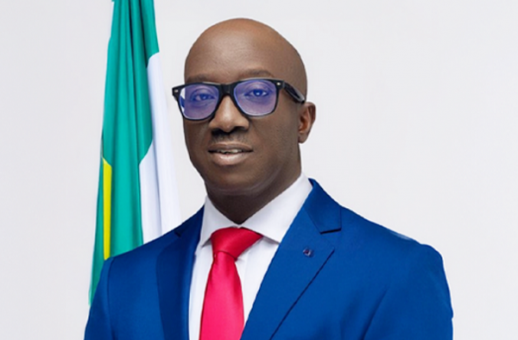
Governor Monday Okpebholo of Edo State has urged Muslims and all Nigerians to continue to pray for peace, unity and progress in the country even as they celebrate the annual Eid-al-Adha
The governor, who was represented by his deputy, Dennis Idahosa, stated this during the annual Eid-al-Adha celebration with Muslim faithfuls held at Government House in Benin City.
He reiterated his administration’s commitment to fairness, inclusivity and equal opportunities for all citizens irrespective of religion and tribe.
READ ALSO:ADC Penetrates Okpebholo’s District As Defections Strengthen Party in Edo Central
According to him, the present administration remains determined to building a government that reflects the diversity of Edo State, noting that competent and qualified Muslims have continued to play vital roles in his government because of their capacity, integrity and commitment to service.
“As a government, we remain committed to fairness, inclusivity and equal opportunity for every Edo citizen, irrespective of religion, ethnicity or political affiliation. This is why quality and competent Muslims are serving in key positions in our administration.”
Okpebholo appreciated the Muslim community in Edo State for their unwavering support and continuous prayers for his administration, noting that such prayers and support have contributed immensely to the peace and steady development being witnessed across the state.
READ ALSO:Okpebholo Felicitates Muslims On Eid-el-Fitr Celebration
He then called on all Nigerians to use the occasion of Eid-al-Adha to pray for the administration of President Bola Ahmed Tinubu, stressing that the country needs collective prayers, unity and cooperation to overcome its present economic and security challenges.
“I urge all Muslims and indeed all Nigerians to use this occasion to pray for our dear nation and for the administration of President Bola Ahmed Tinubu. Nigeria needs our collective prayers, unity and support as we strive to overcome our challenges and build a more prosperous future for all.”
In his remarks, the Chief Imam of Edo State, Abdulfatai Enabulele, applauded the governor for what he described as remarkable developmental strides recorded in less than two years in office.
The cleric commended the administration for ongoing infrastructural development and efforts geared towards improving governance in the state, but appealed to the government to revisit and complete some abandoned projects inherited from the previous administration for the benefit of the people.
News
Children’s Day: Edo Commits To Child Protection
The Edo State Government has reaffirmed its commitment to protecting the rights of children, promoting quality education, and strengthening sports development across the state.
This assurance was given by the governor of Edo State, Monday Okpebholo, during the 2026 Children’s Day Celebration and Governor’s Cup Finale held on Wednesday at the Samuel Ogbemudia Stadium, Benin City.
Addressing pupils, students and teachers,
the governor described children as the pride of Edo State and the future of the nation.
The governor, represented by his deputy, Dennis Idahosa,
noted that the annual celebration provides an opportunity to honour their dreams, talents, and limitless potential.
READ ALSO:Eid-el-Kabir: Edo Deputy Gov Solicits prayers For Okpebholo
Speaking on this year’s Children’s Day theme, “Choose Kindness, Reject Bullying,” the governor said the message was timely and significant, as it emphasizes the need to create safe, supportive, and inclusive environments for children both in schools and communities.
He stated that bullying in all forms — physical, verbal, emotional, or online — has no place in society, adding that the Edo State Government remains fully committed to protecting the rights and dignity of every child.
According to him, the administration will continue to strengthen policies and programmes that promote child protection, discipline, mutual respect, and positive learning environments across schools in the State.
The governor urged children to embrace kindness, compassion, teamwork, and respect for one another, stressing that true strength lies not in intimidation but in empathy, good character, and mutual understanding.

 Metro5 days ago
My Husband Abandoned Me On Our Wedding Night To Attend Political Meeting, I Want Our Marriage Dissolved
- Headline4 days ago
Woman Passes Out After Receiving 100 Strokes Of Cane
- Headline4 days ago
JUST IN: White House Locked Down Briefly As Gunman Opens Fire At Security Checkpoint
- Politics5 days ago
Warri Ijaw Hail INEC Delineation Report, Call For Additional Electoral Wards, Others
- Politics3 days ago
Two Masked Men Gun Down Politician In His Rivers State Hotel
- News5 days ago
Alleged Terrorism: Court Rejects Defendant’s Bid To Travel Abroad
- News3 days ago
More Pain For Nigerians As Cooking Gas Price Increases Nationwide
- Metro5 days ago
My Wife Stop Cooking My Food, Beats Me Black And Blue All the Time, Man Tells Court
- Politics5 days ago
What I’ll Do As President Of Nigeria — Amaechi
- Politics3 days ago
‘Tinubu’s Borrowing In 24 Months Surpasses 55 Years’ Debt Record’


