

News
OPINION: We Beg Bread, They Belch Beer[Monday Lines]




By Lasisi Olagunju
Are Nigerians hungry because they’ve been drinking too much free beer and now the brewery is bankrupt? I ask because President Bola Ahmed Tinubu waxed rhetorical Thursday last week as he dissected the very bad hunger wracking his country and its more than 200 million people. “I understand we are hungry, but no free beer parlour anymore,” he said. Except the president is suggesting that we are a nation of drunkards, I am tempted to wonder what shred of meaning connects “hunger” and “beer” here.
What the president said was a rhetorical gaffe that deserves a rebuke. When a person says what he said and in the context he said it, the Yoruba would look at him and wonder why he is talking ìrù (tail) when we are talking irú (locust beans). What are we saying, what are they saying? We are begging for bread; they are belching beer. The old man saw liquid when his people cried solid. The president’s ‘learned’ supporters will insist that ‘beer’ is the president’s metaphorical substitute for ‘food’. That will be interesting. We’ve always suspected that metaphor serves as a ready refuge for the flawed – especially in the very slippery terrain of politics. But the Emilokan rationalists should remember to tell the president that a successful metaphor is one that is apt. When the vehicle and the topic cohere in semantic peace, we congratulate the metaphor birther for a successful delivery.
His preference for “beer parlour” where ‘food bank’ should be was a tragic subversion of aptness in metaphor deployment. A mandatory credit pass in Literature is recommended for whoever would be president after this one. ‘Beer’ does not collocate with ‘hunger’.
The beer-parlour talk of the president may be one of his lasting contributions to language and the field of political rhetoric. You never can tell. He already, during the 2023 campaigns, dropped ‘balablu’ as one of his hit singles. Sometimes, what the enemy thinks is blemish ends up embellishing one’s memory. We call it èébú d’olá in Yoruba. William Archibald Spooner lived between July 1844 and August 1930. Between those years, he served as a clergyman, author and professor of ancient history, divinity and philosophy at the University of Oxford. He was described as “a well-liked, respected, genial, kindly, hospitable man” but blessed with “a head too large for his body.” Spooner was brilliant but was equally very absent-minded, and he got famous for it. He, in 1879, from the pulpit, famously gave out the first line of a popular hymn as “Kinkering Kongs their titles take” (instead of ‘Conquering Kings Their Titles Take’). And he did it, not intentionally.
When Spooner died, his obituary in the 1 September, 1930 edition of Manchester Guardian contains this passage: “All sorts of stories, probable and improbable, were invented… Of the well-worn ones, the best are those which made Spooner declare that he was leaving Oxford by ‘the town drain,’ that some unauthorised person was ‘occupewing his pie,’ that at a marriage it was ‘kistomary to cuss the bride,’ and that he was tired of addressing ‘beery wenches.’ Much better authenticated and not even a Spoonerism is his famous reply to a young lady who asked him if he liked bananas. He is said to have retorted, ‘I’m afraid I always wear the old-fashioned nightshirt.’”
MORE FROM THE AUTHOR: OPINION: Marriage, Yes; Education, No [Monday Lines]
That Guardian obituary was not only how Spooner was remembered. Because he said all he said, before he died, the English Language got enriched with one more permanent word – spoonerism. The word proceeded to get a barge of honour as a rhetorical device in literature – and a mention in neuro science.
Who knows, courtesy of our president, ‘beer’ may enter the English Dictionary as a synonym for ‘food’ just as the president’s social media enemies, irreverent children of anger, use ‘agbadoan’ as a collective name for his long-suffering fans. Agbado is the Yoruba name for corn. The president, before his election, recommended it as a solution to the hunger on the streets.
Now, more seriously, let us ask the president and his defenders: Can beer replace dinner? Or could it be that we are hungry because our leaders have been taking too much freebies from our liquor bank? Or could it be that our president has been too far removed from the caked reality of the scorched earth for him to know that the world is about to end courtesy of his apocalyptic policies? When the president said what he said and ended it with a demand for patience from the hungry, I heard a loud applause from his fawning followers. The president enjoyed that applause. How I wish he would read Shakespeare in ‘Pericles: Prince of Tyre’. The playwright says: “They do abuse the king that flatter him.” He says again that “kings should let their ears hear their faults.” Clapping when the leader spoke beer when food was needed was distressing; it numbs the soul. But you would ask who made up that adulating audience? Former principal officers of the National Assembly. They are plaintive ex-eagles desirous of new feathers for fresh flights and feasts. They are men who are ready to kneel lower than their knees. A high-five for what the president said shames all – especially the eight million plus who elected him last year.
The president also spoke about “free bowl” which he said hungry Nigerians “cannot just take”. Then he spoke about the closure of Nigeria’s “free beer parlour”. The tone, texture and context of Tinubu’s beer-and-bowl statement trivialized the people’s travails. Who will help Nigerians tell their president that their hunger is not for beer and the inebriation it offers? That the starvation cries in town are not a craving for free meal. That Nigerians do not seek, and are not demanding indebtedness to charity. All they seek are policies with a human face, a government that cares.
MORE FROM THE AUTHOR: OPINION: Yoruba’s Spirit Of Resistance [Monday Lines (1)]
The town writhes in agony because government has lost its meaning. Every citizen has a personal reason for voting in elections. One of those reasons is what English philosopher, Bernard Bosanquet (1848-1923) explains as the hope by the citizen that the government would help him to become “what he has in him to be.” Not all who voted for Tinubu last year did so for party, tribe or money. Some genuinely thought he would make a positive difference in their lives. Now, everyone is stranded because the government crashed the car.
The country is in deep trouble. What is broken in our economy is brittle beer bottle, not calabash. It cannot be mended as is done with calabash. It doesn’t look like the government is worried as we are about the present darkness. Where leaders do not care, we would be right to inquire what they have where a heart ought to be. If there is a heart there, then it must be made of something very hard. William Bascom wrote of the Yoruba concepts of the wicked and the hard-hearted: “A hard-hearted person is bad-tempered, easily offended, willful and stubborn, doing what he likes and paying no attention to what others say. When an ordinary person in anger would throw a small lump of dirt, a hard hearted person throws a large stone. Worse than the hard-hearted person is one who is ‘wicked’ (ìkà). A wicked person loves no one but himself; he advises others to sell things for less than he knows they are worth; he injures others and destroys their property without cause…” I agree. The wicked counts the number of stars he shoots down.
Last week, US vice president, Kamala Harris, told talk show host, Oprah Winfrey, that a leader’s real strength lies in “who he lifts up, not who he brings down.” She said the same, and much more, in another interview in April this year, long before she became the Democratic Party’s presidential candidate:
“We need a protector”, the interviewer told Kamala Harris.
And she replies:
“Yes. Sadly, over the last many years, there has been this kind of perverse approach to what strength looks like, which is to suggest that the measure of one’s strength is based on who you beat down instead of what we know that the true measure of your strength is based on who you lift up. You know, and if you ever want to measure, if you ever want some objective indication of your individual power, see what you can do to help other people, people in need. It could be some simple act, like just listening to how people are feeling and to sincerely, sincerely have some interest and concern about their well-being or their suffering. That’s what we want from leaders…That’s really what strength looks like and that’s the kind of strength that we want.”
MORE FROM THE AUTHOR: OPINION: In Defence Of Our President [Monday Lines]
That is the kind of strength Nigerians demand to see in their president. They do not desire a leader who sits somewhere far in the sky and speaks in tongues about hunger and patience; about beer, bowls and booze. A leader should not preen like a god while his people reel in pain.
We also read the president declaring last Friday that he was in government to work and not to make money. I read him and said great! A leader should take less and give more. “The less a man needs, the nearer he is to God who needs nothing,” said Socrates. But we read of our leaders’ stories of grasping and taking that leave us to wonder if some people’s needs have a limit.
About 50 years ago, Sakara music legend, Yusuf Olatunji, had cause to sing: “You said there is no food but your own children feed to satiation (E ní kò sí, kò sí, omo yín ńyó…).” Between the 1970s when the song was sung and now, what has changed is that things have grown worse. Our presidency is famed as the most powerful in the history of presidential democracy. It is also sadly, the most unfeeling. Ghanaian writer, Ayi Kwei Armah, asks: “Is it always true that it is impossible to have things strong and at the same time beautiful?” Our Federal Government is strong and powerful but so are wolves and lions in the jungle. We think our president should be king – or god – and we have him so invested. That should explain why a president says the wrong things and all palms turn zombie, clapping.
In a careless republic as ours, a president can easily become a virtual monarch, or even a god. We will soon be there – if we are not there already. It is possible some people have a shrine where they make offerings of kola and liquor to the Nigerian president. If they do, they would have several pages of history to guide them. One of them is in the West Africa magazine of March 3, 1945 which published a piece in celebration of the memory of an Alaafin who had just joined his ancestors. “The highest oath that an Oyo man could take was to swear by the head of the Alaafin,” the magazine wrote, and added that the people believed the late oba was divine. The oba himself thought himself so and he said so and acted so. How?
Eshugbayi Eleko was deposed as the Oba of Lagos in 1925 by the British. He was subsequently banished to Oyo town but he didn’t go quietly into the night; he went to court. During the ensuing celebrated case, evidence on some historical issues was needed in support of the deposed oba. It was to the Alaafin of Oyo that counsel to Oba Eshugbayi went.
The Alaafin was asked to swear before his evidence was taken.
Alaafin queried in anger:
“By whose name?”
“God’s name or by the name of your idol,” the lawyer told him.
“I myself am god!” the oba replied.
By calling himself god or God, the Alaafin of 1925 had not said what no one had ever said. About 300 years earlier, King James I of England uttered something weighty about the king occupying a throne almost as powerful as God’s. King James told the English parliament on Wednesday, 21 March, 1609 that “kings sit upon God’s throne, but even by God himself they are called gods.” A king, he said, could make anyone “beggars or rich at his pleasure; restrain, or banish out of his presence…” And he used that power, and faced resistance – from the Catholic Church and from other churches. He fought and won. He enjoyed exercising that divine right, quashing opposition, bringing people up, casting people down. But his son, Charles I, who succeeded him didn’t have the grace he had. History says Charles was fought, defeated, arrested, tried by a parliamentary court and found guilty of charges which included devising “a wicked design to erect and uphold in himself an unlimited and tyrannical power to rule according to his will, and to overthrow the rights and liberties of the people”. At his execution at about 2pm on Tuesday, 30 January, 1649, Charles insisted that he did no wrong, that the people were his subjects who should really have no “share in the government.” He stressed that “a subject and a sovereign are clean different things.” May God give Nigerians the sense to continue to have a share in their government.




News
Xenophobic Attacks: Oshiomhole Tells FG To Retaliate Against South African Companies In Nigeria

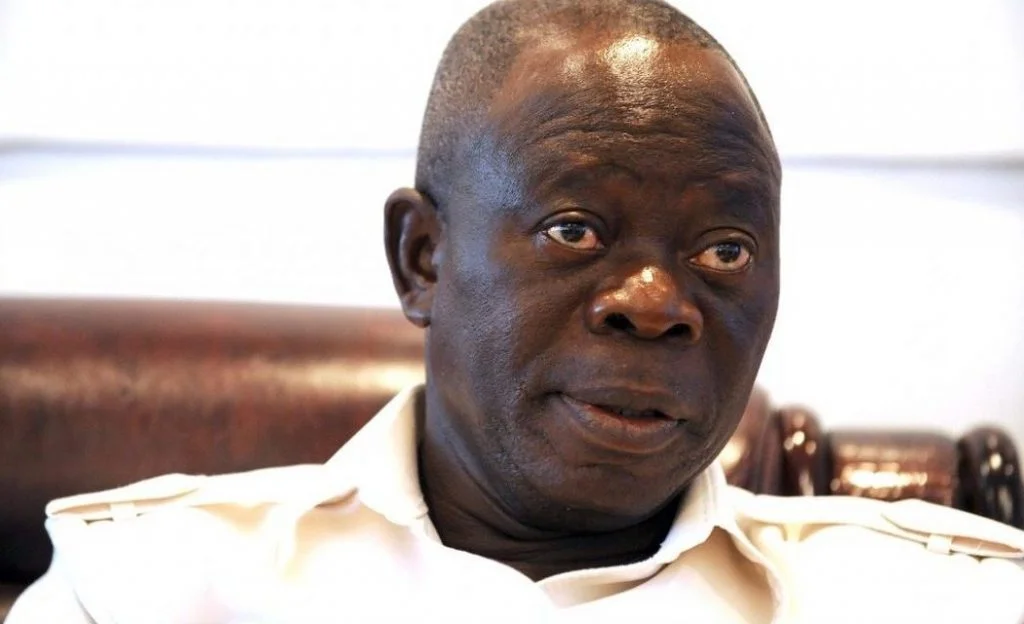
Senator Adams Oshiomhole has called on the Federal Government to retaliate against South African businesses operating in Nigeria following the recent attacks on Nigerians in South Africa.
Speaking during plenary on Tuesday, Oshiomhole said the Federal Government should consider revoking the working license of South African owned companies such as MTN and DSTV.
He argued that Nigeria must respond firmly to what he described as persistent hostility against its citizens.
READ ALSO:South Africa To Investigate ‘Mystery’ Of Planeload Of Palestinians
“I am not going to shed tears. If you hit me, I hit you. I think it is appropriate in diplomacy. It is an economic struggle,” Oshiomhole said.
He argued that while some South Africans accuse Nigerians of taking their jobs, Nigerians should return home and take over employment opportunities created by major South African companies operating in the country, including MTN and DSTV.
“When we hit back, the President of South Africa will not only talk but will also go on his knees to recognise that Nigeria cannot be intimidated.
READ ALSO:South African Ambassador Found Dead Outside Paris Hotel
“We will not condone any life being lost. If a crime has been committed under the South African law they have the right to bring any such person to justice, but to kill our people as if we are helpless, we will not allow that,” Oshiomhole added.
DAILY POST reports that several Nigerians in South Africa have reportedly been attacked, and their businesses destroyed, in ongoing xenophobic attacks in the country.
News
IGP Orders Officers Display Name Tag On Uniform, Gives Update On State Police


The Inspector General of Police, IGP, Tunji Disu, has ordered all police personnel to always have their name tags on their uniforms for easy identification.
Disu disclosed that only police personnel who are undercover are exempted from displaying their name tags.
Speaking on Tuesday, Disu said: “All police officers should have their name tags. All of us on the high table have our names apart from the undercover among us so if you look at all the Commissioners of Police we have our name tags, so it’s not our standard.
READ ALSO:
“All the Commissioners of Police are here and that is why we called this meeting, we have list of things like this that we will want to discuss with the Commissioners of Police, we have told them earlier and we will still let them know that every that happens within their area of jurisdiction falls under their control.”
On the issue of state police, the IGP said: “Since we got the signal that the Federal Government of Nigeria intend to establish State Police and since we are the federal police, we decided to take the bull by the horn and put down our own side of what we believe on how the state police should be run.
“A lot of things were taken into consideration, a lot of comparative analysis was done and it has been transmitted to the National Assembly.”
News
Court Orders SERAP To Pay DSS Operatives N100m For Defamation
The High Court of the Federal Capital Territory has ordered a non-governmental organization, the Socio-Economic Rights and Accountability Project, SERAP, to pay N100 million as damaged to two operatives of the Department of the State Services, DSS, for unjustly defaming them in some publications.
The court also ordered SERAP to tender public apologies to the defamed officers,
Sarah John and Gabriel Ogundele, in two national newspapers, two television stations and its website.
Besides, the organization was also ordered to pay the two operatives N1 million as cost of litigation and 10 percent post-judgment interest annually on the judgment sum until it’s fully liquidated.
Justice Yusuf Halilu of the High Court of the Federal Capital Territory gave the order on Tuesday while delivering judgment in a N5.5 billion defamation suit instituted against SERAP by the DSS operatives.
The judge found SERAP liable for unjustly defaming the two DSS operatives with allegations that they unlawfully invaded its Abuja office, harassed and intimidated its staff, in September 2024.
READ ALSO:How We Arrested Terror Suspect Who Threatened To Kill Students, Teachers In Abuja — DSS
In the offending publication on its website and Twitter handle, SERAP alleged that the two operatives unlawfully invaded and occupied its office with sinister motives.
The judge held that the publication was in bad taste especially from an organization established to promote transparency and accountability, as nothing in the publication was found to be truthful.
The DSS staff had listed SERAP as 1st defendant in the suit marked CV/4547/2024. SERAP’s Deputy Director, Kolawole Oluwadare, was listed as the 2nd defendant.
In the suit, the claimants – Sarah John and Gabriel Ogundele – accused the two defendants of making false claims that they invaded SERAP’s Abuja office on September 9, 2024..
Counsel to the DSS, Oluwagbemileke Samuel Kehinde, had while adopting his final address in the mater urged the judge to grant all the reliefs sought by his client in the interest of justice.
READ ALSO:DSS Arrests Suspected Gunrunner, Recovers 832 Rounds Of Ammunition
He admitted that although the names of the two claimants were not mentioned in the defamation materials, they had however established substantial circumstances that they are the ones referred to in the published defamation article by SERAP on its website.
The counsel submitted that all ingredients of defamation have been clearly established and the offending publication referred to the two officials of the secret police.
However, SERAP, through its counsel, Victoria Bassey from Tayo Oyetibo, SAN, law firm, asked the court to dismiss the suit on the ground that the two claimants did not establish that they were the ones referred to in the alleged defamation materials.
She said that SERAP used “DSS officials” in the alleged offending publication, adding that the two claimants must establish that they are the ones referred to before their case can succeed.
Similar arguments were canvassed by Oluwatosin Adefioye who stood for the second defendant, adding that there was no dispute in the September 9, 2024 operation of DSS in SERAP’s office.
READ ALSO:Alleged Cyberstalking: DSS Plays Video Evidence In Sowore’s Trial
He said that since SERAP in the publication did not name any particular person, the claimants must plead special circumstances that they were the ones referred to as the DSS officials.
Besides, he said that there is no organization by name Department of State Services in law, hence, DSS cannot claim being defamed adding that the only entity known to law is National Security Agency.
The claimants had in the suit stated that the alleged false claim by SERAP has negatively impacted on their reputation.
The DSS also stated, in the statement of claim, that, in line with the agency’s practice of engaging with officials of non-governmental organisations operating in the FCT to establish a relationship with their new leadership, it directed the two officials – John and Ogunleye – to visit SERAP’s office and invite them for a familiarization meeting.
The claimants added that in carrying out the directive, John and Ogunleye paid a friendly visit to SERAP’s office at 18 Bamako Street, Wuse Zone 1, Abuja on September 9 and met with one Ruth, who upon being informed about the purpose of the visit, claimed that none of SERAP’s management staff was in the country and advised that a formal letter of invitation be written by the DSS.
READ ALSO:DSS, Police Partner NCCSALW To End Terrorism, Mop Up Illegal Arms
John and Ogundele, who claimed that their interactions with Ruth were recorded, said before they immediately exited SERAP’s office, Ruth promised to inform her organisation’s management about the visit and volunteered a phone number – 08160537202.
They said it was surprising that, shortly after their visit, SERAP posted on its X (Twitter) handle – @SERAPNigeria – that officers of the DSS are presently unlawfully occupying its office.
The claimant added, “On the same day, the defendants also published a statement on SERAP’s website, which was widely reported by several media outfits, falsely alleging that some officers from the DSS, described as “a tall, large, dark-skinned woman” and “a slim, dark skinned man,” invaded their Abuja office and interrogated the staff of the first defendant (SERAP).
John and Ogundele stated that “due to the false statements published by the defendants, the DSS has been ridiculed and criticised by international agencies such as the Amnesty International and prominent members of the Nigerian society, such as Femi Falana (SAN)”.
“Due to the false statements published by the defendants, members of the public and the international community formed the opinion that the Federal Government is using the DSS to harass the defendants.”
READ ALSO:SERAP To Court: Stop CBN From ‘Implementing ‘Unlawful, Unjust ATM Fee Hike’
They added that the defendants’ statements caused harm to their reputation because the staff and management of the DSS have formed the opinion that the claimants did not follow orders and carried out an unsanctioned operation and are therefore, incompetent and unprofessional.
The claimants therefore prayed the court for the following reliefs: “An order directing the defendants to tender an apology to the claimants via the first defendant’s (SERAP’s) website, X (twitter) handle, two national daily newspapers (Punch and Vanguard) and two national news television stations (Arise Television and Channels Television) for falsely accusing the claimants of unlawfully invading the first defendant’s office and interrogating the first defendant’s staff.
“An order directing the defendants to pay the claimants the sum of N5 billion as damages for the libellous statements published about the claimants.
“Interest on the sum of N5b at the rate of 10 percent per annum from the date of judgment until the judgment sum is realised or liquidated.
“An order directing the defendants to pay the claimants the sum of N50 million as costs of this action.”
-

 Politics4 days ago
2027: Tinubu’s Re-election May Put An End To Nigeria — Baba Ahmed Warns
-

 Metro5 days ago
I’m A Street Girl’ – Bimbo Ademoye Clashes With Area Boys [VIDEO]
-

 Politics5 days ago
BREAKING: 2027: Former Adamawa APC Guber Candidate, Aishatu Binani Defects To NDC
-

 Politics5 days ago
Senatorial Seat: Ogbakha-Edo Warns Against Imposition Of Candidates In Edo South
-

 Business3 days ago
JUST IN: Nigerian Filling Stations Reduce Fuel Price After Hike
-

 Entertainment4 days ago
Actress Eniola Badmus Gets New Federal Appointment
-

 News5 days ago
10 African Countries With Highest Petrol Prices In Prices In April 2026
-

 News2 days ago
BREAKING: Wike Picks Alabo George For Rivers Governorship
-

 Politics3 days ago
NDC Speaks On Peter Obi, Kwankwaso Joining Party
-

 News3 days ago
OPINION: Why South Africans Murder Nigerians In Cold Blood
