
News
OPINION: Why My English Speaks Yoruba

By Lasisi Olagunju
“You taught me language, and my profit on it / Is, I know how to curse” (William Shakespeare: ‘The Tempest’).
The Nigerian government and the Nigerian Academy of Letters are fighting over which language to use in training our kids.
In a recent decision, the government cancelled the language policy which said the first six years of a child’s schooling should be delivered in the language of their local environment. The government probably felt that English is the language of our masters, its owner, so, it cancelled the extant policy rooted in the mother-tongue. It has ordered that henceforth English is the sole language of instruction at all levels of education in the country.
William Shakespeare’s fecundity sows seeds in all fields. He has this passage of lamentation in Richard II:
“The language I have learnt these forty years, /My native English, now I must forgo; /And now my tongue’s use is to me no more/ Than an unstringed viol or a harp, /Or like a cunning instrument cased up /Or, being open, put into his hands /That knows no touch to tune the harmony.”
Above, Shakespeare’s character mourns the loss of his voice, his expression, his linguistic identity. His lines embody a metaphor for linguistic helplessness, for mental dislocation, and forced silence. He says the language he mastered as a youth now lies useless; he laments that his tongue is now a useless instrument, an “unstringed viol or a harp” incapable of producing music.
With permission from Shakespeare, I donate that quote to the children of Nigeria. Their “tongue’s use is to (them) no more.” The Nigerian Academy of Letters (NAL) issued a warning last Friday about the dangers of reversing the language policy of Nigeria. The language policy, recalled the academy, was carefully designed “to promote mother-tongue-based multilingual education by ensuring that children received instruction in the language of their immediate environment during their first six years of schooling.”
MORE FROM THE AUTHOR:OPINION: Absurd Wars, Absurd Lords
Grandfather of Linguistics, 96-year-old Noam Chomsky, in 2013 delivered a series of lectures on ‘What kind of creature are we?’ The first in the series he entitled ‘What is Language?’ To answer the question, he deploys words and clauses spread over 19 pages. I read him as he says that “language is not sound with meaning but meaning with sound.” More importantly, he draws our attention to the traditional conception of language as “an instrument of thought.” I flow with that.
How I think is how I write. Week after week here, I write what I think. Thinking in Yoruba and writing in English is a pleasant affliction that has been part of me since I learnt to put white chalk on black slate. There has never been a conflict; my early teachers taught me everything in the language I encountered at the dawn of my day. That is why my English speaks Yoruba with all its properties. I listen to it and I like the music – probably because it is my music.
If the government won’t do what is right, parents should brace up and save the future. Read Katherine Reid and her colleagues in their ‘Parents as the first teachers’ published in October 2025. They say “early lexical development predicts later vocabulary, critical literacy skills including reading comprehension and, in turn, academic success.” They add that “because parents are typically their children’s first teachers, some intentionally and actively teach their children new words, while others prefer to expose them to language through rich interactions with the world around them in their daily lives.”
In his ‘Language Learning’ published in February 1970, American philosopher of Language, Gilbert Harman, tells us that “the primary use of language is in thought. Knowing a language is being able to think in it.” Chomsky also writes on what he calls “the fundamental Cartesian insight that use of language has a creative character.” But, is it not true that you cannot innovate in a language you do not fully understand? Professor Babs Fafunwa, in his ‘History of Education in Nigeria’ (1974), says mother tongue is “the first language learnt in the home, the language of the child’s immediate environment, the language in which the child thinks and feels.” Before him and after him, there have been studies after studies which have found that “children who start learning in their mother tongue tend to perform better academically, even upon transitioning to another language later.” (Read ‘Language of Instruction Policy in Nigeria’ by Thelma Ebube Obiakor; read N. Hungi and F.W. Thuku’s ‘Differences in pupil achievement in Kenya: Implications for policy and practice’ (2010).
MORE FROM THE AUTHOR:OPINION: Trump’s Wrath Of Oedipus
The Nigerian Academy of Letters, in its complaint signed by its President, Professor Andrew Haruna, condemned the government’s decision on the language policy. According to the academy, dismissing the policy “so glibly, without due regard for expert knowledge and public opinion, is utterly scornful of Nigerians and does not speak well of the government’s respect for evidence-based policymaking.”
In February 1956, China tried doing almost the same thing our government has just done. China toyed with the idea of replacing its Chinese phono-semantic characters with a new thirty-letter Latin alphabet. Chinese nationalists bitterly denounced the initiative as “a declaration of war on China’s cultural heritage.” Read Tao-Tai Hsia’s ‘The Language Revolution in Communist China’ published in the Far Eastern Survey of October, 1956. The fact that the Chinese mandarin is still a language of symbols is proof that commonsense prevailed in 1956.
A child’s first language is the child’s life. When a child acquires the right language at the right age and stage, it develops cognitively well. That is what experts say. But it is not as if we fully obey what our policy says on the language of schooling. We mix, we switch and adapt and we are getting by. But to decree English, the language of our masters, as the sole vehicle of transport is to get the traveller stranded and marooned where footpaths of development meet.
In another piece today, I wrote about Dr Samuel Crowther’s Abeokuta contest of 1860. The man used science to defeat native doctors. The story has deeper implications than a fight over space, pots and plots. It is about props. In drama, prop is that ‘portable’ item which an actor interacts with. When a soldier holds a sword in a fight scene, he is holding a prop. The future belongs to those who master the right props, the real principles that frame the world. Crowther’s props were scientific instruments. His rivals’ props were charms. When Crowther’s controlled explosion roared, the self-proclaimed ‘medicine men’, adorned in costly garments and charms, fled in terror. In their terror and flight, we see loud display collapse before quiet science. The science and the drama and the resultant chaos demonstrate the superiority of calm knowledge over loud, ostentatious power. The moral is that knowledge-based education defeats performance-based traditions. The same principle underlies the National Language Policy: a child’s language of thought is their first prob in class; children must first understand in order to innovate.
MORE FROM THE AUTHOR:OPINION: Kukah And A Nation Of Marabouts
With their mother tongues, China and Korea have established themselves as tech world powers. Could they have done that if they flip-flopped as Nigeria has just done with its own policy? A post on the website of the Korean Academy describes the Korean language, Hangugeo, as “a symbol of identity and innovation.” Go beyond websites as I did. Read ‘A History of Korean Science and Technology’ by Jeon Sang-woon, Robert Carrubba, and Lee Sung Kyu. I read in that book of history more than snippets on the “Sciences of Earth and Fire”; more than the chapter that says “Chemistry began with the human manipulation of fire.” It is a history of a people who knew (and know) the place of appropriate language in education and innovation.
French chemical engineer and writer, François Le Lionnais, writes in the January 1969 issue of the journal, ‘Leonardo’ that science is an art. He argues that “there should be a discipline of the aesthetics of science.” At the core of that ‘art’ is language. The drama of 165 years ago in Abeokuta between a doctor fresh from medical training in London, and the native “physicians” who challenged him to a contest of powers, is far more than a colourful historical anecdote. It is a parable about the power of scientific knowledge, the courage of innovation, and how societies either rise by embracing modern learning or stagnate by resisting it.
I earlier spoke about props. Because China got its language policy and education right, its props today are semiconductors, satellites, and supercomputers. Korea’s props are robotics, AI, and global electronics. These countries are cool tech giants because they carefully built their futures by teaching their children in languages that let them internalise principles. We enjoy the products of their sanity and clear-mindedness. We ride their fuel-efficient cars and flaunt their sleek electronics. They built their tech steeze and sense by not climbing their palm trees from the top. They made their children understand the world in their own languages. They standardised their scientific lexicons, they enabled their generations to think, debate, and innovate in their native tongues. Only after then did they introduce English. Check Dali Yang (1990)’s “State and Technological Innovation in China: A Historical Overview, 1949-89”. Check others.
Nigeria, by returning to English-only instruction, is choosing the rustic path where science is mystery. And, you know, a 21st century society where science remains a mystery is a society stranded in yesterday. Without apology to Martin Esslin, author of ‘The Theatre of the Absurd’, his title will be apt as the name of that society.



News
Ex-Edo Gov Obaseki Reacts As His Cousin Is Beaten, Stripped

The immediate past governor of Edo State, Godwin Obaseki, has reacted to the attack on Don Pedro Obaseki, the Chief Executive Officer of Osamudia Farms.
Don Pedro Obaseki, a cousin to the immediate past governor was attacked at Uwa Primary School where he went to play football.
In a viral video, Pedro Obaseki is seen kneeling at the Oba of Benin Palace gate, before he was dragged into the palace where he was asked to crawl before some chief walked up to the scene and rescued him.
Reacting, the ex-Edo governor described the act as a “grave violation of fundamental human rights and a reckless disregard for the rule of law.”
READ ALSO: Obaseki Beaten, Stripped In Edo
Obaseki, said: “I call on security agencies to immediately investigate this matter thoroughly and transparently, identify those responsible for this barbaric act and ensure they are held accountable in accordance with the law.
“A situation where thugs and non-state actors appear to freely take the law into their own hands on behalf of high-profile individuals and those in positions of authority can only result in one outcome, a degeneration into a state of anarchy, which will do no one no good.”
He further charged, “I urge human rights organizations, civil society groups, and all well-meaning Nigerians to lend their voices and speak out firmly against this injustice and gross violation of human rights.”
News
New Tax Laws: Suspend January 2026 Implementation — Senator Ndume Tells Tinubu
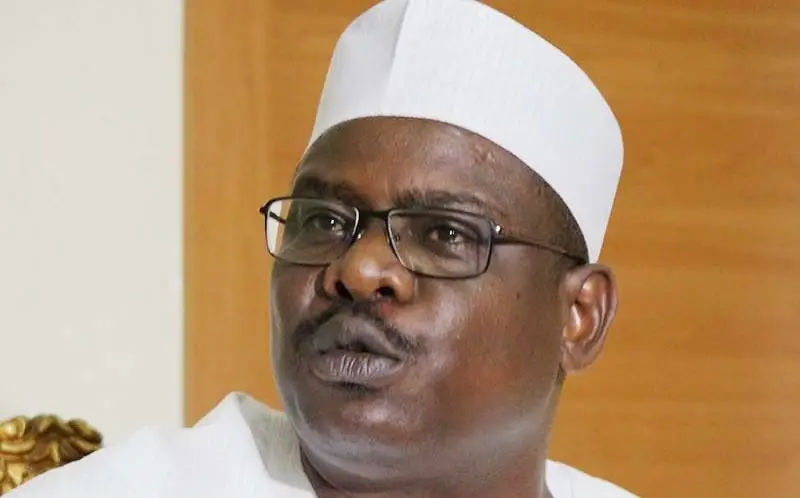
Former Senate Leader, Ali Ndume has appealed to President Bola Ahmed Tinubu to suspend the January 1, 2026, implementation of the country’s new tax laws amid growing controversy.
The federal lawmaker made the appeal in a statement he issued on Wednesday in Abuja.
This comes as the Nigerian Bar Association demanded the suspension of the implementation.
Recall that a member of the House of Representatives, Abdussamad Dasuki, had last week called the Parliament’s attention to alleged alteration to the tax laws.
READ ALSO:FIRS Confirms NIN As Tax ID
Chairman of the Presidential Fiscal Policy and Tax Reforms Committee, Taiwo Oyedele, in an interview on Arise Television on Wednesday, called for calm over claims of alterations in tax laws and urged Nigerians to allow lawmakers to complete their investigation before drawing conclusions.
Speaking on the ongoing controversy about the tax laws, Ndume noted that proceeding with the implementation without getting to the root of the alleged forgery will create a legitimacy challenge for the tax laws.
His statement read, “With the controversy surrounding it, the President should constitute a team to verify the veracity of the claim and act accordingly.
“As the responsive leader that he has always been, he should look at it to find out if the copy that was signed and the claim of alterations are genuine so that he will do the needful to bring the controversy to rest.
READ ALSO:US Threatens To Sanction Countries That Vote For Shipping Carbon Tax
“If not, the controversy will continue.” That is to say, the tax law will not be implemented, because you can’t build on nothing.
“So, Mr. President should suspend the implementation until the issues are resolved because so many civil society organizations, the Arewa Community, and the Nigerian Bar Association are saying that he should withdraw the tax law and investigate the allegation of forgery.”
“Therefore, Mr President should get to the root of the allegation of forgery. The small committee that will be set up should look into it while the House of Representatives does its own.”
News
Tambuwal Engages Security Agencies As US Airstrikes Hit Own LG In Sokoto
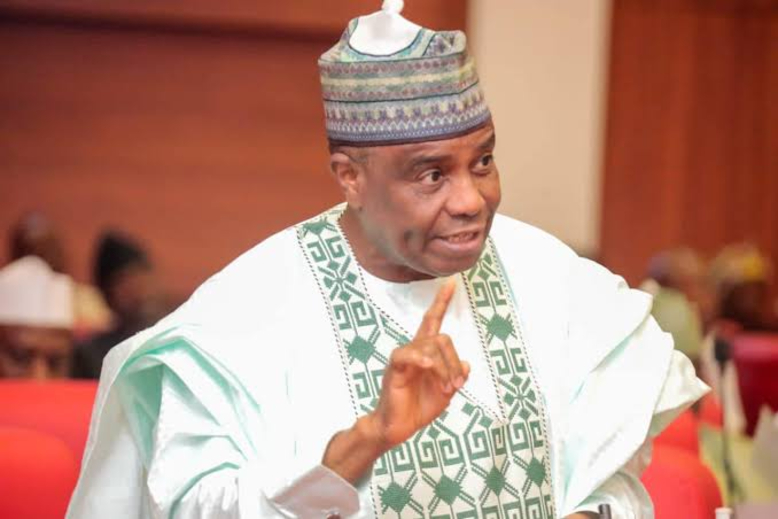
Senator Aminu Waziri Tambuwal, representing Sokoto South, has called on residents of Sokoto State to remain calm following reports of United States airstrikes targeting ISIS-linked terrorists on Christmas Day.
In a statement posted on his personal X account, the former Sokoto State governor said he was aware of reports concerning the airstrikes, which marked a direct US military action in Nigeria based on intelligence about ISWAP threats, and urged citizens to remain law-abiding while authorities clarify the situation.
“I have noted the reports concerning an airstrike carried out as part of ongoing counterterrorism efforts through cooperation between the federal government of Nigeria and the United States,” Tambuwal said. “I urge our communities to remain calm and law abiding as relevant authorities clarify the circumstances surrounding the operation.”
READ ALSO:US Dept Of War Shares Video Of Air Strikes In Nigeria
Tambuwal assured constituents that he was engaging with relevant security agencies to obtain full details of the operation and to ensure that necessary things were in place to protect civilians.
“I wish to assure the people of Sokoto South that I am in active talks with relevant security authorities to obtain full details and ensure that all necessary safeguards are upheld,” he added.
The senator emphasised that counterterrorism operations were aimed strictly at criminal and terrorist elements threatening public safety, not innocent civilians who are often victims of insecurity. He stressed that the protection of civilian lives must remain central to all legitimate security actions.
He further called on community leaders, traditional institutions and residents to work closely with security agencies by sharing credible intelligence and resisting misinformation capable of causing fear or heightening tension.

 News5 days ago
JUST IN: Kano Lawmaker, Sarki Aliyu Daneji, Dies Hours After Colleague’s Passing
- News5 days ago
FULL LIST: Churches That Don’t Celebrate Christmas
- Headline3 days ago
JUST IN: US Forces Bomb Terrorists Camps In Nigeria
- News4 days ago
Okpebholo Slams ₦25bn Libel Suit On Edo PDP Chairman
- Headline3 days ago
US Dept Of War Shares Video Of Air Strikes In Nigeria
- Entertainment5 days ago
AFCON 2025: Davido Wins $96,000 After Super Eagles Beat Tanzania
- News5 days ago
7 Health Risks Of Owning A Cat
- News5 days ago
Sheikh Gummi Sues Two Over Alleged False Facebook Publication
- Headline5 days ago
Coup: Guinea-Bissau Junta Releases Six Held Opposition Politicians
- News3 days ago
PHOTOS: SGF George Akume Weds Ooni’s Ex-Queen


