
Headline
Qatar Makes U-turn, Says Investment Forum ‘ll Hold During Tinubu’s Visit
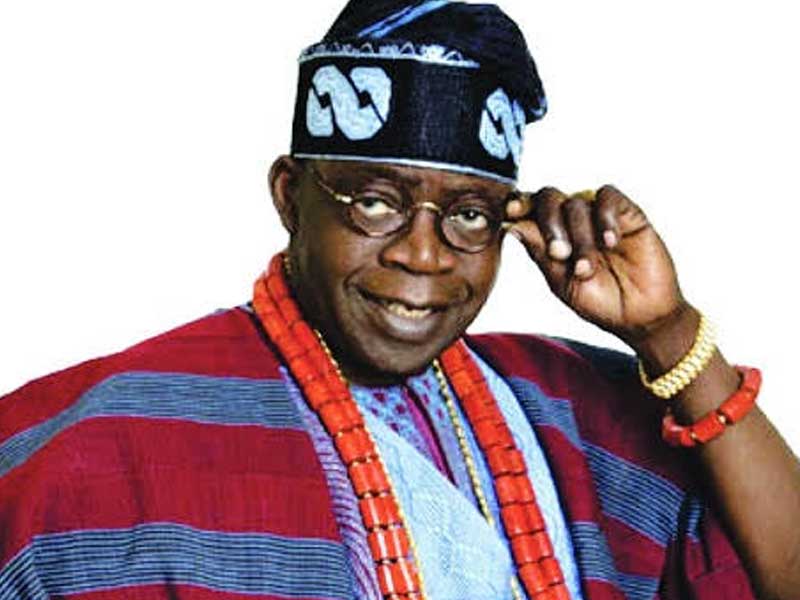
Qatar has made a U-turn on its decision not to host the business and investment forum proposed by President Bola Tinubu during his visit slated for March 2, 2024, to the Arab country.
This followed a leaked memo on Saturday which showed that Qatar declined the proposed investment forum, citing the unavailability of the country’s minister of commerce and industry, Mohammed Bin Hamad Al-Thani.
Also, the embassy of Qatar in Abuja had said there is no agreement between the Arabian country and Nigeria regarding the investment forum.
Recall that the Embassy of the State of Qatar in Abuja stated this in a letter dated February 22 2024 addressed to the Protocol Department of the Ministry of Foreign Affairs in Nigeria.
READ ALSO: $6.2m Fraud: Presidency Asks INTERPOL To Arrest Three Suspects
But in the letter, which was received by the ministry on February 23 2024 and sighted by our correspondent on Saturday, the Ministry of Commerce and Industry in Qatar apologised for the rejection of the proposed business visit.
Reacting to the alleged rejection, the Presidency said the Qatari government did not snub Tinubu.
It explained that the botched investment forum between the Nigerian and Qatari business communities was only one of several events lined up ahead of the President’s state visit to the Gulf country.
“It is not correct for anyone to insinuate that the Qatari authorities have snubbed the Nigerian leader over a business and investment forum which is tangential to the all-important state visit and which President Tinubu is slated to attend as a guest,” a statement signed by Tinubu’s Special Adviser on Information and Strategy, Bayo Onanuga, on Saturday read.
READ ALSO: Presidency Reacts As Qatar Allegedly Rejects Tinubu’s Visit, Business Talk
Onanuga, in a statement titled, ‘President Bola Tinubu’s state visit to Qatar,’ in response to a leaked note between the foreign ministries of both countries explained that Tinubu was expected to proceed to Qatar on the state visit as scheduled and during the visit, the Nigerian leader would engage in high-level bilateral discussions with Qatari leader on many important matters, covering the full range of diplomatic and economic issues.
However, in a twist of event, the Qatari has confirmed that the business parley will be held during Tinubu’s visit to the country in a memo dated Sunday, February 25, 2024, addressed to the Ministry of Foreign Affairs.
Qatar embassy said, “Regarding the upcoming State visit of H.E. Bola Ahmed Tinubu, President of the Federal Republic of Nigeria to Qatar from 2nd-3rd March 2024 and with reference to our Note: Ref: QEA/FA/057/24 dated 22/02/2024 regarding holding of a Business and Investment Forum (BIF) on the margins of Mr. President’s visit to Qatar on 2nd March 2024.”
“The Embassy has the honour to convey that the Qatar Chamber of Commerce will host the above-mentioned event on March 3, 2024, as proposed by the Nigerian side.”



Headline
Russia, China Afraid Of US Under My Administration — Trump
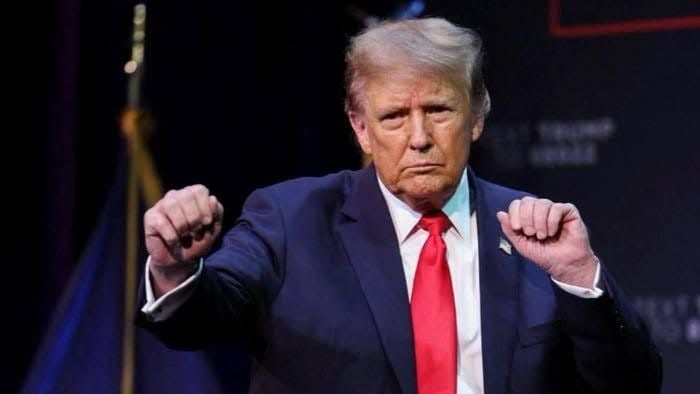
United States President, Donald Trump, has said Russia and China fear the United States because of the strength of his administration, arguing that American global influence is driven primarily by its military power and leadership.
Trump, in a post on Truth Social on Wednesday stated that rival powers would not take NATO seriously without the United States, claiming the alliance lacks deterrent force in the absence of American involvement.
He expressed doubts about whether NATO members would come to the aid of the US in a real crisis, despite Washington’s continued commitment to the alliance.
READ ALSO:Trump To Withdraw US From 66 UN, International Organisations
The president credited his leadership with rebuilding the US military during his first term and sustaining its strength, describing this as the key reason adversaries show respect and caution toward the country.
He maintained that America’s military dominance has played a central role in preserving global stability and saving lives.
Trump also argued that his administration forced NATO members to increase defence spending, saying many allies had previously failed to meet financial commitments while relying heavily on the US.
READ ALSO:Insecurity: US Congressman Riley Moore Reveals Trump’s Mission In Nigeria
He added that his actions helped prevent further escalation in Eastern Europe and contributed to the resolution of multiple conflicts.
According to Trump, the United States remains the only nation that commands genuine fear and respect from both Russia and China, a position he attributed to his administration’s approach to defence, diplomacy, and global leadership.
“He wrote partly, “The only Nation that China and Russia fear and respect is the DJT REBUILT U.S.A. MAKE AMERICA GREAT AGAIN!!! President DJT.”
Headline
Trump To Withdraw US From 66 UN, International Organisations
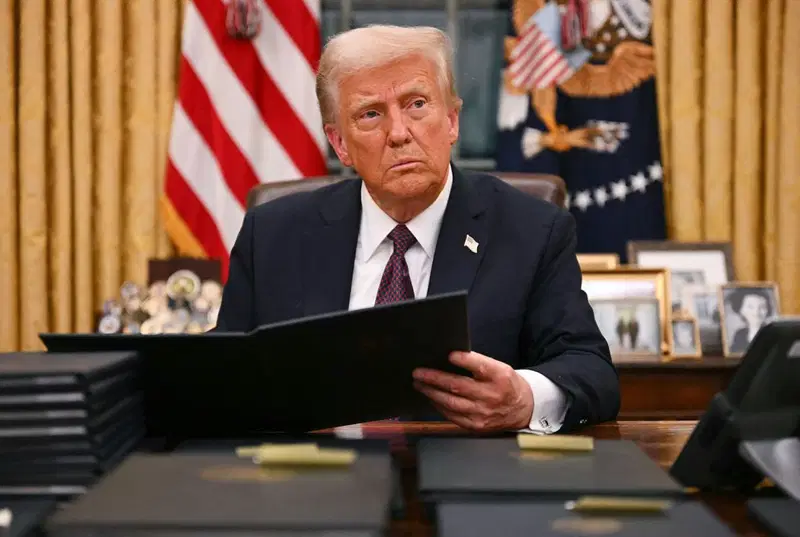
United States President, Donald Trump, has announced plans to withdraw the US from 66 United Nations and international organisations, including key global bodies focused on climate change, peace and democracy.
The decision was disclosed in a presidential memorandum released by the White House on Wednesday evening, following a review of which “organizations, conventions, and treaties are contrary to the interests of the United States.”
According to Trump, the move will see the US end its participation in the affected organisations and cut all related funding.
A list shared by the White House showed that 35 of the organisations are non-UN bodies, including the Intergovernmental Panel on Climate Change (IPCC), the International Institute for Democracy and Electoral Assistance, and the International Union for Conservation of Nature.
READ ALSO:Trump’s Airstrikes: Halt Military Cooperation With US Immediately – Sheikh Gumi Tells Tinubu Govt
Although listed as a non-UN body by the White House, the IPCC is a United Nations organisation that brings together leading scientists to assess climate change evidence and provide periodic reports to guide political leaders.
The memorandum also announced the US withdrawal from 31 UN entities, including the UN Framework Convention on Climate Change (UNFCCC), the UN Democracy Fund, and the UN Population Fund (UNFPA), which focuses on maternal and child health.
Several of the targeted UN bodies are involved in protecting vulnerable groups during armed conflicts, including the UN Office of the Special Representative of the Secretary-General for Children and Armed Conflict.
Reacting to the announcement, UN spokesperson Stephane Dujarric said in a note to correspondents on Wednesday evening that the organisation expected to issue a response by Thursday morning.
Despite repeatedly stating his desire to limit US involvement in UN forums, Trump has continued to exert influence on international decision-making.
READ ALSO:Trump Using FBI To ‘Intimidate’ Congress, US Lawmakers Cry Out
In October last year, he threatened to impose sanctions on diplomats who formally adopted a levy on polluting shipping fuels that had already been agreed to at an earlier meeting, a move that stalled the deal for 12 months.
The Trump administration also sanctioned UN special rapporteur Francesca Albanese after she released a report detailing the role of international and US companies in Israel’s genocidal war on Gaza.
During his first term in 2017, Trump similarly threatened to cut aid to countries that supported a draft UN resolution condemning the US decision to recognise Jerusalem as Israel’s capital.
As a permanent member of the UN Security Council, the US wields significant influence at the United Nations, including veto power, which it has repeatedly used to block efforts to end Israel’s war on Gaza before later mediating a ceasefire.
(Aljazeera)
Headline
UK Supported US Mission To Seize Russian-flagged Oil Tanker – Defense Ministry
The British Ministry of Defence said on Wednesday that it provided support to the United States in its operation to seize a Russian-flagged oil tanker in the North Atlantic.
US seized the tanker, which was being shadowed by a Russian submarine on Wednesday, after pursuing it for more than two weeks across the Atlantic as part of Washington’s efforts to block Venezuelan oil exports.
According to Britain, its armed forces gave pre-planned operational support, including basing following a US request for assistance.
READ ALSO:UK Introduces Powers To Seize Phones, SIM Cards From Illegal Migrants
The UK also said a military vessel provided support for the US forces pursuing the tanker, and the Royal Air Force provided surveillance support from the air.
Defence Secretary John Healey stated that the operation targeted a vessel with a nefarious history linked to Russian and Iranian sanctions evasion networks.
“This action formed part of global efforts to crack down on sanctions busting,” he said in a statement.
READ ALSO:Venezuelan Deportees: US Embassy Gives Reason For Reducing Visa Validity For Nigerians
According to him, the US was Britain’s closest defence and security partner.
“The depth of our defence relationship with the US is an essential part of our security, and today’s seamlessly executed operation shows just how well this works in practice,” he added.
The British government said that the Bella-1 tanker, now renamed Marinera, is sanctioned by the US under its counter-Iran sanctions,
The MoD statement said the support was provided in full compliance with international law.

 Business4 days ago
NNPCL Reduces Fuel Price Again
- News2 days ago
How To Calculate Your Taxable Income
- Metro4 days ago
AAU Disowns Students Over Protest
- Metro4 days ago
Edo: Suspected Kidnappers Kill Victim, Hold On To Elder Brother
- Metro2 days ago
JUST IN: Court Grants Malami, Wife, Son N500m Bail Each
- Headline2 days ago
Russia Deploys Navy To Guard Venezuelan Oil Tanker Chased By US In Atlantic
- Metro4 days ago
Nine Soldiers Feared Dead In Borno IED Explosion
- Metro2 days ago
Edo widow-lawyer Diabolically Blinded Over Contract Seeks Okpebholo’s Intervention
- Entertainment2 days ago
VIDEO: ‘Baba Oko Bournvita,’ Portable Drags His Father, Alleges Bad Parenting, Extortion
- Entertainment4 days ago
VeryDarkMan Finally Unveils Girlfriend Amid Alleged Relationship With Jojo Of Lele


