
News
Rivers: Beyond Wike And Fubara [OPINION]
By Lasisi Olagunju
Chief Obafemi Awolowo’s 1947 book, ‘Path to Nigerian Freedom’, opens with three quotations. The first tells the reader: “This above all: to thine own self be true…” It is from William Shakespeare’s ‘Hamlet’. It simply says do not deceive yourself – like the one with a sore in the right leg but who nurses the healthy left. The one who deceives himself suffers deception from the gods.
The second quote, from Shakespeare’s ‘King Lear’, is a warning that “Who cover faults, at last shame them derides.” In today’s English, it says those who cover their faults always end up being shamed by them. The third quotation enjoins you to “fight all opinions contrary to truth, but let your weapons be patience, sweetness, and charity…” The words belong to an 18th century Catholic saint, John of Kanty, who ended that quotation with a counsel that the best cause almost always gets spoilt by violence.
My eyes caught the quotes as I was considering recommending ‘Path to Nigerian Freedom’ to the gladiators fighting to the death in Rivers State and to the puppeteers behind the problem. If the 134-page book is too thick for them to read, at least, they should buy the three quotes for their politics and, especially, for their politicking.
Rivers State suffers the oríkì of an oba who profits from planting corn of trouble in the backyard of his victims. The king’s fruited corn must not be harvested and, it must not be destroyed. It is trouble.
The people behind the crisis in that state are those who urge the creditor to demand his pay and, at the same time, nudge the debtor to repudiate his debt. Their goal is conflict that benefits the palace.
Yes, dirty water quenches fire but why not use clean water which neither stains nor stinks?
Very wild Rivers State conducted its local government elections two days ago without police presence. The police stayed away and the state said it didn’t miss them. In scoring that first, Rivers State has helped us ask two pertinent questions: is the Nigeria Police Force for the Federation of Nigeria or for the Federal Government of Nigeria? Who should determine what goes on in the local governments? Is it the state or the federal government?
In a properly structured family, a slave knows himself as slave; the indentured knows what he is too (Eru a mo’ra e l’eru; Iwofa a m’ora e ni Iwofa). If Nigeria were a properly structured nation, last week’s drama between Governor Sim Fubara of Rivers State and the Inspector General of Police would be very unnecessary. Who should be in charge of security in Rivers State? Who should be in charge of the local governments there? The Federal Government or the State Government? Or who?
We may not be a very good record-keeping country, but those who enslaved us kept and still keep records. We see in colonial records, including the Hansard of the British parliament, tomes of materials which tell us that Nigeria is a negotiated country. Every bit of its structure was argued and fought over by the founding fathers who did not take anything for granted. On Wednesday, 21 October, 1953, Lord Milverton briefed the British House of Lords on what he called “prospective constitutional developments in Nigeria.” It was essentially a report of that year’s constitutional conference. Here, I am interested in what Lord Milverton said the leaders of the Nigerian people agreed to on the structure and control of the police. Milverton said: “The Conference agreed that the police, other than local authority and native authority police, should be a central function, but control of police contingents stationed in the regions is to be vested in the regional commissioners of police, who will be responsible solely to the Governor of the region, who, in turn, will be responsible only to the Governor-General. I regard this as a very satisfactory decision, to avoid the danger of the police coming under the control of a political party.”
MORE FROM THE AUTHOR: OPINION: We Beg Bread, They Belch Beer[Monday Lines]
Subsequent constitutional conferences of 1954, 1957 and 1958 had variants of this agreement. And there are records that show that two of the regions – the West and the North – which already had local authority and native authority police, demanded regional police in addition to a central police force. The Western Region, especially, believed that “a centralized police force” would most certainly become the “deadliest weapon for any dictator.” But, the Independence Constitution of 1960 struggled to allay the fears of, especially, the West on the potentiality of a federal government appropriating the central police to decimate the regions. The drafters of the constitution – and of subsequent ones – thought that the creation of a Police Council to own and manage the Nigeria Police would keep us safe from dictators. We’ve seen how wrong the allayers of that fear were.
If you’ve ever witnessed how village folks extract kernels from palm nuts, you would understand the struggle for control of the councils between the federal government and the states. Who should manage local governments and their affairs? As flawed and inadequate as the 1999 constitution is, it contains enough hints on what local governments are and how they should be run. But our law means nothing to us – even to the courts. As usual, the judiciary shat in its pants in this Rivers matter. Federal High Court knelt for the federal; State High Court prostrated before the state. The courts messed up so much that street chickens played with their balls.
Unlike the control of the police, management of local governments was not a problem at the beginning of our journey. It is a problem created by the military which found Nigeria in a hole and stupidly dug it deeper. Their training missed for them the first law of holes. What did we inherit?
In April 1952, members of the Western House of Assembly thoroughly debated the local government system they wanted for their people. The region’s Leader of Government Business and Action Group leader, Chief Awolowo, spoke there on what he called “local self-government.” He explained this to mean “a system of local government wherein local councils make, accept responsibility for and implement their own decisions.” A year later, Chief Awolowo described local governments as “the superstructure on which the regional government is erected.” Soon afterwards, the Western Region became the first to conduct council elections and introduce elected representatives into the local government system in Nigeria. That was in June 1953. And the elections were free and fair to the extent that an Adegoke Adelabu got elected as Chairman of Ibadan District Council under a regional government headed by Chief Awolowo. The elections were strictly a regional matter.
MORE FROM THE AUTHOR: OPINION: ‘I am Here to Plunder’ [Monday Lines]
If today’s Federal Government had known its limits, it wouldn’t have suffered the disgrace it suffered in Rivers State at the weekend. The election it struggled to frustrate eventually held. And I see it as a victory for federalism and one major step in our forward march to defeat the current forces of resurgent unitarism.
Should the eye ever forget what the heart has seen? Those words impose on us the duty of protecting our heritage. The people in charge of the government in Abuja today claim to be followers of Chief Awolowo. They claim Awolowo but want states and local governments in their federal pockets. How do they think Awo would have taken it as premier if Prime Minister Tafawa Balewa had attempted to organise an election into Ibadan District Council? Or seek to use federal police to stall the conduct of elections into Western Region’s Divisional Councils?
Our state governors may have not managed excellently the local governments, but digging a hole to fill another will most certainly pockmark the face of the earth. When states conduct local government elections, the ruling party wins all. The present set of governors inherited that wrong from those who had been there, including the incumbent president. We do not find what the governors do with the councils funny at all. We think what they do is not democracy; we think it shames democracy. And what solution do we have? Use the federal police to balance the terror.
What else are we brewing? We have before the Senate a bill seeking to establish an agency for the federal government to conduct local government elections. The promoters call it Local Government Independent Electoral Commission Establishment Bill 2024. The day that bill is passed and signed into law is the day Nigeria becomes Paul Biya’s Cameroun. Check who Paul Biya is and what he means to the peace of his country and to the prosperity of his people.
You remember how Shakespeare’s Cassius paints the canvas of imperial Caesar?: “Why, man, he doth bestride the narrow world/ Like a Colossus, and we petty men/ Walk under his huge legs and peep about/ To find ourselves dishonorable graves.” Historical Caesar truly became a colossus when he seized control of all Roman structures. In the vicious contest for the control of the local governments between the presidency and the governors, behind whom would you queue? My own vote on this would go to the governors. Why? Let me ask: is it not better to have 36 mini emperors ‘assisting’ us to hold down an elephantine imperial presidency than to have a sole administrator, a real Caesar, bestriding the whole Nigerian world like a colossus?
MORE FROM THE AUTHOR: OPINION: Marriage, Yes; Education, No [Monday Lines]
The theory of unintended consequences has ensured that governors fill the void left by what should be a virile opposition and a checking legislature. You will understand my drift if you’ve ever seen how a cackle of hyenas tackle conceited Lion, king of the jungle, and cut him to size. They have to, otherwise they all become endangered, and the forest becomes a proper state of nature – a nasty, brutish dictatorship.
Olusegun Obasanjo’s presidency was stopped by the governors. Governor Bola Tinubu was the field commander in that battle. Umaru Yar’Adua’s and Goodluck Jonathan’s presidential tenures suffered pacification at the hands of their governors. The governors of those eras, warts and all, reined in the omnipotent presidents and we and our democracy were the better for it. Then a paternalistic, free-roaming Muhammadu Buhari came and tamed the governors, and crashed the plane, and landed all of us in this emergency ward. We will see the worst of it with the grasping present.
Fortunately we have a set of governors for whom flames in the tiger’s eyes signify nothing. And these governors are from all parties who have governors.
Imagine 220 million Nigerians peeping under the huge mahogany legs of a presidential table begging to breathe. The spectacle of a begging nation is worse than miserable minions peeping about in search of “dishonorable graves.” And we will have it the moment this president, or the next one, is allowed to ‘elect’ chairmen and councilors into the 774 local government councils.
I try to loan myself sense on the crisis in Rivers State. The issue there is beyond Nyesom Wike and Sim Fubara. The two gentlemen, in fact, need to be rescued; they are grasshoppers in the hands of some wanton gods. Some harvesters’ silos need the grains of that fight for their barns to be truly full. A grisly game of thrones is, therefore, afoot. Wike and Fubara and their Rivers are mere boots in that battle.
The very week of our independence anniversary was the week we experienced Rivers State.
Public intellectual and ebullient media icon, Ambassador Yemi Farounbi, early last month sent me a text: “I’m getting worried by the increasing distance from good governance, the rapid movement towards dictatorship and the deafening graveyard silence within the Nigerian elites.”
The day Nigeria celebrated its 64th independence anniversary was the day Farounbi turned 80. Amidst all the dirt and madness around, the old man has managed to keep his medal of sanity. A man with such a journey and unique birth date should be celebrated with the nation. But there was no reason to roll out the drums. For our country, the auguries are not good.
If you make a dove president of Nigeria, the present structure will transform that dove into a hawk overnight. Too much money and too much power at the centre is what I meant by ‘structure’. Everything comes down to the imperative of meeting our demand for a proper federation run on the principles of true federalism. We run an inverted federation of the centre holding the ladle at the dining table. The current revenue sharing formula gives the federal government 52.68 percent, the 36 states 26.72 percent and the 774 local governments, 20.60 percent. The oil-producing states take 13 percent as derivation revenue. Typically in this Orwellian contraption, Big brother harvests more than it should take. The Federal Government takes more than half of everything, yet it cheats.
I am aware that four states are currently before the Supreme Court asking my Lords to order the president to obey Section 162 (1) and (3) of the constitution. The section makes it mandatory for all monies made by the federation to go into the federation account. Section 162(3) provides that “any amount standing to the credit of the Federation Account shall be distributed among the federal and state governments and local government councils in each state of the federation on such terms and in such manner as may be prescribed by the National Assembly.”
But the states say that the Federal Government, in the name of deductions and transfers; refunds and interventions, cheats them and the local governments monthly. For instance, at the July 2024 meeting of the Federation Account Allocation Committee (FAAC), N1.35 trillion was shared to the three tiers of government as allocations for the month of June 2024 from a total gross revenue of N2.4 trillion. There is a difference of over N1 trillion between what the federation admitted making in that month and what the tiers of government shared. Check other months; the pattern is the same. We wait to see what the Supreme Court will say on those four cases. It will make new laws.
The fear of the worst happening is ever present. The consolation is in one of the lines I dropped here some weeks ago. “The closer the collapse of the empire, the crazier its laws are.” The quote belongs to Roman orator, lawyer and statesman, Marcus Tullius Cicero. You must not keep quiet, covering your faults and letting them shame you. We should know that when it rains – and it will rain – all roofs will get wet. And, so with charity and sweetness of patience, we must continue to “fight all opinions (that are) contrary to truth.”



News
NiMet Warns Of Flash Flooding In 19 States

The Nigerian Meteorological Agency (NiMet) has warned that 19 states across the country may experience flash flooding.
In an advisory issued yesterday, NiMet said increased surface runoff and flash flooding could occur during heavy early rains due to dry and hardened soils that prevent water from properly soaking into the ground.
The agency listed the states likely to be affected as Zamfara, Nasarawa, Kwara, Oyo, Lagos, Ogun, Ekiti, Delta, Imo, Anambra, Enugu, Ebonyi, Akwa Ibom, Cross River, Rivers, Edo, Ondo, and Bayelsa.
NiMet said the possible impacts include flooded roads, traffic disruption, damage to homes, farmlands, and infrastructure, blocked drainage systems, power outages, telecommunication disruptions, and increased risks of injuries and water-borne diseases.
READ ALSO:Meningitis: NiMet Lists High-risk States
The agency advised residents to clear blocked drainage and stay updated with weather and flood alerts.
NiMet also cautioned motorists and pedestrians against driving or walking through flooded areas.
The agency asked relevant authorities and stakeholders to strengthen coordination, preparedness, and emergency response measures to reduce flood-related risks.
“An informed community is a prepared community. Know the risks and act early,” the advisory read.
READ ALSO:NiMet Predicts Three-day Rain, Thunderstorms From Monday
The Federal Government had warned that 14,118 communities in 33 states and the Federal Capital Territory (FCT) are at risk of severe flooding in 2026.
The states include Abia, Adamawa, Anambra, Bauchi, Bayelsa, Benue, Borno, Cross River, Delta, Ebonyi, Edo, Enugu, Gombe, Imo, Jigawa, Kaduna, and Kano.
Others are Kebbi, Kogi, Kwara, Lagos, Nasarawa, Niger, Ogun, Ondo, Osun, Oyo, Plateau, Rivers, Sokoto, Taraba, Yobe, and Zamfara, and the FCT.
READ ALSO:NiMet Predicts 3-day Thunderstorms, Rains
Meanwhile, Nimet and the National Emergency Management Agency (NEMA) have intensified efforts to improve disaster management in the country with plans to develop a national early warning system roadmap.
The move was announced yesterday during a courtesy visit by the Director General of NEMA, Zubaida Umar, to the Director General of NiMet, Charles Anosike, at the NiMet headquarters in Abuja.
Mrs Umar applauded NiMet for the timely release of the 2026 Seasonal Climate Prediction and its consistent weather forecasts, noting that the agency had recorded significant improvements under Prof. Anosike’s leadership.
News
‘Nothing New’ – Wike Defends Houses For Judges, Dismisses NBA Criticism
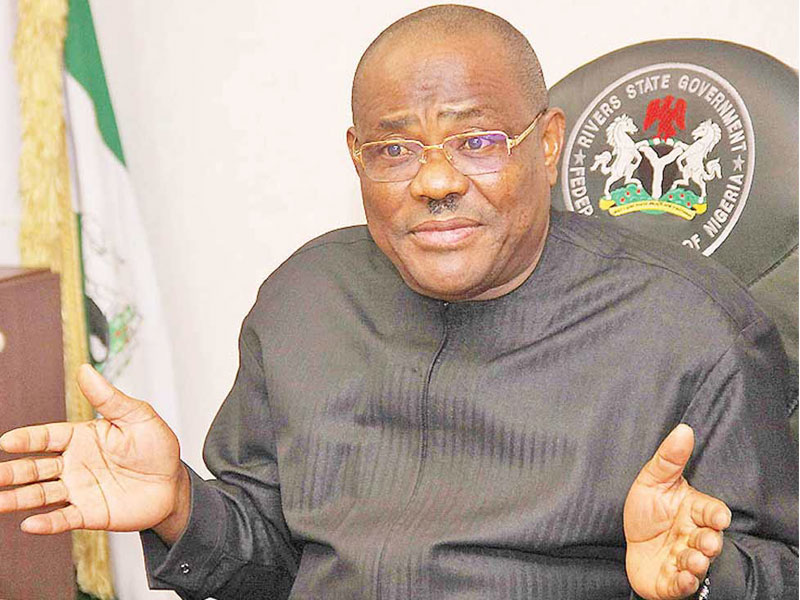
Federal Capital Territory, FCT, Minister, Nyesom Wike, on Friday defended the construction of houses for judges and justices in Abuja, dismissing concerns that the projects could compromise the independence of the judiciary.
Wike spoke after inspecting ongoing judicial infrastructure projects, including judges’ residences, the Court of Appeal Abuja Division and proposed residential projects for judges of the Industrial Court and the Code of Conduct Tribunal.
The minister’s remarks followed criticisms reportedly raised by the Nigerian Bar Association (NBA) over executive involvement in the provision of infrastructure for the judiciary.
Rejecting the concerns, Wike argued that government provision of facilities for judicial officers was neither new nor a threat to judicial autonomy.
He said: “The mere fact that the executive constructs buildings does not mean it will interfere with the judiciary.
READ ALSO:2027: Wike Opens Up On Preferred Rivers Guber Candidate
“We have built public houses for the National Assembly and for the judiciary before. The Supreme Court was built by government. So there is nothing new in this.”
Wike accused the NBA leadership of inconsistency, alleging that the association frequently sought financial support from state governments for its conferences and activities while criticising government interventions in the judiciary.
“All they are interested in is when state governments will sponsor NBA activities. If governments fund their conferences, does that mean they are no longer independent?” he queried.
He maintained that the FCT Administration would not be distracted from implementing projects designed to improve the welfare and working conditions of judges and justices.
“This is a voluntary act by government to make judicial officers comfortable and focused on their work. It is not done to erode judicial independence,” the minister added.
READ ALSO:Open Bank Account In PDP Name, See What Will Happen – Wike Dares Turaki Faction
Wike said the projects formed part of activities lined up to mark President Bola Tinubu’s third anniversary in office.
He expressed satisfaction with the completion level of the judges’ quarters, describing the project as well executed and nearly ready for inauguration.
“We’ve seen the judges’ quarters beautiful. I’m very elated that the job was done well. The houses are well furnished and almost 99 per cent ready,” he stated.
The minister also disclosed that preparations had begun for the groundbreaking ceremony of residences for judges of the Industrial Court and the Code of Conduct Tribunal.
However, he expressed dissatisfaction with aspects of the finishing at the Court of Appeal Abuja Division project, despite its advanced stage of completion.
READ ALSO:Trump Tired Of War In Iran – Shehu Sani
“Almost 90 per cent complete, but I must say it’s not the quality I expected. I have told the contractor that several errors must be corrected before inauguration,” he said.
Wike assured that the administration would continue monitoring contractors to ensure all projects are delivered according to specification and within schedule.
“All the promises that have been made, we are going to fulfil them. That is why we are going around to inspect and ensure contractors are ready,” he added.
News
LASG Fixes Dates For Public Service Exams, Releases CBT Guidelines

The Lagos State Government, through the Ministry of Basic and Secondary Education and the Lagos State Examinations Board, has released the timetable and guidelines for the 2026 Public Service Examinations.
In a statement by the Lagos State Government, the announcement, which aligns with a prior circular from the Head of Service with Ref No: CIR/HOS/’26/005 dated January 21, 2026, sets out key instructions for candidates preparing for the exercise.
The examinations will hold between Tuesday, May 12 and Tuesday, May 19, 2026, at the Lagos State Public Service Staff Development Centre (PSSDC), Magodo, Lagos.
They include the Compulsory Examination for all cadres in the State Public Service, the Combined Confirmation/Promotion Examination for Clerical Officers II (CO II) and Clerical Assistants (CA), as well as the External Secretarial Examination.
READ ALSO:Lagos Begins 2026 Civil Service Promotions
According to the board, candidates are expected to begin printing their examination slips from Tuesday, May 5, 2026, through the official portal using their registration login details.
The slip will contain key information such as each candidate’s exam date and time.
“All candidates are required to present valid identification at the examination centre. Acceptable forms of identification include Staff Identity Cards, National Identification Number (NIN) slips, and Lagos State Residents Registration Agency (LASRRA) cards,” the statement said.
Candidates are also required to bring printed copies of their examination slips to the venue and must strictly follow the date and time allocated to them.
READ ALSO:Why Tinubu Didn’t Attend Project Commissioning In Lagos —Presidency
The board further advised candidates to acquaint themselves with basic computer skills ahead of the exercise, as the examinations will be conducted using a Computer-Based Test, CBT, format.
It also warned that dressing must be formal, adding that inappropriate dressing will not be allowed at the examination centre.
Candidates were urged to comply fully with all instructions to ensure a smooth and orderly process.
“The Lagos State Examinations Board urges all candidates to comply fully with these guidelines to ensure a smooth and orderly examination process,” the statement added.

 News5 days ago
BREAKING: Wike Picks Alabo George For Rivers Governorship
- Business4 days ago
Why We Sited Our Multi-Billion Naira Automobile Firm Branch in Benin – Skyewise Group CEO
- Politics4 days ago
JUST IN: Why I left ADC For NDC With Kwankwaso – Peter Obi Opens Up
- Politics4 days ago
BREAKING: 17 ADC Reps Follow Join NDC
- Entertainment5 days ago
Why I Stopped Attending Church Service – Funke Akindele
- Business3 days ago
Again, Dangote Refinery Hikes Fuel Price
- News3 days ago
Xenophobic Attacks: Nigerian Students To Picket MTN, MultiChoice, Other Businesses
- News4 days ago
OPINION: APC’s Politics Of Consensus
- Entertainment5 days ago
‘My Mum Started Quoting Bible’ — Shank Sparks Debate After Tattoo Confession
- News3 days ago
IGP Orders Officers Display Name Tag On Uniform, Gives Update On State Police


