
Headline
Robots Hit streets Of U.S. UK As Demand For Food Delivery Grows
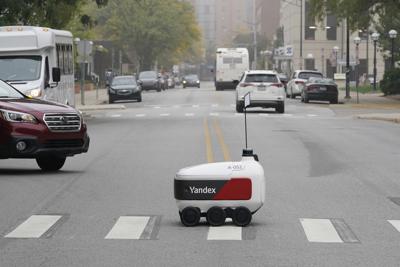
Robot food delivery is no longer the stuff of science fiction. But you may not see it in your neighborhood anytime soon, Associated Press reports.
Hundreds of little robots __ knee-high and able to hold around four large pizzas __ are now navigating college campuses and even some city sidewalks in the U.S., the U.K. and elsewhere.
READ ALSO: ICPC, DSS Arrest 48 Lecturers, Security Officers, Others For Exam Malpractices
While robots were being tested in limited numbers before the coronavirus hit, the companies building them say pandemic-related labor shortages and a growing preference for contactless delivery have accelerated their deployment.
“We saw demand for robot usage just go through the ceiling,” said Alastair Westgarth, the CEO of Starship Technologies, which recently completed its 2 millionth delivery. “I think demand was always there, but it was brought forward by the pandemic effect.”
Starship has more than 1,000 robots in its fleet, up from just 250 in 2019. Hundreds more will be deployed soon. They’re delivering food on 20 U.S. campuses; 25 more will be added soon. They’re also operating on sidewalks in Milton Keynes, England; Modesto, California; and the company’s hometown of Tallin, Estonia.
Robot designs vary; some have four wheels and some have six, for example. But generally, they use cameras, sensors, GPS and sometimes laser scanners to navigate sidewalks and even cross streets autonomously. They move around 5 mph.
Remote operators keep tabs on multiple robots at a time but they say they rarely need to hit the brakes or steer around an obstacle. When a robot arrives at its destination, customers type a code into their phones to open the lid and retrieve their food.
The robots have drawbacks that limit their usefulness for now. They’re electric, so they must recharge regularly. They’re slow, and they generally stay within a small, pre-mapped radius.
They’re also inflexible. A customer can’t tell a robot to leave the food outside the door, for example. And some big cities with crowded sidewalks, like New York, Beijing and San Francisco, aren’t welcoming them.
But Bill Ray, an analyst with the consulting firm Gartner, says the robots make a lot of sense on corporate or college campuses, or in newer communities with wide sidewalks.
“In the places where you can deploy it, robot delivery will grow very quickly,” Ray said.
Ray said there have been few reports of problems with the robots, other than an occasional gaggle of kids who surround one and try to confuse it. Starship briefly halted service at the University of Pittsburgh in 2019 after a wheelchair user said a robot blocked her access to a ramp. But the university said deliveries resumed once Starship addressed the issue.
Patrick Sheck, a junior at Bowling Green State University in Bowling Green, Ohio, gets deliveries from a Starship robot three or four times a week as he’s leaving class.
“The robot pulls up just in time for me to get some lunch,” Sheck said. Bowling Green and Starship charge $1.99 plus a service fee for each robot delivery.
Rival Kiwibot, with headquarters in Los Angeles and Medellin, Columbia, says it now has 400 robots making deliveries on college campuses and in downtown Miami.
Delivery companies are also jumping into the market. Grubhub recently partnered with Russian robot maker Yandex to deploy 50 robots on the campus of Ohio State University in Columbus, Ohio. Grubhub plans to add more campuses soon, although the company stresses that the service won’t go beyond colleges for now.
U.S. delivery orders jumped 66% in the year ending in June, according to NPD, a data and consulting firm. And delivery demand could remain elevated even after the pandemic eases because customers have gotten used to the convenience.
Ji Hye Kim, chef and managing partner of the Ann Arbor, Michigan, restaurant Miss Kim, relied heavily on robot delivery when her dining room was closed last year. Kim had partnered with a local robot company, Refraction AI, shortly before the pandemic began.
Kim prefers robots to third-party delivery companies like DoorDash, which charge significantly more and sometimes cancel orders if they didn’t have enough drivers. Delivery companies also bundle multiple orders per trip, she said, so food sometimes arrives cold. Robots take just one order at a time.
Kim said the robots also excite customers, who often post videos of their interactions.
“It’s very cute and novel, and it didn’t have to come face to face with people. It was a comfort,” Kim said. Delivery demand has dropped off since her dining room reopened, but robots still deliver around 10 orders per day.
While Kim managed to hang on to her staff throughout the pandemic, other restaurants are struggling to find workers. In a recent survey, 75% of U.S. restaurant owners told the National Restaurant Association that recruiting and retaining employees is their biggest challenge.
That has many restaurants looking to fill the void with robot delivery.
“There is no store in the country right now with enough delivery drivers,” said Dennis Maloney, senior vice president and chief digital officer at Domino’s Pizza.
Domino’s is partnering with Nuro, a California startup whose 6-foot-tall self-driving pods go at a maximum speed of 25 mph on streets, not sidewalks. Nuro is testing grocery and food delivery in Houston, Phoenix and Mountain View, California.
Maloney said it’s not a question of if, but of when, robots will start doing more deliveries. He thinks companies like Domino’s will eventually use a mix of robots and drivers depending on location. Sidewalk robots could work on a military base, for example, while Nuro is ideal for suburbs. Highway driving would be left to human workers.
Maloney said Nuro delivery is more expensive than using human drivers for now, but as the technology scales up and gets more refined, the costs will go down.
For cheaper sidewalk robots __ which cost an estimated $5,000 or less __ it’s even easier to undercut human delivery costs. The average Grubhub driver in Ohio makes $47,650 per year, according to the job site Indeed.com.
READ ALSO: Women Group Condemns Invasion of Justice Odili’s Home
But robots don’t always cost delivery jobs. In some cases, they help create them. Before Starship’s robots arrived, Bowling Green didn’t offer delivery from campus dining spots. Since then, it has hired more than 30 people to serve as runners between kitchens and robots, Bowling Green dining spokesman Jon Zachrich said.
Brendan Witcher, a technology analyst with the consulting firm Forrester, says it’s easy to get excited about the Jetsons-like possibility of robot delivery. But ultimately, robots will have to prove they create an advantage in some way.
“It’s possible that we see this emerge into something else,” he said. “But it’s the right time and place for companies considering robots to test them and learn from them and do their own evaluation.”
(AP)



Headline
Indian Court Denies Bail To Nigerian Man Over Drug Charges
A court in India has denied bail to a 44-year-old Nigerian national, Cristian Soporuchukwu, who is currently facing drug trafficking charges in the country.
Cristian Soporuchukwu initially entered India on a business visa but was later arrested over allegations of involvement in the sale of hard drugs.
Reports indicated that after arriving in India, Soporuchukwu travelled through Goa, Delhi, and Mumbai, where he allegedly established links with suspected drug traffickers.
READ ALSO:Indian National Arraigned In Lagos Over Alleged N22m Supermarket Fraud
He was accused of purchasing MDMA crystals and distributing them to college students and information technology workers.
According to reports, operatives of the Beguru Police arrested Cristian Soporuchukwu in April 2025 for allegedly selling MDMA crystals around Begur Lake and the AECS Layout Road area.
The New Indian Express reported that the High Court of Karnataka subsequently dismissed the Nigerian’s bail application.
READ ALSO:NDLEA Intercepts Indian Lady With 72 Parcels Of Heroin ON n Chocolate Wraps
“The anti-narcotics wing seized about 1 kg of MDMA crystals, a pocket weighing machine, 10 zip-lock covers, a mobile phone and a scooter from him,” the report stated.
Justice V. Srishananda, while ruling on the bail application, reportedly held that errors relating to the grounds of arrest could not automatically justify bail in serious narcotics-related offences under the Narcotic Drugs and Psychotropic Substances, NDPS, Act.
The court further noted that Cristian Soporuchukwu had allegedly overstayed his visa in India, according to the report.
Headline
Strait Of Hormuz: US Announces Sanctions Against Iran

The United States Treasury has announced sanctions against Iran’s Persian Gulf Strait Authority.
Treasury Secretary, Scott Bessent, said this in a statement on Wednesday.
The statement extended the threat of sanctions to anyone paying the fees, saying they may be providing support to and receiving services from Iran’s Revolutionary Guards, and therefore may be exposed to sanctions risk.
READ ALSO:Strait Of Hormuz: Pakistan Thanks Trump For Pausing ‘Project Freedom’
“The Iranian military’s latest attempt to extort global maritime trade is proof that Economic Fury has left the regime desperate for cash.
“Treasury has deprived the Iranian regime of revenue for their weapons programs, terrorist proxies, and nuclear ambitions,” Bessent said.
Bessent added that the US has succeeded in disrupting tens of billions of dollars’ worth of revenue from being accessible to Tehran.
Headline
US Launches New Airstrikes On Iran

The United States has launched new airstrikes in southern Iran.
The strike shot down four one-way attack drones that posed a threat around the Strait of Hormuz and then a ground control site.
A US official revealed that American forces struck an Iranian ground control station in Bandar Abbas that was about to launch a fifth drone.
READ ALSO:US Restricts Entry Routes For Travellers From DRC, Uganda, South Sudan Over Ebola Outbreak
The official described the strikes as purely defensive, saying the US intended to maintain the ceasefire.
Report says this is the second time in three days that the US has carried out self-defense strikes against Iranian military targets in southern Iran.
Recall that on Monday the US carried out airstrikes against Iranian missile locations and boats that US Central Command said were preparing to launch mines in the Strait of Hormuz.

 Metro5 days ago
My Husband Abandoned Me On Our Wedding Night To Attend Political Meeting, I Want Our Marriage Dissolved
- Headline4 days ago
Woman Passes Out After Receiving 100 Strokes Of Cane
- Politics5 days ago
Warri Ijaw Hail INEC Delineation Report, Call For Additional Electoral Wards, Others
- Headline4 days ago
JUST IN: White House Locked Down Briefly As Gunman Opens Fire At Security Checkpoint
- News3 days ago
More Pain For Nigerians As Cooking Gas Price Increases Nationwide
- Politics3 days ago
Two Masked Men Gun Down Politician In His Rivers State Hotel
- Metro5 days ago
My Wife Stop Cooking My Food, Beats Me Black And Blue All the Time, Man Tells Court
- News5 days ago
Alleged Terrorism: Court Rejects Defendant’s Bid To Travel Abroad
- Politics5 days ago
What I’ll Do As President Of Nigeria — Amaechi
- News3 days ago
FG Declares Two Days Public Holiday For Eid-el Kabir Celebration


