
News
University Admission: What JAMB’s Catchment Area Policy Means For Candidates

University admission in Nigeria involves more than UTME scores and departmental cut-off marks. For candidates seeking admission into competitive federal universities, understanding the admission framework can help in making informed choices about institutions and courses.
One important aspect of this framework is the university catchment area policy.
Catchment areas are geographical regions linked to specific federal universities for admission purposes. The policy is intended to promote a more balanced distribution of access to higher education across the country.
However, being from a university’s catchment area does not guarantee admission. Candidates must still meet the academic and programme-specific requirements of their chosen institutions.
What is a university catchment area?
A university catchment area refers to a group of states considered to be geographically connected to a particular federal tertiary institution.
According to the admission framework outlined by the Joint Admissions and Matriculation Board (JAMB), federal tertiary institutions operate a three-part admission structure comprising 45 per cent merit, 35 per cent catchment area and 20 per cent for candidates from Educationally Less Developed States (ELDS).
The catchment allocation, however, should not be interpreted as a quota reserved exclusively for people from the state where a university is located.
A federal university may have several states within its designated catchment area, depending on the institution and applicable admission guidelines.
Therefore, living close to a university does not automatically make a candidate eligible for its catchment consideration.
Catchment status does not guarantee admission
There is a common misconception that candidates from a university’s catchment area can secure admission with significantly lower scores.
READ ALSO: ‘It’s A Jamboree’ — Opposition Slams Okpebholo’s London Trip
Catchment status does not mean that a candidate with a lower score will automatically be admitted ahead of a higher-scoring candidate. Academic performance remains important, particularly for highly competitive programmes.
The 45 per cent merit component also makes academic performance a major part of the federal admission framework. Catchment should therefore be regarded as one factor in the admission process rather than a substitute for strong academic preparation.
Why catchment matters more for competitive courses
Catchment areas become more significant when the number of qualified applicants exceeds the available spaces.
Candidates seeking admission into competitive programmes such as Medicine, Law, Nursing, Engineering and Computer Science still face stiff competition, even when applying to institutions within their catchment areas.
Applicants should therefore consider each university’s admission requirements, previous admission trends, programme competitiveness and available spaces before making a decision.
Choosing a university solely because it is believed to offer a catchment advantage could prove risky.
Catchment area differs from state of origin
While the terms are sometimes used in the same way, state of origin and catchment area are different.
State of origin is the student’s legal home state, while a catchment area is the geographical region connected to a university.
READ ALSO: 2026 UTME Original Result Slips Ready For Printing – JAMB
JAMB’s system allows schools to look at many factors, including the chosen program, state of origin, Local Government Area (LGA), gender, and UTME scores. This shows why accuracy is important during the admission process.
Claims about a state of origin must be based on facts and documents, not on what is convenient or the location of a school.
Establishing state of origin
Documentation depends on the school and the time of the admission cycle. Screening often requires a Certificate of Origin or Local Government identification to verify a student’s status.
For example, the Federal University of Technology, Akure, and the Federal University Lokoja both require a Certificate of Local Government of Origin.
Students should make sure all documents are real and consistent across JAMB registration and university enrollment.
Choosing a university based on catchment
Catchment status can be considered when selecting a university, but it should not be the sole basis for the decision.
Candidates should assess their UTME scores, O’level results, course requirements, post-UTME performance, ELDS considerations, institutional policies and available spaces.
A candidate interested in engineering, for instance, should compare several universities offering the programme instead of assuming that a nearby institution automatically provides the best admission opportunity.
READ ALSO: 7 Things You May Not Know About 39-year-old JAMB Registrar, Prof. Aina
The goal should be to find an institution where the candidate’s academic profile and chosen programme align with the admission requirements.
Candidates outside catchment areas can gain admission
Being from outside a university’s catchment area does not prevent a candidate from securing admission.
The policy does not exclude candidates from other parts of the country. The 45 per cent merit component provides an avenue for candidates to compete based on their scores regardless of their location or state of origin.
A candidate from a non-catchment state with strong academic qualifications can therefore remain competitive for admission.
State universities have different admission rules
The federal 45:35:20 admission framework does not automatically apply to state-owned universities.
According to the source, state universities operate under criteria approved by their respective proprietors, which may differ from the federal framework.
Candidates applying to state-owned institutions should therefore consult the admission policy of the specific university rather than assuming that federal university rules apply.
Using catchment information strategically
Catchment information can be useful when it forms part of a broader admission strategy.
Candidates should first identify their preferred course and assess their academic standing. They can then compare universities offering the programme and examine each institution’s admission requirements and policies.
Applicants should also check current information because admission rules can change. Official publications from JAMB and individual university websites remain more reliable than outdated social media posts, rumours or unverified claims.
Catchment is an advantage, not a guarantee
University catchment areas form part of the federal effort to promote wider regional access to higher education.
While the 45:35:20 structure provides a general framework for federal university admissions, it does not guarantee admission to any particular candidate.
READ ALSO: JAMB Releases 2026 UTME Mock Results, Blacklists 20 CBT Centres
UTME performance, programme requirements, institutional policies and available spaces remain important considerations.
For candidates, the best approach is to treat catchment status as one factor in the admission process while prioritising academic preparation and carefully assessing the requirements of their preferred institutions.
Frequently Asked Questions
What percentage of federal university admissions is strictly allocated to national merit scores?
JAMB’s federal admission framework designates 45% for merit, 35% for catchment, and 20% for Educationally Less Developed States. The 45% merit component indicates that nearly half of placements are determined by score ranking, although institutional and programme-specific requirements continue to apply.
How does a candidate legally prove their state of origin during the university physical screening process?
The required documentation varies by institution. Universities typically request a Certificate of Origin or Local Government identification. For instance, institutions like FUTA and Federal University Lokoja list the Certificate of Local Government of Origin among their essential screening documents. Candidates should ensure all documents are genuine and consistent with their application data.
Do state-owned universities apply the same regional catchment area quotas as federal institutions?
State-owned universities do not necessarily apply the same quotas as federal institutions. JAMB guidelines specify that state institutions follow criteria approved by their respective proprietors. Therefore, candidates should consult the specific policy of the state university in question rather than assuming the federal framework applies.
(TRIBUNE)

News
Six Corps Members Receive N10m Grants To Boost Agribusiness

Six members of the National Youth Service Corps (NYSC) have received a total of N10 million in grants to expand their agribusiness ventures under the Farmers for the Future Programme.
The programme was organised on Monday by the British American Tobacco Nigeria Foundation (BATNF) in collaboration with the NYSC to encourage young Nigerians to embrace agriculture and develop sustainable businesses.
Presenting the cheques to the beneficiaries in Abuja, the NYSC Director-General, Brigadier General Olakunle Nafiu, urged Corps members to maximise the opportunities provided by the service year by venturing into commodity marketing and other viable businesses.
Nafiu said agribusiness remained a viable avenue for young people to build sustainable enterprises, create employment and generate wealth.
READ ALSO: NYSC Swears In 1,600 Corps Members In Bauchi
He also stressed the importance of value addition to the success and sustainability of business ventures, while commending BATNF for placing Nigerian youths at the centre of its entrepreneurship initiatives through value-chain development, employment creation and its partnership with the NYSC.
“I charge you to spread the news around. We have seen the outcome, and it is a good idea,” he said.
The beneficiaries are Dominic Olufemi (FC/25C/1143), who received N3 million; Temitope Adewole (ED/26A/2251), N2 million; Abdulwaheed Bala (ED/25B/1402), N2 million; Olanike Mayungbe (OG/26B/1037), N1 million; Kingsley Udoeyen (KG/26A/1735), N1 million; and Lorember Lorsue (JG/25B/1742), N1 million.
Speaking on the selection process, the Acting Director, Skills Acquisition and Entrepreneurship Development (SAED), Mrs Winifred Shopeka, said the programme began with an online registration portal through which Corps Members engaged in agribusiness submitted their business plans.
READ ALSO: NCCSALW Deploys NYSC Members In Fight Against Illegal Arms In Northeast
She said nearly 3,000 Corps members applied and underwent a rigorous selection process that produced 20 finalists.
According to her, the finalists participated in a boot camp and a final pitching session, which produced the 10 best presenters before the six ultimate winners were selected.
Shopeka said the beneficiaries had also been mentored and attached to established market operators to assist them in marketing their products.
She added that Corps Members who did not make the final stage of the competition were also trained by BATNF.
The BATNF Team Lead, Mr Oludare Odusanya, congratulated the beneficiaries and urged Corps Members engaged in agribusiness to master the fundamentals and acquire the knowledge and skills necessary to succeed.
“We are happy with our collaboration with the NYSC, and it will continue,” he said.
READ ALSO: NYSC Lauds Gov. Mohammed’s Intervention In Fence Collapse
Odusanya explained that BATNF was an independent organisation established to contribute to poverty reduction in Nigeria through sustainable agricultural practices and other interventions.
He said the Farmers for the Future Programme was instituted in collaboration with the NYSC to encourage Corps Members to venture into agribusiness and become job creators.
He added that the beneficiaries would be attached to mentors who would guide them towards achieving success in their respective businesses.
According to him, the programme has, since its inception, continued to enhance the entrepreneurial capacity of Corps Members.
News
CBN Reduces Interest Rate To 23%

The Central Bank of Nigeria (CBN) on Tuesday announced the reduction of the interest rate, also known as Monetary Policy Rate (MPR) to 23 percent.
Briefing the media in Abuja, the Governor of the CBN, Mr. Olayemi Cardoso, said at the 307th MPC meeting held on September 22, 2026 agreed the resetting of the MPR and recaliberation of the monetary policy market.
According to Cardoso, the committe is satisfied with the disinflation progress, adding that members noted stable banking sector following successful recapitalisation.
READ ALSO: CBN Monetary Tightening Worsening Nigeria’s N50tn Development Finance Gap – Group
Meanwhile, according to Nigerian Tribune, reports that that the MPC, at its 306th meeting in July 2026, disclosed its resolution to retain the interets at 26.5 percent.
According to the Governor of the CBN, Olayemi Cardoso, “the Committee’s decision to maintain the current policy stance followed a thorough assessment of the balance of risks. Although headline inflation moderated marginally in June 2026, global uncertainties have heightened, due mainly to the renewed hostilities in the Middle East.
“In view of the evolving developments, maintaining a cautious monetary policy stance remains appropriate. In arriving at its decision, the Committee noted the recent resurgence of hostilities in the Middle East, with particular attention to its spillover effects on global energy prices and the potential pass-through to domestic inflation.”
News
NURTW: KWAM1 Settles Long-time Rift Between MC Oluomo, Tafa Sego
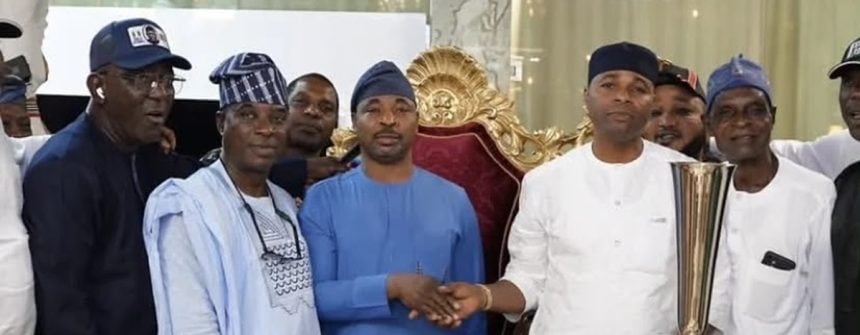
Nigerian Fuji musician, Wasiu Ayinde Marshal, popularly known as KWAM1, has brokered a peace deal between the National Union of Road Transport Workers (NURTW) National President, Musiliu Akinsanya, popularly known as MC Oluomo, and the Lagos State Chairman of the union, Mustapha Adekunle, aka Tafa Sego.
The reconciliation took place at Ojusagbola in Ijebu, Ogun State, where several NURTW chieftains gathered for the meeting.
The development was announced on Tuesday on KWAM1’s digital media page on Instagram, alongside photographs from the meeting.
According to the post, the two union leaders have resolved their differences after years of strained relations.
READ ALSO: Why FG Named KWAM 1 Aviation Security Ambassador — Keyamo
“After years of an age-long rift, MC Oluomo and Tafa Sego have finally settled their differences. And from what we know now, this is final,” the post said.
The musician was said to have intervened as the Mayegun of Yorubaland, with the aim of bringing an end to the longstanding disagreement between the two NURTW figures.
“K1 acted in his role as the Mayegun of Yorubaland by seeking an end to the long-standing rift, once and for all,” it said.
The post also described the meeting as a significant step beyond previous public displays of reconciliation.
READ ALSO: FG Gives KWAM 1 Aviation Appointment, After Airport Incident
“This time, it was not just another handshake for the cameras. The two old friends and colleagues came together at Ojusagbola, with King Wasiu Ayinde Marshal (K1) playing the peacemaker.”
Both MC Oluomo and Tafa Sego were reported to be pleased with the outcome of the intervention.
“Both parties are delighted about the new development,” the post said.
The two men had previously been allies and prominent figures within the Lagos NURTW before their relationship became strained amid disagreements linked to leadership of the union in the state.

 News3 days ago
BREAKING: Tinubu Extends Working Vacation
- News5 days ago
Six Hidden Health Benefits Of Unsweetened Zobo
- News5 days ago
Jehovah’s Witnesses Announce New Position On Blood Transfusion Policy
- News5 days ago
How 36 Nigerian States Got Their Names
- News5 days ago
2027: Step-by-step Guide To Applying For INEC Ad Hoc Staff Recruitment
- Headline5 days ago
Nigerian Man Jailed After Masturbating In Front Of Woman On UK Train
- Headline3 days ago
How To Format An Academic CV For US Master’s, PhD Applications
- News5 days ago
Stop Acid Reflux Pain: Foods You Must Ban From Your Kitchen
- Business5 days ago
Naira Appreciates Against Dollar At Official FX Market
- Politics3 days ago
Crisis Rocks NDC Over Obi-Kwankwaso Campaign Council


