
News
Why I Tore My Husband’s Passport, Woman Breaks Silence
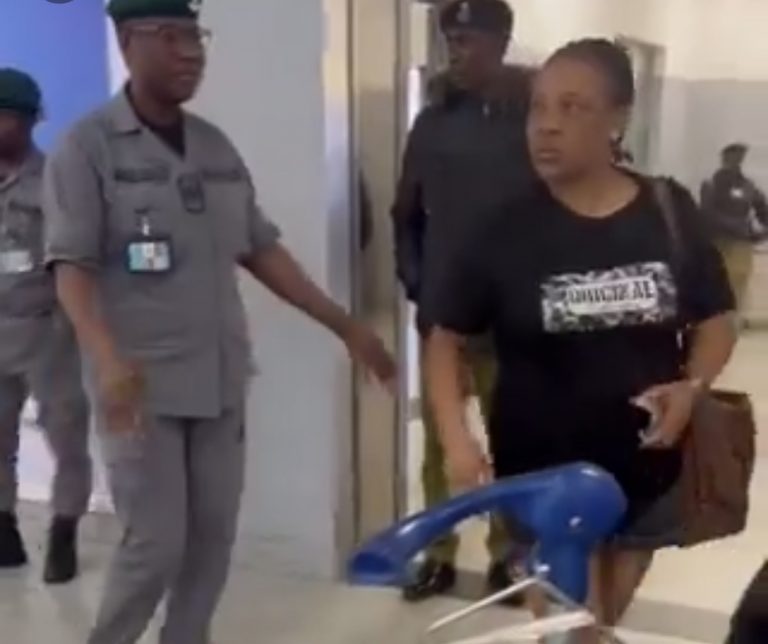
The woman who tore her husband’s passport, Mrs Igiebor, has broken her silence on the reasons she did it.
According to her, they have had family issues long before they return to Nigeria from Europe.
Igiebor, a content creator known for sharing content about her husband and kids on TikTok, made the revelation on Monday.
In the video, she said, “This issue has been going on for a long time. And I have to do what I did. Don’t just look at my actions alone. I’m not a mad woman. I have gone through so many things. I have my own reasons.
READ ALSO: No President Makes Reforms Reading To His Downfall, Only Jonathan – Shehu Sani
“What if I had done this thing in Europe, where we came from? I don’t want him to go through much stress, which is why I did it in Nigeria. So many people at the airport that day saw me acting. It has been a family issue all the time. My husband even cannot speak about it. I suffered with him, and just like that, his family wants my suffering to be shattered.
“To be sincere, I did it so my husband would not return (to Europe). I have gone through pain. Many don’t know what I’m going through. My husband bought me an iPhone to calm me. It has been going on for years. He knows that I’ve not forgotten it; I’m just pretending to have gone past it.”
The woman apologised to Nigerians who were angry over her action and to Nigerian immigration.
Igiebor further said her husband had neglected her for his family, adding, “My husband is a mother’s boy, sister’s and brother’s best brother. Making me the wife to be suffering. I did what I did for him to know that I’ve been bearing the pain.
READ ALSO: No President Makes Reforms Reading To His Downfall, Only Jonathan – Shehu Sani
“Those of you calling for my arrest should come and hold me responsible. I cry every time after three kids. They should let me rip what I have sown with him. My husband should come out and say what happened,” she stressed.
Masquerader arraigned for assaulting woman in Enugu
Although Igiebor did not provide specific details about the events that led to the passport destruction, she hinted at family issues.
The PUNCH earlier reported Igiebor, in a viral video tearing her husband’s Nigerian Standard Passport shortly after they arrived at the Lagos Airport on Saturday, August 10, 2024.
In the footage, an agitated Igiebor, when questioned about her actions, retorted, “Is it your passport?”
However, the Nigeria Immigration Service has launched a probe into an incident.
READ ALSO: FG To Pay Julius Berger N280bn To Complete Abuja- Kano Highway
This was contained in a statement released on Sunday by the NIS Public Relations Officer, Kenneth Udo.
“The Nigeria Immigration Service has launched a formal investigation following the circulation of a video on social media, showing a female traveller destroying a Nigerian Standard Passport at the Murtala Mohammed International Airport (MMIA), Lagos,” the statement read.
The NIS noted that her actions could be a violation of Section 10(b) of the Immigration Act 2015 (as amended), which prohibits the willful destruction of Nigerian travel documents.
The act outlines specific penalties for such offences.
The statement further emphasised the service’s dedication to enforcing the Immigration Act strictly to safeguard national security and preserve the integrity of Nigeria’s legal and diplomatic instruments.

News
Why I Resigned As CIGM Boss – Arogundade Breaks Silence

Jubril Arogundade, former senior executive of CIG Motors, has clarified the circumstances surrounding his departure from the company.
He explained that his exit was voluntary and motivated by concerns over corporate governance, not misconduct.
Recall that Arogundade resigned from his position on December 2, 2025, citing persistent issues with internal controls, financial management, and regulatory compliance.
READ ALSO:Resign As Minister, Face Your Obsession With Rivers – APC National Secretary Slams Wike
“I resigned from my position at CIG Motors after careful reflection and in line with due process,” he said.
“It is therefore deeply concerning that my voluntary exit has been publicly mischaracterized. My decision was guided by principle and professional responsibility.”
He explained that over a sustained period, he had raised concerns internally about corporate governance gaps, growing debt, and unresolved regulatory obligations but did not see meaningful corrective action.
READ ALSO:Nine Soldiers Feared Dead In Borno IED Explosion
“As a Nigerian professional, I take governance, compliance, and institutional responsibility very seriously,” Arogundade said.
“When internal efforts to address these matters did not yield results, I chose to resign rather than compromise on standards that I believe are fundamental to sustainable business.”
Addressing reports linking him to financial impropriety, Arogundade said, “I have nothing to hide and welcome any lawful, independent, and objective review of my conduct during my tenure. Contrary to public insinuations, no regulatory or law enforcement agency has contacted me regarding these claims, and I remain fully available to cooperate should any legitimate inquiry arise.”
News
Why Nigeria’s New Tax Law May Not Succeed – CPPE

The Centre for the Promotion of Private Enterprise has said the new tax laws, which began January 1, 2026, may not succeed because they are unfolding under unusually delicate circumstances.
CPPE Executive Chief Officer, Muda Yusuf disclosed this in a statement on Sunday.
This comes as DAILY POST reports that new tax laws kicked off despite calls for their suspension.
READ ALSO:OPINION: Saraki’s Persona In Bolaji’s Book
Commenting, CPPE stressed that the ultimate success or failure of Nigeria’s tax reform will depend far less on its legislative provisions and far more on how it is implemented.
The economic think tank said with 2026 shaping up as a pre-election year, political and social caution is imperative and could impact the implementation of the tax laws.
“Without careful sequencing, political sensitivity, and economic realism, even well-intentioned reforms can trigger resistance, disrupt livelihoods, and further erode public trust,” CPPE said.
News
OPINION: Saraki’s Persona In Bolaji’s Book

By Lasisi Olagunju
I begin with a telling scene. In 2001, former Sports Minister, Bolaji Abdullahi, then a young journalist, visited the strongman of Kwara politics, Dr. Olusola Saraki, at his Lagos home. From his vast library, the elder Saraki presented his guest with a book: ‘Life in the Jungle’ by Michael Heseltine. “Politics is truly a jungle,” the old politician told the young journalist.
That moment stayed with me as I read Bolaji’s latest book, ‘The Loyalist: A Memoir of Service and Sacrifice’, slated for presentation in Abuja on January 27. I was to review it at the event but for my phobia for Abuja and its toxins. The author, nevertheless, sent me an advance copy. I got it on Friday. This is my preview of the book.
From beginning to end, what I see here is Bolaji’s own version of D.O. Fagunwa’s ‘Ogboju Ode’, a forest thick with demons, trials, and betrayals. Former Ekiti State governor, Dr. Kayode Fayemi, captures its essence in a cover blurb; he describes the book as an exploration of “the underbelly of human nature.” Aptly so.
The author started his political life as Governor Bukola Saraki’s Special Assistant, then commissioner for education. Later he became Goodluck Jonathan’s Sports Minister. Did he become minister because Saraki willed it? If the position did not come through Saraki, why did he lose it because of him? The book speaks on these.
‘The Loyalist’ is an unflattering, tell-all account of the author’s long association with Senator Bukola Saraki. It takes a brief detour into Nigeria’s ailments, then settles into a story of power, patronage, promise, and eventual separation after 22 years. It is a primer on godfather-godson politics and on what happens when loyalty is repeatedly tested.
Bolaji insists he set out to tell his own story, but he concedes that “in telling your own story, you tell other people’s as well.” He writes: “Nobody’s story has been as intricately connected with mine in the 20 years that this book covers as Senator Bukola Saraki’s… For most of the journey, I walked under his shadow… Therefore, readers will find that, to a large extent, this book is his story as well.”
MORE FROM THE AUTHOR:OPINION: Black Is White, Foul Is Fair, Wrong Is Right
I would argue it is even more Saraki’s story than the author admits.
Throughout the book, the boy sketches the boss as a man of effortless authority and magnetism—one who draws people in while holding them at arm’s length. Proximity here is never accidental; it is rationed, measured, controlled. Once, boss and boy shared a romance of duty, trust, and friendship. The early chapters bear witness to that bond. Later chapters show how politics devoured it.
What Bolaji is set to release is less a memoir of self than a study of a ruler—a cold, calculating king who “keeps himself in clouds,” to borrow from William Shakespeare’s ‘Hamlet’. Many orbit him; few approach; none fully enter.
The book runs to 13 chapters and 287 pages. Chapter Three, “Sowing the Mustard Seed,” is described by Olusegun Adeniyi, who wrote the foreword, as “easily the most important chapter.” Perhaps. I might have chosen the later chapters of raw politics, broken promises, and disappointment. Still, it is here that Bolaji takes a scalpel to power’s façade, slicing through the boss’ fine charm to reveal the architecture of control beneath.
He writes of Saraki: “He exuded an aura that appeared to attract and repel at the same time… It was as if he was surrounded by invisible fences… In the innermost chamber of his life, he resided alone, inscrutable, like a god.”
To write thus is to lay a living leader on a cadaver table. Power prefers action to autopsy. Bolaji’s disquisitive tendency could actually be the undoing of his politics. Who knows? In Shakespeare’s ‘Julius Caesar’, Caesar loathes Cassius because he “looks quite through the deeds of men”—a man too observant to be safely ignored.
The recurring theme of promise and disappointment runs through the book. Check this: In November 2016, Saraki urged Bolaji to accept the role of APC Publicity Secretary, warning: “I don’t want us to send someone who will see small money and turn against us.” Twenty months later, on July 27, 2018, Saraki hinted that Bolaji would soon be asked to quit that office. A consolation prize was dangled: the governorship of Kwara State. Three days later, Saraki asked him to resign and follow him back to the PDP. Bolaji complied. He pursued the governorship with total commitment. One day, boss asked a cleric to pray for Bolaji’s success; Bolaji knelt before cleric and received the supplication into his life. Bolaji’s campaign ran out of cash, boss supplied cash. Days before the primary, boss quietly instructed delegates to support another aspirant. The directive leaked to Bolaji. Bolaji asked boss, boss did not confirm or deny it. The D-Day knocked. Without announcing it, boss doubled down on giving the ticket to the other man. A shattered Bolaji withdrew from the race. End of story. Or, as Shakespeare would have it in Richard II – Act 5, scene 5: “I wasted time, and now doth time waste me.”
MORE FROM THE AUTHOR:OPINION: Trump Must Finish What He Started
Disappointment recurs. Like photographs in a coffee-table book, the author lays them out for judgment. What emerges is a tactician who rationed intimacy, gave offices in the evening and withdrew them in the morning; a leader who made unreadability a method. You could orbit his star, but are never allowed to explore it.
Some would argue that what this persona reflects is not cruelty but strategy for survival in a field of mines and betrayal. Perhaps.
Segun Adeniyi says readers will enjoy “Bolaji’s disquisition on Saraki’s persona.” Disquisition. The word is precise: exposition, interrogation, laying bare. Readers may enjoy it. The subject himself is unlikely to. To dissect power is to threaten its crown. Someone said leaders prefer to be felt, not explained. Power feeds on mystery.
The book also offers insight into how power was organised. Bolaji wrote: “Collective decisions presupposed the existence of a team, but he never built a team… No one ever had the full picture… There was always a game at play, with the end goal known only to him.”
Yet ‘The Loyalist’ is not only about a ruler and his follower. It is also a portrait of a wicked Nigeria that sees nothing wrong betraying its poor. As commissioner for education, Bolaji encountered schools without learning. “We soon found ourselves clapping for pupils in Primary IV” because they “could spell their names,” he writes. He experienced the bad and the ugly. He saw teaching jobs sold and teachers’ salaries siphoned by officials employed to enforce moral and academic standards.
MORE FROM THE AUTHOR:OPINION: Gov Makinde, His Sons And His ‘Friends’
‘The Loyalist’ is a beautiful book well written. But the content is a warthog in ugly details. It has a space for the Nigerian voter cashing in before elections. Bolaji recalls a hospital calling him because a man had abandoned his pregnant wife, left Bolaji’s number, and named him as the one to pay for a caesarean section. All politicians from Bola Tinubu to the lowliest of the low will easily connect with this. The Nigerian hangers-on is an albatross on their necks.
In the early chapters, Bolaji’s relationship with Saraki is rendered almost as governor and unofficial deputy. It was that close. So what became of everything? The answer comes quickly. At Pastor Tunde Bakare’s church in 2017, Bolaji heard a counsel: “Do not treat as optional those who treat you as their priority.” He wished he could send that message to his boss without sounding rebellious. He has now written a whole book to do just that.
It is a notorious notion that every book must have a last line; the question is whether it closes the story or merely ends it. On page 280 comes Bolaji’s final verdict: “Some relationships can only be saved through an amicable divorce.” It is a sad, dramatic closure.

 News2 days ago
What I Saw After A Lady Undressed Herself — Pastor Adeboye
- Headline2 days ago
PROPHECY: Primate Ayodele Reveals Trump’s Plot Against Tinubu
- Metro2 days ago
Armed Robbers Shot PoS Operator To Death In Edo
- Metro2 days ago
Gunmen Demand N200m Ransom For Kidnapped Brothers In Edo
- Metro2 days ago
Joint Task Force Kills 23 Bandits Fleeing Kano After Attacks
- Politics2 days ago
Why Kano Governor Postponed Formal Defection To APC
- Entertainment2 days ago
Anthony Joshua Returns To UK In Private Jet
- News2 days ago
Reps Release Four Tax Acts For Public Records
- Metro18 hours ago
AAU Disowns Students Over Protest
- Politics2 days ago
2027: Rivers APC Pledges To Follow Wike’s Instructions


