
News
Building Collapse: Experts Advocates Punishment Law For Defaulters
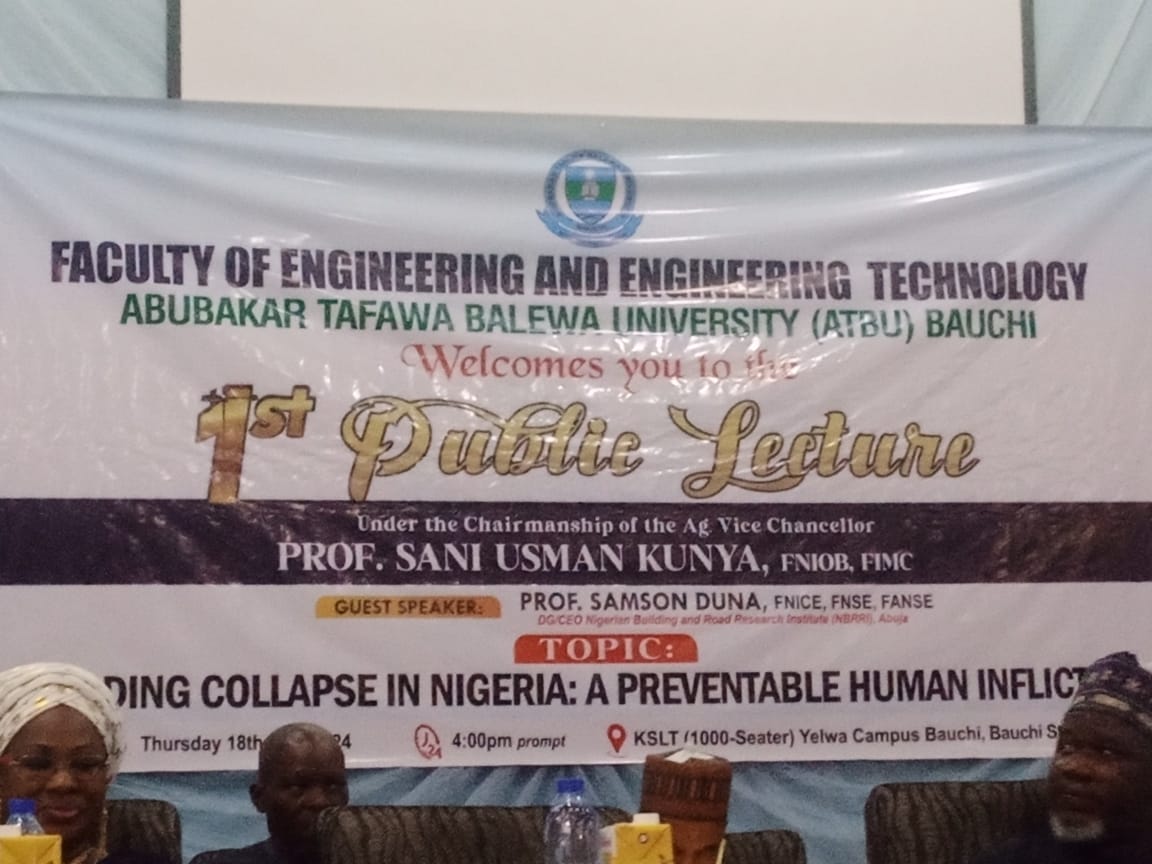
Prof. Samson Duna, the Director General of the Nigerian Building and Road Research Institute (NBRRI) Abuja, has called for the enactment and enforcement of a law to punish anybody that violates the building code in Nigeria.
Duna, who stated this in a public lecture at the Abubakar Tafawa Balewa University (ATBU), Bauchi on Friday, said this would serve as a deterrent to anybody found wanting.
“Since the history of building collapse, we have never had a case where somebody was punished by being taken to court or jailed for being responsible.
“We are calling on the National Assembly to enact a law so that anybody that is found wanting as far as carelessness is concerned, man-made error somewhere, the person should be punished, face the music and this will serve as a deterrent to others,” he said.
READ ALSO: CBN Resumes Forex Sales To BDCs
Duna, also the Chief Executive Officer NIBRRI, advocated for the establishment of rapid response teams across the 36 states and FCT to swiftly respond to any form of building collapse and save lives on time.
He said, “we are agitating that each state government should establish a response team, buy facility excavators, keep them, train people just as if you are going to war.
“This is necessary so that anytime a building collapse occurs, you are there as a rapid response team and not when a building collapses you start begging people to bring equipment.
“No equipment for excavation and we know that these buildings will continue to fail. We are not praying for anything like that to happen in Bauchi state, but if it does, do we have an excavator nearby?
READ ALSO: BREAKING: Scores Injured As School Building Collapses In Plateau
“Do you have people trained to do something nearby and that’s why I’m calling authorities like the state governments to establish a Rapid Response Team to cater for unforseen circumstances like building collapse”.
In order to prevent building collapse in the country, Duna advocated that structural integrity assessment should be carried out for all existing structures built over a period of 15 years with emphasis on areas or locations that have experienced bomb blast.
He advised that all stakeholders in the construction industry should adhere strictly to the provisions of the building code, adding that construction of buildings must be carried out in accordance with design specifications.
READ ALSO: UPDATED: Scores Killed, About 200 Students Trapped In Jos Collapsed School Building
According to him, regulatory professional bodies should regularly organise workshops for stakeholders in the building industry to update their knowledge as well as regular public enlightenment and sensitisation campaigns for the people.
Also speaking, the Acting Vice Chancellor, ATBU, Bauchi, Prof. Sani Kunya, said it was important to look at various variables that bothered on abuse of building standards and building procedures.
He said it was also necessary to look at the outright official corruption to grant official permission to substandard and clearly dangerous structures as well as tempering with the approved original plans and structures of buildings.
The topic of the lecture is Building Collapse in Nigeria: A Preventable Human Infliction.



News
Togo, Niger, Benin Owe Nigeria Over $17.8m For Supplied Electricity – NERC

Nigeria’s electricity regulator has disclosed that three neighbouring countries, Togo, Niger and Benin, are indebted to Nigeria to the tune of $17.8 million, equivalent to more than N25 billion at prevailing exchange rates, for power supplied under bilateral electricity agreements.
The Nigerian Electricity Regulatory Commission, NERC, made this known in its Third Quarter 2025 report, which reviewed market performance within the Nigerian Electricity Supply Industry, NESI.
According to the report, the international customers were billed a total of $18.69 million by the Market Operator for electricity supplied during the third quarter of 2025. However, only $7.125 million was paid, leaving an unpaid balance of $11.56 million for the period under review.
NERC also revealed that the same international offtakers had outstanding legacy debts amounting to $14.7 million from previous quarters. Of this amount, $7.84 million was settled, leaving a residual balance of $6.23 million.
READ ALSO:Expert Identify Foods That Increase Hypertension Medication’s Effectiveness
When combined with the Q3 2025 shortfall, the total outstanding debt stood at $17.8 million, which translates to about N25.36 billion at an exchange rate of N1,425 to one US dollar.
The regulator identified the international electricity customers as Compagnie Énergie Électrique du Togo, Société Béninoise d’Énergie Électrique of Benin Republic, and Société Nigérienne d’Électricité of Niger Republic.
NERC stated that the three utilities collectively paid just $7.125 million against the $18.69 million invoice issued for electricity supplied in the third quarter, resulting in a remittance performance of 38.09 per cent.
This meant that more than half of the billed amount remained unpaid at the close of the quarter.
READ ALSO:Electricity Workers Threatens Shutdown Over Staff Brutality
The commission explained that the electricity exported to the three countries was generated by grid-connected Nigerian generation companies and delivered through cross-border bilateral power supply arrangements.
By contrast, NERC reported a stronger payment performance among domestic bilateral customers. According to the report, local customers paid N3.19 billion out of the N3.64 billion invoiced for the same quarter, representing a remittance rate of 87.61 per cent.
The regulator further noted that some bilateral customers, both international and domestic, made additional payments to offset outstanding invoices from earlier quarters.
READ ALSO:Reps Ask NERC, DISCOs To Reverse Band A Tariff Hike
Specifically, the Market Operator received $7.84 million from international customers and N1.3 billion from domestic customers in settlement of previous obligations.
Beyond bilateral transactions, NERC disclosed that Nigeria’s 11 electricity distribution companies remitted a total of N381.29 billion to the Nigerian Bulk Electricity Trading Plc and the Market Operator in the third quarter of 2025. This was out of a cumulative invoice of N400.48 billion, translating to an overall remittance performance of 95.21 per cent.
The commission said the figures were derived from reconciled market settlement data submitted as of December 18, 2025, as part of its statutory evaluation of the commercial health and performance of the electricity market.
News
Expert Identify Foods That Increase Hypertension Medication’s Effectiveness
Hypertension remains one of the leading causes of premature death worldwide, contributing significantly to heart disease, stroke, and kidney failure. Despite the availability of effective antihypertensive drugs, long-term control of high blood pressure is often challenging because of drug resistance, side effects, and poor adherence.
This has fueled growing scientific interest in complementary strategies that can enhance drug efficacy while minimising toxicity. One promising approach is the combination of conventional antihypertensive medications with herbs and spices in many kitchens.
Recent evidence suggests that augmenting modern antihypertensive drugs with foods rich in p-coumaric acid, a naturally occurring phenolic acid, may offer a novel and effective strategy for blood pressure control.
Phenolic compounds, commonly found in fruits, vegetables, whole grains, and legumes, are known for their antioxidant, anti-inflammatory, and blood vessel–protective properties.
READ ALSO:Russia, China Afraid Of US Under My Administration — Trump
In a study, researchers investigated the combined effects of lisinopril, a widely used antihypertensive drugs and p-coumaric acid on hypertension.
They reported in the Comparative Clinical Pathology that p-coumaric acid enhance the antihypertensive action of lisinopril, potentially allowing for improved blood pressure control without increasing drug dosage.
The study used an established animal model in which hypertension was induced in rats through oral administration of L-NAME, a compound known to suppress nitric oxide production and raise blood pressure.
Following the induction of hypertension, the animals were treated for 14 days with p-coumaric acid (at two different doses), lisinopril alone, or a combination of both.
READ ALSO:Man Suffers Hypertension As Daughter, Grand-daughter Disappear For 10 Years
Untreated hypertensive rats showed significantly elevated activities of key enzymes linked to high blood pressure such as ACE, arginase, acetylcholinesterase, and phosphodiesterase-5 along with increased lipid peroxidation, an indicator of oxidative stress. At the same time, levels of nitric oxide, a critical molecule for blood vessel relaxation, were markedly reduced.
By contrast, rats treated with a combination of lisinopril and p-coumaric acid experienced notable improvements. Blood pressure was better controlled; harmful enzyme activities were reduced, oxidative stress declined, and nitric oxide levels increased. These improvements were mirrored in the tissues the heart compared with untreated hypertensive animals.
They said that the findings suggest that p-coumaric acid may enhance the antihypertensive action of lisinopril, potentially allowing for improved blood pressure control without increasing drug dosage.
This drug–food interaction model is particularly important in the circumstance of long-term hypertension management. Many patients rely on lifelong medication, and strategies that can improve treatment outcomes while reducing side effects are highly desirable.
READ ALSO:Delta Unveils Free Hypertension, Diabetes Screening
The study also reinforces the growing recognition that diet is not merely supportive but can be biologically active in disease control.
The use of medicinal plants and plant-based therapies in the management of hypertension is deeply rooted in traditional medicine across many cultures. While such practices have often existed outside conventional healthcare systems, modern scientific research is now providing evidence-based explanations for their effectiveness.
While these findings are based on animal studies and cannot yet be directly translated into clinical recommendations for humans, they open the door to future research on dietary strategies that can safely complement antihypertensive drugs.
READ ALSO:Why West African Troops Overturned Benin’s Coup But Watched Others Pass
Further clinical studies are needed to determine appropriate dosages, safety profiles, and real-world effectiveness.
In the fight against hypertension, the future may lie not only in new drugs, but also in smarter combinations, where medicine and nutrition work together to deliver better, safer outcomes for patients.
Such nutrition to help maintain healthy blood pressure includes garlic, potatoes, walnuts,tomato and tomato products, legumes and citrus fruits (grapefruits and oranges).
(TRIBUNE)
News
Researchers Develop Treatment For Advanced Prostate Cancer

Researchers at Case Western Reserve University have developed a treatment for advanced prostate cancer that could eliminate a side effect so debilitating that patients often refuse the life-saving therapy.
The innovative approach, according to the researchers, targets prostate cancer cells just as successfully as existing treatments while causing significantly less harm to salivary glands.
For many people with prostate cancer, it relieves the extreme dry mouth that makes speaking, chewing, and swallowing nearly impossible.
According to the findings published in Molecular Imaging and Biology, the treatment targets PSMA (Prostate-Specific Membrane Antigen), a protein present in high numbers on prostate cancer cells.
READ ALSO:Edo Deputy Gov Tasks Lab Scientists On Research, Vaccine Production
Radioligand therapy (RTL) attaches radioactive material to a targeting molecule that acts like a GPS system, guiding the radiation directly to cancer cells while avoiding healthy tissue.
Current PSMA-targeted radioligand therapy is one of the most promising precision cancer treatments for end-stage prostate cancer because it acts as a “smart bomb” that locates and destroys cancer cells.
The downside, however, is that this therapy often causes severe salivary gland damage, resulting in extreme dry mouth that can be so debilitating that patients choose to stop treatment that might save their lives.
James P. Basilion, professor in the Department of Biomedical Engineering at Case Western Reserve and co-leader of the Cancer Imaging Program at the Case Comprehensive Cancer Centre (Case CCC), explained that various strategies to mitigate this side effect have been attempted before, with limited success.
READ ALSO:Nigerian Researcher Develops Wireless Charging Tech For Electric Vehicles
According to the study, PSMA-1-DOTA has a four-fold greater affinity for prostate cancer cells than current therapies.
In addition to having the same tumour-fighting effectiveness as the current standard radioligand therapy, it also significantly reduced damage to the tear and salivary glands, almost eliminating the risk of dry mouth.
This discovery has the potential to significantly alter the treatment of prostate cancer by making PSMA-targeted therapy an earlier intervention rather than a “last resort.”
READ ALSO:Research: Experts Seek Improved Funding Of Monotechnic, Polytechnic Libraries
The research included comprehensive testing on mouse models and in a human patient with metastatic prostate cancer at the Technical University of Munich in Germany.
The patient study confirmed the lab findings, showing the new treatment avoided the salivary glands (potentially preventing dry mouth) while still finding and attacking prostate cancer cells.
The researchers, from now on, are preparing for clinical trials late this year on about 12 prostate patients to validate the promising results and establish the most effective dosing procedures.
(TRIBUNE)

 News4 days ago
What I Saw After A Lady Undressed Herself — Pastor Adeboye
- Headline4 days ago
PROPHECY: Primate Ayodele Reveals Trump’s Plot Against Tinubu
- Metro4 days ago
Armed Robbers Shot PoS Operator To Death In Edo
- Metro3 days ago
AAU Disowns Students Over Protest
- Business3 days ago
NNPCL Reduces Fuel Price Again
- Metro4 days ago
Joint Task Force Kills 23 Bandits Fleeing Kano After Attacks
- Politics4 days ago
2027: Rivers APC Pledges To Follow Wike’s Instructions
- Metro3 days ago
Edo: Suspected Kidnappers Kill Victim, Hold On To Elder Brother
- Metro3 days ago
Nine Soldiers Feared Dead In Borno IED Explosion
- Metro4 days ago
Gunmen Demand N200m Ransom For Kidnapped Brothers In Edo


