
News
Delineation: Warri Ijaw Commends INEC, Says Itsekiri Protesting Out Of Ignorance
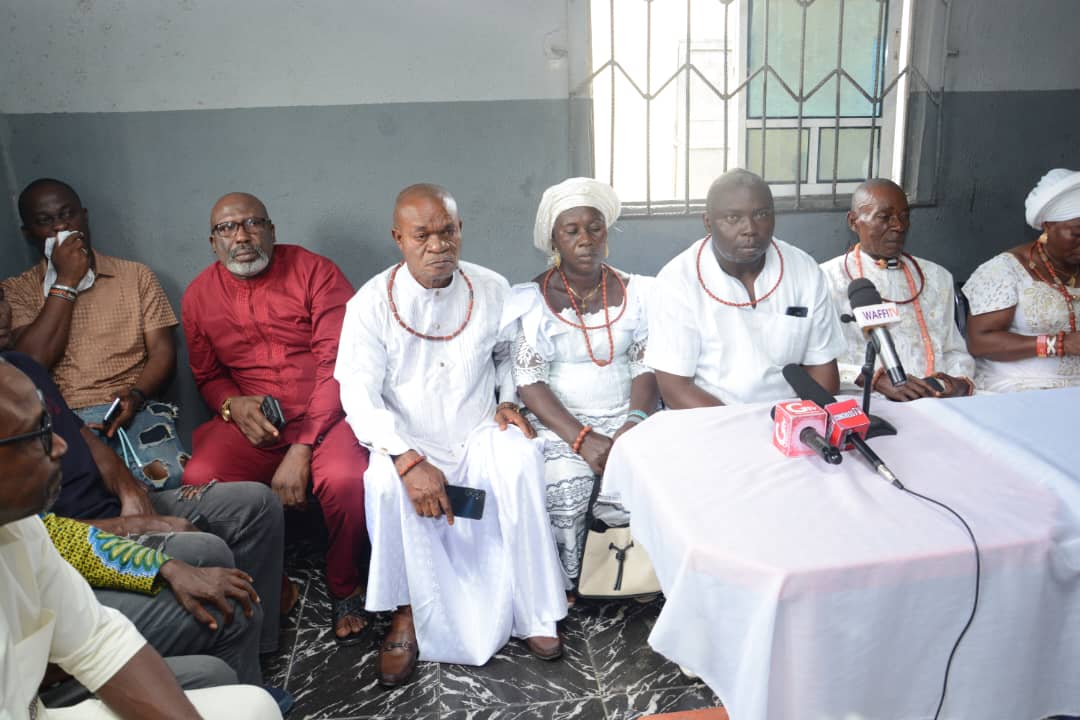
The Ijaw speaking people of Ogbe-Ijoh -Warri kingdom have described as ignorance the protest by Itsikiri people against the fresh delineation of Warri Federal Constituency by the Independent National Electoral Commission.
They stressed that the “delineation of electoral wards and polling units to cover the Ijaw areas in Warri Urban is not a new development, but has been in existence for decades even before those protesting were born.”
Briefing journalists in Warri on Friday, the Ogbe-Ijoh people whose statement was read by Chief Monday Keme, the Principal Secretary to Amaokosu of Ogbe-Ijoh Kingdom, said “the recent exercise only seeks to correct an obvious injustice where the Ijaws in Warri South LGA are delineated into different polling units and denied representation in the Warri South LGA administration.”
The Ogbe-Ijoh people, while making reference to a Supreme Court ruling which ordered delineation, stressed that whether Ogbe-Ijoh is part or Warri or not is an issue that had been settled, adding that even the Itsekiri knows this.
“The delineation of electoral wards and polling units to cover the Ijaw areas in Warri Urban is not a new development, but has been in existence for decades even before those protesting were born.
READ ALSO: Court Adjourns As Delta Family’s Search For Corpse Hits Five Months
“It is important to note with specific reference to the Supreme Court ordered delineation that, the issue of whether the Ogbe-Ijoh (Ijaw) people are part of Warri South Local Government Area or not was raised at the INEC stakeholders meeting by the Itsekiris, reflected in the minutes of stakeholders meetings and it was dealt with by the stakeholders in the said meetings by resolving that from available intelligence reports, legal documents, physical communities on ground and existing electoral polling units, the Ogbe-Ijoh (Ijaw) people are integral part of Warri South Local Government, but denied electoral representation by not having homogenous electoral wards of their own, but balkanised into different polling units in different wards in Warri South LGA.
“The Itsekiris too admitted this fact.
It was on this basis that, at the stakeholders meeting of Ijaw, Itsekiri and Urhobo held on 8th of July, 2024 at Government House Annex, Warri preparatory to starting the Fieldwork in Warri South LGA, a team of INEC Field Officers were assigned to the Ijaw areas in Warri South LGA, just as INEC Field Officers were assigned to the Itsekiri and Urhobo areas.
“Furthermore, the INEC field officers assigned to the Ijaw areas were the only ones who covered the Ijaw areas by the proposed Ewein, Bulouama, Ogbe-Ijoh Warri Urban and part of GRA wards of Warri South LGA.
“The INEC field officers assigned to Itsekiri and Urhobo areas did not and could not have covered these areas because they are indigenous Ijaw communities, where the Ijaws reside in the knowledge of all persons and authorities.”
“These facts are known to the Itsekiri leaders and especially those who participated in the INEC fieldwork, but are not telling the public.”
READ ALSO: Delta: Burutu LG Boss, Takeme, Inaugurates Peace, Advocacy Committee
Further going memory lane, the Ogbe-Ijoh people said it is in record that they first settled in Warri.
“For historical purposes and to educate younger Itsekiri people who do not know the founding history of Warri, Ogbe-Ijoh is recorded as the first settlement in the present Warri Urban along the Ogbe-Ijoh-Warri River (otherwise known as the Warri anchorage) in Warri South Local Government Area of Delta State.
“Indeed, the present Warri started from Ogbe-Ijoh. In 1955, when the first local administrative structure was established and electoral delineation done in Warri Urban, the Ogbe-Ijoh (Ijaw) people were included in the Warri Urban District Council together with a section of Urhobo and Itsekiri as defined by Western Region Laws of Nigeria No 177 of 1955.
“The said law created four autonomous electoral wards for the Ijaw people of Ogbe-Ijoh, which were– Alders town B3, Ogbe-Ijoh Ward C1, Ogbe-Ijoh Ward C2 and Government Area F1. This structure with elected Ogbe-Ijoh Councillors remained operational till sometime in 1976, when the Olusegun Obasanjo’s Military Government introduced local Government reforms giving birth to the present local Government structure.
“The defunct Warri Urban District Council is today known as the Warri South Local Government Council.
It is important to note that, before the introduction of Local Government administration, there were Seven (7) District Councils in the Warri area, including the Warri Urban District Council, which was only the Warri main City.
“But the Ode-Itsekiri District Council which was not part of the Warri Urban District Council was included to make up the present Warri South LGA.”
READ ALSO: NDDC Releases N10bn For Niger Delta Entrepreneur Programme
The Ogbe-Ijoh further stated that “contrary to the false impression being created by the Itsekiris, the Ijaw areas have always been separated from the Itsekiri areas in Warri Urban.
“It is for this reason that, the Chiefs Law of 1957, CAP 19, provides that, the authority of the Itsekiri monarch, the Olu of Warri excludes Ogbe-Ijoh Areas.
“The 1979 Bendel State Traditional Rulers and Chiefs Edict, B.S.L.N 44, described the Amaokosu of Ogbe-Ijoh as the prescribed authority of Ogbe-Ijoh lands and people in Warri metropolis.
“This meant that, all the lands of the Ijaw of Ogbe-Ijoh are excluded from claims by the Itsekiri people.
“Furthermore, the Delta State Traditional Rulers, Chiefs and Council Law, Vol. 3, now cap T3 Laws of Delta State, 2006 recognizes four Clans in Warri Metropolis: Itsekiri Kingdom, where the Olu is the prescribed authority, Okere-Urhobo Kingdom where the Orosuen of Okere-Urhobo is the prescribed authority, Agbassa Kingdom where the Ovie of Agbarha is the prescribed authority and the Ogbe-Ijoh Kingdom where the Amaokosu of Ogbe-Ijoh is the prescribed authority of Ogbe-Ijoh Kingdom in Warri metropolis.
READ ALSO: Delta: Site Engineer Murdered By Employees, Police Arrest Two Suspects
“The purpose of the above laws is to the effect that, the Ogbe-Ijoh Kingdom and their lands in Warri metropolis in Warri South Local Government Area are excluded from the claim of the Itsekiri people.
“This position has been confirmed by the Court of Appeal in Appeal No CA/AS/441/2016 in a judgement delivered on the 5th of June, 2023.”
The Ogbe-Ijoh people, while commending INEC for commencing the “delineation process despite series of litigation against the Commission by the Itseikiri,” and being “fair to all the ethnic nationalities and stakeholders,” urged the commission to create more wards for them, arguing that by their population and land mass, they deserved such.
“We, therefore, call for the creation of more electoral wards for Ijaws in Warri Urban and also urge the Independent National Electoral Commission to disregard frivolous protests against the delineation exercise in Warri South LGA by the Itsekiris.
“We wish to call on the INEC for creation of additional wards and state Constituency for the Ijaws of Warri South. This is predicated on the ground that the Itsekiris and Urhobos already have their own State Constituencies in the Warri South,” they added.



News
IELTS Speaking: How Nigerian Candidates Can Improve Their Band Score

For most Nigerian candidates applying to study, work or migrate abroad, the IELTS Speaking test is the single most nerve-wracking 11 to 14 minutes of the entire exam.
Unlike Listening or Reading, there is no answer sheet to fall back on, and the pressure of speaking directly to a trained examiner can make it easy to freeze or, just as damagingly, over-prepare until you sound robotic.
The good news is that the test is graded against four public, named criteria, rather than a vague impression of how confident you sounded. Understanding exactly what each criterion rewards can therefore be one of the fastest ways to improve your band score.
Understand what the examiner is listening for
Every Speaking test is scored equally across four categories: Fluency and Coherence, Lexical Resource, Grammatical Range and Accuracy, and Pronunciation, each worth 25 percent of the final band.
Fluency and Coherence measures whether you can keep talking without excessive hesitation, and whether your ideas connect logically rather than jumping around.
Lexical Resource measures the range and precision of your vocabulary, including whether you can paraphrase a question instead of repeating the examiner’s own words back at them.
Grammatical range and accuracy looks at how varied and accurate your sentence structures are, from simple statements to more complex clauses using words like although, because, or if.
Pronunciation covers clarity, stress, and intonation, not whether you sound like a native speaker from a particular country.
READ ALSO: New Air Traffic Control Failure Delays Flights At UK Airports
This last point matters enormously for Nigerian candidates specifically: a Nigerian accent does not lower your score. IELTS examiners are trained to assess intelligibility, not accent neutrality, and both the British Council and IELTS Australia explicitly confirm that speaking with an accent is not penalised as long as your pronunciation is clear enough to be understood without strain.
What actually costs marks is mumbling, running words together so meaning is lost, or shifting stress patterns so unpredictably that the examiner has to work to follow you. Focus your practice on clarity, not on erasing an accent that was never the problem.
Never memorise answers
One of the biggest mistakes candidates can make in the Speaking test is relying on a memorised response, particularly in Part 2, the two-minute monologue based on a task card.
Examiners listen to many candidates and are trained to recognise rehearsed language, whether it is a pre-written answer or a generic template adapted to whatever topic appears.
A scripted answer can sound stiff, contain unnaturally advanced vocabulary that does not match the rest of the candidate’s speech, or ignore the specific details of the task card in favour of prepared content.
When an examiner detects this, it can affect your Fluency and Coherence score because genuine coherence comes from responding directly to what was asked, rather than delivering a monologue prepared in advance.
The solution is not to avoid preparation. Instead, prepare a structure rather than memorising sentences.
READ ALSO: Race To Find Survivors As Morocco Quake Deaths Top 1,300
For Part 2, practise a flexible structure that covers the setup, specific details, a turning point or reflection, and what you think about the subject now. Then fill that structure with fresh details based on the topic you receive on test day.
This gives you the organisation examiners reward without the unnatural delivery of a memorised script.
Use natural fillers and steady pace, not dramatic slowdown
It is perfectly acceptable to pause briefly to think. Natural fillers such as “That’s an interesting question” or “Let me think about that” can give you time to organise a more complex response without necessarily costing you marks.
Used sparingly, such phrases can sound like normal discourse markers rather than signs of weakness.
However, dramatically slowing down your speech to avoid mistakes is not a good strategy.
Multiple examiner-facing sources emphasise that speaking too slowly can be just as problematic as speaking too quickly. Fluency and Coherence partly involve how naturally your language flows, and an overly cautious pace can make your speech sound unnatural or uncertain.
READ ALSO: UK Skilled Worker Visa: 10 Ways To Prepare For Your Interview
The target is a steady, natural pace — similar to how you would explain something to a friend. You do not need to race through your answers, but you also should not deliberately stretch every sentence.
If you genuinely do not understand a question, do not guess or pretend you do. Politely asking the examiner to repeat or rephrase the question is explicitly stated by the British Council to have no effect on your score.
That is safer than answering a question you did not understand, because an irrelevant or confused response can affect your coherence more than a brief request for clarification.
Use idioms only when they actually fit
Rare or idiomatic vocabulary can contribute to a strong Lexical Resource score, as the official descriptors reward the natural use of less common and idiomatic vocabulary.
The key word, however, is naturally.
Using an idiom simply because you memorised it from a study list can work against you if it does not fit the context, is mispronounced or sounds rehearsed.
An expression that is forced into an answer can make your speech sound unnatural and may suggest that you are relying on memorised language rather than demonstrating genuine vocabulary range.
READ ALSO: Putin Issues ‘Veiled Threat’ To UK Over Support For Ukraine
One or two well-placed idiomatic expressions used correctly and naturally can therefore be more useful than filling your answers with several memorised phrases.
If you are not confident about an expression or it does not come to you naturally, use a clear, simple sentence instead. A natural response is preferable to a complicated phrase that is confused, forced or mispronounced.
FAQs
Does a strong Nigerian accent negatively impact an applicant’s final IELTS speaking score?
No. Examiners assess pronunciation for clarity and intelligibility, not for how closely you sound like a native speaker of a specific variety of English. A Nigerian accent is not penalised as long as your speech is clear enough to be easily understood; unclear articulation or unpredictable stress patterns are what actually cost marks, regardless of accent.
What should a candidate do if they completely misunderstand the examiner’s question?
Ask the examiner to repeat or rephrase it. This is explicitly permitted and, according to the British Council, does not affect your score. Guessing at an answer to a question you didn’t understand is far riskier, since it can produce an off-topic or confused response that damages your Coherence score.
How does using rare idioms correctly boost the Lexical Resource score in the IELTS exam?
Correctly used idiomatic language demonstrates the range and flexibility that the official Band 7 and above descriptors specifically call for, which can meaningfully lift a Lexical Resource score. The key word is correctly: a forced, mispronounced, or contextually awkward idiom has the opposite effect, since examiners are trained to notice when an expression sounds rehearsed or doesn’t fit the sentence around it.
(TRIBUNE)
News
Group Commends COREN For Training Engineers In Engineering Failure, Forensic Investigation In Nigeria
Foundation for the Development of Shira Community (FODESCO) in Shira Local Government Area of Bauchi state has commended the Council for the Regulation of Engineering in Nigeria (COREN) for conducting a pioneer training on Engineering Failure and Forensic Investigation (EFFI) for 50 licensed engineering practitioners across the country.
Engr. Shehu Wakili, the Chairman of the Foundation made the commendation in an interview with newsmen on Friday.
According to him, the training which was conducted by COREN in collaboration with the Nigerian Building and Road Research Institute (NBRRI) and the Chartered Institute of Forensic and Certified Fraud Investigators of Nigeria (CIFCFIN), was to equip engineers and professionals from academia, industry, and government MDAs with practical skills to investigate infrastructure failures and prevent recurring building collapses.
READ ALSO: ICPC, COREN Working To Curb Quackery In Engineering — Don
He added that the training was also to build a pool of trained specialists who could investigate building collapses and other engineering failures, determine their root causes, and recommend measures to prevent recurrence, saying that the trainees would form part of a register of trained and certified forensic engineering investigators.
He further lauded COREN for the subsequent induction of its member, Engr. Abdullahi Muhammad MNSE, who among the 50 participants, hails from Bauchi state as a Chartered Engineering Forensic and Failure Investigator (CEFFI), certified by CIFCFIN.
“FODESCO is proud of him and wishes him well in all his endeavours”, he prayed.
Wakili, also the Chairman, Nigerian Society of Engineers (NSE), Bauchi state chapter, revealed that the training covered failure analysis, forensic investigation methodologies, risk assessment, and professional reporting.
“This initiative supports broader efforts by COREN and the National Assembly to enforce stricter building codes, identify quackery, and ensure accountability across the construction sector,” he said.
News
NBS: Lagos, Rivers, Enugu Top List As States Generated N5.15trn In 2025
The National Bureau of Statistics (NBS) has disclosed that 36 states and the FCT generated a total of ₦5.15 trillion in 2025, indicating a growth rate of 40.93 percent from ₦3.65 trillion recorded in 2024.
NBS stated on Thursday citing the Nigeria Revenue Service ( NRS) as source of its information that Lagos emerged top on the list of states with the highest revenue generation in the sum of ₦1.77 trillion.
“Followed by Rivers state ₦428.42 billion and Enugu with IGR record of ₦406.77 billion in the period referenced.”
The. Bureau said Yobe, Ebonyi and Sokoto states reported the least revenues with ₦16.01 billion, ₦17.18 billion and ₦20.48 billion, respectively.
READ ALSO: Trump Bans CNN, Others From White House Coverage, Gives Reason
According to NBS, Pay As You Earn (PAYE) was the most tax revenue recorded during the period, valued at ₦2.64 trillion, representing 69.51 percent of the total tax revenue collected, while capital gains tax was the least with ₦12.40 billion while the share of total tax revenue to total IGR was 73.64 percent nationally.
“Other states and their share of IGR are FCT – N356.34 billion, Ogun – N252.36 billion, Delta – N202.49 billion, Edo – N132.21 billion, Oyo – N103.25 billion and Kano – N102.26 billion.
“Ten other states in lowest category of IGR include Yobe – N16.01 billion, Ebonyi – N17.18 billion, Sokoto – N20.48 billion, Taraba – N28.16 billion ; Benue – N29.57 billion, Zamfara – N30.07 billion, Kebbi – N31.23 billion, Nasarawa – N32.57 billion, Adamawa – N33.76 billion andcBorno – N36.36 billion “.
READ ALSO: Nigeria’s Economy Grew By 3.13% In Q1 2025 — NBS
NBS noted that the states generated their most and least revenue from taxes and other government sources. “PAYE was the dominant revenue source nationally, generating N2.64 trillion and accounting for 69.51% of total tax revenue for the year.
“Other sources included direct assessment, road taxes, stamp duties, withholding taxes and capital gains tax, which was the smallest contributor at N12.40 billion,” the Bureau stated.

 News4 days ago
BREAKING: Tinubu Extends Working Vacation
- Headline4 days ago
How To Format An Academic CV For US Master’s, PhD Applications
- News4 days ago
Benue Govt Suspends Muslim Pilgrims Welfare Board Chairman, Secretary
 News4 days ago
OPINION: The Stranger In APC’s Kitchen
- Entertainment4 days ago
Why Funke Akindele Was Not At My Movie Premiere – Kamo State
- Politics4 days ago
Crisis Rocks NDC Over Obi-Kwankwaso Campaign Council
- News4 days ago
FULL LIST: Names Of 37 Illegal Miners Who Died In NSCDC Custody
- Sports4 days ago
5 Football Players Who Excelled In Multiple Positions
- News4 days ago
OPINION: Shehu Sani Tells Truth To His North
- Sports4 days ago
Premier League Predictions For Matchweek 5 Fixtures


