News
Edo Bags NECO Excellence Award

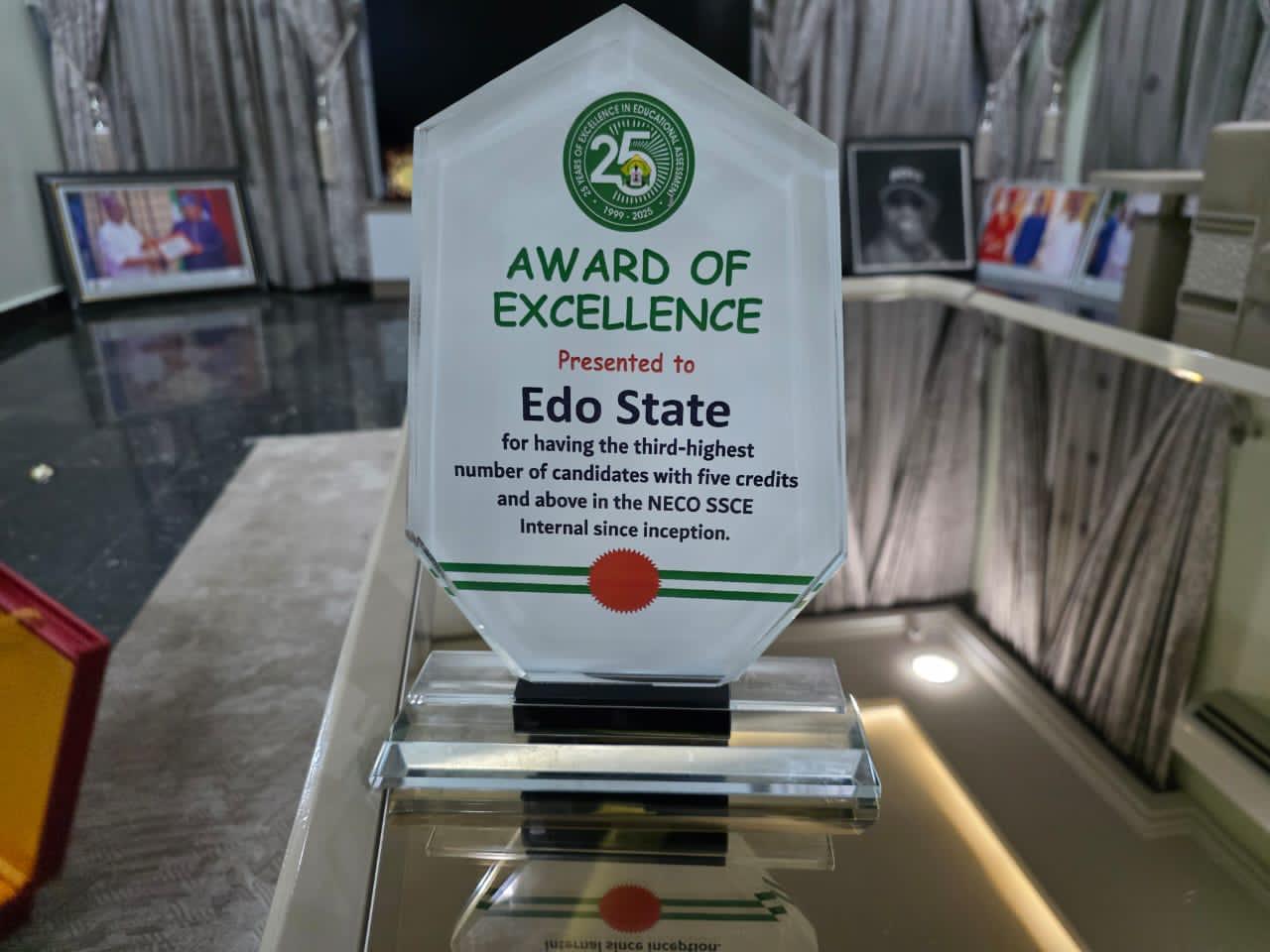
Edo State has bagged the National Examinations Council (NECO) Award of Excellence.
The award followed Edo State’s emergence as the state with the third highest percentage of candidates who obtained five credits and above in the Senior School Certificate Examination (SSCE) Internal examinations since inception.
This was contained in a statement made available to INFO DAILY on Sunday by Governor Monday Okpebholo’s Chief Press Secretary, Dr Patrick Ebojele.
READ ALSO:Okpebholo Felicitates Muslims On Eid-el-Fitr Celebration
NECO, while announcing the annual award, said it recognises state governments and institutions that have demonstrated consistent excellence in students’ academic performance and participation in its examinations.
The examination body noted that the category of award highlights measurable, data-driven achievements, including high pass rates, expanded access to examinations, and sustained investment in the education sector.
Accordingly NECO, the recognition also underscores the importance of sub-national governments in improving educational standards and outcomes across the country.
READ ALSO:How Bloomberg’s $1m Award For Benin City Validates Okpebholo’s Vision For Urban Renewal
“It also reflects the critical role of sub-national governments and institutions in driving educational outcomes and improving standards. By rewarding excellence at the state level, the award encourages healthy competition and stronger commitment to quality education,” the council stated.
NECO added that the award aligns with its broader mission of promoting quality education and ensuring that assessment outcomes contribute meaningfully to national development.
The council further described the honour as both a recognition of achievement and a challenge to other states and institutions to improve standards within Nigeria’s education system.
News
OPINION: Was The Awolowo, Akintola Crisis Instigated By Enemies?
By Festus Adedayo
William Shakespeare, in Othello, warned of the destructive power of envy and manipulation when he wrote: “O, beware, my lord, of jealousy; it is the green-eyed monster which doth mock the meat it feeds on.” Across history, enemies have often thrived by sowing discord among friends, destroying noble causes and wrecking enduring relationships. The tragic crisis between Chief Obafemi Awolowo and Chief Samuel Ladoke Akintola remains one of the most painful examples in Yoruba political history.
A very deep political analyst told me on Friday that he believed both Awo and Akintola were victims of their individual and regional enemies. “If their team had governed the West long enough, the region would have become a first world society,” the analyst told me, and I agreed with him. Read history for the firsts they scored while leaving the other regions panting and taking catch-up measures.
Thirty-nine and sixty years respectively after their passing, the two friends-turned-foes have not ceased being subjects of discourse. With Chief Awolowo as leader and Akintola as his deputy, their team cooked the huge pot of soup the Yoruba still eat their pounded yam with today. They earn an epitaph in the heart of Irish poet, Oscar Wilde, who said, “There is only one thing in the world worse than being talked about, and that is not being talked about.”
Yesterday marked the 39th anniversary of the transition of Chief Awolowo, yet the world still rose to salute him and the stellar leadership he gave his people. Politicians still invoke his name to win votes and get positions. Chief Akintola took his own exit in the military putsch of January 15, 1966.
I thought of those two great men as we marked Awo’s transition yesterday. I reflected on their lives together and their lives apart, while laughing at children of ignorance who attempt to denigrate Awolowo’s legacies simply because they cannot measure up to a fraction of the standard he set as a leader. They think they can exhume the skeleton of the Awolowo-Akintola rift and turn it into a ritual of power: those who oppose today›s small gods are branded betrayers, while those who worship them are canonized as patriots. They misbehave and demand applause. Again, William Shakespeare has words for them in Julius Caesar: “The abuse of greatness is when it disjoins remorse from power.”
The trickster god in Yoruba cosmology is called Esu. Dauda Epo Akara, Ibadan Awurebe music lord, sang of how the Trickster tricked two friends almost to their deaths using a cap that had both black and white colours. This messenger of discord rarely fights a man directly; he sows quarrels between friends. That is why the Yoruba say that where two friends become enemies, the hand of Esu is never far away. Esu existed and wielded power in the Yoruba past; he remains super-powerful today.
Why did Awo and Akintola, two friends and associates, unexampled leaders and committed nationalists, suddenly become sworn enemies, splintering like the bull›s-eye seeds, (ajatuka àgbáàrín), their fight eventually fatally halting the supersonic speed of Western Region’s development? Was their destructive fight really an ideological battle or an instigated destruction? That is a posthumous food for thought in the memory of the two avatars of the Yoruba nation that is worthy of discussion today.
Awolowo and Akintola had almost similar trajectories of personal development. While Awo was born in 1909, SLA was born a year later, in 1910. They were both journalists and lawyers who worked in the Daily Times and Daily Service, respectively. Indeed, SLA, supported by a major shareholder in the Daily Service and Awo’s bosom friend, Chief Akinola Maja, replaced Ernest Sese Okoli as editor of Daily Service in 1943.
Following the 1959 federal elections, a governmental transplant occurred. Awolowo left the West as Premier to contest the federal election and Akintola returned home from being AG’s Parliamentary Leader/Leader of Opposition in the Federal House of Representatives. He became Minister for Health and later Minister for Communications and Aviation before becoming Premier of the Western Region. Since our elders say it is only the outset of a war that is cognizable and not its end, that swap became the beginning of a fratricidal crisis in the West which eventually incubated the collapse of that republic.
READ MORE FROM THE AUTHOR:OPINION: Why South Africans Murder Nigerians In Cold Blood
Why then did these two friends and associates fight such an acrimonious war? Why did Awolowo pick Akintola as his successor? On Page 167 of his book, The Travails of Democracy and the Rule of Law (1987), Awolowo confirmed his reluctance in picking Akintola as Premier. Political scientist, Prof Bill Dudley, in his An Introduction to Nigerian Government and Politics (1982), however, put the schism down to ideological disagreement. While Awolowo was a democratic socialist, Akintola was a conservative.
Another political scientist, Prof Eghosa Osaghae, in his book, Crippled Giant: Nigeria Since Independence (1998), attributed the leadership crisis to the anti-Northern stance of Awolowo as Leader of Opposition in Parliament, which incensed Akintola. Chief Bola Ige, one of Awo’s lieutenants, on the other hand, writing in his 1998 book, People, Politics and Politicians of Nigeria (1940 – 1979), said the disagreement was caused by the decision by Akintola to act independently of the Action Group. According to him, immediately he became Premier, Akintola began building his own political base and structure, abhorring the idea of basking under the political sunshine of Awolowo who made him Premier.
Awolowo seems to have confirmed the above in his book when he recounted moments of Akintola’s anger at being welcomed to functions by shouts of “Awo!”, hitherto the sloganeering of the AG. It was on April 3, 1960, at the installation of Oba Sikiru Adetona as the Awujale in Ijebu Ode.
Dare Babarinsa’s House of War (2003) quoted an interview Akintola granted the famous Drum magazine of May 1965, wherein he reportedly said: “The basic disagreement was just that I favoured a national government and co-operation with the Northern Peoples Congress while he (Awolowo) opposed both.” Awo ostensibly agreed with Akintola on this reason.
In one of his books, Awo laid the path of the disagreement as follows: “Ever since he became AG leader of Opposition in the House of Representatives in 1954, some unhealthy associations between SLA and the NPC leaders had been suspected. He spoke Hausa fluently and had Hausa blood in his veins. Almost ad nauseam, he never tired in private conversation of condemning the Ibo in the most derisive language, extolling the Hausa/Fulani in the most eulogistic terms, and emphasising the age-old intercourse which existed between the Hausa/Fulani and the Yoruba, as well as the strong similarity observable in their cultures.”
Akintola, while further explaining where he stood, according to Babarinsa, citing the Drum interview, said his romance with the North was borne out of fear of the economic, educational and commercial aggressiveness of the Igbo, which he saw as being of greater danger to the Yoruba than the political hegemony of the Hausa/Fulani. He said further that most of the topmost positions in the civil service, police and other sectors of the economy were held by the Igbo and that an alliance with the NPC could rescue the Yoruba from political annihilation.
Bola Ige, agreeing with both Dudley and Osaghae, said that Awo and SLA’s ideological fissures gave rise to the crisis. In late 1961, the AG constituted a group of young men tasked with formulating a cogent ideology to guide the party, and it agreed to adopt democratic socialism.
Lateef Jakande, an Awo disciple, also had this to say in his book, The Trial of Obafemi Awolowo (1996): “Akintola was a contrast to Chief Awolowo in many ways. Smooth, witty, politically slippery and cunning, he made virtue of ambiguity… The new Premier, while proclaiming his acceptance of the supremacy of the party ‘on policy matters,’ was in fact taking decisions clearly at variance with party policy.” While Awo believed in life abundant for the people, Akintola took some people-denigrating policy decisions like reducing cocoa prices, increasing school fees, abolishing women’s taxation, distributing or withdrawing party patronage without reference to his leader and, according to Jakande, “demanding personal loyalty to himself from his ministers.”
Awo held a meeting with Premier Akintola on January 12, 1961 and advised him against the reduction of the prices of cocoa. It was then the main export commodity in the Western Region. Awo believed if Akintola reduced the price mid-season, it would amount to a breach of faith with poor farmers who toiled in rain and sunshine to produce for the economy. In Awolowo’s spirited efforts at bringing out the Janus-faced disposition of Akintola to the fore, as well as his untrustworthy tendency, he said in his book that while he thought he had successfully convinced him, Akintola went ahead to address a press conference on January 13, 1961, to announce new lower prices of cocoa for the rest of the season. Even the Minister of Finance in the NCNC/NPC coalition, Chief Festus Okotie-Eboh, denounced Akintola as “not justified in reducing the price of cocoa paid to the producers…”
READ MORE FROM THE AUTHOR:OPINION: Is Ibadan Tinubu’s 2027 Strait Of Hormuz?
Adekunle Ajasin, another leader of the AG, located the disagreement between Awo and SLA in what he called, in his book, Memoirs and Memories (2003), variations in “ideology and strategy” which manifested in a mutual suspicion between the duo and Akintola conducting himself as “Premier to whom the party and its leadership were irrelevant to the running of his government.”
While the AG leadership saw him as a traitor, external forces, scions of the North like Maitama Sule, sided with Akintola and saw him as an “independently minded person.” Akintola, on his own, believed that, having been vested with the Premiership, he ought to be left alone and bequeathed with all the full paraphernalia of his office.
Olarinmoye O. O., in “The Politics of Ethnic Mobilisation among the Yoruba of South Western Nigeria” (2008), quoted SLA to have said in Yoruba that, “ti a ba fi agbo fun eegun, a jowo okun e”, translated to mean, if a ram is bequeathed to a masquerade, it is consequent upon the giver to let go of its leash.
At an intangible level, some commentators claimed that the 1962 crisis had a lot to do with the spouses of the two leaders. Mackintosh J. P. (1966), in his book, Nigerian Government and Politics, subtly said this when he averred that a minor source of the conflict could be located in the “acute rivalry” between Mrs Awolowo, “a most astute and successful business woman,” and Mrs Faderera Akintola.
However, in February 1962, at the AG’s Federal Executive Council (FEC) meeting held in Jos, the crisis tipped over. Akintola not only walked out of the meeting, he immediately took a train back to Ibadan to receive the Premier of the Northern Region, Sir Ahmadu Bello, AG’s arch-enemy. Bello had ostensibly come for the commissioning of a student hostel named after him at the University of Ibadan, but it was believed to be a covert plan to strike a political deal with the Sardauna. This irked AG members who could not countenance Akintola’s insolence, especially his riding in an open car with the Sardauna and, according to Ige, “instead of the usual shouts of ‘Awo’ with which he used to be cheered, it was ‘SLA’.”
Chief Ayo Rosiji, former AG Secretary, also tendered his letter of resignation from the party at the Jos meeting. The February 5, 1962 report of the event by the Daily Express newspaper, of which Bisi Onabanjo was its editor and editorial director in the 1950s and early 1960s, reported Rosiji’s resignation with a screaming headline, Congress clash: AG Secretary’s crisis!
Still believing that Akintola was not implacable, Awolowo sent five leaders of the AG to make him change his mind and return for the Jos convention. The Express reported in its edition of February 8, 1962 that the Premier rebuffed them, with the screaming headline, SLA snubs the elders! The leaders were Dr Akinola Maja, Chief T. A. Odutola, Alhaji S. O. Gbadamosi, Chief E. A. Okunowo and M. A. Ogun.
Akintola then began to weed out known supporters of Awolowo from his government. He began with the removal of Mr J. O. Odeku, newly elected Assistant Federal Secretary of the AG at the Jos convention, from his office as a member of the Marketing Board. Thereafter, on May 6, 1962, he dismissed Mr Alfred Rewane, Chief S. O. Lanlehin and Mr Ayo Akinsanya, Chairman and Executive Directors respectively of the Western Nigeria Development Corporation (NDC). This, Ige said, was regarded as a “political slap on Awolowo.” Akintola also further incensed the Awolowo group by sending Oba C. D. Akran to London, ostensibly to seek an alliance between the Akintola faction of the AG and Remi Fani-Kayode’s NCNC.
AG’s Yoruba West and Mid-West Executive Committee, on May 19, 1962, however, met and moved a motion for Premier Akintola to resign. The next day, the Premier held a press conference and declared that he would not. He then called on the Governor-General and the Speaker of the Assembly to convene an emergency meeting to test his popularity, a plea turned down by both. On May 21, 1962, Sir Adesoji Aderemi, the Governor-General, addressed a letter to Akintola, removing him from office.
READ MORE FROM THE AUTHOR:OPINION: The President’s Psychologically Punishing Jokes
At the height of the crisis, Akintola attempted to mow down opposition. On November 5, 1963, a woman, Mrs Sikuola Odunaro, shouted the name of Awolowo in Ibadan while the Premier was passing by. Akintola ordered that she be bundled into a police van.
In 1964, the year that followed, Akintola attempted to establish a rival faction of the Egbe Omo Oduduwa, the cultural-cum-political group that metamorphosed into the AG, founded in London by Awolowo. Akintola named his rival faction, first, Egbe Omo Yoruba and later, Egbe Omo Olofin. His major undisguised aim was to finally put a seal on the political effervescence of an Awolowo who was by then serving a ten-year jail term in the Calabar prisons. Akintola centred his own Egbe around political arch-enemies of Awolowo and new converts who believed that his jailing had stopped Awolowo’s relevance.
The Egbe had as members former Administrator of the Western Region in the Emergency year, Dr M. A. Majekodunmi, who was a personal physician to Tafawa Balewa; Chief H. O. Davies, some high court judges and traditional rulers. Some leaders of the Awolowo camp had by then also begun changing camp to Akintola’s. At the maiden meeting of the new Egbe, held on January 3, 1964, Akintola’s Egbe issued a press release which castigated Awolowo, calling him unprintable names.
After Akintola’s NNDP, a coalition of his United People’s Party and Fani-Kayode’s NCNC, was purportedly re-elected in 1965, the West was thrown into complete anarchy. The government went into a heavy economic recession. Workers refused to pay taxes, using highly erratic payment of salaries as justification. Akintola then resorted to cutting the prices of cocoa from £110 per tonne to £60.
This ignited an unprecedented violence, with lives and property destroyed, in what has been described as Operation Wetie. Farm hands set cocoa farms on fire, while Hausa settlers in the Sagamu area and other parts of the West were burnt alive. But Balewa, being an ally of Akintola, did not want to re-invoke the 1962 powers of Emergency, turning the other eye. On a tour of Benin, when asked by journalists if he did not see the escalating crisis, Balewa said he could not take action merely by judging the intensity of lawlessness in the West on account of newspaper reports of the brigandage.
A few days after, on December 9, 1965, the Nigerian Tribune wrote a fortuitous and clairvoyant editorial comment calling on the Premier to resign. “Today, we say to Akintola, get out! We say he should get out today for the sake of Nigeria, for the sake of Western Nigeria and for the sake of his family.” A week to the putsch of January 15, which claimed the lives of Akintola, Balewa and many other key functionaries of government, Tribune again wrote another editorial on January 7, 1966, entitled, Those Who Have Eyes, where it called on “those who have eyes” to learn “a big lesson” from the ousting of the David Dacko government of the Central African Republic.
I wrote all the above to give insight into the crisis which trapped both Awolowo and Akintola. At this time, with the passing of the administrative baton from the former to the latter, Western Region’s economy was reputed to have experienced a “golden age” of rapid, proactive growth, with the West considered one of the most advanced regions in Africa. Western Region pioneered incredible social programmes and modern infrastructure founded on a robust economy through its cocoa exports.
With the above in mind, emerging thoughts suggest that, unbeknownst to Awo and Akintola, there might have been a connivance between certain foreign interests and local forces outside the Western Region who resented the West’s supersonic development and therefore sowed destructive tares of discord between the two leaders. If this indeed happened, the agent provocateurs achieved their aim, as the crisis halted the Western Region’s remarkable developmental pace and marked the decline of development-oriented leadership in the region.
Unfortunately, no lesson has been learnt.
As we rue that era of discord, we still have the present to manage. Unfortunately, what we see all around us today are small gods stomping the earth as though they own it, acting as if there will never be a tomorrow. We live a present which has leaders who hate Awo, want the West to idolise them like him, govern like Akintola but get their media hyenas to postulate a-historical defence of their Awoism. May history be kinder to us than our own age has been, just as it has remained kind to Awolowo.
News
My Husband Disappeared From Home For Six Years, Left Me, Our Children To Starve — Wife
…I left home to earn a living — Husband
An Upper Area Court in Mararaba, Nasarawa State, has dissolved the marriage between a couple, Aisha Salisu and Abubakar Isah under Islamic law on the grounds of abandonment by the latter for six years and lack of love.
Aisha had approached the court seeking the dissolution of her marriage to Abubakar for lack of love, negligence and six years disappearance.
Aisha stated that her husband married her under Sharia Islamic law, while both parties reside in Anguwan Hashimu, Mararaba, within the court’s jurisdiction.
READ ALSO:‘My Husband Showed No Concern To Our State Of Infertility, Refused To Attend Treatments’
According to the News Agency of Nigeria (NAN), she alleged that Abubakar failed to take up his responsibilities in the home as husband.
“He does not provide for my healthcare, feeding and clothing.”
She prayed the court to dissolve the marriage based on lack of love and abandonment for six years.
READ ALSO:My Husband Is A Figurehead, I Feed Our Five Children, Pay Their Fees
Abubakar, who did not deny the allegations, told the court that he left the house to go and earn more money.
He, however, told the court to grant his wife’s prayer and pronounced divorce on her under the Islamic law.
The judge, Adamu Haruna, granted Aisha’s request and asked the two to go their separate ways.
He ordered Aisha to wait for three-months before contracting another marriage.
News
Presidency Reveals Details Of Ribadu’s Meeting With US VP, Secretary Of State
The Presidency has disclosed details of meetings held between Nigeria’s National Security Adviser (NSA), Nuhu Ribadu, and top United States government officials during a three-day working visit to Washington from May 4 to May 6.
Ribadu met with US Vice President J.D. Vance, Secretary of State and Acting National Security Adviser Marco Rubio, Undersecretary for Political Affairs Allison Hooker, and Assistant Secretary of War Daniel Zimmerman.
The meetings, according to a statement issued on Saturday by the Special Adviser on Information and Strategy to President Bola Ahmed Tinubu, Bayo Onanuga, focused on counterterrorism, defence cooperation, intelligence sharing, regional security, economic resilience, and democratic governance.
The statement noted that Ribadu conveyed Tinubu’s commitment to Nigeria’s longstanding strategic partnership with the United States and used the visit to push for deeper bilateral cooperation in addressing security threats facing West Africa and the Sahel region.
READ ALSO:Why Tinubu Didn’t Attend Project Commissioning In Lagos —Presidency
The NSA identified terrorism, violent extremism, transnational organised crime, and cyber threats as key areas requiring sustained joint action between both countries.
At the US Department of State, Ribadu met with Undersecretary Hooker and reaffirmed Nigeria’s commitment to implementing the agreed roadmap under the Nigeria-US Joint Working Group (JWG), a bilateral framework established to coordinate structured cooperation on strategic and security matters.
Both sides, according to the statement, reviewed progress under the JWG and discussed measures to strengthen intelligence sharing, military cooperation, border security, strategic communications, and capacity development for Nigerian security institutions.
It added that Ribadu also briefed US officials on ongoing reforms by the Tinubu administration aimed at improving national security, stabilising conflict-affected communities, and addressing the root causes of insecurity.
READ ALSO:2027: Why We Called On Goodluck Jonathan To Run For Presidency – Ohikere
The statement noted that US officials acknowledged Nigeria’s role as a leading strategic partner on the continent and commended its efforts toward regional peace and security.
Both sides also pledged to sustain diplomatic engagement and ensure the effective implementation of ongoing bilateral initiatives.
The statement reads partly, “The meetings provided an opportunity for both sides to review the current state of Nigeria–United States relations and to further strengthen ongoing collaboration in counterterrorism, defence cooperation, intelligence sharing, regional security, economic resilience, and democratic governance.
“Ribadu emphasised the importance of sustained cooperation in addressing emerging security challenges confronting West Africa and the broader Sahel region, particularly terrorism, violent extremism, transnational organised crime, and cyber threats.
READ ALSO:Tinubu Set To Name Envoys – Presidency Sources
“The NSA noted that Nigeria remains fully committed to working with international partners in promoting peace, stability, democratic governance, and economic development across Africa. He further underscored Nigeria’s role as a regional leader and frontline state in counterterrorism efforts across the Lake Chad Basin and West Africa.
“Discussions also focused on the evolving security situation in the Sahel, the need for enhanced regional cooperation, and the importance of strengthening institutional capacity to respond effectively to complex and asymmetric threats.
“During his meeting with Under Secretary for Political Affairs Allison Hooker at the U.S. Department of State, NSA Ribadu expressed Nigeria’s appreciation to the U.S. government for its continued support and cooperation in various sectors, particularly in security assistance, intelligence collaboration, defence capacity building, humanitarian support, and counterterrorism operations.
“He reaffirmed Nigeria’s commitment to implementing the agreed roadmap under the Nigeria–U.S. Joint Working Group (JWG), established to advance structured bilateral cooperation on strategic and security-related matters.”
-
Politics5 days ago
BREAKING: 17 ADC Reps Follow Join NDC
-
Business4 days ago
Again, Dangote Refinery Hikes Fuel Price
-
News4 days ago
Xenophobic Attacks: Nigerian Students To Picket MTN, MultiChoice, Other Businesses
-
News5 days ago
IGP Orders Officers Display Name Tag On Uniform, Gives Update On State Police
-
News4 days ago
N5m, N10m Zero-interest Loans: SheVentures Opens Applications For Women Entrepreneurs
-
Headline4 days ago
Strait Of Hormuz: Pakistan Thanks Trump For Pausing ‘Project Freedom’
-
Politics4 days ago
2027: Wike Opens Up On Preferred Rivers Guber Candidate
-
News4 days ago
Transfer: Premier League Clubs Scramble For Dele-Bashiru
-
News5 days ago
Court Orders SERAP To Pay DSS Operatives N100m For Defamation
-
News5 days ago
Xenophobic Attacks: Oshiomhole Tells FG To Retaliate Against South African Companies In Nigeria