
Business
External Debt Rises To $40bn Under Buhari
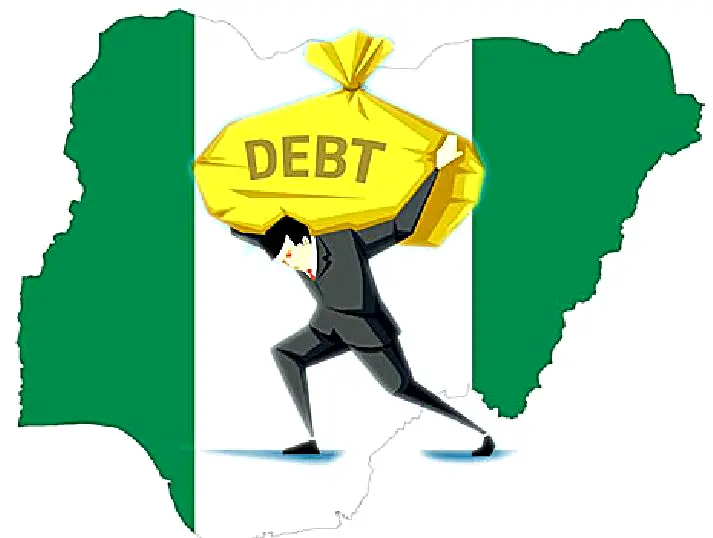
Nigeria’s total external debt has risen from $10.32bn on June 30, 2015, to $40.06bn as at June 30, 2022, The PUNCH has learnt.
This shows that there has been an increase of 288.18 per cent in seven years, according to the external debt stock reports by the Debt Management Office.
A breakdown shows that in 2015, 36 states had $3.27bn external debt while the Federal Government had $7.05bn.
By 2022, states’ external debt rose to $4.56bn, while the Federal Government’s external debt increased to $35.5bn.
READ ALSO: National Debt Grew By N3.2tn in Six-month—Buhari
The debts included loans from multilateral sources such as the World Bank, the African Development bank and the International Monetary Fund.
They also included bilateral loans from China, France, Japan, Germany and India, as well as commercial sources including Eurobonds and Diaspora bonds.
Nigeria’s external debt ballooned as the naira lost value, increasing Nigeria’s debt service burden and worsening its ability to service debt. The International Monetary Fund recently said that the long-term rate of the depreciation of the naira equated to a loss of 10.6 per cent of its value annually since 1973.
According to the IMF, this rate was 1.5 times higher than the long-term rate of the currencies of other emerging markets and developing economies at 7.2 per cent and sub-Saharan Africa at seven per cent over the same time period.
The IMF said, “Its exchange rate underwent more persistent depreciation. Nigeria’s long-term rate of currency depreciation (on average 10.6 per cent annually since 1973) was 1.5 times higher than both EMDE (7.2 per cent) and SSA (seven per cent). Given limited availability of long-term data, it is difficult to estimate the exact reasons.”
The Bank of America recently said Nigeria’s local currency unit was set to weaken further next year as its current exchange rate to the dollar was well above fair value.
According to a report by Bloomberg, the bank said, “Three indicators, the widely-used black-market rate, the central bank’s real effective exchange rate, and our own currency fair value analysis shows the naira is 20 per cent overvalued.
“We see scope for it to weaken by an equivalent amount over the next six-nine months, taking it to as high as 520 per USD.”
During a workshop on tax expenditure organised by the ECOWAS Commission in Abuja, financial experts advised that Nigeria and other West African Countries should move away from reliance on foreign assistance to the financing of developmental projects in the region.
According to them, over-dependence on financial aid and external loans might affect long-term prosperity of the entire region.
READ ALSO: Nigeria’s Debt Hits N42.8trillion
The Special Advisor to the Director (Custom Union and Taxation in ECOWAS), Gbenga Falana, while emphasising that the debt profile of most of the countries in the sub-region was mounting, stressed the need for West African countries to look inwardly and finance local projects through effective domestic resource mobilisation.
Reacting, the Managing Director/Chief Executive Officer of Cowry Asset Management Limited, Mr Johnson Chukwu, said that high external debt would impose a huge debt service on the economy.
He said, “This will impose a huge debt service on the economy, particularly at a period when we have low revenue from oil sales. If the revenue from oil sales does not improve, then the government will be struggling to meet that debt service obligation to foreign lenders.”
However, he noted that Nigeria could service its foreign debt at the current level, but a constant increase in debt without a corresponding increase in foreign currency earnings could put the country in a difficult position.



Business
Naira Appreciates Against Dollar At Official FX Market
…Black market (Buying and selling rates): N1,385— N1,390
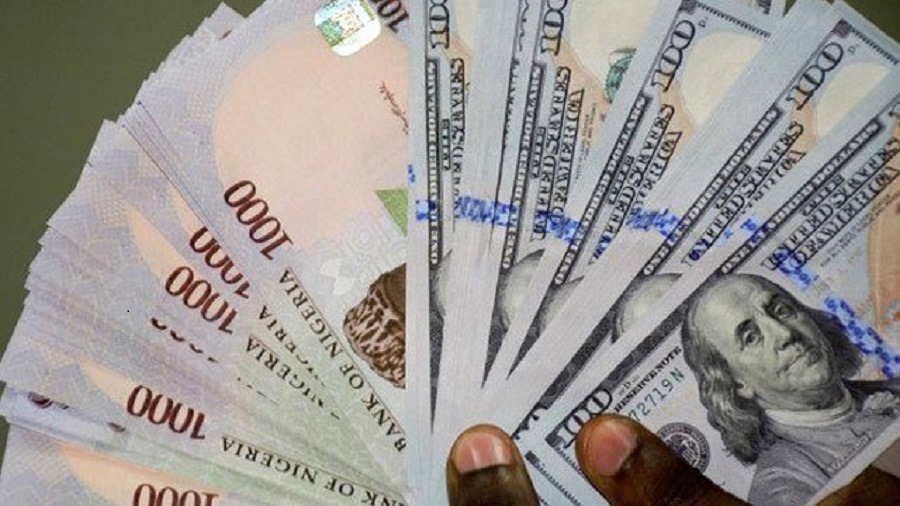
The Nigerian naira appreciated against the United States (US) dollar, trading at N1,331.2027 at the Central Bank of Nigeria (CBN) official foreign exchange (FX) window on Friday, September 18, 2026.
The data shared on the CBN’s official platform shows that the naira traded at the Nigerian Foreign Exchange Market (NFEM) rate of N1,331.2027 per dollar and closed at N1,329.9900 per dollar.
The currency, which traded at an NFEM rate of N1,331.2812 on September 17, 2026, appreciated by at least N0.08 after trading activities on Friday.
READ ALSO: Naira To Dollar Exchange Rate At Official FX Market
At the parallel market, both the buying and selling rate decreased by N5, when compared to the previous trading rate on Thursday, September 17, 2026.
According to Aboki FX , the Naira-to-dollar exchange rate at the black market on Friday, September 18, 2026, was N1,385 and N1,390 per dollar for buying and selling rates, respectively.
Business
Again, Naira Depreciates Against Dollar At Official FX Market
…Black market (Buying and selling rates): N1,380— N1,385
The Nigerian naira depreciated against the United States (US) dollar, trading at N1,329.8568 at the Central Bank of Nigeria (CBN) official foreign exchange (FX) window on Wednesday, September 16, 2026.
The data shared on the CBN’s official platform shows that the naira traded at the Nigerian Foreign Exchange Market (NFEM) rate of N1,329.8568 per dollar and closed at N1,329.5600 per dollar.
The currency, which traded at an NFEM rate of N1,329.1485 on September 15, 2026, depreciated by at least N0.71 after trading activities on Wednesday.
READ ALSO: Naira To Dollar Exchange Rate At Official FX Market
At the parallel market, both the buying and selling rate remained the same, when compared to the previous trading rate on Tuesday, September 15, 2026.
According to Aboki FX , the Naira-to-dollar exchange rate at the black market on Wednesday, September 16, 2026, was N1,380 and N1,385 per dollar for buying and selling rates, respectively.
Business
How To Buy Dangote Refinery Shares As IPO Opens September 14

Investors seeking to own a stake in the Dangote Petroleum Refinery and Petrochemicals FZE will be able to subscribe to its initial public offering (IPO) from September 14, 2026.
The ₦2.15 trillion offer by Dangote, valued at about $1.6 billion, involves 4.1 billion ordinary shares priced at an indicative ₦525 per share.
The offer, which is expected to become Nigeria’s largest-ever public share sale, will remain open until October 13, 2026.
The development gives Nigerians and other eligible investors an opportunity to acquire shares in the refinery as the Dangote Group moves to broaden ownership of the business.
At the signing of the IPO documents in Lagos on September 7, President of Dangote Group, Aliko Dangote, said the offer was designed to enable ordinary Nigerians to become shareholders in the refinery.
“What we are trying to achieve is to make sure our drivers, cooks, servants, and everybody have the opportunity of having stakes in the refinery,” Dangote said.
READ ALSO: BREAKING: Dangote Refinery Reduces Petrol, Diesel Prices
How to subscribe
According to the Managing Director, Investment Banking, Chapel Hill Denham, Mr Lanre Buluro, prospective investors can subscribe digitally using a bank account, Bank Verification Number (BVN) and a mobile phone or laptop.
He said an investor can complete the process within two to three minutes, with the minimum subscription set at 10 shares.
At ₦525 per share, the minimum subscription of 10 shares will cost ₦5,250.
Buluro said investors could access the offer through platforms including Moniepoint, MTN MoMo, Airtel, Payaza, Piggyvest, Paga, Bamboo and Chapel Hill Denham’s Invest Naija platform.
Do I need a CSCS account?
Buluro said prospective investors do not necessarily need an existing Central Securities Clearing System (CSCS) identity number before subscribing.
READ ALSO: Dangote Refinery Reduces Petrol Gantry Price
According to him, a CSCS account can be created for a new investor during the subscription process after the investor’s BVN and bank account details have been verified.
He explained that stockbrokers are behind the participating platforms and would contact subscribers after the transaction to provide their CSCS and Clearing House Number (CHN).
The allotted shares will subsequently be domiciled in the investor’s CSCS account.
What happens after subscription?
Investors can subscribe throughout the offer period, which runs from September 14 to October 13.
At the close of the offer, the advisers and the Securities and Exchange Commission (SEC) will assess the total subscriptions and determine the final allotment.
This means investors may not necessarily receive all the shares they apply for if the offer is oversubscribed.
READ ALSO: Dangote Unveils 10-day Credit Facility For Petrol Station Owners
Buluro disclosed that the offer has a provision to accommodate additional subscriptions in the event of oversubscription.
He said up to about 30 per cent additional shares could be issued under the oversubscription provision, potentially increasing the number of shares available from 4.1 billion to about 5.3 billion.
Before you invest
Buluro advised prospective investors, particularly first-time investors, to read the IPO prospectus carefully and seek guidance from a qualified financial adviser before committing their funds.
Investors should also understand that subscribing to an IPO does not guarantee a profit. The value of shares can rise or fall after allotment, depending on the company’s performance and market conditions.
The Dangote Refinery IPO is expected to significantly deepen public participation in the Nigerian capital market by allowing more individuals to take direct equity positions in one of the country’s largest industrial projects.
(TRIBUNE)

 News4 days ago
BREAKING: Tinubu Extends Working Vacation
- Headline4 days ago
How To Format An Academic CV For US Master’s, PhD Applications
- News4 days ago
Benue Govt Suspends Muslim Pilgrims Welfare Board Chairman, Secretary
 News3 days ago
OPINION: The Stranger In APC’s Kitchen
- Politics4 days ago
Crisis Rocks NDC Over Obi-Kwankwaso Campaign Council
- Entertainment4 days ago
Why Funke Akindele Was Not At My Movie Premiere – Kamo State
- Sports4 days ago
5 Football Players Who Excelled In Multiple Positions
- News4 days ago
FULL LIST: Names Of 37 Illegal Miners Who Died In NSCDC Custody
- News5 days ago
[OPINION] Wike-APC: Fights Always End Adultery
- Sports4 days ago
Premier League Predictions For Matchweek 5 Fixtures


